Agios Myronas: the village of St Myron above ancient Rhaukos
The most complete guide to Crete: 221 places on the map, 23 routes and 49 articles — with photos, videos and the story behind every place. Everything is open and free: no sign-up, no paid sections and no advertising, open or hidden. You can install the guide on your smartphone as an app.
Routes drawn along real roads
Weather at every stop
Full-text search
“Near me” by geolocation
Create your own printable itinerary
Satellite, terrain, dark mode
Works offline
⌕
Searches 1.7 million characters of descriptions, not just names
—places
4regions
—routes
—with video
Search results
—
Interactive map
Find what is near you
Filters narrow the map and the list at once. Zoom out and pins group together.
Region
Category
Фильтры карты
Landmarks
Featured places
RegionCategory
Routes
Ready-made day trips
Individual places
Articles about landmarks
Agios Myronas and ancient Rhaukos
The substantial village of Agios Myronas (Άγιος Μύρωνας) lies about 18 kilometres south-west of Heraklion and spreads across two neighbouring hilltops – which is why the Ottomans called it Tsatal Kiogiu, the “village with the two peaks”. It stands at about 340 metres, and the wide panorama from almost any corner of the village takes in the hills of Malevizi, the sea and Psiloritis. The census of 2011 counted a little over 600 inhabitants, that of 2021 exactly 569; in 1837 there had been seventy families. They have always lived chiefly by the vine and the wine press, and by raisins, olives and a little stock-raising. The wine of Malevizi, traded as malmsey as early as Venetian times, is esteemed throughout Greece and abroad – though scholars now trace the word malmsey to the Peloponnesian port of Monemvasia rather than to Malevizi, however fondly the district claims it.
The village itself is worth seeing. The devastating earthquake of 1856 reduced it almost entirely to rubble, and with it the fine houses of an earlier age; in the rebuilding the traditional Cretan manner prevailed, with rubble-stone walls, vaulted passages and narrow cobbled lanes. Only ten years later, on 4 November 1866, Reşit Pasha had the place laid waste again during the great Cretan revolt, desecrating its churches and setting fire to the houses, for its strong natural position had made Agios Myronas a refuge of the insurgents. From the years that followed date the stone fountains of 1906 and the school clock of 1900, whose movement came from Genoa and was the gift of a villager who had emigrated to Argentina – a landmark of the village to this day.
The district has been inhabited since the earliest times. Here stood the ancient city of Rhaukos (Ραύκος), an independent and powerful city-state striking its own coins, which local tradition counts among Homer’s hundred cities of Crete and sends to the war against Troy to win back fair Helen. The Periplus of Pseudo-Skylax names Rhaukos south of Knossos; later writers, Aelian and Diodorus among them, mention it too. The city was allied with Gortyn and was the rival of Knossos and of neighbouring Lykastos. According to Polybius it was captured in 166 BC by Knossos and Gortyn acting together, and its territory was divided between the victors. The site has never been systematically excavated; what is known comes from chance discoveries – coins of the city, numerous inscriptions, Greek and Roman pottery and vessels, carved stones, and a Late Minoan chamber tomb with four clay sarcophagi. Tradition carries the oldest finds back to c. 1900 BC. They are kept in the Archaeological Museum of Heraklion. The place is said to have borne the name Rhaukos until the 4th century AD, when it was renamed in honour of St Myron. The new name first appears in writing in a contract of 1281, and the Venetian census of 1583 lists the village as “Samiro”, with 254 inhabitants.
The church and the memory of the saint
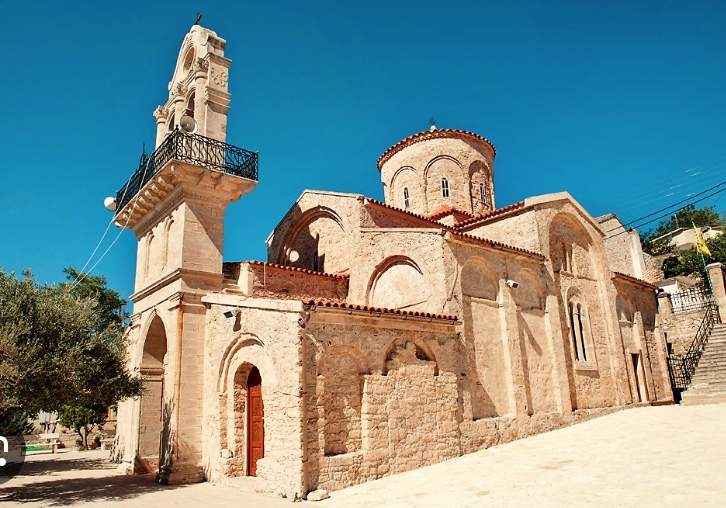
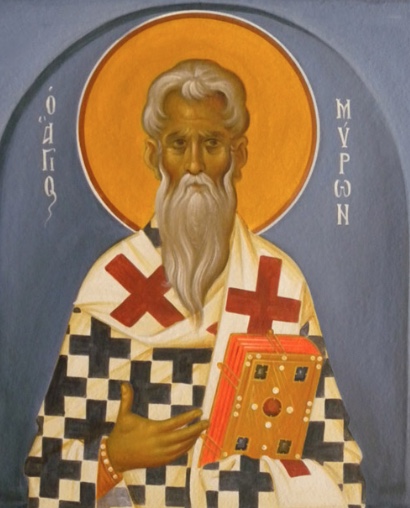
The cathedral church dedicated to the saint was built beside the cave in which he prayed. He had asked to be buried in his birthplace; his relics were brought here, and from him the place took its name. The bones of St Myron are held to work wonders to this day; many people testify that they have recovered from illness at his tomb, and the faithful report that the relics give off a fragrance like that of myron, the consecrated chrism. In May 2014 the tomb was opened, after the saint was said to have appeared repeatedly to three people to ask for it; beneath a marble slab more than two hundred fragments of bone were found.
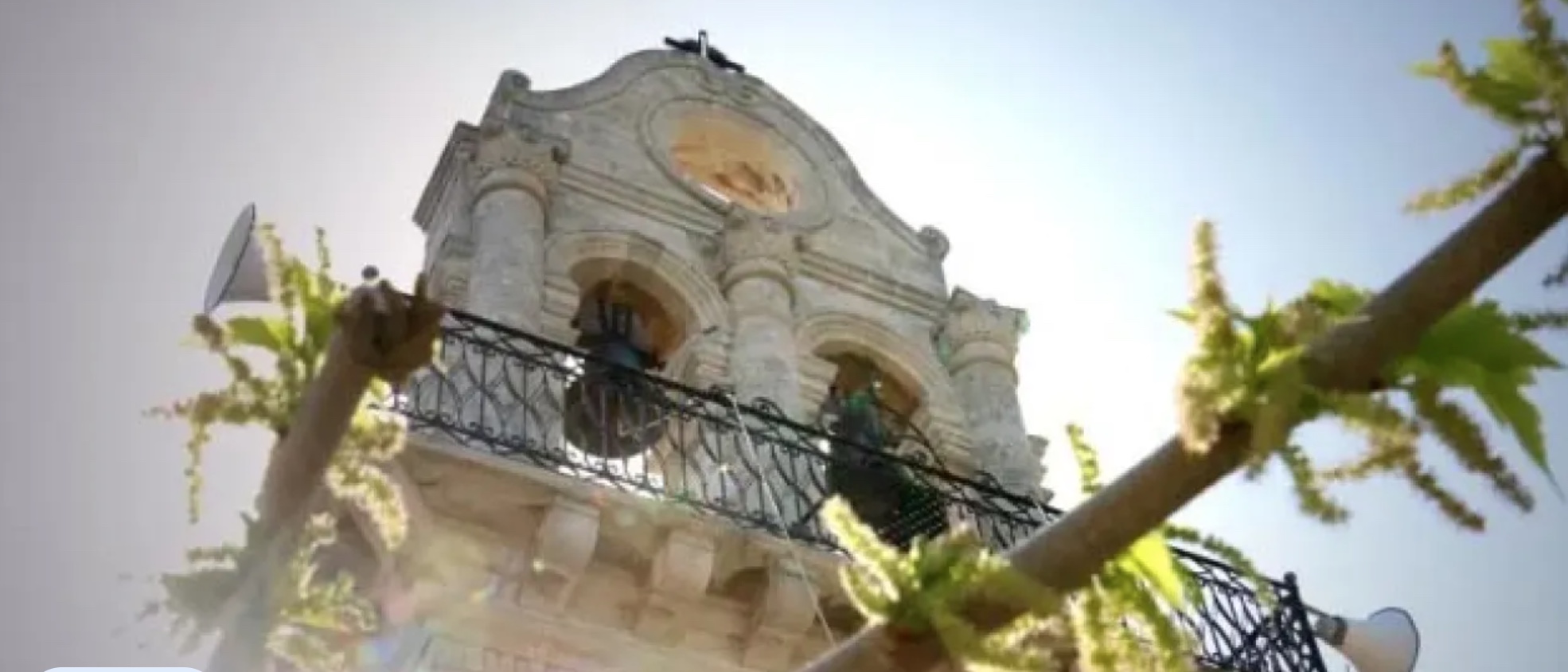
The building stands on the foundations of an Early Christian basilica, of which the great arch of the sanctuary and the synthronon – the stepped bench for the bishop and his clergy – survive. Its present form, a cross-in-square church whose dome rests on four supports, is dated on the evidence of its architecture to the 12th century, when, after the Byzantine recovery of Crete in 961, the seat of the bishops of Knossos is thought to have moved up here. Later a tripartite narthex was added, opening into the aisles through three arches, and in the 19th century the west wall was strengthened so that it could carry the large bell-gable with its two arches. The wall paintings inside are modern. In the south-east an arcosolium has survived, a vaulted tomb recess that is venerated as the bishop’s resting place and seems to have been connected with the hermitage below.
The cave of St Myron
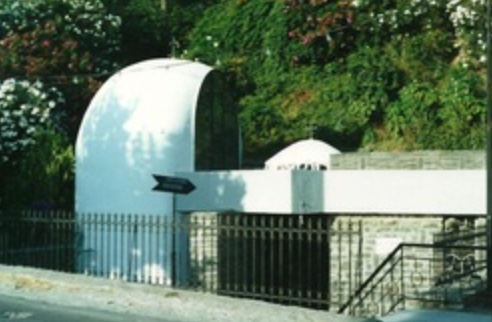
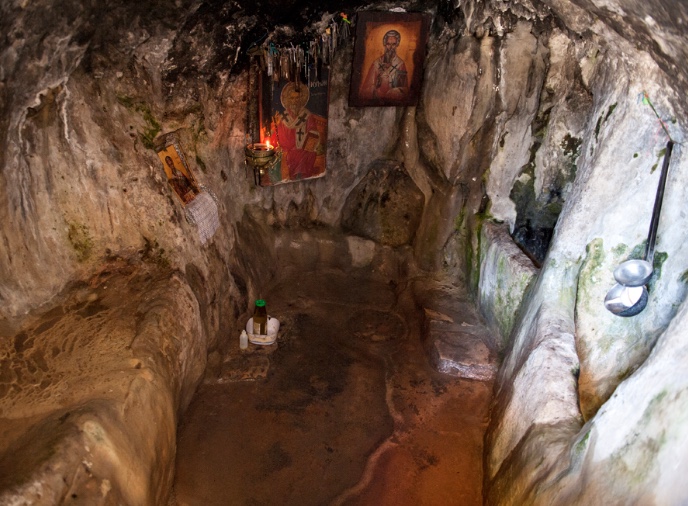
From the inner courtyard of the church the way leads down the western slope to a small rock cave directly beneath the building, on the north-western side of the village not far from the main square. It is the true seed of the sanctuary: a place hallowed by the presence of St Myron and later fitted out as a chapel. Here the bishop is said to have spent the greater part of his ascetic life.
The holy water and its veneration
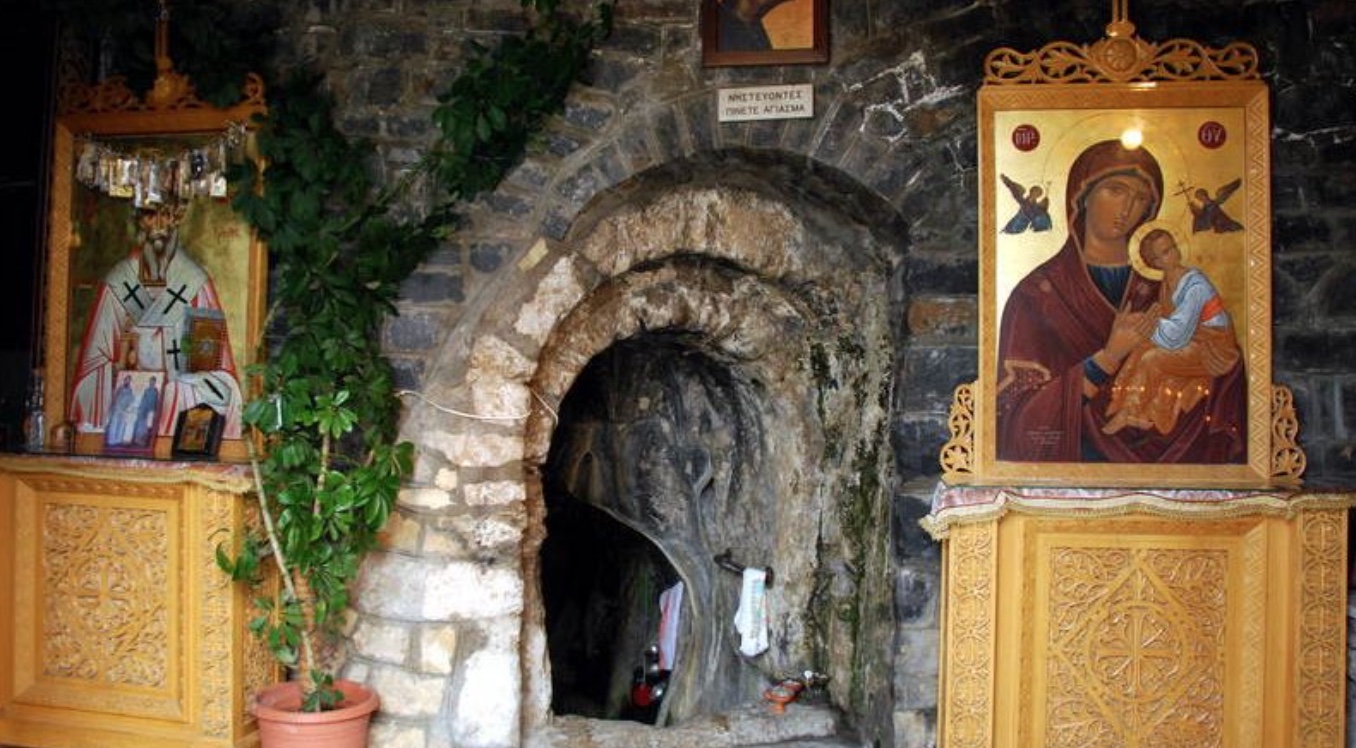
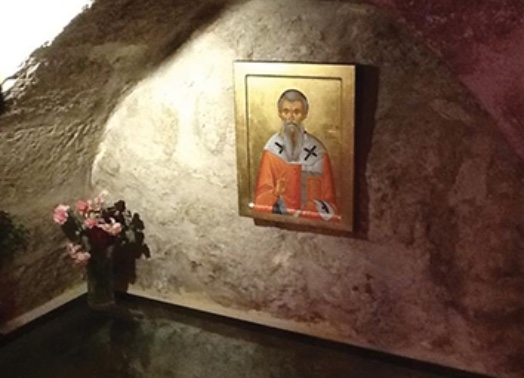
To enter the cave one goes down three steps into a cramped, almost circular chamber. On the left, about half a metre above the floor, rises a small ledge of rock which, tradition says, served the saint as his meagre bed. Stones lie round about, and three hollows can be made out in the floor; in the middle one the holy water always gathers. In a niche in the rock, above a small altar, stands the icon of the saint, with a lamp kept burning perpetually before it.
The tradition of the spring that never fails
Countless people have drawn the holy water over the centuries, yet it never runs out – to the astonishment of villagers and pilgrims alike. No one has yet found an explanation – and in the village it is accepted with equanimity that in matters of faith not everything is open to human understanding. It is also said, though, that there have been visitors for whom the hollow yielded no water at all.
Two explanations are current. According to the first, the water issues directly from the saint’s tomb – something that investigations undertaken for the purpose have failed to confirm. According to the second, the moisture in the cave increases on the saint’s feast day, at the very moment when the Gospel is read, and then collects in the little basin.
Whichever explanation one favours, at any season anyone who passes may draw some of the water with the long-handled ladle that lies ready, and – so the pilgrims believe – experience its miraculous effect. Some even speak of three spoons of different lengths – a short one, a middling one and a long one – from which each person chooses the one that matches the measure of his faith.
A miracle of the holy water
There is a more recent incident, too. Father Nikolaos Kritsotakis, who has served the church since 1997, witnessed something that could not be explained. When the church attendants decided to clean the hollow of the odds and ends that had fallen into it and of lamp oil, they baled the basin completely dry and washed it out thoroughly. To their amazement they found it soon afterwards full again – and with more water than before.
The life of St Myron
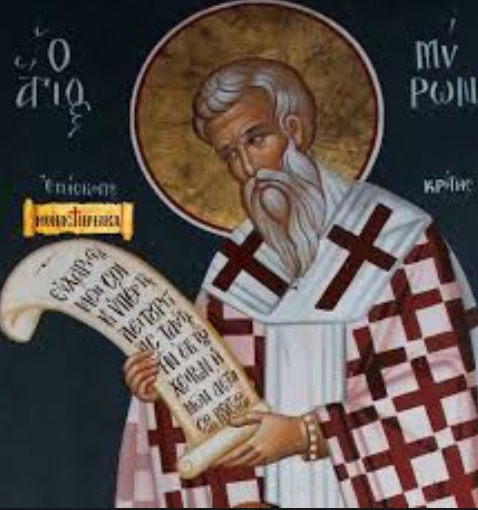
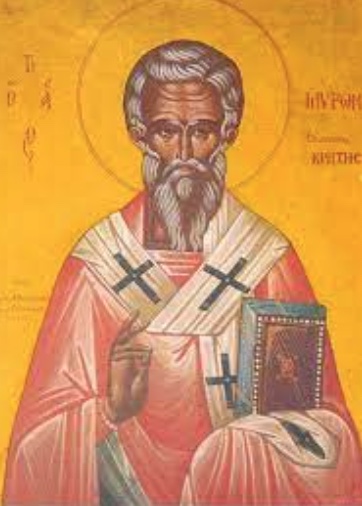
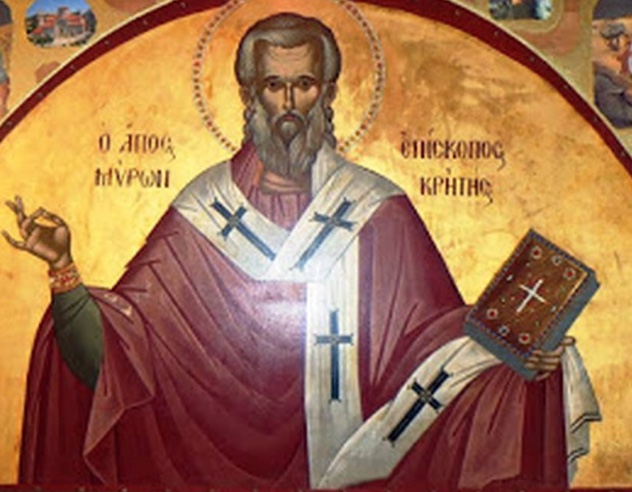
His birth is placed at about AD 250 and his death – the koimesis, the “falling asleep”, as the Church puts it – at about 350. He ascended the episcopal throne of Gortyn, then the capital and metropolitan see of the island, at some point between about 320 and 330. Myron was born at Rhaukos of noble and devout parents. His birth and childhood fell in the hard years of the persecution under the emperor Decius (249–251); his parents laboured all the more zealously to bring him up rightly and to shield him from the idolatry of the age. Even in the child one could see what path he would take within the Church: he was sensible and level-headed, shunned childish frivolity and was obedient to his parents. His kindly nature and his gift of miracles, of which many tales are told, showed themselves early. The best known is the miracle of the grapes and the wine.
Charity and the miracle in the vineyard
Tradition relates that one day Myron gave away every grape from his family’s vineyards to the poor. His mother reproached him: they had toiled in the vineyard for a whole year, and now not a berry was left to make wine. He did not argue, but said only: “God has kept something for us too, Mother.” Then he went out and found on the vines a single bunch with three grapes. He carried it home and laid it in a cup. At once the must began to flow, and it went on flowing until the casks of the family and of the whole village were full. In a wine district such as Malevizi it is easy to see why this, of all the stories, is still the one most gladly told.
The saint and the thief
When he had grown up, Myron worked the land, and whatever it earned him he gave to the poor. In this period of his life, too, he helped everyone as best he could: he fed the hungry, clothed the naked, cared for widows and orphans, gave strangers shelter and stood by anyone in need. Episodes from these years are characteristic of his cast of mind, and one of them has lodged especially in the memory.
One evening the saint learned that thieves had come to steal the wheat from his threshing floor. They believed him asleep. They filled their sacks, each helped the next to hoist the load on to his shoulder, and went off. But there was no one left to help the last man, and he struggled in vain to heave up the heavy sack. Then the saint got up and with his own hands set the sack on the man’s shoulder. “May God forgive you” was all he said – and the thief went on his way shaken.
From family life to the bishop’s throne
When Myron reached marriageable age he took a devout and faithful wife. She died soon afterwards, however, and he, released from the bonds of marriage, dedicated himself wholly to God. Every day he read the Holy Scriptures, fasted and prayed, and did not slacken in his works of charity. Because his virtue had become known, he was ordained first reader and then presbyter. In the years that followed, under Constantine the Great, when the persecutions had ceased, he devoted himself with still greater zeal to proclaiming the Gospel – less by words than by his deeds and his example.
So his fame spread quickly across the whole island. When the bishop of Crete died, everyone – clergy, dignitaries and people – turned to him and begged him to take on the care of their souls, and he yielded only reluctantly. Myron was consecrated bishop of Crete and in that office continued his miracles and his works of mercy, travelling regularly through his diocese to see to the needs of his flock. On one such journey towards Knossos, the story goes, he found the river Triton in flood; he prayed, struck the water with his staff, and a path opened through which he and his companions crossed dry-shod. He is said to have lived to about a hundred. He left behind an immense pastoral work, which has shown hundreds of people from that day to our own the way to a Christian life.
Miracles associated with St Myron
The veneration of the saint did not end with his death. Stories are handed down in the village of things that are said to have happened at his church during the centuries of foreign rule; several of them have come down with dates and names attached – a village schoolmistress, Eleftheria Linardaki, was among those who wrote them down – and they are a fixed part of what is told at the patronal feast. One of the grimmer ones tells how men who came to plunder the saint’s tomb in 1861 were found dead within days.
The miraculous deliverance of the captives in 1826
In 1826 Turks from the Megalo Kastro, the “Great Castle”, as Heraklion was then called, set out under Hasan Pasha on a punitive expedition against the villages of the province of Malevizi. Many of the inhabitants were taken prisoner, brought to Agios Myronas and held on the flat roof of a house beside the church. On the following day they were to be led to the town, some to be killed, the others to be sold into slavery. To make sure that no one escaped, the guard was doubled for the night. All night long the prisoners prayed and called on the saint for help. At midnight a blinding light appeared in the sky, and it was as though tongues of fire came down and hung above the church. At the same time thunder broke out and a deafening din. The Turks thought themselves surrounded by a Christian army and fled in panic; the villagers hurried up and set free the prisoners, who gave thanks to the saint for their deliverance.
The healing of Hüseyin Aga
Hüseyin Aga of Archanes, who had taken part in many massacres of Christians, went blind. No healer and no doctor had been able to help him, and so in the end he sought a cure from them no longer, but went into the church and knelt before the saint’s tomb. He remained on his knees throughout the liturgy. As the priest read the Gospel, the blind man cried out: “Glory to God, and thanks to the holy old man – I can see.” After the service the aga went down into the cave to which the saint had once withdrawn, washed his eyes and was completely healed. From then until his death in 1859 he came very often to the village and the church, bringing offerings.
The apparition of the old man in Ottoman times
The Ottomans used the saint’s church as a store for provisions and war material and posted a guard in front of it. One night, however, thunder broke out and a fearful noise. The villagers started from their sleep and ran to the church, from where the uproar came. There they saw the Turkish guards running away and heard them shouting that the evliya – the Turkish word for a saint – was after them, an old man with a white beard, dressed all in gold. The next day the Turks cleared their military stores out of the church and gave it back to the Christians for free worship.
The healing of Marigo Kolyvaki in 1861
In the summer of 1861 Georgios Kolyvakis of Heraklion came to Agios Myronas with his wife, Marigo. According to the doctors she was suffering from a serious nervous disorder. During their stay in the village her condition grew worse, and her family, hoping in the saint’s healing power, brought her to his church. For five days the priests prayed at the tomb together with many of the villagers and celebrated the Divine Liturgy daily; all the while a wonderful fragrance came from the grave and filled the whole church. On the Wednesday evening the saint appeared to the sick woman and told her that on Friday she would be freed from the evil spirit. On the Friday, as the priest in the liturgy spoke the words “Exairetos …” – “Especially for our all-holy Lady …” – the woman gave a loud cry, staggered and fell to the ground as if dead. After a while she rose, perfectly well, praised God and thanked the saint for her cure.
The legend of the dragon and the monster turned to stone
The legend is tied to the Dragon’s Gorge (Charadra Drakos) near the village, where in a high wind a hollow booming can be heard that recalls the roaring of a dragon. According to the legend the beast devoured people and animals that strayed into the gorge. One Sunday it appeared while the bishop was celebrating in the church of Christ the Saviour; Myron sent his deacon to command it, in the name of Christ, to stand still, and only the saint’s episcopal staff subdued it. He cast a stone at it, a hail of stones followed, and it was turned to rock – a great mass, still called the Drakos, covering about a thousand square metres. The rock face of the gorge does indeed resemble the stiffened body of a dragon – though without a head. This, the story continues, came away from the body and was petrified in the very cave where the saint lived as an ascetic: in the projections of the cave wall above the spring one can just make out the dragon’s eyes and nostrils. The villagers also read the weather from the rock; its booming is for them the herald of a change, small white bubbles like foam in its crevices foretell rain, and a strange noise from within announces a hard winter.
The patronal feast and the Raukeia
On 8 August, the saint’s day, Agios Myronas celebrates one of the largest church festivals on Crete. On the eve pilgrims are already pouring in from the whole province for vespers, venerate the relics and go down to the cave. The feast is set within the “Raukeia”, a week of cultural events held from 1 to 8 August and organised by the village cultural society, whose name recalls ancient Rhaukos: concerts, evenings of dancing to Cretan music and exhibitions fill the lanes. Those who come at a quieter time will find kafenia and tavernas in the village, the wine of the local growers and the produce of the women’s cooperative, “Melissanthi”; the church is as a rule open during the day.