Paliani Convent and the Holy Myrtle of the Panagia Myrtidiotissa
The most complete guide to Crete: 221 places on the map, 23 routes and 49 articles — with photos, videos and the story behind every place. No sign-up, no trackers.
Routes drawn along real roads
Weather at every stop
Full-text search
“Near me” by geolocation
Create your own printable itinerary
Satellite, terrain, dark mode
Works offline
⌕
Searches 1.7 million characters of descriptions, not just names
—places
4regions
—routes
—with video
Search results
—
Interactive map
Find what is near you
Filters narrow the map and the list at once. Zoom out and pins group together.
Region
Category
Фильтры карты
Landmarks
Featured places
RegionCategory
Routes
Ready-made day trips
Individual places
Articles about landmarks
The history of Paliani Convent
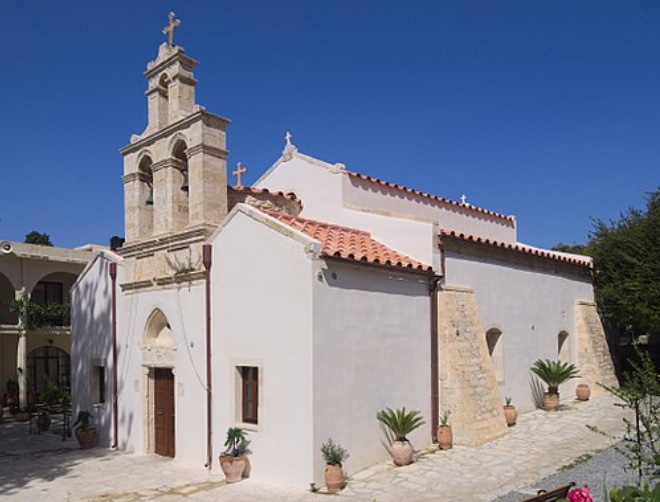
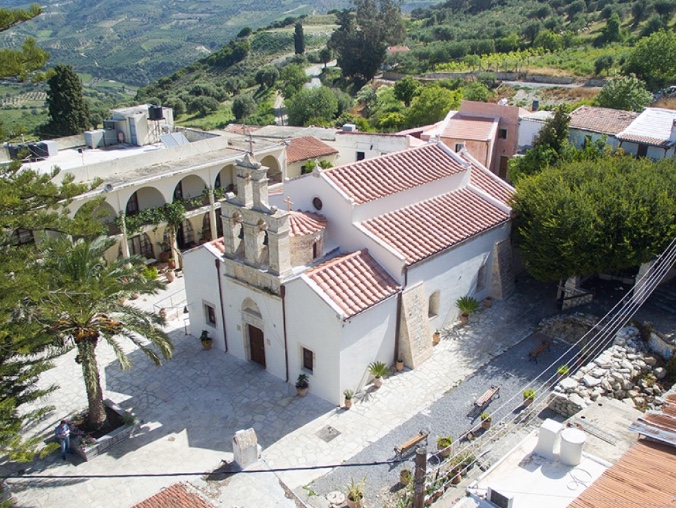
Paliani Convent (Moni Panagias Palianis) lies at about 280 metres, some 700 metres east of the village of Venerato and roughly 20 kilometres south of Heraklion, on a hillside at the edge of the small Venerato gorge, with Psiloritis and its outlying peak Koudouni filling the view to the west. It is counted among the oldest monastic houses on Crete still inhabited. The exact date of foundation is unknown: tradition places the beginnings in the 4th century, while some scholars speak of the Early Byzantine period and of the 6th century. The earliest evidence usually cited – first brought to notice by the Italian scholar Giuseppe Gerola – is a letter of Pope Vitalian of the year 668 that mentions a monastery called “Palaia”; it was, in other words, already thought old. The name is accordingly most often read as “palia moni”, “old monastery”; another view, put forward by Paul Faure, holds that it preserves the memory of the ancient city of Apollonia, which lay nearby. Architectural fragments and Byzantine capitals show that an Early Christian church stood on the site of the present katholikon; local tradition supposes an ancient sanctuary beneath that again, sometimes named as a temple of Athena. The house is assumed to have been ruined during the Arab occupation of 824–961 and refounded afterwards.
A patriarchal monastery and the trials of history
Such considerable property made Paliani a prize worth fighting over. Under the Venetians the powerful quarrelled about it: in 1304 the Pope removed it from the Patriarchate and placed it under the Latin Archbishop of Crete, which set off protracted disputes, and in 1323 it passed into the care of the Doge. The Ottoman period dealt far harder blows. The convent was plundered and destroyed; as the community remembers it, the nuns were murdered and the precious silver vessels and icon covers, among them gifts of Byzantine emperors, were carried off. The catastrophe came on 24 June 1821: of some seventy sisters under Abbess Melanthi, sixty-seven were killed or dragged into slavery, and only three are said to have survived. After these upheavals Paliani was rebuilt and in time ranked once more among the well-to-do monasteries of the island; it had sixty-five nuns in 1930 and as many as eighty-five in 1942.
Katholikon, chapel and museum
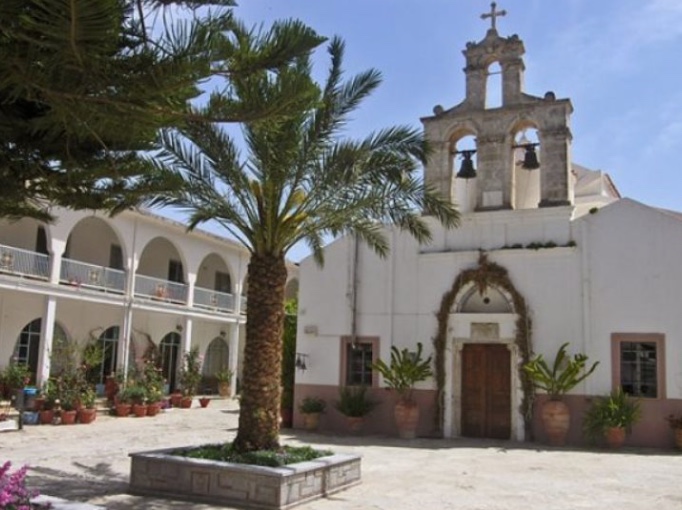
The main church of Paliani is a three-aisled basilica. The central aisle is dedicated to the Dormition of the Mother of God (15 August), the south aisle to the Three Hierarchs (30 January) and the north to the Great Martyr St Panteleimon (27 July). A barrel vault covers the nave; the aisles are divided by stone arches resting on columns of Byzantine type, whose capitals are carved with pierced acanthus foliage, some of them Early Byzantine work. Further Byzantine marble fragments lie scattered about the grounds or are built into the walls and the paving of the courtyard, and the holy table stands on four old capitals, one of which bears a cruciform monogram. Among the 19th-century icons of the screen is a Dormition by Stephanos Nikolaidis, painter, cantor and hymnographer. The form of the building has been much changed by repeated renewal. The convent also has a small chapel of the Holy Apostles, which keeps its feast on 30 June, the nuns’ cells and service rooms, grouped round the church, and remains of the defensive wall that sheltered the community in troubled times. The old stone gate was pulled down in about 1970 and replaced by a new entrance in concrete.
The convent also has charge of the Byzantine church of St John, with frescoes of the 14th century and a door lintel of ancient marble carved in relief with the Annunciation. The museum, set up in the 1990s, keeps icons, holy relics, liturgical vessels and books and manuscripts of historical and archaeological value. Paliani is open from sunrise to sunset. The sisters live not under a strict communal rule but on the older pattern of the lavra, in which an elder nun guides two or three younger ones in her own cell; they support themselves by embroidery and weaving, and their blankets, knitwear and needlework are sold in the convent shop.
The holy myrtle of Paliani
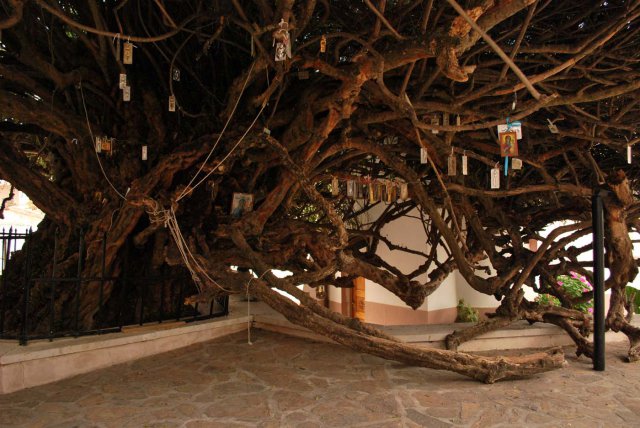
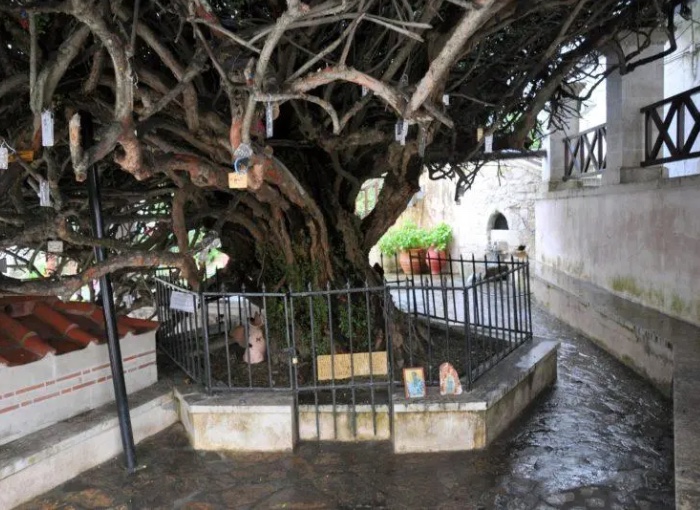
The convent’s greatest treasure is an ancient myrtle which the nuns call “Agia Myrtia”, the holy myrtle. The myrtle (Myrtus communis) is an evergreen of the family Myrtaceae, with white, scented flowers and leaves full of essential oils; ordinarily it remains a shrub, but here it has grown into a mighty tree with a trunk of many interwoven stems. Its age cannot be determined exactly: local tradition speaks of a millennium and a half, while more cautious estimates put it at over a thousand years. It stands in the south-eastern part of the convent, just south of the katholikon, beside the spring called Kavousi.
The finding of the icon of the Myrtidiotissa
According to the legend, the people of the district – in other versions they are shepherds – were clearing the woodland by fire to win land for the plough when, as the flames reached an old thicket of myrtle, the voice of the Mother of God rang out and told them to stop. In the branches they saw an icon on which the Panagia was surrounded by painted sprays of myrtle, and they built a shrine on the spot. When a church had been put up, the story continues, the icon was carried into it, and on three successive nights it vanished and was found again in the tree – a sign that it wished to stay out of doors. Later, children noticed that the painted sprays seemed to carry on into the living tree, little by little hiding the image. That is why it is believed at Paliani that only children can still see the icon whole – those whose hearts have not lost their purity.
The feast of the holy myrtle
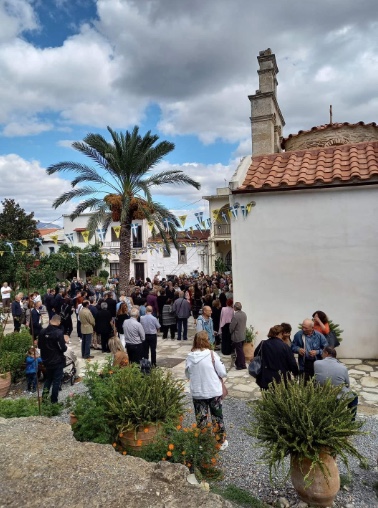
Paliani celebrates the Panagia Myrtidiotissa on 24 September, separately from the principal feast of the Dormition on 15 August; on the eve, 23 September, solemn vespers are sung. The loaves are blessed beneath the holy myrtle, and the table used for the purpose is an ancient Corinthian capital from the Early Christian basilica that once stood on this spot. Pilgrims take sprigs of the tree home as a blessing, make small crosses and amulets from them, or use them to deck the icon corner of the house.
The Dormition and the crosses of myrtle wood
On 15 August, the feast of the Dormition of the Mother of God, which Greeks call the “Easter of summer”, the holy tree becomes the centre of devotion and thousands of worshippers fill the convent. Some, known as “dekapentistes”, lodge here through the whole fortnight of the fast that leads up to the feast, in fulfilment of a vow, and join each evening in the prayers before the icon. The lower branches, those within reach of visitors, are then gradually stripped bare: the faithful pick leaves and break off small pieces of wood to keep at home or carry with them when they pray. The nuns carve little crosses from the twigs, around which many stories of help and healing have gathered. A shrine with the image of the Mother of God is fixed to the trunk; beside it burns the lamp, and all around hang the offerings of thanks.