The most complete guide to Crete: 221 places on the map, 23 routes and 49 articles — with photos, videos and the story behind every place. Everything is open and free: no sign-up, no paid sections and no advertising, open or hidden. You can install the guide on your smartphone as an app.
Routes drawn along real roads
Weather at every stop
Full-text search
“Near me” by geolocation
Create your own printable itinerary
Satellite, terrain, dark mode
Works offline
⌕
Searches 1.7 million characters of descriptions, not just names
—places
4regions
—routes
—with video
Search results
—
Interactive map
Find what is near you
Filters narrow the map and the list at once. Zoom out and pins group together.
Region
Category
Фильтры карты
Landmarks
Featured places
RegionCategory
Routes
Ready-made day trips
Individual places
Articles about landmarks
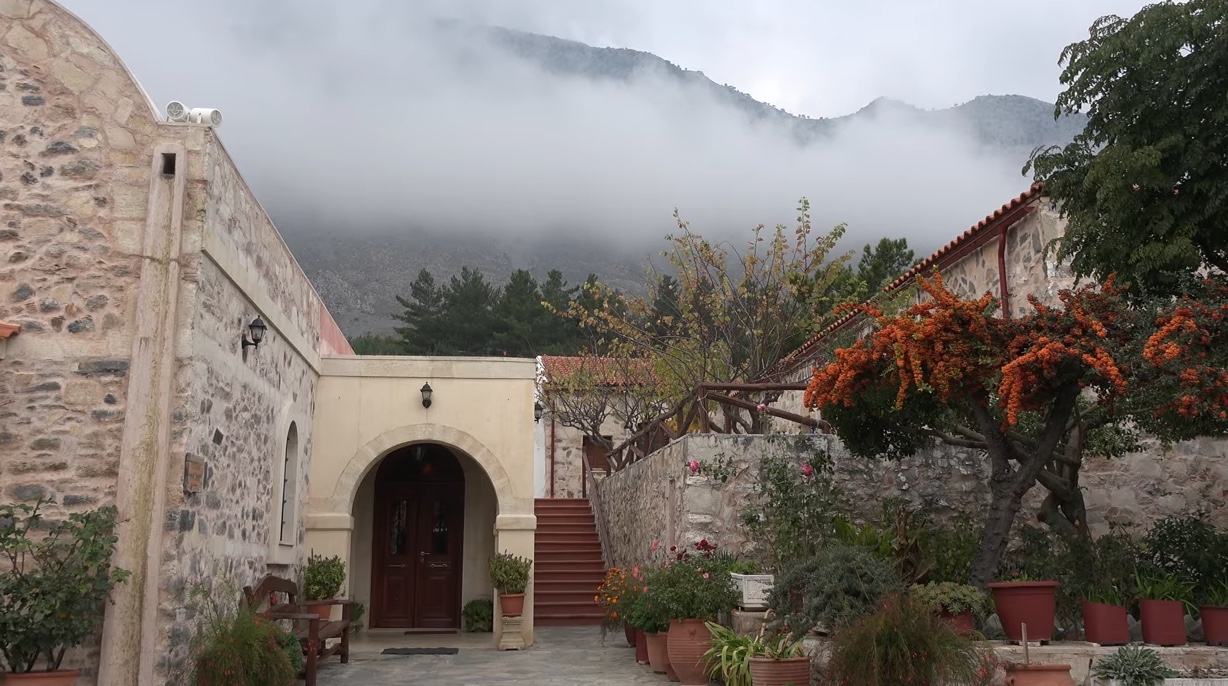
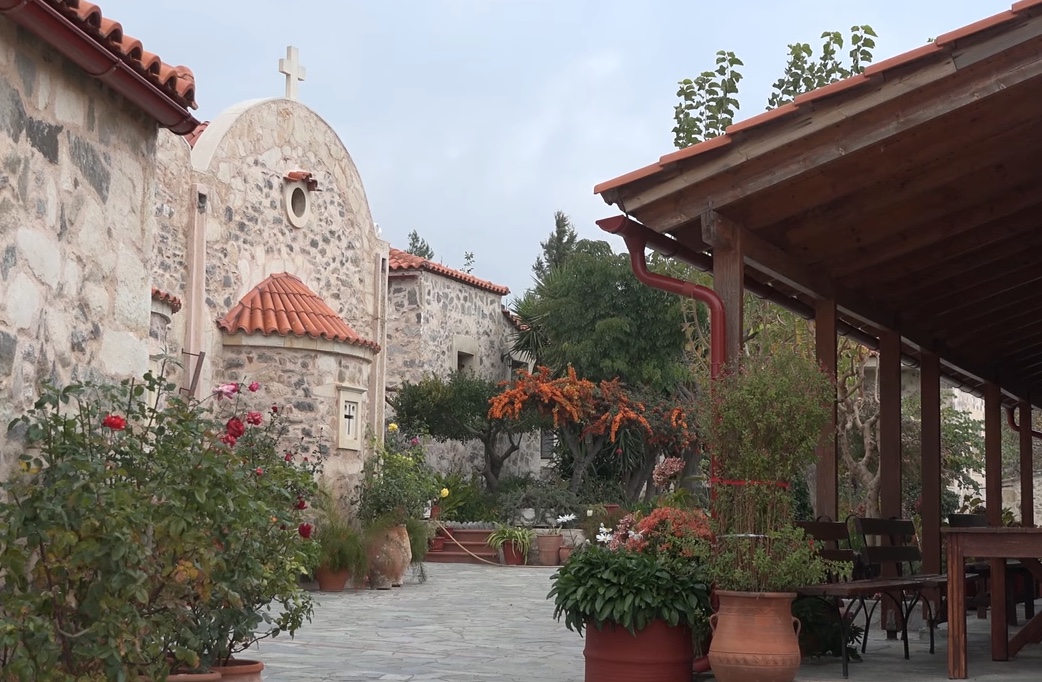
The monastery of St Irene on Mount Gournos
Moni Agias Irinis (Μονή Αγίας Ειρήνης) lies at about 650 metres on the eastern slope of Gournos, an outlier of Psiloritis whose summit reaches 1,293 metres. From Krousonas it is roughly three kilometres west on the asphalt road that continues up to the Livadi plateau, a further six kilometres on; from Heraklion the drive is about 25 kilometres. A small settlement that has taken the monastery’s name lies just below it. Historians place the foundation in the 14th or 15th century, and written records of the monastery survive from the period of Venetian rule. In the village itself people like to claim a far greater age and speak of the 7th century; there is nothing to prove it.
Those who make the climb find a place more like a garden than a fortress: cypresses, pines and eucalyptus form a small wood around the whitewashed buildings, the courtyards are full of flowers, and the view runs over the vineyards and olive groves of Malevizi to the sea. The natural position on a steep hillside, with the mouth of the Krousonas Gorge close at hand, also made it a place of refuge in earlier times. An old path through that gorge, in use since Minoan times, led up to Zominthos and on to the Idaean Cave above the Nida plateau, so that the monastery stood beside one of the ancient routes into the high mountain.
Destruction and rebirth
That an Orthodox monastery should form part of the fief of a Latin family is nothing unusual in late Venetian Crete: it was a period in which Latins and Orthodox lived side by side in mutual tolerance. In the first years of Ottoman rule Agia Irini was held to be one of the richest monasteries in the district, and it kept a school. Insurgents found shelter here.
In 1822 that proved its undoing. After the battle in the Krousonas Gorge, in which the insurgents – who had used the monastery as their base – inflicted heavy losses on the troops of Hasan Pasha, some four hundred Turks being killed, the Ottoman soldiers destroyed the monastery and put the monks to death at a spot called Trochalakas for having helped the rebels. Oral tradition speaks of seventy monks cut down, whose bodies were covered with stones – “trochalos” is the Cretan word for a heap of stones. The cells were pulled down, the church looted and set on fire. The extensive lands were made over to the monastery of Kera Eleousa; some of the property is said to have been appropriated by the Ottomans as well. For more than a century the place lay deserted and silent.
In 1936 the priest of Krousonas, Dimitrios Fasoulakis, began to work for its revival. In December 1944, with the war still in progress and with the backing of the village’s resistance groups, the deed establishing a convent was drawn up; the first abbess is named as Parthenia. The first cells were built in 1947, the second aisle of the church was completed in 1949, and on 9 June 1951 a royal decree gave the new foundation official recognition. The first nuns were four young women from Krousonas. A further campaign of building and renovation between 1996 and 2005 gave the convent the appearance it has today, and it now ranks among the larger nunneries of the island.
The monastery owes its reputation as a place of miracles to an incident of 1928 handed down in popular tradition: St Irene is said to have appeared in the monastery holding a key like the one that the abbess alone kept, and then to have vanished in a cloud.
Church, crypt and feast days
The twin-aisled monastery church is dedicated to the Great Martyr St Irene, whose memory is kept on 5 May, and to the Dormition of the Virgin, celebrated on 15 August. On both days pilgrims come up from all over Crete, but above all from the villages of Malevizi, which hold the monastery in particular affection. The walls of the church are covered with new frescoes, painted by nuns from a convent near Chania. Round about stand the modern buildings in which the sisters live – a small community today, which tends house, courtyards and gardens with great care.
In the western part of the main church an underground burial crypt has survived, unique in the care with which it was built. It dates from the Venetian period and is the most impressive relic of the old monastery that perished in 1822.
The monastery is inhabited and is not a museum: visitors should respect the sisters’ hours of prayer and their midday rest. A visit combines well with a walk round Krousonas and a drive up to the Livadi plateau; the road beyond the convent runs along the southern flank of the gorge, with views across to the wind turbines on the summit of Voskero opposite, and the waymarked path through the gorge itself, five kilometres long, starts close by.