Kato Asites and Ano Asites: twin villages on the eastern slopes of Psiloritis
The most complete guide to Crete: 221 places on the map, 23 routes and 49 articles — with photos, videos and the story behind every place. No sign-up, no trackers.
Routes drawn along real roads
Weather at every stop
Full-text search
“Near me” by geolocation
Create your own printable itinerary
Satellite, terrain, dark mode
Works offline
⌕
Searches 1.7 million characters of descriptions, not just names
—places
4regions
—routes
—with video
Search results
—
Interactive map
Find what is near you
Filters narrow the map and the list at once. Zoom out and pins group together.
Region
Category
Фильтры карты
Landmarks
Featured places
RegionCategory
Routes
Ready-made day trips
Individual places
Articles about landmarks
Two villages on the eastern slopes of Psiloritis
Kato Asites (Κάτω Ασίτες) and Ano Asites (Άνω Ασίτες), Lower and Upper Asites, lie on the eastern foothills of Psiloritis in the historical district of Malevizi. They are neighbouring mountain villages, less than a kilometre apart, joined by a shared road, the same landscape and an old farming culture of olives, vines, sheep and goats. Kato Asites, the larger of the two with something over a thousand inhabitants, is about 23 to 24 kilometres from Heraklion at an altitude of roughly 450 metres; it is reached by way of Agios Myronas, six kilometres back down the road, and Pyrgou. Ano Asites, with a little over four hundred people, sits slightly higher, at about 480 metres, tucked between slopes, gorges and olive groves. Small streams run through the gullies, cypresses, walnut trees and oaks line the lanes, and behind the last houses the mountain rises abruptly.
The name is traced to the ancient city of Assos in Mysia, a region on the north-west coast of Asia Minor. Tradition has it that after the Byzantine reconquest of Crete from the Arabs in 961 the emperor Nikephoros II Phokas settled warriors here who came from Assos. Provided with allotments of land, they became part of the island’s new Byzantine population of soldier-farmers; hence the Greek form of the name preserves the memory of the “Assites”, the people of Assos – which is why those who know the place hold the spelling with a double s to be the correct one. In the written sources Ano Asites first appears in 1393 and Kato Asites in 1394, in the Venetian archives of Chandax, as a fief of one Paulus Theupolo; from 1577 onwards both villages are recorded in every Cretan census, and that of 1583 gives Ano Asites 228 inhabitants.
Churches and the memory of the Church
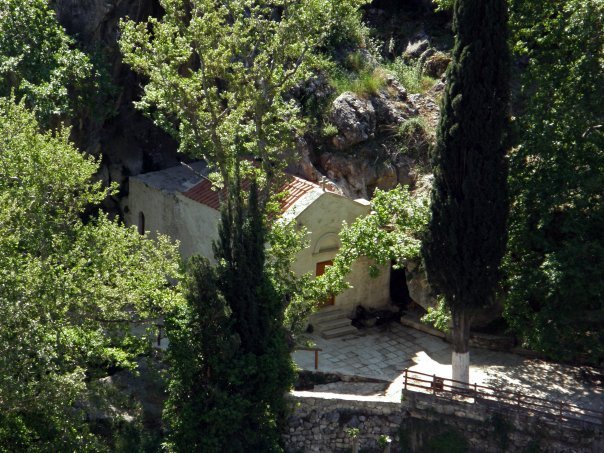
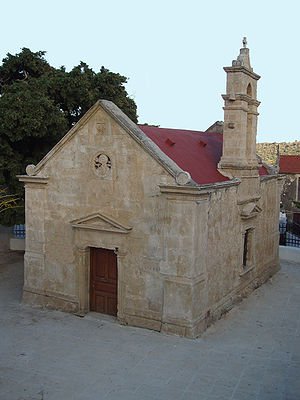
The old places of worship of Kato and Ano Asites form a small ecclesiastical landscape of their own; in Kato Asites alone eighteen churches and chapels are counted in which services are still held. Those usually named are the church of the Panagia, the All-Holy Mother of God, which is dated to the 12th century, and the Byzantine church of St Antony in Kato Asites, of the 11th century, together with the churches of St George and St Paraskevi. To these must be added the main church of the Transfiguration of Christ, of the mid-19th century, which keeps its feast on 6 August; Ano Asites, for its part, honours St John as its patron on 29 August with a festival of sport and cultural events. Rubble masonry, modest dimensions and a position in the midst of the houses are a reminder that on Crete worship was for centuries part of everyday rural life. The church of St Antony, for instance, can hardly be told apart from the houses around it: one enters through a stone doorway behind a modern porch – and it is best to ask a local the way through the twisting lanes. It is not to be confused with the Byzantine chapel of the same saint out in the gorge that bears his name, near the ruins of a small monastery.
The principal church in the heart of Kato Asites is dedicated to the Great Martyr St Paraskevi, patron saint of the village. Her feast on 26 July is kept with a panigiri, the patronal festival with a service, a shared meal and Cretan music, arranged by the village cultural association, “To Gorgolaini”; the celebrations run from 19 to 26 July, and since 1974 the service of supplication, the Paraklesis, has been sung every evening during those days. The small single-aisled basilica, rebuilt in 1745 and restored in recent times, has kept its stone masonry. Above the entrance is a relief of St Paraskevi with cross and palm branch, the emblems of faith, of victory and of incorruptibility.
Museum, gorges and ancient Rizinia
Ano Asites has a folklore museum, which brings together household goods, weaving equipment and the tools of field work. Round about, paths lead into the gorges of St Antony and St Charalambos, into the wooded country of Prinos and to the refuge of the Heraklion Mountaineering Club, which stands at about 1,100 metres in a wood of prickly oak and is a favourite starting point for the ascent into the Psiloritis massif; the European long-distance path E4 passes this way, and on a clear day the view is said to reach Santorini. On the hill of Patela near Prinias lie the remains of ancient Rizinia, which some also call Apollonia: the settlement goes back to Minoan times, flourished above all in the Archaic period – its Temple A, of about 625 BC, is the earliest known Greek temple to be decorated with sculpture, now in the Archaeological Museum of Heraklion – and lasted into the Roman age, widening the historical horizon of the district far beyond the Middle Ages. On the territory of Asites itself, at the spot called Siderospilia, its necropolis has been excavated – some 680 graves from three successive phases of use, with grave goods running from the Late Minoan period onwards and tholos tombs beside which horses, and a few dogs, were sacrificed and buried. Roman baths have also come to light in the area.
Risings, earthquakes and resistance
In the 19th century both villages were strongholds of the Cretan risings. The nearby monastery of St George Gorgolaini – a kilometre or so from Kato Asites at 480 metres, among huge plane trees, cypresses and oaks, founded according to tradition in the 13th century by a monk named Sylvestros, with a church completed in 1627 – was badly damaged in the fighting of 1822 and restored under Abbot Methodios in 1830. In 1866 it served as headquarters of the insurgents, among them the chieftain Michalis Korakas, and in the engagement at Asites in 1868 the aged Kapetan Frangias Mastrachas fell; his tomb and his statue are at the monastery, where a plane and a cypress are protected as natural monuments and a Venetian fountain stands bereft of the marble lion stolen from it in 1990. The great earthquake of 1856–57 destroyed Ano Asites completely, which is why hardly any older houses survive there. During the German occupation the village was once again a centre of resistance and a safe passage for the hunted, led by the Bandouvas family, whose Manolis Bandouvas was among the foremost leaders of the Cretan resistance. Of the old crafts, the forging of sheep bells and basket-weaving live on to this day.
Kato Asites and Ano Asites are best understood not as separate sights but as a living mountain landscape. In them the memory of Byzantine settlement, churches of different ages, the Cretan risings, agriculture and the present-day care of the walking trails all come together. An excursion here shows that the history of Crete is preserved not only in museums but equally in living parishes, in family houses, in festivals and in the daily work of the inhabitants. There is no lack of places to stop and rest: Kato Asites has several tavernas, a number of kafenia and a few country guesthouses, and the women’s cooperative sells home-made specialities. Summers here are hot and dry; in winter there is rain and now and then snow, so that spring and autumn are the kindest seasons for the paths.