Garazo – churches, cobbled paths and the citron festival
The most complete guide to Crete: 221 places on the map, 23 routes and 49 articles — with photos, videos and the story behind every place. No sign-up, no trackers.
Routes drawn along real roads
Weather at every stop
Full-text search
“Near me” by geolocation
Create your own printable itinerary
Satellite, terrain, dark mode
Works offline
⌕
Searches 1.7 million characters of descriptions, not just names
—places
4regions
—routes
—with video
Search results
—
Interactive map
Find what is near you
Filters narrow the map and the list at once. Zoom out and pins group together.
Region
Category
Фильтры карты
Landmarks
Featured places
RegionCategory
Routes
Ready-made day trips
Individual places
Articles about landmarks
Garazo – a village of stone and the festival of the citron
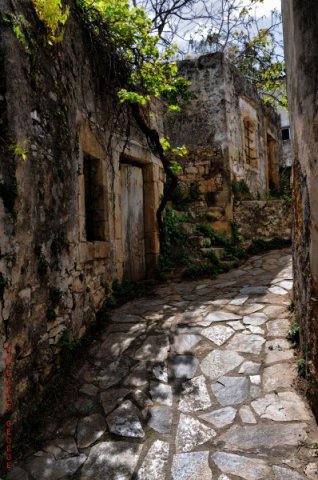
Garazo (Γαράζο) is a traditional hill village of Mylopotamos, some 37 km from Rethymno and about 270 metres above sea level on the southern slopes of Kouloukonas, the highest ridge of the Talea mountains; the village was the seat of the former municipality of Kouloukonas, merged into Mylopotamos in 2011. Stone houses, flowering inner courtyards, narrow lanes and paved ways – the kalderimia – have preserved the picture of a Cretan village in which the tight building also served as protection against raids. The settlement falls into two parts: a modern quarter and an old one that keeps its Venetian and Ottoman character, joined by the sloping cobbled path known as “tou Dore”. In the centre rises the church of Agia Kyriaki; according to local accounts it goes back to the 12th century and was rebuilt from the ground up in 1974.
The village is held to be a Byzantine foundation, but sherds of Minoan pottery that keep coming to light in the neighbourhood testify to far older settlement. It is first recorded in 1577, as “Garaso”, by the Venetian scholar Francesco Barozzi, and in the Venetian census of 1583 it appears with 314 inhabitants; today about 500 people live in Garazo and its dependent hamlets of Mourtziana, Omala and Faratsi, mostly from farming and stock-raising – from olive oil, wine, carob, raisins and citrus fruit. The origin of the name is a matter of conjecture: village tradition tells of two brothers who fell out, and derives it from a word for quarrel and rancour, which others trace to Arabic. In the uprisings against the Ottomans the sheltered village was several times the meeting place of the leaders; from that period survive the house of a Turkish aga and the old Turkish lock-up.
Churches, museum and the old aqueduct
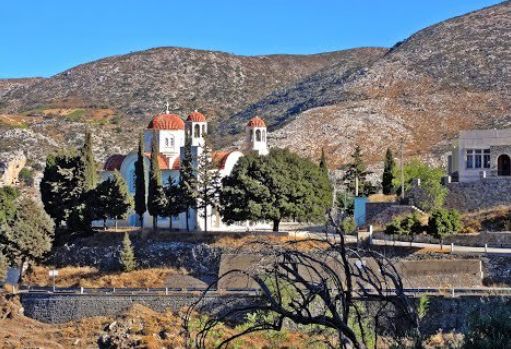
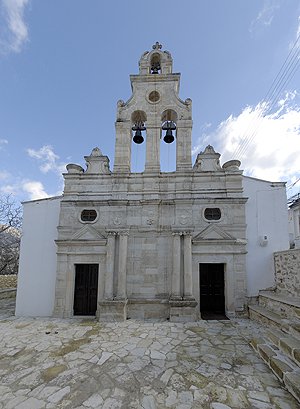
Worth seeing in Garazo is the two-aisled church dedicated to two saints, St Charalambos and the Dormition of the Mother of God, designed by the architect Markos Makridis. It is sometimes described as a modified copy of Arkadi Monastery; it is more accurate to speak of an architectural kinship – above all the belfry gable recalls the famous façade – and of a deliberate reference to Arkadi as the symbol of Cretan church history. Immediately beside it is the Museum of Folk Sculpture, which shows the work of local stonemasons and carvers who had no academic training; the village also keeps a folklore museum, a museum of everyday pottery and a museum of the olive and its oil.
In 1915 the inhabitants built their water supply with their own hands; the old aqueduct survives in the Arkalia quarter. At the spring begins a Venetian cobbled path – a kalderimi – about a kilometre and a half long, which leads to the oldest stone building of the village. Among the smaller churches of the parish are a chapel of St John in basilica form, near the Volta quarter, the chapel of Zoodochos Pigi built in Ottoman times and, high up on the summit of Kouloukonas, the little church of the Holy Cross, whose age the villagers put at some five hundred years; the climb to it is rewarded with a view over the whole of Mylopotamos and the north coast.
The avenue to the old village
On both sides the kalderimi is planted with plane, walnut and fruit trees. The path thus becomes a shaded avenue, pleasant to walk even in the midday heat, in which water, vegetation and stone architecture merge into a single rural landscape. Older villagers still tell of a huge oak under whose crown, it is said, hundreds of people could find room; it fell in the years of the German occupation. Three great oaks once shaded the central square as well, and a younger tree now stands in their place.
On the edge of the village stands the little church of St George, built around 1890. Its modest dimensions contrast with the churches in the centre, but it is precisely such chapels that keep alive the memory of the parish life of individual quarters and paths.
The citron festival
In summer Garazo holds the pan-Cretan festival of the citron, the Giorti Kitrou (Γιορτή Κίτρου). It has been celebrated since the end of the 1980s and has by now seen well over thirty editions – the festival of 2025 was the thirty-fifth, organised by the village cultural association, which was then marking its forty-fifth year. The main events usually fall in the middle of August, in the days around the Dormition of the Virgin, and may extend over several days, with some performances held in the neighbouring hamlet of Faratsi. The programme includes concerts of Cretan music, theatre, popular festivities with dancing, exhibitions of crafts and generous hospitality at which the fruit is served in all its preparations, among them kitroraki, the citron-flavoured spirit of the village. The exact dates change from year to year and are announced by the municipality of Mylopotamos.