Ancient Eleutherna and Margarites – city, museum and potters’ craft
The most complete guide to Crete: 221 places on the map, 23 routes and 49 articles — with photos, videos and the story behind every place. Everything is open and free: no sign-up, no paid sections and no advertising, open or hidden. You can install the guide on your smartphone as an app.
Routes drawn along real roads
Weather at every stop
Full-text search
“Near me” by geolocation
Create your own printable itinerary
Satellite, terrain, dark mode
Works offline
⌕
Searches 1.7 million characters of descriptions, not just names
—places
4regions
—routes
—with video
Search results
—
Interactive map
Find what is near you
Filters narrow the map and the list at once. Zoom out and pins group together.
Region
Category
Фильтры карты
Landmarks
Featured places
RegionCategory
Routes
Ready-made day trips
Individual places
Articles about landmarks
Ancient Eleutherna – city, necropolis and museum
Ancient Eleutherna lies at an altitude of about 380 metres between the hills of Pyrgi and Nisi, on the north-western slopes of Psiloritis. Its backbone is a long ridge of marly limestone, the hill of Prines, whose stepped northern end is Pyrgi; the spur to the west owes its name Nisi, “island”, to the way it juts out like a promontory between two stream beds. As a city the settlement arose in the Early Iron Age; continuous use of the ground, however, can be followed from about the 3rd millennium BC into Byzantine times. The site had everything an ancient community needed – springs and wells, arable land and pasture close by, timber, good building stone and a view to the north coast. In antiquity Eleutherna was an independent city-state, a polis, which commanded the routes between the north coast and the interior of the island and maintained connections across the sea; in the 4th century BC it struck its own coins, and in the wars among the Cretan cities in 220 BC it stood on the side of Knossos.
In ancient tradition the city was called Eleutherna; the name Apollonia also occurs, but is not securely attested as a second name. The story of Eleuther, one of the Kouretes, as the giver of the name – the Kouretes being the armed guardians who clashed their bronze shields so that Kronos should not hear the cries of the infant Zeus – belongs to mythological tradition, whereas archaeology can trace the development of the city layer by layer and building by building. Antiquity also counted several notable figures among its sons: the poet Linos, the lyric poet Ametor, the philosopher Diogenes and the sculptor Timochares.
The first investigations began in 1929, when Humfry Payne of the British School at Athens dug here briefly; the systematic excavations of the University of Crete have been running since 1985 under the direction of Nikolaos Stampolidis, who dates the first cut of the spade to 8 September of that year. The archaeological museum, opened in 2016, was the first museum of an excavation site on Crete. Run jointly by the university and the Ministry of Culture, and bearing the subtitle “Homer in Crete”, it was built to house the results of thirty years of digging and has three exhibition rooms, a lecture hall, laboratories and a study centre. Its display spans the history of Eleutherna from the late 3rd millennium BC to the Byzantine period and brings out the city’s links with the world of Homer; the pieces on show are changed from time to time, so that new and older finds take their turn. In addition the museum mounts temporary exhibitions with loans from all over the Mediterranean. The excavation has changed the surrounding villages too: young people are coming back where formerly there was only emigration.
The city possessed an acropolis, defensive walls and its own limestone quarries, the latter on the hill of Peristere. At the locality of Orthi Petra a necropolis of the Late Geometric and Archaic periods came to light; the burials are dated to about 870 to 850 and 600 to 550 BC. Various rites are represented – cremation, burial in jars and simple inhumation – and the finds of weapons, jewellery and pottery help in understanding the structure of the early polis. One built tomb held four women of a single aristocratic family, aged about seventy, twenty-eight, sixteen and thirteen, the eldest of whom, to judge by what was buried with her, held priestly office. More than four hundred objects of the 9th to 5th centuries BC were recovered, worked in gold, silver, bronze, iron, ivory and semi-precious stones; they attest connections with the Aegean, Asia Minor, Cyprus, Phoenicia, Syria and Egypt, and with the eastern and central Mediterranean at large.
Hellenistic, Roman and Early Christian Eleutherna
On the hill of Nisi a Hellenistic residential quarter was excavated that was abandoned at the beginning of the Roman period. The houses had their own cisterns for collecting rainwater. On the hill of Pyrgi and on its slopes there survive Hellenistic walls, dwellings, a bridge, water tanks, Roman installations and the Early Christian basilica of the Archangel Michael, dated to about 430 to 450. Near it 42 Early Christian graves were found; the basilica was destroyed in the 7th century and had been built over an older pagan sanctuary.
In 67 BC Eleutherna was subjugated by Rome in the campaign of Quintus Caecilius Metellus Creticus, having held out for some time on the strength of its fortified position. Under the Romans the city lived on and later became the seat of a bishop. In the Arab period its importance dwindled; after the Byzantine reconquest of Crete by Nikephoros Phokas in 961 the population moved to a new settlement, which today is called Archea Eleftherna.
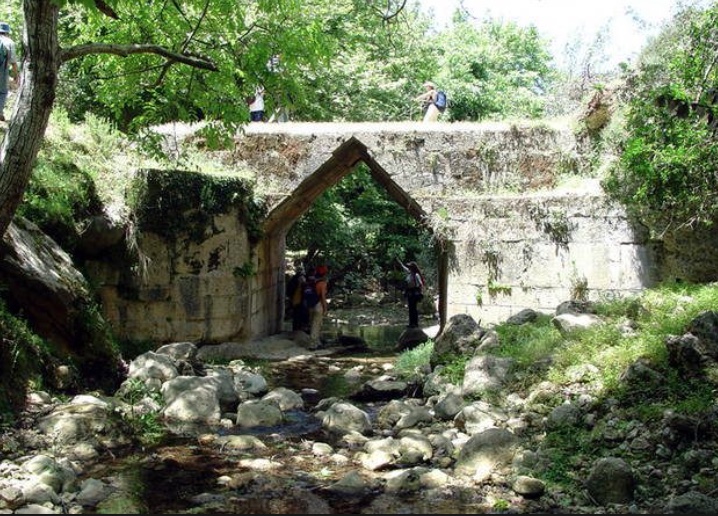
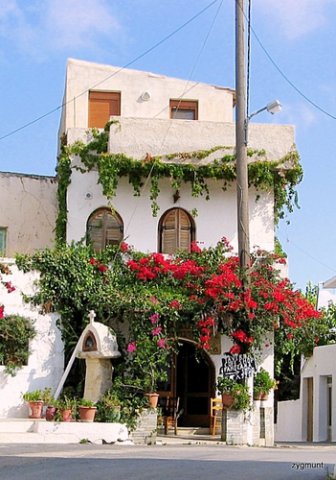
Three kilometres from the excavations lies Archea Eleftherna, a village among cypresses and olive trees. Venetian, Arab and Ottoman influences can be recognised in its buildings; not far away the Hellenistic bridge survives, which has spanned an old stream bed for more than two thousand years. The village has kafenia and parking; since the ancient remains lie scattered over both flanks of the ridge, with the necropolis down on the western slope and the basilica on the eastern, it is as well to allow the greater part of a day for the museum and the park together.
Margarites – the village of Cretan pottery
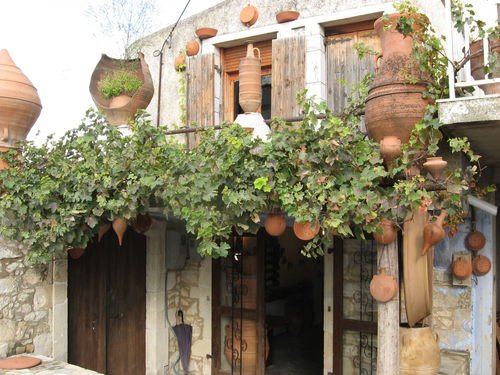
Margarites lies at the northern foot of Psiloritis at an altitude of about 300 metres, looking out over green ravines to the sea off Rethymno. The village is famous for its handmade pottery: the craftsmen shape jugs, tableware and large storage jars by traditional methods whose roots go back to Minoan times. Along with Thrapsano near Heraklion, Margarites is one of the great pottery centres of the island; at least sixteen workshops are active here today, each with a hand of its own somewhere between tradition and contemporary form. The characteristic piece is the pot-bellied water jar, the stamnos of Margarites. The clay, however, is now mostly bought in and no longer dug from the local pits.
The site was already inhabited in Minoan times; after its destruction in the Arab period the settlement rose again in the 10th century, and from the Venetian era mansions with stone doorways and shutters survive. The name of the village probably has nothing to do with the flower: it is derived from the Byzantine word “magarika” for earthenware, and Venetian archives write “Magarites”. Its history was a turbulent one – in 1333 the Venetians burnt the village down because of the rebellious temper of its inhabitants; under the Ottomans Margarites was the administrative seat of the district of Mylopotamos, and in 1829 the Cretan Council met here.
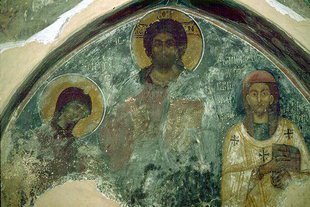
Byzantine and post-Byzantine churches survive in Margarites, among them those of the Transfiguration of the Saviour (Metamorfosi tou Sotira), of the Archangel Michael and of the Panagia Perdikiotissa. The oldest is held to be the church of St John the Theologian, with wall paintings of 1383 and a stone iconostasis; to these may be added St John the Baptist, of the 15th century, the church of the Dormition of the Virgin with its imposing bell tower and, on a slope above the village, the small monastery of the Saviour and St Gideon. Village and archaeological park together make a route on which ancient urban culture, Christian heritage and living craft continue side by side.