The most complete guide to Crete: 221 places on the map, 23 routes and 49 articles — with photos, videos and the story behind every place. No sign-up, no trackers.
Routes drawn along real roads
Weather at every stop
Full-text search
“Near me” by geolocation
Create your own printable itinerary
Satellite, terrain, dark mode
Works offline
⌕
Searches 1.7 million characters of descriptions, not just names
—places
4regions
—routes
—with video
Search results
—
Interactive map
Find what is near you
Filters narrow the map and the list at once. Zoom out and pins group together.
Region
Category
Фильтры карты
Landmarks
Featured places
RegionCategory
Routes
Ready-made day trips
Individual places
Articles about landmarks
Amnatos: an old settlement and its Venetian inheritance
Amnatos (Αμνάτος) stands on the eastern spurs of the Gargani ridge, some 17 kilometres south-east of Rethymno. Its height of about 340 metres explains the wide view, which takes in the plain as far as the town and the coast on one side and Psiloritis on the other. Oaks, cypresses, olive trees and aromatic herbs surround the village and preserve the rural character of a district through which almost every visitor passes on the way to Arkadi Monastery. The community also includes the small neighbouring settlements of Kapsaliana and Pikris and the monastery itself; together the four had 653 inhabitants in 1940 and no more than 191 at the census of 2021.
That the site was inhabited in antiquity is shown by an inscription that preserves the name of the settlement and by archaeological finds; rock-cut tombs can be made out on the eastern slope. Some scholars connect the district with the ancient Tripodos. Where the place name comes from has never been settled: some think of a kinship with Minoan Amnisos, others of a personal name, Amnatos, attested in inscriptions – neither reading is generally accepted.
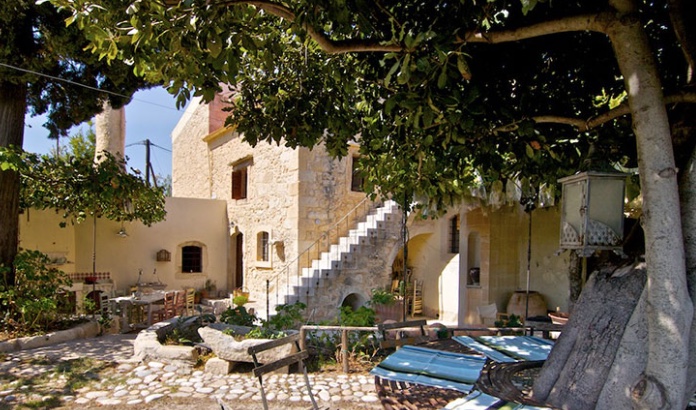
In the Venetian village the residences of the leading families, round-arched doorways, armorial stones and a network of stone-paved lanes come together as a single whole. The Ottoman period is recalled by the remains of a Turkish tower above the village and by reports of a mosque with a minaret; after the rising of 1821 the Muslim inhabitants are said for a time to have been in the majority. In the 19th century Amnatos was also closely bound up with the ‘School of Arkadi’, an establishment run by the monastery in which clergy and teachers were trained and which counts as the village’s first school. Among its churches are Agia Marina and Zoodochos Pigi, the church of the ‘Life-giving Spring’. The care taken of all this was recognised in 2005, when Amnatos was named the cleanest and best-ordered traditional community.
Amnatos and the memory of the rising of 1866
The rising of 1866 made Amnatos part of the story of Arkadi. The monastery is only some four kilometres away, and so the fate of the village was inseparable from that of the besieged abbey. Many of the inhabitants took part in the fighting; others – women and children above all – sought shelter behind the monastery walls, where 964 people were gathered in all, only 259 of them under arms. When the powder magazine went up on 9 November 1866, people from Amnatos were among the dead. The village itself was burnt and badly damaged, but was later rebuilt.
On the square in the middle of the village stands the monument to Chariklia Daskalaki and the other women of Amnatos who lost their sons in the struggle against Ottoman rule. Daskalaki is one of the best-known figures in the defence of Arkadi; her bust is a reminder that resistance was not the business of the armed men alone. According to the tradition kept up in the village, three of her sons fell in the events of the Cretan rising of 1866 to 1869.
Amnatos today preserves its traditional way of building and makes a rewarding halt on the road to Arkadi. Having seen the monument and the museums, linger a while on the square, where a traditional coffee house serves home-made pastries and Cretan snacks. A short detour into the surrounding country is worth while too – to Kapsaliana, once a farm of Arkadi Monastery with its own olive press, or to Pikris with its Venetian country houses. Walkers can go on from the monastery along the E4 long-distance path, which runs from Arkadi to ancient Eleutherna and the potters’ village of Margarites.