Stavromenos – an archaeological coast and the memory of the Battle of Crete
The most complete guide to Crete: 221 places on the map, 23 routes and 49 articles — with photos, videos and the story behind every place. No sign-up, no trackers.
Routes drawn along real roads
Weather at every stop
Full-text search
“Near me” by geolocation
Create your own printable itinerary
Satellite, terrain, dark mode
Works offline
⌕
Searches 1.7 million characters of descriptions, not just names
—places
4regions
—routes
—with video
Search results
—
Interactive map
Find what is near you
Filters narrow the map and the list at once. Zoom out and pins group together.
Region
Category
Фильтры карты
Landmarks
Featured places
RegionCategory
Routes
Ready-made day trips
Individual places
Articles about landmarks
Stavromenos – an archaeological coast and the memory of the Battle of Crete
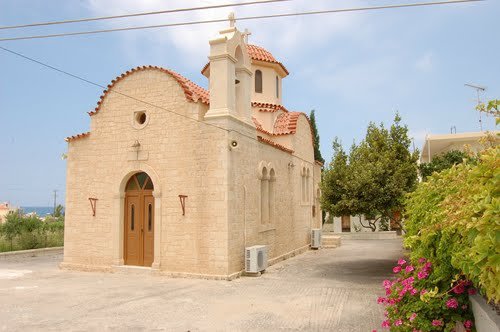
Stavromenos is a small settlement on the coast east of Rethymno, shaped by tourism. Close to the shore stands the church of the Holy Cross; the Greek name Σταυρωμένος – literally “the Crucified”, in a wider sense “belonging to the Cross” – derives from it. A small beach and the proximity of the resorts of Sfakaki and Platanes have made the place part of a well-developed holiday zone: Sfakaki lies about a kilometre to the west, Skaleta, where the long sands of the Bay of Rethymno finally come to an end, a few hundred metres to the east. The shore here is broad and sandy, the water clear, but the coast lies open to the north wind, which often raises waves; there are stretches with sunbeds, lifeguards and showers, and quieter ones without. Together with Pangalochori, Asteri and Chamalevri, Stavromenos is one of the Katomeria, the “lower villages” of the coastal country below Arkadi Monastery.
Four thousand years of settlement, craft and oil
Stavromenos belongs to the large archaeological area of Chamalevri–Pangalochori–Sfakaki. On the hills and along the coast settlements have been uncovered that existed from the Early Minoan period – from about 2600 BC – and can be traced through every one of the Minoan periods. What the ancient city was called is not yet settled; Allaria and Agrion are among the proposals.
The excavations brought to light residential quarters, workshops and cemeteries of the Classical, Hellenistic and Roman periods, as well as a large Roman bath complex at the locality of Tsikouriana, near which there is also a cave church. In the Manouses area a Roman olive press and a potter’s kiln were discovered. The study of olive stones and other residues shows that the inhabitants of this coast were already producing olive oil and scented oils some four thousand years ago. The workshop installations, which belong to the years around 2100 to 2000 BC, comprised hearths, refuse pits, stone tools and vessels made specially for the purpose and bearing traces of fire; on the walls of the vessels olive oil, iris oil, honey and resin could be detected – evidence of a properly organised craft production.
To the Early Byzantine period belong residential complexes with spacious rooms, small courtyards, water basins and mosaic floors. These finds show that the coastal zone kept its importance after antiquity too; Stavromenos was part of an unbroken history of settlement, craft and agriculture. A small archaeological park has been laid out by the shore, and in nearby Chamalevri a defensive tower of later date still stands.
Stavromenos in the days of the Battle of Crete
In the Second World War the Rethymno airstrip lay near Stavromenos, on the coastal plain by the village of Pigi, some thirteen kilometres east of the town. During the Battle of Crete, from 20 to 29 May 1941, there was bitter fighting here: German paratroopers – about 1,700 men of the 2nd Parachute Regiment under Colonel Alfred Sturm – faced Greek units and Australian troops under Lieutenant-Colonel Ian Campbell, who were joined by armed inhabitants. The defence consisted of some 1,270 Australian infantrymen and more than 3,000 Greek soldiers, gendarmerie cadets and armed police, and it turned on the heights overlooking the strip, known to the Australians simply as Hill A and Hill B. The defenders held the airstrip to the last; part of the attacking force dug itself in at an olive-oil factory near Stavromenos, which became one of the two German strongholds of the battle, the other being the village of Perivolia on the edge of Rethymno. Sturm himself was captured on 21 May. Campbell surrendered on 29 May; 96 Australians had been killed and more than 900 went into captivity, though some fifty evaded capture and, with the help of Cretan villagers, eventually reached Egypt. In the village a memorial commemorates the fallen Greek and Australian soldiers. In the Greek record of the villages that suffered reprisals in 1941 Stavromenos appears as well – together with Chamalevri, Asteri and Pangalochori; at Asteri twelve men were shot on 1 June.