Arkadi Monastery – abbey, monument and place of remembrance
The most complete guide to Crete: 221 places on the map, 23 routes and 49 articles — with photos, videos and the story behind every place. No sign-up, no trackers.
Routes drawn along real roads
Weather at every stop
Full-text search
“Near me” by geolocation
Create your own printable itinerary
Satellite, terrain, dark mode
Works offline
⌕
Searches 1.7 million characters of descriptions, not just names
—places
4regions
—routes
—with video
Search results
—
Interactive map
Find what is near you
Filters narrow the map and the list at once. Zoom out and pins group together.
Region
Category
Фильтры карты
Landmarks
Featured places
RegionCategory
Routes
Ready-made day trips
Individual places
Articles about landmarks
Arkadi: monastery, architecture and the memory of 1866
The monastery stands among vineyards, olive trees, cypresses, pines and oaks on the north-western slopes of Psiloritis. The drive of a good 23 kilometres from Rethymno passes through traditional villages such as Amnatos and by an old Ottoman bridge of 1685, before the gorge opens and the fortress-like complex appears on its plateau. To this day Arkadi is a working Orthodox monastery and at the same time one of the most important historic monuments on Crete. In its prosperous years it pressed some four hundred measures of oil annually and made a malmsey wine; its library held more than a thousand volumes, Homer, Virgil, Strabo and Dante among them.
Tradition links the foundation with the Byzantine emperor Arcadius in the 5th century – or, in another version, with Heraclius; other accounts ascribe the early monastery to a monk named Arkadios and place it in the Byzantine period after the reconquest of Crete from the Arabs, and the monastery itself names the 11th century. The early date thus belongs to tradition, while the surviving complex came into being only by degrees. The oldest tangible evidence is held to be a 14th-century inscription, found in 1951 in the area of the arcades, which records a dedication to St Constantine. From the 16th century Arkadi was a centre of spiritual life and of learning: liturgical books were copied here – an important source of income in the 17th century – a library was kept, and monks were trained.
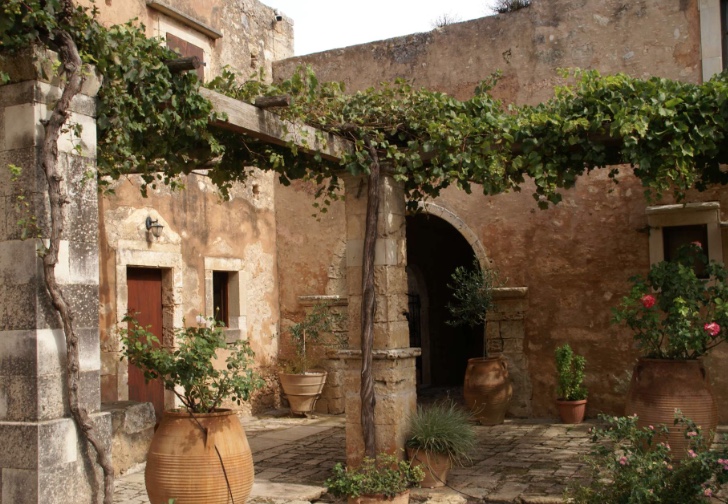
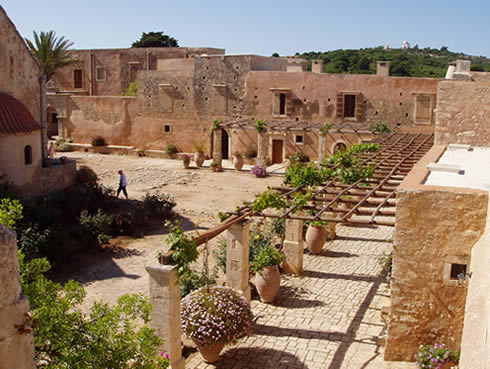
Arkadi forms a closed, not quite regular quadrangle of roughly 74 by 79 metres, enclosing about 5,200 square metres, and its high outer walls give it the look of a fortress. Round the courtyard are ranged the cells and the domestic buildings: refectory, kitchens, bakery, storerooms, wine cellar and cistern, and in the west range the arcades with their round-arched openings and the abbot’s lodgings. Such an arrangement allowed the community to provide for itself. By about 1600 the fortified monastery was essentially complete in its present form, though it went on growing: the refectory, a vaulted hall 18.1 metres long, dates from 1687, the west gate from 1693, and the stables were added in 1714 by Abbot Neophytos Drossas. When the Ottomans took Rethymno in 1648 the monastery was plundered, but Hussein Pasha afterwards granted it the privilege of ringing its bells – alone among Cretan monasteries – and the Turks knew it as Çanlı Manastır, the monastery with the bell. In its heyday Arkadi was famous, too, for its workshops of gold and silver embroidery, whose liturgical vestments found buyers far beyond Crete in the 18th century.
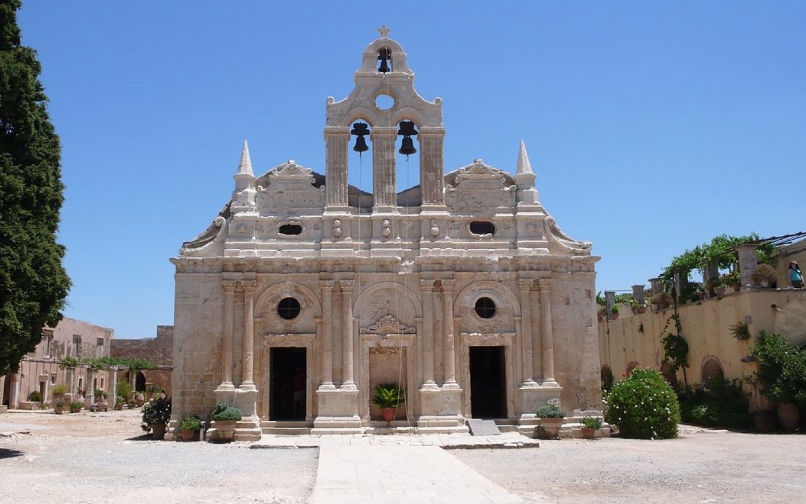
In the middle of the courtyard stands the two-aisled katholikon, the main church of the monastery. It was completed in 1587, in Venetian times, under Abbot Klimis Chortatzis and, tradition says, at the bidding of Matthaios Kallergis; the date is recorded in a relief inscription at the foot of the bell-cote, the two halves of the year set either side of the abbot’s name. Building is thought to have taken some twenty-five years. The north aisle is dedicated to the Transfiguration of Christ, the south to Saints Constantine and Helena, Equal to the Apostles. The façade unites the forms of the Italian late Renaissance – the pattern books of Serlio and the work of Palladio have been invoked – with the native Cretan building tradition: three doorways, four pairs of Corinthian columns raised on tall pedestals, pediments and a two-tiered bell-cote come together in a composition of rare unity. Inside, to the left of the sanctuary, a scorched fragment of the old icon screen survives from the fire of 1866; the present screen, of cypress wood, was set up in 1902.
Siege and explosion, 8 and 9 November 1866
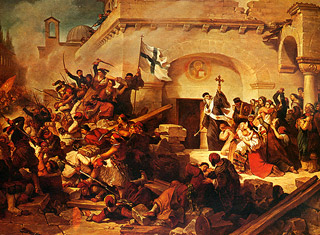
By November 1866 the monastery’s wine cellar, a vaulted room 21 metres long and 5.4 wide, had become its powder magazine. During the Cretan rising, monks, armed defenders and women and children from the surrounding villages had gathered at Arkadi – some 900 people in all; Greek tradition counts exactly 964, of whom 325 were men and only 259 fit to bear arms. Abbot Gavriil Marinakis presided over the revolutionary committee of the district; Ioannis Dimakopoulos commanded the garrison. On 8 and 9 November the troops of Mustafa Pasha, many times superior to the besieged in numbers and in artillery, surrounded the monastery: the figures given run from several thousand to 15,000 men – infantry, cavalry and Albanian auxiliaries – with thirty guns, to which two heavy cannon were brought up from Rethymno. After two days of defence, when the west gate had been shot to pieces and the attackers were pouring into the courtyard, Kostis Giamboudakis from nearby Adele fired the powder. The explosion destroyed the magazine and most of those shut up in it, and many of the attackers with them, but spared the besieged captivity. Abbot Gavriil fell in the fighting; many of the survivors were killed afterwards, thirty-six of them in the refectory. The dead on the Cretan side are put at about 850, with 114 taken prisoner and three or four who got away; the Ottoman losses are estimated at 1,500.
The ‘Holocaust of Arkadi’ became one of the emblems of Crete’s struggle against Ottoman rule. News of the tragedy stirred sympathy in Greece and throughout Europe; philhellenes such as Giuseppe Garibaldi and Victor Hugo – whose letters on Crete were printed in the Greek newspaper Kleio at Trieste – took the Cretans’ part in public, and volunteers came from France, Italy, Hungary and Serbia, the Frenchman Gustave Flourens among them. In memory of the dead, church and state ceremonies are held every year on 8 November, at Arkadi and in Rethymno alike.
After its destruction the monastery was rebuilt – the west gate as early as 1870, the guest house in 1906 on the site of the abbot’s ruined residence, the church restored between 1924 and 1927; the powder magazine was deliberately left without a roof, as an open wound. Today the walls house a museum, founded in 1933 by Metropolitan Timotheos Veneris, with icons of the 16th and 17th centuries, liturgical vessels, manuscripts, embroideries, weapons and objects connected with the events of 1866, including the defenders’ banner with the Transfiguration. In the courtyard the visitor sees the powder magazine, the refectory, whose tables still bear the marks of sword cuts, the cells, and the old cypress with an Ottoman bullet still lodged in its trunk. Outside the walls an ossuary, an octagonal former windmill converted in 1910, holds the bones of the victims, many of them visibly scarred by shot and blade. Arkadi has remained not only a museum but a living monastery: pilgrims and visitors come to look at the architecture, to pray and to remember the dead. UNESCO has designated the abbey a European Freedom Monument.