The most complete guide to Crete: 221 places on the map, 23 routes and 49 articles — with photos, videos and the story behind every place. No sign-up, no trackers.
Routes drawn along real roads
Weather at every stop
Full-text search
“Near me” by geolocation
Create your own printable itinerary
Satellite, terrain, dark mode
Works offline
⌕
Searches 1.7 million characters of descriptions, not just names
—places
4regions
—routes
—with video
Search results
—
Interactive map
Find what is near you
Filters narrow the map and the list at once. Zoom out and pins group together.
Region
Category
Фильтры карты
Landmarks
Featured places
RegionCategory
Routes
Ready-made day trips
Individual places
Articles about landmarks
Melidoni and the Gerontospilios – a cave of remembrance
Melidoni (Μελιδόνι) is a historic village of the Mylopotamos district, some 30 kilometres east of Rethymno and a short drive inland from the coast, at the foot of Mount Kouloukonas, the Tallaion range of antiquity. Local tradition derives its name from the Byzantine family of Melidonis, to whom this stretch of country belonged; the surname is still common in the village and throughout Crete. The memory of the family lives on in the place name and in the stories told of its members. Best remembered is Georgios Melidonis: in the years of the 1821 uprising he had studied medicine in Europe, brought smallpox vaccination to Crete and taught the villagers to vaccinate one another – he is regarded as the first to introduce inoculation on the island. Melidoni has remained a living village, the historic chief community of the former district of Geropotamos, and is officially classed as a settlement of particular cultural importance.
How modest life here long remained can be seen from the old surveys preserved in the village chronicle: 195 families, about 780 people, shared 172 houses, in which several families often lived under one roof together with their animals and their stores. Olive and carob trees fed man and beast, but the real source of income was grain.
The festival of the “abduction of the bride”
Every year on the first day of Orthodox Lent, “Clean Monday” (Kathara Deftera), Melidoni stages the custom of the “Klopi tis nyfis” – the “abduction of the bride”. It is a carnival play in which the performers act out the story of a wedding. The name sounds dramatic, but this is popular festivity, not kidnapping; visitors watch a piece of broad, cheerful street theatre and are welcome to join in the high spirits of the day.
The Cave of Melidoni – the Gerontospilios
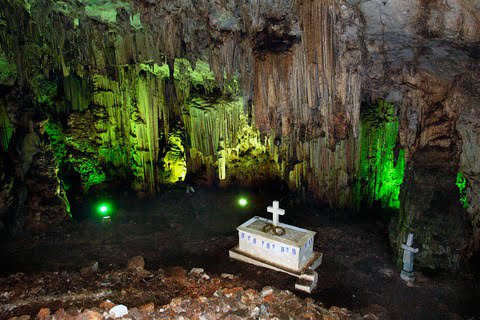
Just under two kilometres north-west of the village, at about 220 metres on the southern slope of Kouloukonas and reached by an asphalt road, lies the Cave of Melidoni, also called Gerontospilios – the “Old Man’s Cave”. Archaeological investigation has shown that people used it from prehistoric times. In the Late Neolithic and the Early Minoan period it was a place of habitation and of sacrifice, and during the Middle Minoan centuries (2100–1600 BC) it became primarily a place of worship; later it was the sanctuary of Talos, the mythical bronze guardian of Crete, and after him of Hermes Tallaios. On the wall by the entrance an inscription of the 3rd century BC connected with the cult of Hermes survives. The vessels, hearths, tools, lamps and cult objects recovered – among them female figurines of c. 680–600 BC found beside a phallus-shaped stalagmite, Hellenistic figurines, and lamps and pins of Late Roman date – bear witness to the long history of the place, which runs on into the Roman period.
The cave opens at the bottom of a collapsed hollow some 25 metres across. The entrance itself is unassuming – about two and a half metres high and four wide – yet behind it the cave unfolds on three levels, and a flight of steps leads down to the floor of the great chamber, round which a path makes a circuit. This first hall measures roughly 50 by 30 metres, with a roof 16 to 25 metres high; a second runs back for about 40 metres. The chambers have names: the Hall of the Heroes, off which opens a recess named after the French geologist Raulin, is followed by the “Crossroads”, the hall named after the English traveller Robert Pashley, who came here in 1834, with its rich dripstone decoration, the Hall of the Rocks, the Chamber of the Curtains and the “Upper Room”. As a rule only the Hall of the Heroes is shown to visitors, the deeper chambers being reserved for archaeological work.
In antiquity the cave was a place of worship. It is associated with Talos, the bronze guardian of Crete in mythical tradition, and the inscription at the entrance attests the veneration of Hermes Tallaios. The first discoveries were made by chance and by clandestine digging: Neolithic tools in 1928, a bronze double axe in 1940. Systematic research began with the French scholar Paul Faure in 1954, and rescue excavations by the Greek Archaeological Service have continued since 1987; in 1998 a lime kiln was identified near the entrance. Excavations by the Italian Archaeological School and the Greek service brought to light objects of Minoan date, bronze votive weapons, figurines and double axes; the finds show that the Gerontospilios served not only as a refuge but also as a sanctuary. Part of the material is kept in the Archaeological Museum of Rethymno.
Linked with the village is Antonios Melidonis, also known as Dandolos, a member of the Filiki Eteria and a champion of the Greek national movement. He distinguished himself in the uprising, was given the rank of pentakosiarch – a commander of five hundred men – and was murdered in 1822 by a comrade-in-arms, Roussos Vourdoumbas. A third brother, Ilias, fought alongside Georgios Karaiskakis and fell in 1827 at the battle of Faliro. Local history also keeps alive the memory of the physician Georgios Melidonis, who after his studies in Europe brought the knowledge of smallpox vaccination to Crete. These lives round out the history of the cave: Melidoni was not only the scene of a tragedy but also a place of civic energy.
The tragedy of January 1824
In October 1823, during the uprising against Ottoman rule, the inhabitants of Melidoni and the surrounding villages sought shelter in the Gerontospilios: 370 women and children and some 30 armed defenders. A detachment of the Turco-Egyptian army under Hussein Bey invested the cave and demanded its surrender. After three months of vain attempts to storm the entrance, the besiegers blocked it with branches, straw, oil and olive-press residue, and then set fire to combustible material through the upper opening of the cave, so that the smoke was driven inside. On 24 January 1824 those shut in suffocated in the smoke. Some 400 people died in all. The bones lay where the victims had fallen for years; when Pashley was taken into the cave a decade later, the dead were still there. The event has entered the memory of the island as the “Holocaust of Melidoni”.