Perama – the “Road of the Kouretes” and the cultural trails of Mylopotamos
The most complete guide to Crete: 221 places on the map, 23 routes and 49 articles — with photos, videos and the story behind every place. Everything is open and free: no sign-up, no paid sections and no advertising, open or hidden. You can install the guide on your smartphone as an app.
Routes drawn along real roads
Weather at every stop
Full-text search
“Near me” by geolocation
Create your own printable itinerary
Satellite, terrain, dark mode
Works offline
⌕
Searches 1.7 million characters of descriptions, not just names
—places
4regions
—routes
—with video
Search results
—
Interactive map
Find what is near you
Filters narrow the map and the list at once. Zoom out and pins group together.
Region
Category
Фильтры карты
Landmarks
Featured places
RegionCategory
Routes
Ready-made day trips
Individual places
Articles about landmarks
Perama – the green heart of Mylopotamos
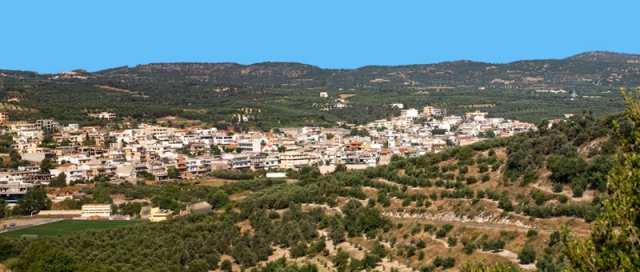
Perama (Πέραμα) is a green country town and the administrative seat of the historic district of Mylopotamos in the regional unit of Rethymno. It lies some 24 km east of Rethymno on the old national road to Heraklion, at only about 75 metres above sea level, on the left bank of the Geropotamos – the river that has given the whole valley its name and was known in antiquity as the Oaxes. All around spread gardens, vineyards, olive groves and fertile arable land; the plain about the town is cultivated almost to the last field, while to the south the limestone ridges of Kouloukonas and Talea close the view, with the bulk of Psiloritis beyond them. The municipality of Mylopotamos, formed in 2011 from the former municipalities of Geropotamos, Kouloukonas and Zoniana, covers some 360 square kilometres and had 14,363 inhabitants at the 2021 census, of whom 6,108 lived in the Perama municipal unit.
The place name itself tells the story of the town’s origin: “Perama” means a crossing or ford. The settlement grew up at the point where the river was crossed on the way from the surrounding villages to Melidoni and Panormos. Real importance, however, came only in the 20th century. When the first motor road through the interior of central Crete was built in the 1920s, traffic shifted from the coast into the valley, and Perama replaced the little harbour town of Panormos as the commercial and administrative centre of the district. Today it holds the town hall of the municipality of Mylopotamos, the court, a health centre, secondary schools, banks and the seat of the union of agricultural co-operatives that serves the farmers and shepherds of the whole district. Thanks to its position on the road between the north coast and the mountain villages below Psiloritis, Perama has remained the market town and cultural centre of the district to this day.
Festivals and public life
In summer Perama fills with cultural life. Best known is the Perama carnival: a loud and cheerful procession with music, concerts and theatrical turns, to which visitors stream from the whole valley. At the end of August follows the grape festival, which joins music, dancing and a shared meal to the memory of the vineyards and the rural way of life of Mylopotamos. In recent years a festival of regional cooking has been added around 15 August, the feast of the Dormition of the Virgin, at which the producers of the valley present their oil, wine, cheese and honey.
The “Road of the Kouretes” ecomuseum
Perama is the home of the “Kouritia Odos” (Κουρήτια Οδός) ecomuseum, the “Road of the Kouretes”. Its aim is not to lead its guests into a single building but to introduce them to a living cultural landscape – to the olive groves and vineyards, the crafts, the archaeological sites and the natural world of Mylopotamos. On offer are short, thematically grouped walks and routes that introduce the ecology of the region and its agrotourism, arranged in four strands: cultural routes to the potters’ village of Margarites, to archaeological sites and sacred caves; water routes along the streams of Mylopotamos; marked hiking trails through gorges and forest; and “Minoan tastes”, which take in vineyards, shepherds’ huts and the heritage of the olive, including a tree at Tripodo reckoned to be some 2,600 years old. One watches oil being pressed, cheese being shaped and honey being spun from the comb, and grasps along the way how ancient these activities are in this valley.
The routes of the ecomuseum
The route “Achlades: the way of the olive” introduces a modern olive-processing plant, traditional cheese-making and the remains of the Minoan settlement of Grivila. In the village of Melidoni the sanctuary of Hermes, a walk through the Talea mountains and a visit to a honey-processing business are combined. The sanctuary is the great stalactite cave above the village, the Gerontospilios, which opens at about 220 metres on the southern side of Kouloukonas some 1,800 metres north-west of the village; finds show that it was used from the late Neolithic to late Roman times; it became a place of worship in the Middle Minoan period, and in antiquity Hermes Talaios was venerated here – the cave is linked in legend with Talos, the bronze guardian of Crete. For Cretans it is also a place of mourning: in the winter of 1823–24 several hundred villagers who had fled from the Ottoman troops – about 370 people, most of them women and children – were suffocated in the smoke when the forces of Hussein Bey lit fires at the blocked entrance. Their bones rest in an ossuary in the first great chamber, the Hall of the Heroes.
The Tsanakiana route takes in a Minoan tomb, the “House of the Kouretes”, a grove of rare cypresses with horizontally spreading branches and 112 species of endemic plants. At Monastiraki, finally, the route takes in a Minoan palatial building of about 2000 BC, the building methods of the ancient dwellings and an evergreen plane tree that local tradition links with Zeus – a tree that does not shed its leaves even in winter and has therefore been regarded since antiquity as a divine sign, like the famous evergreen plane of Gortyn under which Zeus is said to have lain with Europa.
Perama as a starting point
From Perama, Melidoni, Achlades, Monastiraki and the other villages of Mylopotamos are easily reached; Melidoni is only a few kilometres away, the coast at Panormos hardly more, and the potters’ village of Margarites and the ancient city of Eleutherna lie within a short drive to the south-west. In the surrounding country one comes upon Minoan monuments, caves, old churches and traditional workshops, and to the south the roads climb by way of Garazo and Axos up to Anogeia on Psiloritis. Those who stop in the town itself find kafenia, tavernas and shops in which the locals do their errands – a market town without a tourist backdrop. That is why Perama repays a visit not only on festival days: it shows the everyday Crete in which vineyards, archaeology and the community life of the present exist side by side.