The most complete guide to Crete: 221 places on the map, 23 routes and 49 articles — with photos, videos and the story behind every place. Everything is open and free: no sign-up, no paid sections and no advertising, open or hidden. You can install the guide on your smartphone as an app.
Routes drawn along real roads
Weather at every stop
Full-text search
“Near me” by geolocation
Create your own printable itinerary
Satellite, terrain, dark mode
Works offline
⌕
Searches 1.7 million characters of descriptions, not just names
—places
4regions
—routes
—with video
Search results
—
Interactive map
Find what is near you
Filters narrow the map and the list at once. Zoom out and pins group together.
Region
Category
Фильтры карты
Landmarks
Featured places
RegionCategory
Routes
Ready-made day trips
Individual places
Articles about landmarks
Sfendoni Cave at Zoniana
Sfendoni Cave (Σπήλαιο Σφεντόνη), which local people call simply “Trypa tou Sfendoni” – Sfendonis’s Hole – opens about a kilometre outside the mountain village of Zoniana, on the steep southern slope of the hill of Chalepa, in the locality known as Myronos. Until about 1920 it also went by the name of “Zeus’s Pit”. The entrance lies some 630 to 700 metres above sea level, at about the height of the village itself. It is a good 50 kilometres from Rethymno – 52 by road – and about 43 from Heraklion. On its north-western side the hill falls away in rock faces up to 50 metres high, and the car park by the entrance looks out across the valley of Mylopotamos. The cave belongs to the Psiloritis Natural Park, which has been admitted to the network of UNESCO Geoparks, and it is reckoned one of the outstanding natural sights of the Mylopotamos district.
Age and structure of the cave
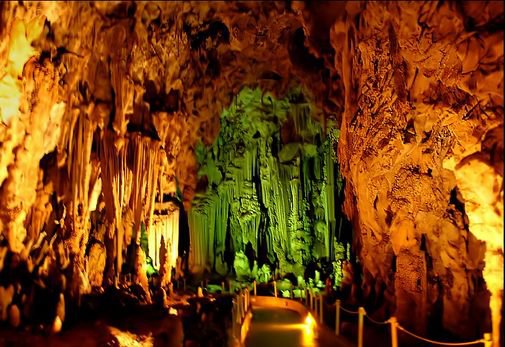
The precise geological age of Sfendoni Cave has not been established: published estimates range from eight to fourteen million years. It lies where the limestones of the Tripoli series meet phyllite-quartzite rocks, along a line of major faulting, and it was made by the patient work of water dissolving the limestone over spans of time that defy the imagination. In a straight line the cave measures no more than 145 metres, and its floor area is given as roughly 3,000 to 3,500 square metres. Between half and two thirds of the underground space is open to visitors; the constructed circuit winds for about 270 metres through several halls, between huge columns that divide the interior into something like a labyrinth. The cave is still “alive”: water drips, and the deposition of calcite goes on. The temperature holds steady all year at 16 to 17 degrees Celsius and the humidity comes close to one hundred per cent – a light jacket is no bad idea even in high summer.
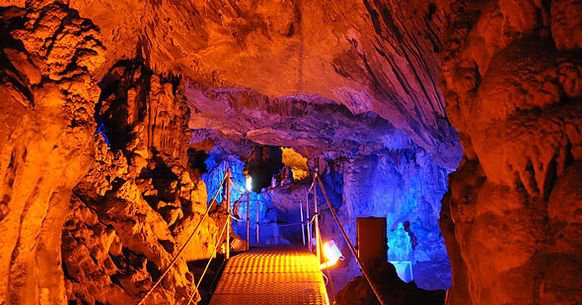
The original entrance was a cleft barely a metre wide; it was enlarged for visitors, and a paved path now leads to it from the ticket kiosk. Inside, metal walkways with handrails, and safety ropes on the sloping stretches, spare the fragile floor and make the route safe even for those unused to caves; the cave is also described as accessible to wheelchair users. Near the entrance the roof is faintly blackened with soot, a reminder of the fugitives and guerrillas who sheltered here in harder times.
Halls, water and patterns in stone
Sfendoni is famous for the sheer profusion of its formations. Fourteen halls open one after another, among them the Hall of Harmonies, the Sanctuary of the Fairy (also called the Nymph’s Refuge), the Chapel, the Palace, the Parthenon, the Panorama, the Metropolis, the Hall of the Lost Child and the Hall of the Petrified Waves. Those most often singled out are the Palace, the Organ Hall, the Parthenon, the Panorama and the Metropolis. In the Hall of Harmonies the stalactites hang from the roof in close ranks like organ pipes. In the Parthenon, a chamber of about 30 by 30 metres, rows of columns rise to as much as six metres; the Palace holds the most massive formations, the Parthenon the most regular and the most gracefully undulating. The colours shift with the composition of the rock from pure white through grey to dark red, and minute crystals of calcium carbonate make some surfaces glitter in the light. Between the stalactites and stalagmites lie small rimstone basins hollowed by water (known as “gours”), stone “curtains” and cave pearls – small rounded concretions of calcium carbonate that do indeed resemble pearls.
The systematic exploration of Sfendoni began in 1956, when the speleologists Ioannis and Anna Petrocheilou examined it; Anna Petrocheilou, who also surveyed the cave, is credited with naming the halls. A route of about 270 metres has been laid out for visitors, leading through five principal halls; the overall extent in a straight line is 145 metres and the area some 3,000 to 3,400 square metres. The names of the halls – Harmonies, Sanctuary of the Fairy, Chapel, Palace, Parthenon, Panorama, Metropolis and Hall of the Lost Child – reflect the pictorial language in which the local guides have long presented the cave.
That the cave also served people was shown by an excavation in 1987, carried out by E. Gavrilakis for the regional Ephorate of Antiquities of the Greek Ministry of Culture: it established regular, apparently seasonal use beginning in the Early Minoan period (c. 3500–2300/2150 BC) and lasting into Late Roman times – not intensive occupation, but the recurring presence of shepherds, traced through their pottery. Neolithic sherds, stone tools and animal bones also came to light: ninety-five bones in all, of lambs, goats and pigs and of wild animals too – among them deer, from an age when deer still lived in Crete.
Wildlife and the traditions of Zoniana
A tiny woodlouse adapted to life in the dark was discovered in the cave: Graeconiscus guanophilus, about a centimetre long, colourless and blind, known only from Sfendoni and found nowhere else in the world. It shares its habitat with other colourless, blind small creatures – cave crickets, pseudoscorpions, millipedes, diplurans and snails – and with several species of bat, of the horseshoe-bat family; the bat population is put at a few hundred animals, and the darkly stained patches of roof betray where they roost.
In the village the name “Sfendoni” is linked with the memory of Sfendonis, a chainis from Sfakia – a rebel and irregular fighter, that is – who according to tradition lay hidden here. A rougher version has it that he killed an uninvited visitor with a kick – a young man who had come looking for food. Another legend tells of a girl who lost her way in the underground passages, and yet another of a fairy who used to bathe at the spring of Skafidia; wounded by a shepherd, she laid on him the curse of trembling hands and for years found refuge in the cave. That is why the image of the nymph and that of the lost child live on in the names of the halls. The tale has a sober core: decades ago the skeleton of a child really was found, close to the last hall, coated with a layer of calcite and, by local account, many centuries old; how the child died has never been explained. These stories belong to the cultural memory of Zoniana and stand beside the scientific description of the cave.