Kamares Cave and a Cretan Rarity – the Orchid Cephalanthera cucullata
The most complete guide to Crete: 221 places on the map, 23 routes and 49 articles — with photos, videos and the story behind every place. No sign-up, no trackers.
Routes drawn along real roads
Weather at every stop
Full-text search
“Near me” by geolocation
Create your own printable itinerary
Satellite, terrain, dark mode
Works offline
⌕
Searches 1.7 million characters of descriptions, not just names
—places
4regions
—routes
—with video
Search results
—
Interactive map
Find what is near you
Filters narrow the map and the list at once. Zoom out and pins group together.
Region
Category
Фильтры карты
Landmarks
Featured places
RegionCategory
Routes
Ready-made day trips
Individual places
Articles about landmarks
Kamares Cave and Kamares ware
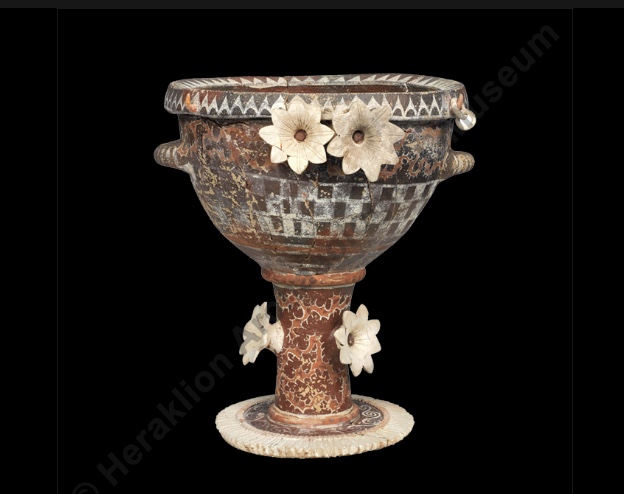
The cave of Kamares (Καμαραϊκό σπήλαιο), which local people also call Mavrospilio, the “Black Cave”, lies on the southern flank of Psiloritis at an altitude of roughly 1,520 to 1,530 metres, on the slopes of the Soros massif and beneath Mavri Korfi, the “Black Peak”. Together with a second summit, Mavri Korfi forms the twin-headed ridge known in popular speech as the Saddle of Digenis. The mouth of the cave is enormous – some 42 metres wide and 20 metres high – and on clear days it shows as a dark smudge far across the Messara Plain, even from the palace hill at Phaistos. From the mountain village of Kamares, 57 kilometres from Heraklion, a steep path climbs through the Kamares forest; the ascent takes three to four hours one way. Inside, the floor drops away over scree into a main chamber about a hundred metres long and some forty metres deep, off which opens a small inner room with a modest display of stalactites and stalagmites. The cavern has formed in the dolomites of the Tripoli zone, along the great fault that geologists call the Cretan detachment. Its fame, however, owes nothing to its shape: it rests on the thousands of Minoan sherds and vessels found here, which gave their name to one of the most distinctive styles in Aegean pottery.
The discovery of the cave and the archaeological finds
The first to know that the cave held antiquities were the shepherds. In the late 1880s and around 1890 the first brightly painted vessels reached Heraklion from the hands of local people – collectors of antiquities dug here too, and the cave was certainly plundered around the turn of the century – and before long Italian scholars took notice. The earliest scholarly reports of these unusual vessels go back to the reconnaissance made by the Italian archaeologist Antonio Taramelli in 1894. Systematic excavation followed in June 1913, when the British School at Athens worked here under Richard MacGillivray Dawkins, assisted by Max Laistner. The team recovered some seventeen thousand pottery fragments, representing more than 1,800 vessels, together with terracotta animal figurines, tools of stone and bone, animal bones and – from a later age – six iron spearheads. Traces of grain in a number of the vessels suggest that the deity was also offered the produce of the fields. In 2002 the material was studied afresh with modern methods by Aleydis Van de Moortel.
Pottery from the age of the palaces
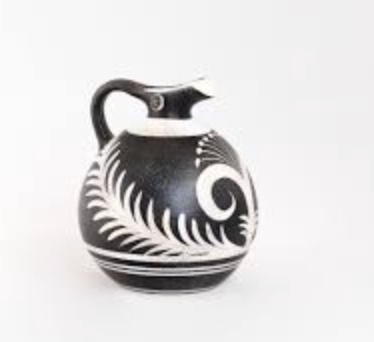
The bulk of the celebrated vessels belongs to the Middle Minoan era, the heyday of the first palaces, in the centuries around 2000 BC. The style appears in Middle Minoan IA, takes to the wheel in the following phase and reaches its peak in Middle Minoan II, when the walls grow ever thinner and the painting bolder. Those thin walls and the exacting decoration speak of a highly developed craft and of well-established exchange between the mountain sanctuary, Knossos and Phaistos. Cups, beaked jugs, fruit stands and large storage jars were carried up the steep slope – an effort that gives some measure of the cult’s importance. Local tradition holds these gifts to have been votive offerings to Eileithyia, the goddess of childbirth, who was familiar to the Minoan world as she was to the later Greek one; a fertility goddess akin to Demeter has also been suggested.
In the Archaeological Museum of Heraklion
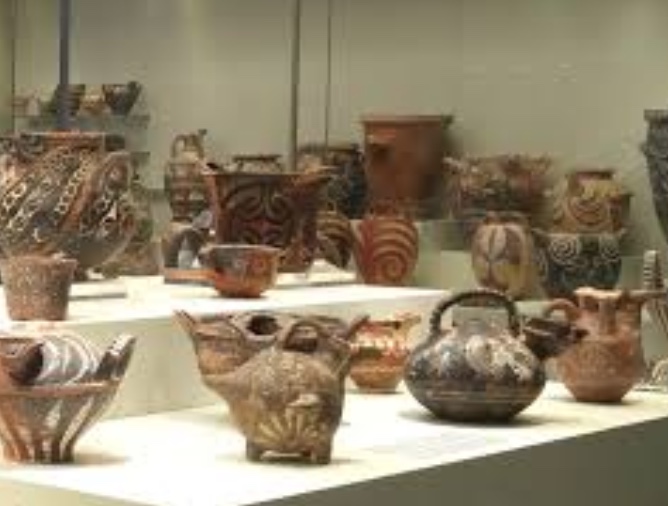
Most of the finds are kept in the Archaeological Museum of Heraklion. There the Kamares vessels are presented not as isolated objects of beauty but as evidence of the Minoan economy, of religion and of the work of artists’ workshops. In the display cases the pieces from the cave stand beside the showpiece vessels from the palaces of Knossos and Phaistos, so that shapes and patterns can be compared directly. Recent analysis of the clay shows that the pottery was made in several workshops of the western Messara and distributed through a wider network than was once supposed; elsewhere on the island the style was also produced at Malia and at Mochlos and Vasiliki in the east.
The way up to the cave
The route to Kamares Cave is a mountain walk for experienced hikers, not a stroll to a developed attraction. The path begins at the upper edge of Kamares village and is waymarked, forming part of the E4 European long-distance footpath; it climbs through open stands of kermes oak, passes three or four springs and stone troughs for the flocks, and time and again opens up views over the Messara and the Libyan Sea – in clear weather as far as the island of Gavdos. Allow about six hours for the ascent and descent together, with a height gain of roughly a thousand metres. The final stretch follows a steep and stony track, so sturdy closed footwear is essential, as are a generous supply of water, protection from the sun and a navigation device or a good map; an experienced guide is advisable, since the markings are not everywhere easy to follow. For the cave itself a torch is needed. The best seasons are late spring and autumn; in winter snow lies up here. A second approach comes across from the Nida Plateau, where the walk can be combined with a visit to the Idaean Cave.
The orchid of Mana Nerou
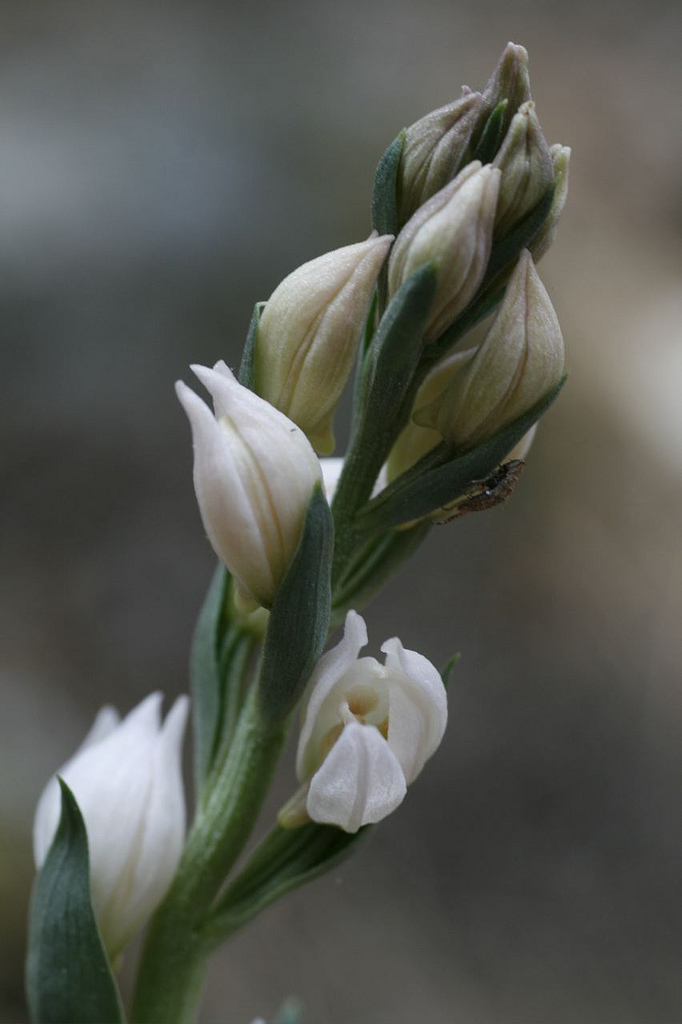
Not far from Kamares, at the spot known as Mana Nerou (“Mother of the Water”), grows one of the rarest plants in Europe: Cephalanthera cucullata, an orchid of the helleborine tribe that is endemic to Crete and known in Greek as κεφαλάνθηρο. It was first collected in May or June 1845 by the French scientist Victor Raulin and bears the botanical authority of Boissier and Heldreich. It occurs in the mountain forests of Psiloritis at altitudes between about 500 and 1,500 metres. This slender perennial, which grows from a short rhizome, seldom stands much more than twenty centimetres tall – thirty at the very most – and carries up to two dozen white to pale pink flowers. They appear in late spring, usually in May and June, in the half-shade of kermes oaks and cypresses – and not every year, for the plant may skip flowering altogether. By the end of June the seeds are ripe, after which the parts above ground wither away.