Vrontisi Monastery – the house of St Anthony on Psiloritis
The most complete guide to Crete: 221 places on the map, 23 routes and 49 articles — with photos, videos and the story behind every place. Everything is open and free: no sign-up, no paid sections and no advertising, open or hidden. You can install the guide on your smartphone as an app.
Routes drawn along real roads
Weather at every stop
Full-text search
“Near me” by geolocation
Create your own printable itinerary
Satellite, terrain, dark mode
Works offline
⌕
Searches 1.7 million characters of descriptions, not just names
—places
4regions
—routes
—with video
Search results
—
Interactive map
Find what is near you
Filters narrow the map and the list at once. Zoom out and pins group together.
Region
Category
Фильтры карты
Landmarks
Featured places
RegionCategory
Routes
Ready-made day trips
Individual places
Articles about landmarks
A treasury of Cretan history and art
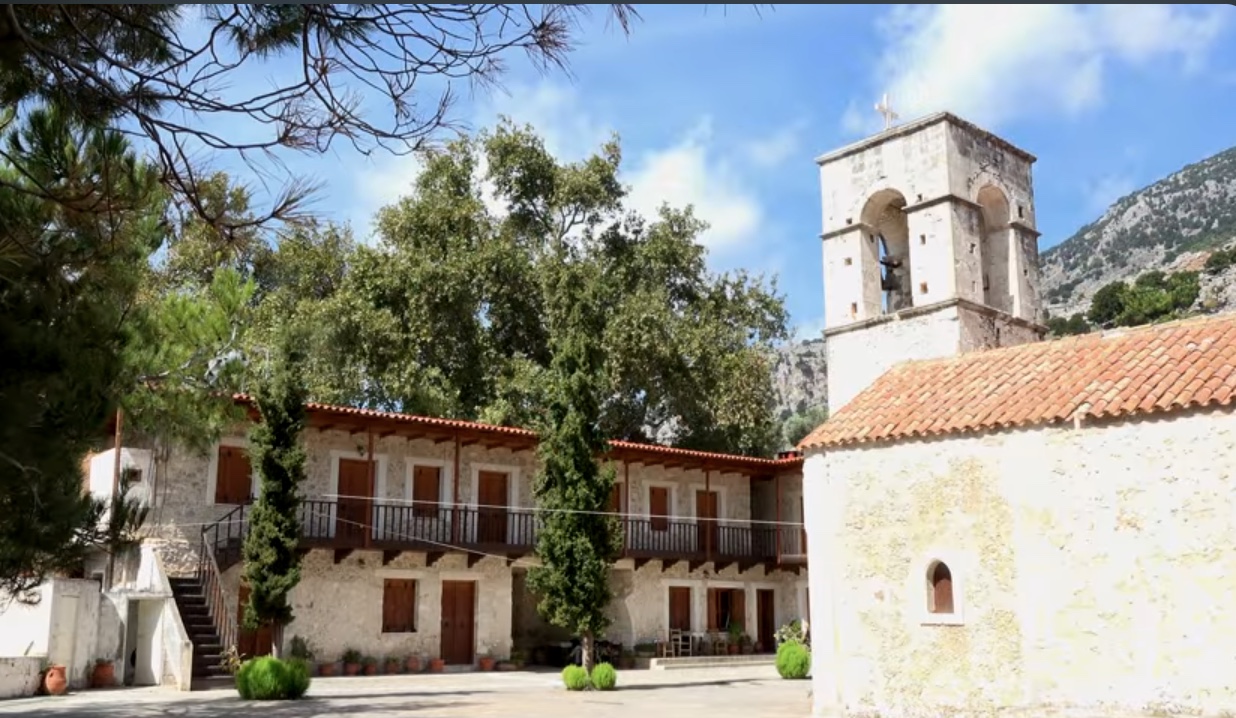
Anyone taking the road west from Zaros sees, after a few kilometres, two mighty plane trees, centuries old, standing on the hillside. They shade the entrance to one of the most important monasteries of southern Crete: Moni Vrontisiou (Μονή Βροντησίου), dedicated to St Anthony and looking out from a terrace 550 metres up far across the Messara Plain. Today the place seems modest, almost hushed; of the old buildings little more than the fountain, the church and the bell tower remain. Yet in the last century of Venetian rule it was a spiritual and artistic centre whose reputation reached across the whole island.
Vrontisi Monastery and its history
The monastery of St Anthony lies between Zaros and Vorizia on the southern slopes of Psiloritis, some fifty kilometres south-west of Heraklion and only about two kilometres from the centre of Zaros; a tarmac road runs right up to the gate. When it was founded is not known. Some accounts place its beginnings as early as the second Byzantine period (961–1204), but written references are certain only from about 1400; the earliest regularly cited dates from 1474. The name is usually traced to a founder called Vrontisis – priests of that name are mentioned in 1323 in documents from Chandax, the Candia of the Venetians and the Heraklion of today. In its early days Vrontisi was a metochi, a dependent estate, of the nearby monastery of Varsamonero. When that house fell into decline around 1500, the relationship was reversed: in the late 16th and the 17th century Vrontisi rose to be an independent spiritual and artistic centre, and it was in this heyday that most of the buildings now to be seen were put up.
The monastery came through the Ottoman conquest lightly at first: tradition has it that the Grand Vizier Köprülü had it spared by express command, and after 1645 monks from Arkadi Monastery, which had been abandoned, even found refuge here. The Turks called the place after its fountain, Santrivanli Monastir, the monastery with the fountain. Not until the 19th century was the community hard hit. During the great revolt of 1866–69 Vrontisi served the fighters of Captain Michail Korakas, commander of the eastern provinces, as a headquarters; in reprisal four monks were killed, the church and ten cells burnt down and the harvest destroyed. In 1878 insurgents gathered at the monastery once more, and in the two risings most of its treasures were lost. In the Second World War, too, Vrontisi gave shelter to resistance fighters throughout the occupation of 1941–44; on 27 August 1943 the monks had to look on as the German occupiers destroyed the neighbouring village of Vorizia. The old defensive wall has gone, though traces of the former fortified gateway can be made out beside the new entrance, and since 1992 the complex has been thoroughly restored.
The marble fountain and the image of Paradise
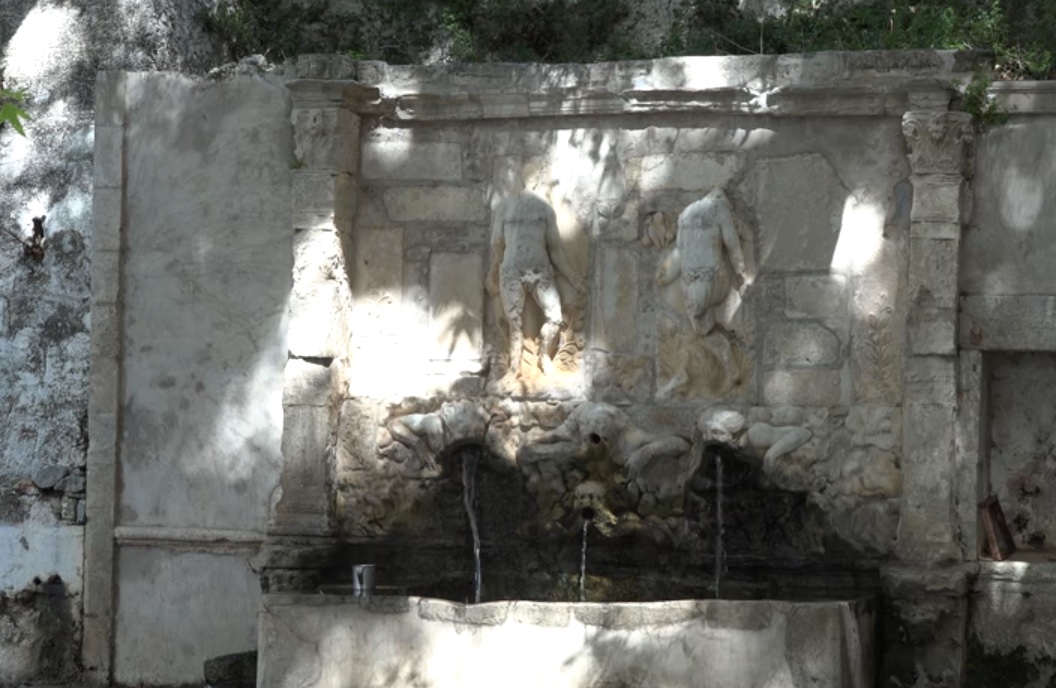
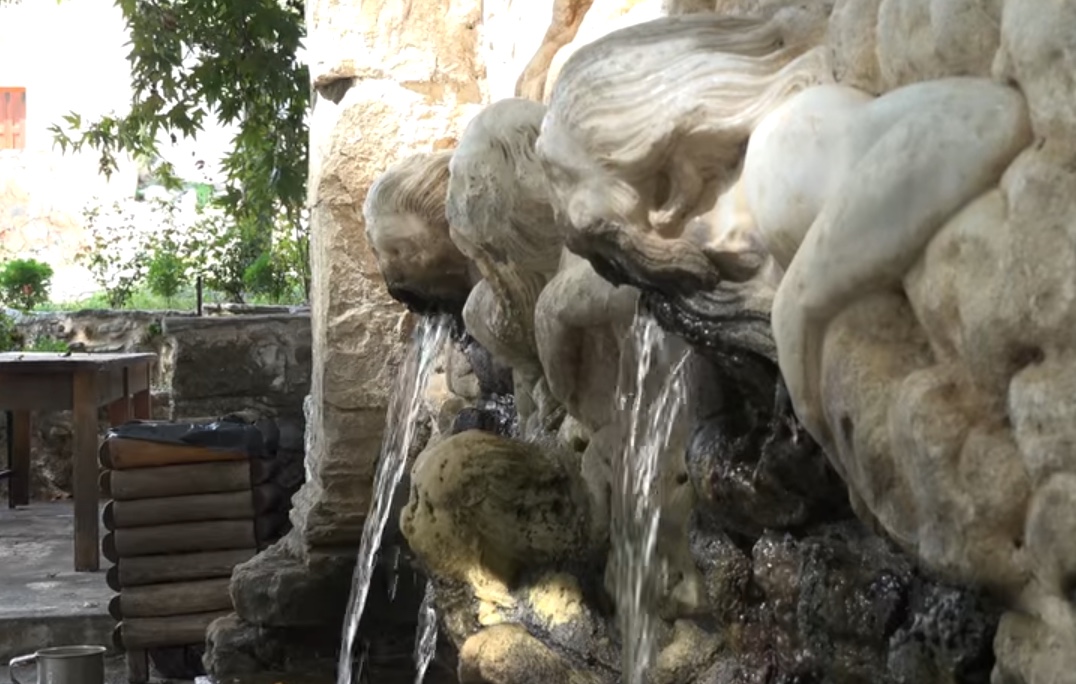
Before the entrance to the monastery courtyard a marble fountain has survived, probably the best-known work of Venetian sculpture in the Cretan hill country and often called the finest fountain in the island’s provinces. It is usually dated to the late 16th or early 17th century, though Giuseppe Gerola, who surveyed the Venetian monuments of Crete, assigned it to the 15th. Its relief shows our first parents, Adam and Eve, at the feet of God; below them recline four figures, personifications of the rivers of Paradise, and the water issues from three lion masks. The heads of the figures are damaged, but the composition reads clearly. The fountain is more than an ornament: it turns the approach to the monastery into an image of the Garden of Eden, in which the living water calls to mind both the biblical Paradise and the symbolism of baptism. Cool spring water still flows here, and walkers and pilgrims fill their bottles at it.
The icons of Michael Damaskinos
Vrontisi is famous for six icons by Michael Damaskinos, one of the greatest masters of the Cretan School of the 16th century. Born in Candia in the early 1530s, he worked for some twenty years in Italy – in Venice, where he painted the icons of the screen of the Greek church of San Giorgio dei Greci, and briefly in Sicily – before returning to Crete in about 1583; he died there in 1592 or 1593. He painted the six panels to the order of the monastery, and according to tradition lived here himself while he worked. Damaskinos combined the Byzantine iconographic tradition with the means of Venetian painting – spatial depth, animated groups of figures and luminous colour, with the paler flesh tones he was the first to bring into post-Byzantine art – and his panels testify to the artistic flowering of Crete under the rule of Venice.
The six works – the Adoration of the Magi, the Last Supper, the Divine Liturgy, the Mother of God as the Burning Bush, the “Noli me tangere” and the First Ecumenical Council of Nicaea – stayed in the monastery until 1800. Then a bishop named Gerasimos had them taken to Heraklion, to the church of St Minas. Today they can be seen there in the collection housed in the church of St Catherine of Sinai, the museum of Christian art right beside the cathedral. Anyone who has visited Vrontisi should not fail to make that further journey. In the katholikon itself there still hangs an older treasure, set in the icon screen: the icon of “Christ the Vine” (Ambelos), attributed to the Cretan painter Angelos and counted among the most remarkable works of the Cretan School.
A rare programme of frescoes: the Menologion
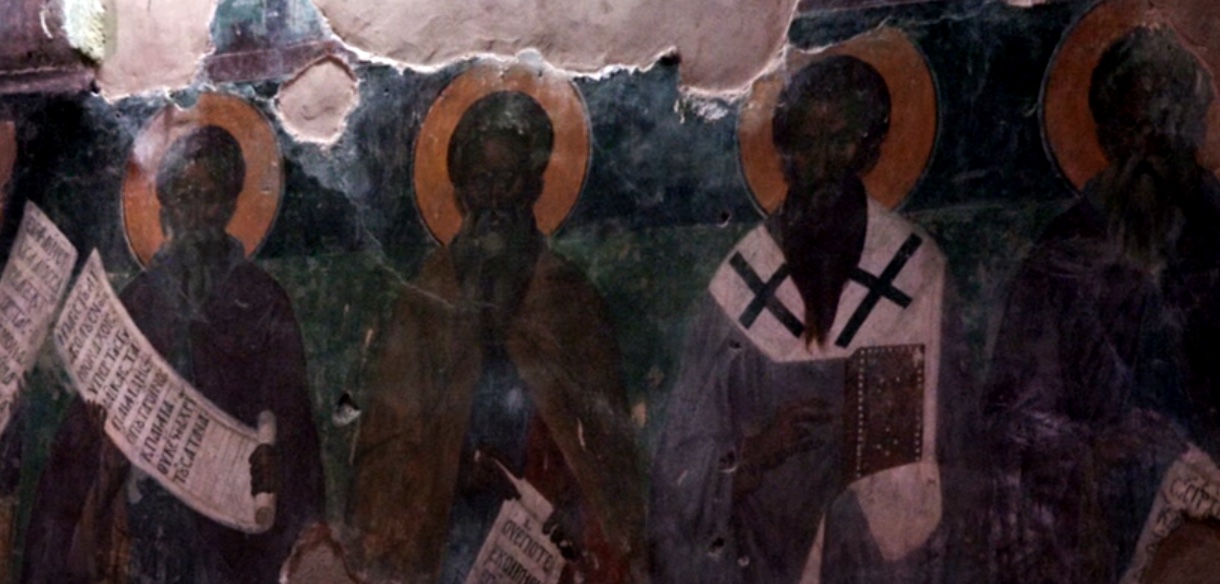
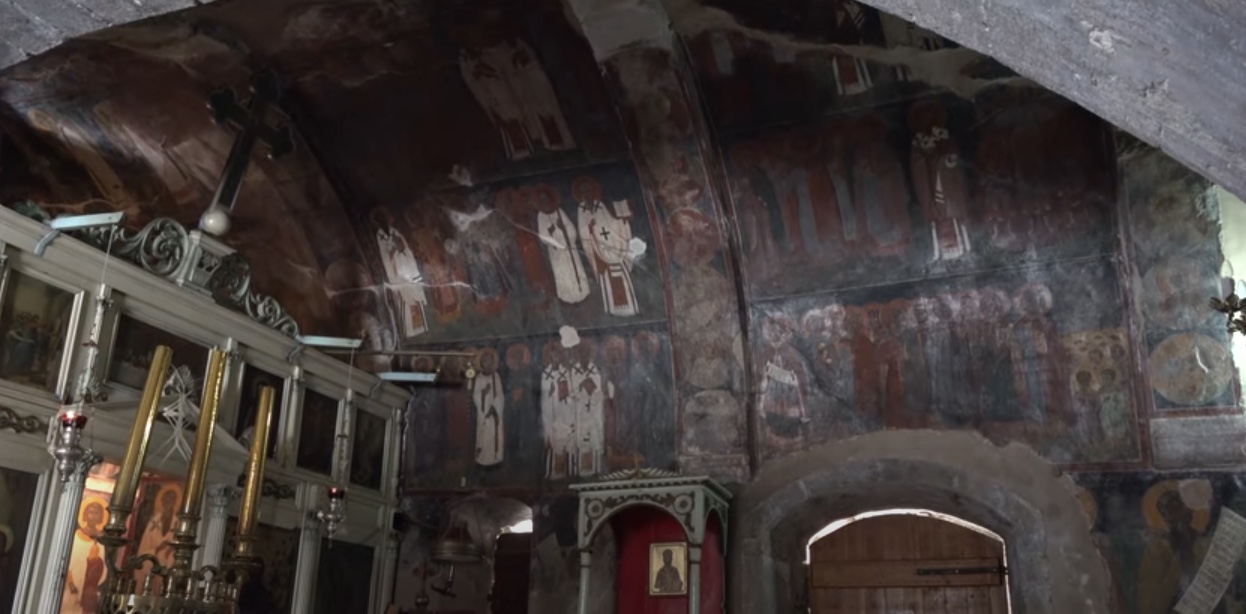
In the original nave – the southern one – frescoes of the 14th century have been preserved, though only a small part of what was once there. What sets them apart is that they show not the customary cycle of Gospel scenes but a Menologion: a church calendar in pictures, in which saints and feasts are arranged according to the days of the year. On the south wall December can be made out, with the saints celebrated in that month; the series closes with the Massacre of the Innocents at Bethlehem. Scholars see in the high quality of this painting, which is close to the art of the Palaiologan age and has been found to carry Italian as well as Byzantine notes, the hand of a master specially summoned from Constantinople or Thessaloniki.
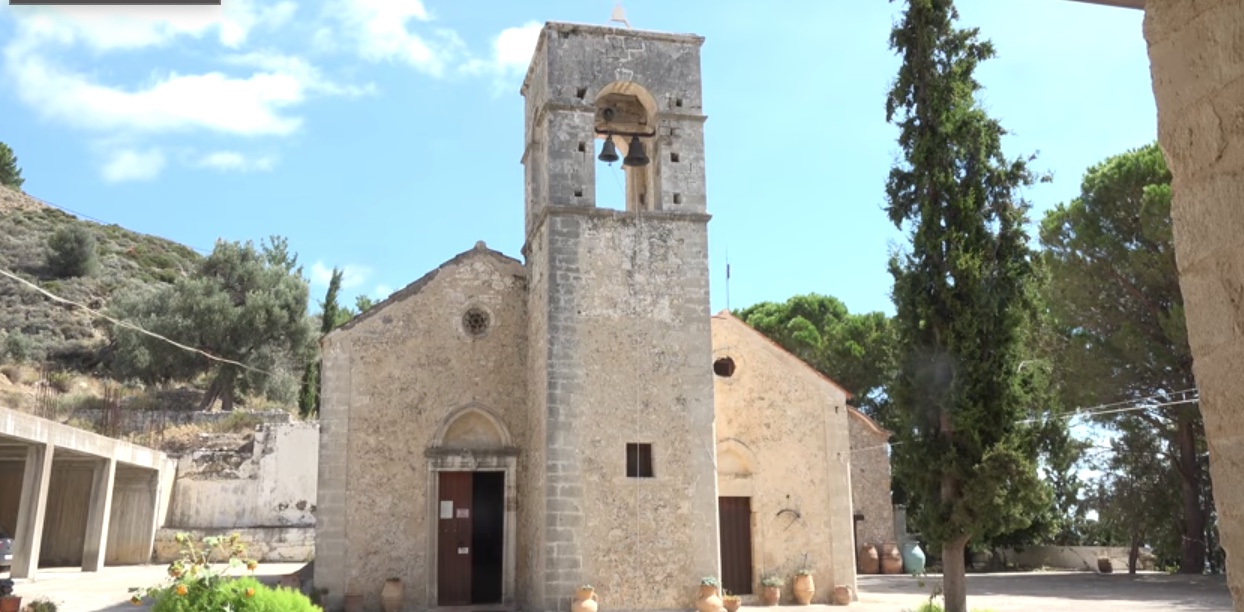
The two-aisled katholikon is dedicated in its south aisle to St Anthony and in its north aisle to the memory of the Apostle Thomas, which is celebrated on the Sunday after Easter; in ecclesiastical tradition that day coincides with the commemoration of the consecration of the Church of the Resurrection. The church was at first single-aisled, was lengthened westwards by the end of the 16th century and then received the second aisle. From the same period comes the free-standing, tower-like belfry in a western, Venetian-influenced manner – one of the oldest of its kind on Crete. Round about stand the remains of the old monastic buildings, which once formed a fortified, two-storeyed enclosure. For all its losses Vrontisi remains one of the most important monuments of southern Crete: here the history of an Orthodox monastery, Venetian architecture, Cretan icon painting and the memory of the island’s spiritual life meet.