The most complete guide to Crete: 221 places on the map, 23 routes and 49 articles — with photos, videos and the story behind every place. No sign-up, no trackers.
Routes drawn along real roads
Weather at every stop
Full-text search
“Near me” by geolocation
Create your own printable itinerary
Satellite, terrain, dark mode
Works offline
⌕
Searches 1.7 million characters of descriptions, not just names
—places
4regions
—routes
—with video
Search results
—
Interactive map
Find what is near you
Filters narrow the map and the list at once. Zoom out and pins group together.
Region
Category
Фильтры карты
Landmarks
Featured places
RegionCategory
Routes
Ready-made day trips
Individual places
Articles about landmarks
The wonder-working icon of the Annunciation
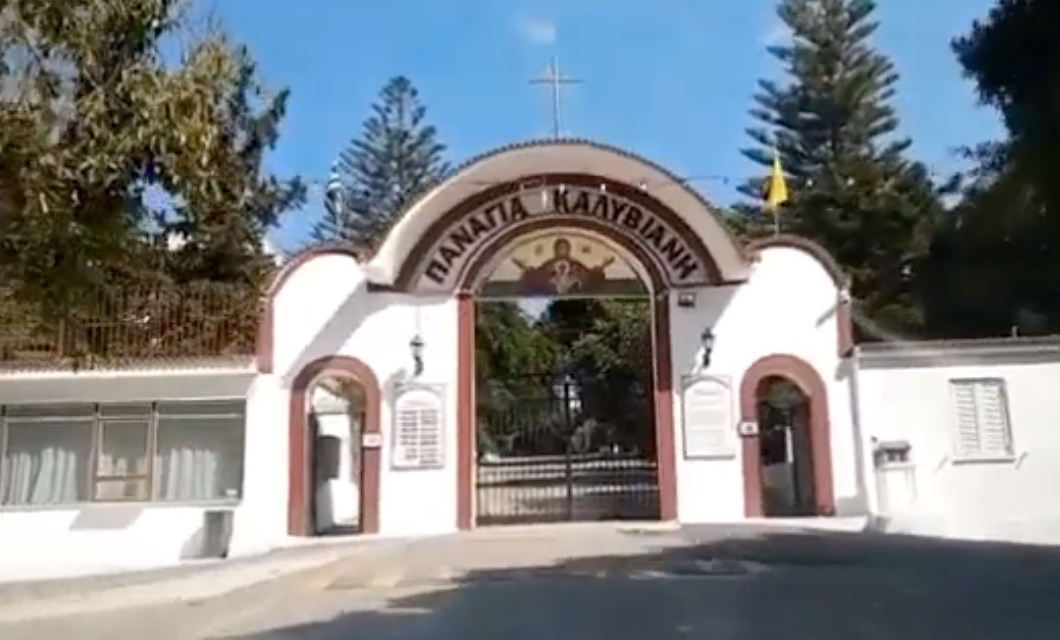
The Monastery of Panagia Kalyviani (Ιερά Μονή Παναγίας Καλυβιανής) lies in the middle of the Messara Plain, at an altitude of about eighty metres beside the road from Mires to Tymbaki, close to the village of Kalyvia and some sixty kilometres south of Heraklion. It belongs to the diocese of Gortyn and Arkadia, where it is the only convent among half a dozen monasteries for men, and it ranks among the most important shrines of southern Crete. In its church the faithful venerate a small icon of the Annunciation to the Mother of God, which church tradition holds to be wonder-working. People pray before it, ask for help and give thanks for help received; votive offerings surround the image. For that reason Kalyviani remains a living place of pilgrimage to this day, and not merely a historical monument.
The monastery as a centre of practical charity
In the course of the 20th century Kalyviani became not only a convent of nuns but a large charitable enterprise. An orphanage for girls was founded here, along with a home for the elderly, institutions for the protection of children and young people, a Sunday school, hostels, and workshops for dressmaking, weaving and icon painting. The sisters produce liturgical embroidery, vestments and pieces of folk art, some of which are offered for sale in the monastery shop. The convent also has a museum of ecclesiastical and folk exhibits – icons, liturgical vessels, early printed books, woven textiles and household goods from the villages of the Messara.
This development has altered the face of the landscape. The buildings of the foundations line the approach, with gardens, flower beds and shady courtyards between them; the monastery became a place where prayer is joined to education, to the care of children, to help for the old and to training in handicrafts. The Greek Church calls such service diakonia – practical care for one’s fellow human beings as a continuation of the life of worship. Today the community numbers between thirty and forty sisters, under an abbess who bears the name Timothei. Some of the former institutions have since closed or been scaled down; the home for the elderly was kept going longest.
Churches and places of remembrance
Within the precinct stands the chapel of the Life-giving Spring, which is bound up with the early history of Kalyviani and with the finding of the icon. The small 14th-century building, sunk deep into the ground, preserves frescoes with scenes from the life of Christ and with the Holy Ten, the martyrs of the Messara; the masonry altar screen with its painted image of Christ is noteworthy. The three-aisled main church was begun in 1911 and completed in 1924, and a narthex was added after 1961. Its three aisles are dedicated to the Nativity of the Mother of God (8 September), the Annunciation (25 March) and the Dormition of the Virgin (15 August). Behind the church lies the grave of St Charalambos, a hermit monk from Dafnes, over which a chapel of its own has been built; pilgrims venerate it, and his feast is kept on 23 August.
The feasts of the Panagia Kalyviani
The principal feast of the monastery falls on the Dormition of the Mother of God, on 15 August; on that day and on its eve, thousands of the faithful from all over Crete gather at Kalyviani. 25 March and 8 September are also solemnly observed. Around these dates the Messara holds patronal festivals (panigyria), markets and cultural events, and in summer Mires stages processions and folklore festivals. The monastery receives pilgrims and visitors daily, though around midday the gate is generally closed. Information on visiting times can be had from the monastery by telephone on 28920-22151.