The most complete guide to Crete: 221 places on the map, 23 routes and 49 articles — with photos, videos and the story behind every place. No sign-up, no trackers.
Routes drawn along real roads
Weather at every stop
Full-text search
“Near me” by geolocation
Create your own printable itinerary
Satellite, terrain, dark mode
Works offline
⌕
Searches 1.7 million characters of descriptions, not just names
—places
4regions
—routes
—with video
Search results
—
Interactive map
Find what is near you
Filters narrow the map and the list at once. Zoom out and pins group together.
Region
Category
Фильтры карты
Landmarks
Featured places
RegionCategory
Routes
Ready-made day trips
Individual places
Articles about landmarks
Phaistos – palatial centre of the Minoan Messara
The palace of Phaistos (Φαιστός) is one of the four great centres of Minoan civilisation – alongside Knossos, Malia and Zakros – and the most important in the south of Crete. It stands on the easternmost spur of a low ridge, about a hundred metres above sea level and a good sixty kilometres south-west of Heraklion, with the sea less than six kilometres away and the sister site of Agia Triada some three kilometres off. From its courts the whole of the Messara Plain, the largest and most fertile on the island, lies spread out below: to the north Psiloritis, often snow-capped into early summer; to the south the Asterousia Mountains; to the west the Gulf of Tymbaki on the Libyan Sea. At the foot of the hill flows the Geropotamos, the ancient Lethaios, which supplied the settlement with water. Whoever ruled here controlled the grain, the oil and the roads to the harbours of the south coast. The hill had been lived on since about 3600 BC; the palace that eventually crowned it covered some 8,400 square metres, roughly two thirds the size of Knossos. Since 2025 Phaistos has been inscribed on the UNESCO World Heritage List as one of the Minoan Palatial Centres.
Around 1900 BC, when towns and writing were still unheard of on the European mainland, a palace already rose on this hill – a marvel of Minoan building, with courts, grand staircases, storerooms and shrines, laid out on four levels and built of limestone and alabaster blocks, mudbrick and timber. One may picture rulers pacing its corridors with measured step, and priestesses and priests searching in sacred rites for signs from the gods. Three times in some three hundred years the palace was destroyed and rebuilt, the New Palace rising around 1700 BC. Phaistos is a place where archaeology and mythology meet, and where almost every stone carries a story as old as tradition itself. Let us begin, then, as is only proper on Crete, with the myths.
Rhadamanthys, the just judge
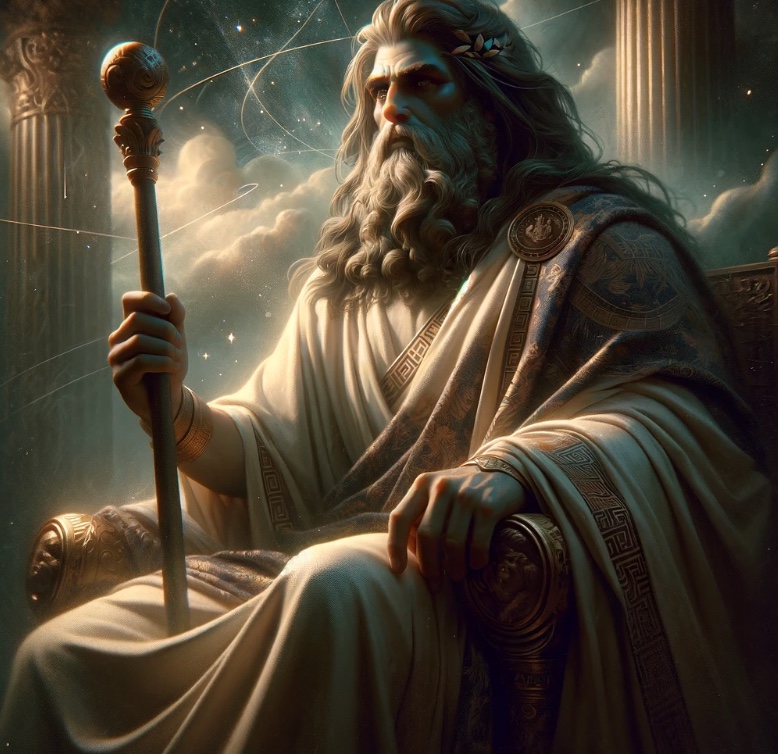
Rhadamanthys is among the most impressive figures in Greek mythology. He is one of the three sons whom Europa bore to Zeus, brother of Minos and Sarpedon, and was brought up by his stepfather Asterion, king of Crete. Tradition links him with Phaistos: while Minos reigned at Knossos, Rhadamanthys is said to have held sway over the city in the Messara, and even today’s municipality traces the dynasty of the palace back to him. He is regarded as a wise lawgiver and judge, in the realm of the living as in the hereafter – a just ruler who issued numerous laws and so established order and right among men. One of them allowed a man who defended himself against an aggressor to go unpunished; another had the Cretans swear their oaths by animals. His laws are described as strict but fair; according to legend they were written on the walls of the temples, so that everyone could see and obey them. One thinks at once of nearby Gortyn – linked in myth with his son Gortys – where a great civic law code, actually carved in stone, can still be read today.
After his death Rhadamanthys was raised to be one of the three judges of the dead in the underworld, together with his brother Minos and with Aiakos. In that office he passed judgement on the souls of the departed and decided who deserved eternal bliss in Elysium and who must do penance in Tartarus; in Plato’s Gorgias he tries the souls that come from the east and Aiakos those from the west, while Minos has the casting vote. Homer already names “fair-haired Rhadamanthys” in the Odyssey as a dweller in the Elysian fields. Phaistos itself appears in the Iliad, in the Catalogue of Ships, among the Cretan cities that sent warriors to Troy, as a “well-peopled” town; its name was derived from a hero Phaistos, held to be a son or grandson of Heracles, though Diodorus Siculus counted it, with Knossos and Kydonia, among the three cities founded by Minos.
Talos, the bronze guardian of Crete
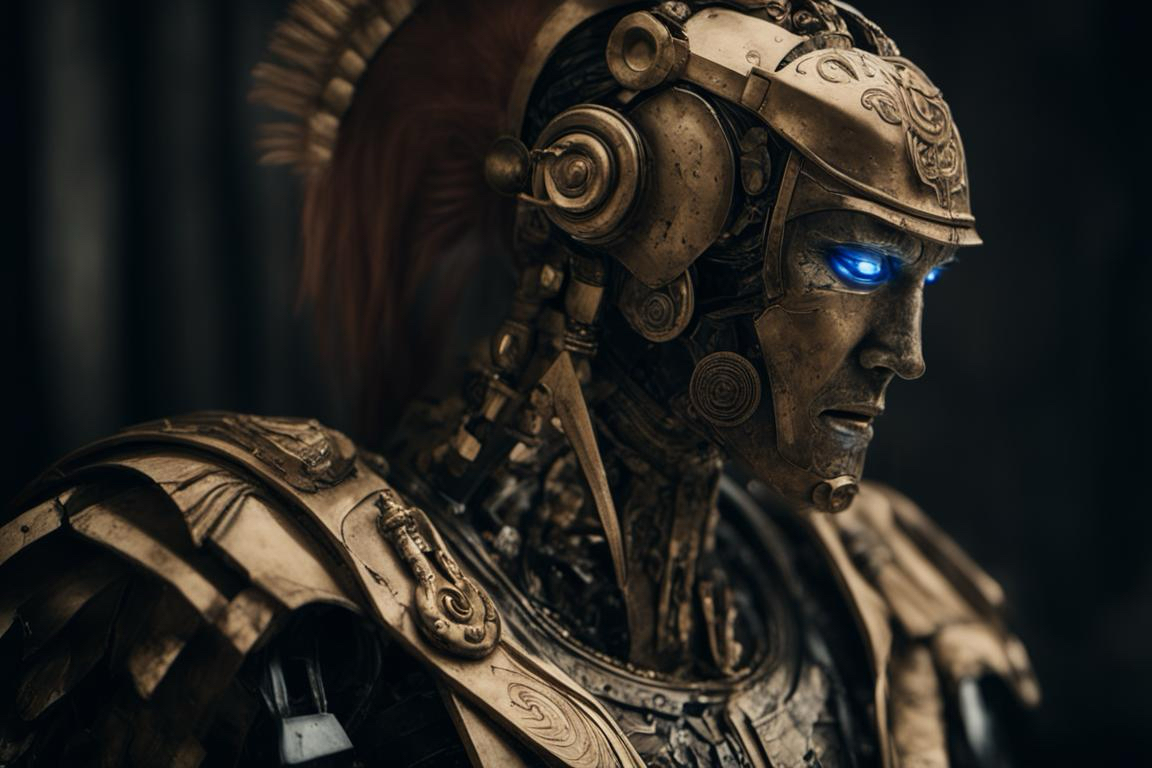
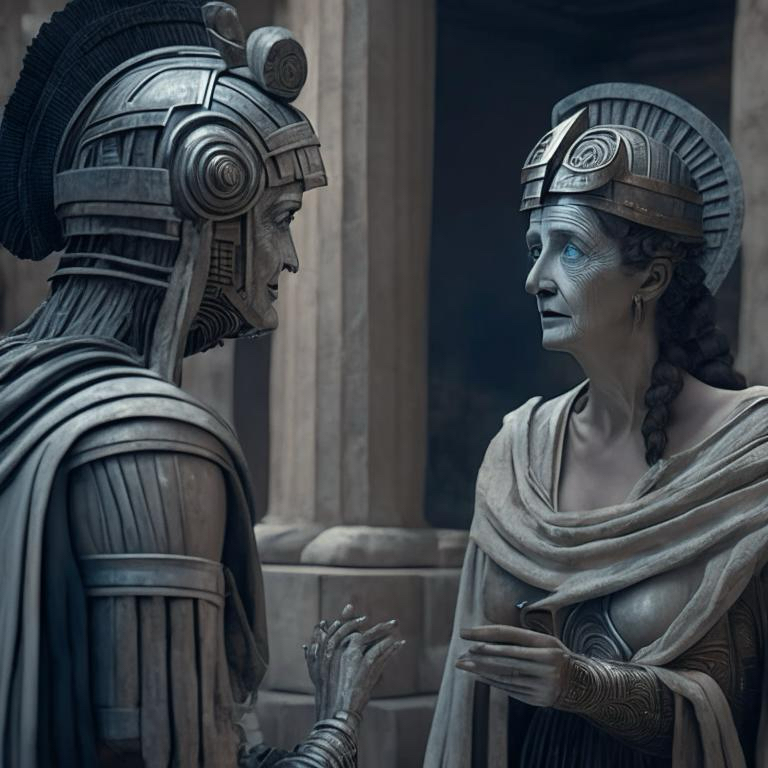
Talos appears in Greek mythology as a giant of bronze, fashioned by the smith-god Hephaestus – in one version as a present for Minos, in another as a gift from Zeus to Europa; a third tradition makes him a descendant of the race of bronze. He is one of the earliest images of an artificial being and so anticipates ideas now familiar to us from robotics: a creature of metal, endowed with something that can be read as an early sketch of artificial intelligence. The city of Phaistos felt a particular bond with the guardian: its silver coins of the Classical period show Talos as a naked, winged youth, his arm raised in the act of hurling a stone.
Talos was, in modern parlance, programmed to protect the island of Crete, and he carried out his duties with a high degree of autonomy. Three times a day he made the circuit of the island; if uninvited guests approached, he sank their ships with boulders. According to another tradition he heated his body red-hot in the fire and clasped the intruders in a deadly embrace. His vital force – today one would say his capacity for self-renewal – he owed to ichor, the divine fluid that ran through his single vein from neck to heel. This vein was sealed with a plug or, in another variant of the myth, with a bronze nail; others said that it was merely covered at the ankle by a thin layer of skin. Seen in this light, Talos was the first bio-robot in literature. Plato, for his part, took a more sober view: in the dialogue Minos Talos is a man who toured the villages of Crete three times a year, carrying the laws inscribed on tablets of bronze.
The seal of the vein was removed, the myth relates, by Medea, the sorceress who was travelling with Jason and the Argonauts on the quest for the Golden Fleece; Apollonius of Rhodes tells of the encounter in the fourth book of his Argonautica, written in the early 3rd century BC. She did so in order that the ship might put in safely on the Cretan coast and continue its voyage. Talos, whose task was to preserve the island from every stranger, did not enquire into the newcomers’ reasons and was a mortal danger. How Medea went about it is told in different ways. In one version she lulled the giant with spells – or called up the spirits of death, so that he grazed his ankle – and then drew out the plug, so that the ichor poured away; for an automaton, admittedly, hardly a convincing explanation. In the other she led him to believe that removing the seal would cure him of his vulnerability and indeed make him immortal. A third account dispenses with her altogether and has the Argonaut Poeas shoot an arrow into the giant’s ankle. The scene of his death is painted on three surviving kraters of around 400 BC, most memorably on the red-figure vase by the so-called Talos Painter in the Jatta Museum, where the dying giant sinks into the arms of the Dioscuri.
It is in the second version that the real point lies. Like every artificial intelligence, Talos feared only one thing: being cut off from his source of energy – a motif that modern storytelling has taken up again and again, down to the film “The Matrix”. He was persuaded that his fear of having the plug pulled was, so to speak, an error in his system, and that in truth no danger threatened. Talos possessed that degree of artificial intelligence to which present-day technology also aspires: he could decide for himself. He drew the seal, the ichor ran out, and the guardian died.
To the question that exercises our contemporaries – what happens when neural networks learn to decide independently, that is, to think unpredictably – the Greek myth thus gives an answer of its own: the technology breaks down. Man, however, sails on in search of the Golden Fleece, for he is a being that can dream, and the dream is at bottom nothing other than the capacity for mythical thought. Whether one cares to follow this reading of the old myth is a matter for each reader to decide.
The Disc in brief
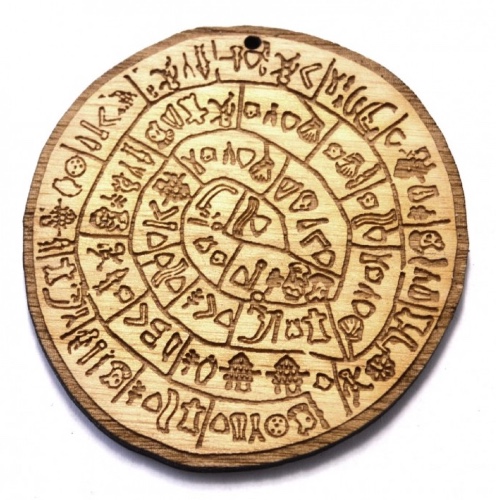
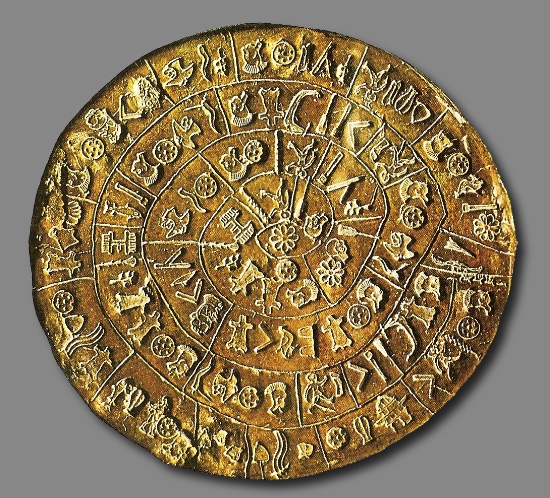
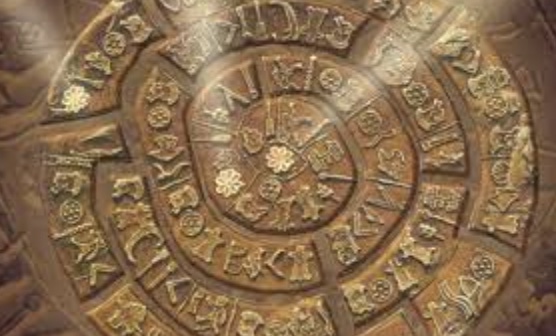
The Phaistos Disc is one of the most enigmatic finds of Minoan civilisation. This unique piece is dated to roughly 1700 to 1600 BC and thus belongs to the Middle Minoan era. It fascinates scholars and enthusiasts alike by its unusual form, the technique of its making and above all its undeciphered script. Small wonder that the Disc plays a special part in the modern myth-making that surrounds Crete; its image has been adopted as an emblem far beyond archaeology – side A serves as the logo of FORTH, one of the largest research centres in Greece. Yet it is no myth itself: it exists, and can be seen in Heraklion – only what it is and what it says, nobody knows.
The Disc was found in 1908 during the excavations of the Italian archaeologist Luigi Pernier in the palace precinct of Phaistos. It is made of clay fired to ceramic and bears stamped signs on both faces, arranged in a clockwise spiral from the rim to the centre.
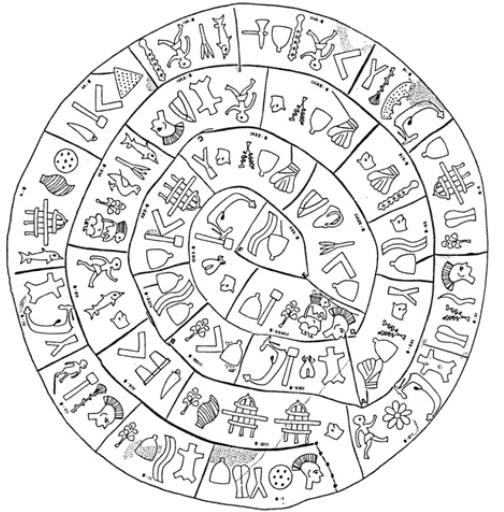
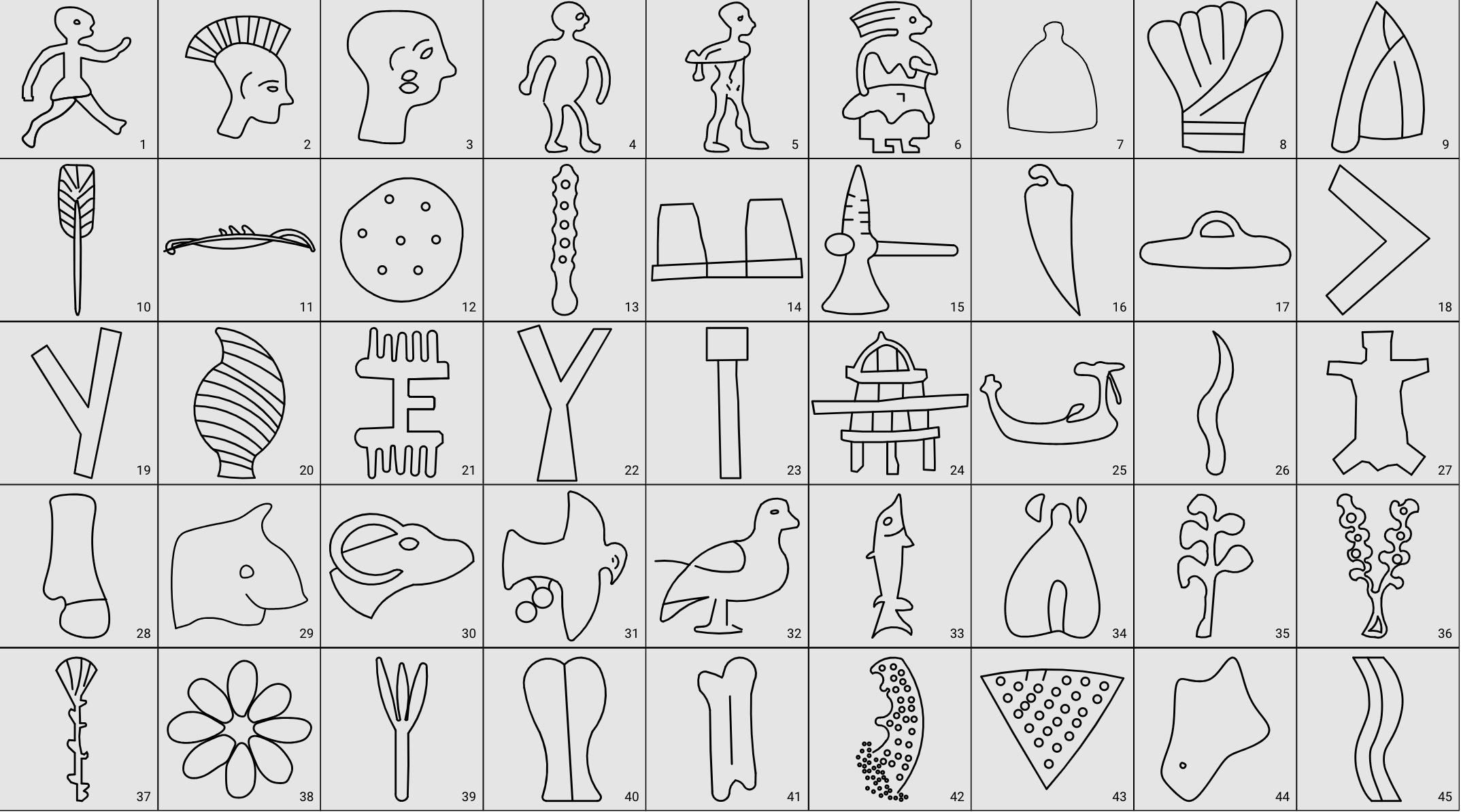
Its diameter is about 16 centimetres, its thickness around 2 centimetres. The surface bears 241 signs – 242 if one that was erased is counted – drawn from a repertoire of 45 different pictorial signs: human figures, animals, plants, implements and geometric shapes. Scholars refer to them by the numbers 01 to 45 that Arthur Evans assigned, and by descriptive names; the commonest are the plumed head, which occurs nineteen times, the helmet and the shield, while nine signs appear only once. Each sign was pressed into the soft clay with its own stamp, a procedure without parallel for its time. The Disc has therefore been called the oldest printed document in the world, more than three millennia before Gutenberg.
To this day the Disc has not been deciphered, though there has been no shortage of attempts. Since 1911 it has been read as Ionic or Homeric Greek, as Hittite, as Luwian, as a Semitic language; the interpretations range from a religious text to a calendar and a piece of musical notation, and it has even been taken for a votive gaming board. None of these theories has won broad acceptance among scholars, and most specialists doubt that a single short text can ever be read unless further inscriptions in the same script come to light.
The find and the chronology of events
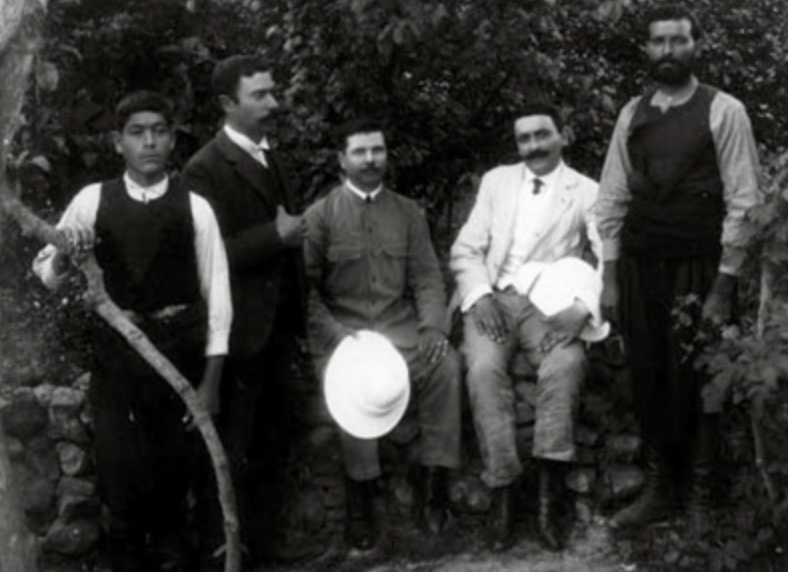
According to the entries in the excavation diary of the director, Luigi Pernier, the Disc was discovered at seven o’clock in the evening of 3 July 1908 by Zacharias Iliakis, the trusted foreman of the Italian mission at Phaistos. That evening Iliakis was supervising the work, while Pernier had returned to the mission house at Vori to write a letter to the director of the School. He had barely finished and signed the letter when Iliakis arrived with the find. Dusk was already falling, and Pernier, examining by poor light an object still partly caked with earth, noticed written signs on one side only.
Shaken by the discovery, he added a postscript to the letter: “I am glad to be able to inform you that this evening, in the new excavations in the north-east of the plateau of the acropolis of Phaistos, we have found a clay disc (diameter 0.16) covered with Minoan pictographic signs (more than a hundred), impressed with a stamp in concentric circles. We have before us one of the most important monuments of early Cretan writing.” The next day Pernier went to the excavation, had Iliakis show him the findspot and entered the particulars in the diary: the Disc had lain in a layer of black earth mixed with ash and burnt cattle bones, in a basement compartment lined with fine plaster. Only after cleaning did it emerge that the second side was inscribed as well. Swift publication in the journal Ausonia soon made the find known throughout the learned world; by 1909 plaster casts were already to be seen in museums.
The findspot of the Phaistos Disc. – Luigi Pernier between Salvatore Aurigemma and Antonio Minto; on the right stands the foreman Zacharias Iliakis. Gortyn, before 1911 (Archive of the Italian Archaeological School).
Unique features
The clay is of great purity and fine grain, similar to that from which the wafer-thin eggshell ware of Kamares pottery was made. The Disc is not a perfect circle but faintly egg-shaped in outline: its diameter varies between 158 and 165 millimetres. Nor is the surface quite flat – side A is slightly concave, side B slightly convex – and the thickness lies between 16 and 21 millimetres, for the Disc was shaped by hand, by pressing out a lump of clay on a flat support, not in a mould.
The 242 signs unfold in a spiral band which the craftsman drew in the clay with a stylus as a guideline from the rim to the centre, and were pressed with stamps into the still soft material. Forty-five different signs form 61 groups of between two and seven signs – 31 on one side, 30 on the other. They are separated from one another by short incised radial lines and evidently correspond to words; beneath the last sign of some groups there is also a small oblique stroke, perhaps marking off sections of the text. The reading probably ran from the rim to the centre, starting at a vertical line with five dots. Side A, which bears 122 signs and one that was erased, was probably made first; side B has 119 signs. In a number of places the scribe wiped out signs and stamped them afresh, in other words made careful corrections, and in one instance widened the frame of a word to fit in a further sign.
After stamping, the Disc was fired. This was evidently done on purpose, for the firing succeeded so perfectly that the surface became smooth and took on a handsome yellowish hue. Ordinary administrative tablets were left unbaked and survive only where an accidental blaze happened to harden them. The makers of the Disc plainly wished to preserve it for a long time – it is regarded as the only deliberately fired written document of the prehistoric Aegean.
The question of authenticity
The Disc lay in Room 8 of Building 101, on the north-eastern plateau of the hill, in a group of four rooms that served as an entrance to the palace on its northern side. With it, only a few centimetres away, was found a tablet in Linear A – known as PH 1 – and above all pottery in the Kamares style. These associated finds argue for dating the Disc to around 1700/1650 BC. The date of the layer excavated by Pernier was confirmed by more recent investigations by Pietro Militello on the same spot, in the course of which a further fragment of a Linear A tablet came to light.
Important for the dating, too, is a clay sealing with the sign of the “comb”, found in 1955 in the layer of seal impressions and Linear A tablets beneath the floor of Room 25. According to the latest findings this is the destruction level of the final phase of use of the Old Palace (Middle Minoan II B). To the same time, or to the phase Middle Minoan III A, belongs a vessel with a stamped impression of the same “comb” sign from the house “south of the ramp”, recovered in 1965. Other objects with spirally arranged inscriptions – the gold ring from the cemetery of Mavro Spilio near Knossos (Middle Minoan III / Late Minoan I), two conical cups from Knossos (Middle Minoan III) and a cup of the Neopalatial period from Tsoutsouros – support the dating and show that the Disc belongs to the artistic world of central Crete. To these may be added signs on the bronze double axe from the cave of Arkalochori and on an offering stone from Malia that resemble those of the Disc, and a vase from Knossos bearing a stamped sign identical to one of them. All these parallels became known only after 1908 – a weighty argument against the suspicion of forgery.
The script
The script of the Disc is contemporary with Cretan Hieroglyphic and with Linear A, two scripts that developed side by side in the period of the Old Palaces – either in different regions of the island or for different purposes. Cretan Hieroglyphic, so called because of its outward resemblance to the Egyptian hieroglyphs, was in reality a syllabic script: each sign stood for a syllable, not for an idea. The same holds for Linear A and later for Linear B. Accordingly the pictorial signs of the Disc are not ideograms either, but syllabic signs that combine to form words; a stock of 45 signs is, indeed, typical of a syllabary, which is why most attempts at decipherment start from that assumption.
The 61 groups of signs, that is, 61 words, are distributed over both faces, and the text on each face is a different one; of the 45 signs, 26 occur on both. The differences from Cretan Hieroglyphic are explained in part by the fact that the signs of the Disc were not incised but impressed with stamps. There is no complete agreement on the direction of reading – Evans himself at first proposed reading outwards from the centre and later changed his mind – but most scholars assume that it followed the direction in which the spiral line was drawn and the stamps were set, that is, from the rim to the centre.
The signs
The signs on the disc mostly depict people, animals, plants and objects. There are 45 different ones in all, stamped 242 times – 123 on side A and 119 on side B – and most are easy to recognise. Since Evans they have been numbered 01 to 45, and since 2008 they have even had their own block in the Unicode standard. The names used below follow Louis Godart’s monograph “The Phaistos Disc: The Enigma of an Aegean Script”; the associations attached to them are suggestions, not established readings. Many scholars in fact assume that the script is a syllabary, in which case a picture would stand for a sound and not for the thing it shows.
People and headgear
The series opens with the striding man, who might signify movement or a journey; he appears eleven times. Next comes a head with a striking hairstyle or headdress – the “plumed head”, with 19 occurrences the commonest sign on the disc – perhaps a mark of rank or of a role in the community. A face with a tattoo on the cheek may indicate membership of a particular group. The figure of a captive with his hands bound behind his back possibly stands for imprisonment or subjection, the image of a child, apparently naked, for innocence or the beginning of life; each of these two is stamped only once. The woman with bared breast and long skirt, who has been compared with clay figurines from Malia and Phaistos itself, suggests fertility or female power. A sign that could represent a cap or helmet – the second most frequent, with 18 impressions, nearly all on side B – may point to status or occupation; the hand wrapped in a bandage or thrust into a boxing glove, to combat or protection. A further sign was read by Arthur Evans as a kind of tiara, an emblem of power or priestly rank.
Weapons and tools
The arrow may stand for hunting or war, as may the bow, which belongs to both the chase and the battlefield and occurs only once. The circle with seven dots is read as a shield or as a wax tablet, and would then symbolise protection or a message; it is stamped 17 times, and an identical stamped sign has turned up on a vase from Knossos. The club may denote power or strength. One sign remains uncertain: Evans took it for manacles, Pernier for a mountain symbol. Then come a mattock or some implement for working the soil; a sign for which a matching bronze object was found at Phaistos – tool or weapon; a saw for working wood; a lid or stopper; an angle or boomerang, which again may be tool or weapon and appears a dozen times; and a kind of carpenter’s plane.
Utensils, house and ship
The tun shell (Dolium), a large sea snail, perhaps alludes to water or to a voyage across the sea. The comb could be a sign of purity or of a ritual; a potter’s mark almost identical to it was found in 1965 on the base of a bowl at Phaistos, and a similar sign on a sealing from the Old Palace – two of the parallels that speak for the disc’s authenticity. Another sign is interpreted as a sling or as a musical instrument, and would then stand for hunting or for art. A piece of wooden furniture, a cage or a beehive possibly indicates house or trade. The ship, shown seven times, is an emblem of travel and commerce; the horn may have served as a signalling instrument.
Animals
An animal hide recalls hunting or sacrifice; with 15 impressions it is among the four commonest signs, and in one group on side A it is twice stamped upside down. The horn of the bull – read by others as the leg of an ox – is taken as a sign of strength or fertility. The head of a cat may mean grace or protection, the ram’s head a sacrifice or a cult object. The flying bird, usually called an eagle, is associated with freedom or the spiritual, the perched dove with peace or a message. The fish, perhaps a tunny, stands for fertility or abundance, the bee for industry or community.
Plants and remaining signs
A leafy branch or a tree – the catalogues call it a plane tree – symbolises life and growth; a shrub, listed elsewhere as a vine, perhaps nature or a remedy; the papyrus, writing or knowledge. A round sign is interpreted as a water wheel or as a flower, a rosette, and would stand for technology or beauty. The lily is held to be a sign of purity or of death. The backbone of an ox possibly refers to strength or stock-raising, the flute to music or festivity. There remain a grater, a utensil for preparing food; a strainer, which may have served for cleansing or a ritual; a small axe as tool or weapon; and finally a wavy band, perhaps an image of water or of movement. Grater, strainer and small axe each occur once only – three of the nine signs on the disc that are never repeated.
The difficulties of interpretation
The Minoan language recorded on the disc is still unknown to us – and that is the greatest obstacle to understanding what it says. Even so, there have been countless attempts to crack the script and interpret the inscription, and many of them belong to the realm of fantasy: since 1911 the text has been declared Ionic or Homeric Greek, Egyptian, Semitic and Luwian in turn, without any of these readings convincing the profession. For the present only a few observations can be made. The text runs in a spiral from the rim to the centre, and its 61 sign groups – 31 on side A and 30 on side B – are divided by incised lines. More than ten of the 61 groups begin with the same two signs, the head with the striking hairstyle and the circle with seven dots; indeed the “shield” follows the “plumed head” thirteen times out of the seventeen on which it appears. Certain other groups also recur, such as bull’s leg and striding man, flying bird and bull’s horns, or oar, head and rosette. Eighteen times a short oblique stroke has been scratched by hand beneath the last sign of a group, perhaps to mark the end of a verse or section, and in a dozen places the maker erased a sign and stamped another over it – he was evidently working to a text that had to be right.
These repetitions have led some to suspect a religious hymn or a magical text with refrains. Others have thought of an astronomical calendar. The sheer brevity of the text sets narrow limits to any decipherment: at 242 signs it is too short for a hypothesis to be tested reliably so long as no second document in the same script comes to light. The number of different signs, 45, is of the order one would expect of a syllabary, as in Linear B, but with nine of them occurring only once the full repertory must have been larger than the disc reveals. A real interpretation will be possible only when Cretan hieroglyphic and Linear A have been understood and deciphered.
Neolithic (7000–3000 BC)
The Neolithic produced the first settlements on the hill of what was to become Phaistos; the earliest traces of habitation are generally placed in the fourth millennium BC, a little later than at Knossos. Simple dwellings of branches and clay, some already on stone foundations, gradually gave way to ordered communities that lived by tilling the soil and keeping livestock. The excavators found sherds of this period beneath the courts of the palace.
Early Minoan period (3000–2100 BC)
In the Early Minoan period the first larger stone buildings appear and the art of metalworking develops. Phaistos becomes one of the centres of Minoan civilisation, as finds of pottery and luxury goods attest. At the same time the communities of the Messara lay out their great circular vaulted tombs, the tholoi used by whole clans over many generations – at nearby Agia Triada, for example, and to the south-west of Phaistos itself.
Middle Minoan period (2100–1600 BC)
The Middle Minoan period is the heyday of Phaistos. Around 1900 BC the first palace, the Old Palace, was built on terraces levelled out of the hillside; scholars hold that it was not only the ruler’s residence but also the hub of religious life, administration and the economy. More than six thousand clay sealings found beneath the floor of one of its rooms show how closely goods were controlled. Damaged several times by earthquakes and repaired – the excavators distinguish three building phases – it perished around 1700 BC in a great catastrophe accompanied by fire. Over its ruins rose the New Palace, set on a higher level and somewhat smaller in extent. It was in this age, too, that the famous disc was made, to this day one of the great riddles of archaeology.
Late Minoan period (1600–1100 BC)
The Late Minoan period brings the destruction of many Minoan palaces, including that of Phaistos – presumably through earthquakes and the unrest that followed them. Whereas Phaistos had recovered quickly after the fall of the Old Palace and had even extended its influence, the New Palace was not rebuilt after its destruction around the middle of the 15th century BC. The town at its feet lived on, however, while the administration of the region seems for a time to have passed to Agia Triada. The name itself survived the change of masters: the Linear B tablets of Knossos, written in Greek, mention a place pa-i-to more than sixty times.
After the end of Minoan civilisation
From about 1100 BC, and after the arrival of the Mycenaeans and the Dorians in Crete, Phaistos remains inhabited. Each succeeding culture left its trace in the history of the town: in the Geometric period, in the 8th century BC, the settlement grew again; in the Archaic period a temple attributed to Rhea was built south of the old palace; and in Classical and Hellenistic times Phaistos was a prosperous, independent city striking its own coinage, silver staters among them, whose well-built houses stood right up on the upper court of the palace. Homer lists it in the Iliad among the Cretan cities that sent men to Troy, and calls it well peopled. Yet the place never recovered its former importance as a great cultural and economic centre. Around the middle of the 2nd century BC Phaistos was destroyed and subjugated by its neighbour Gortyn.
Architecture and layout
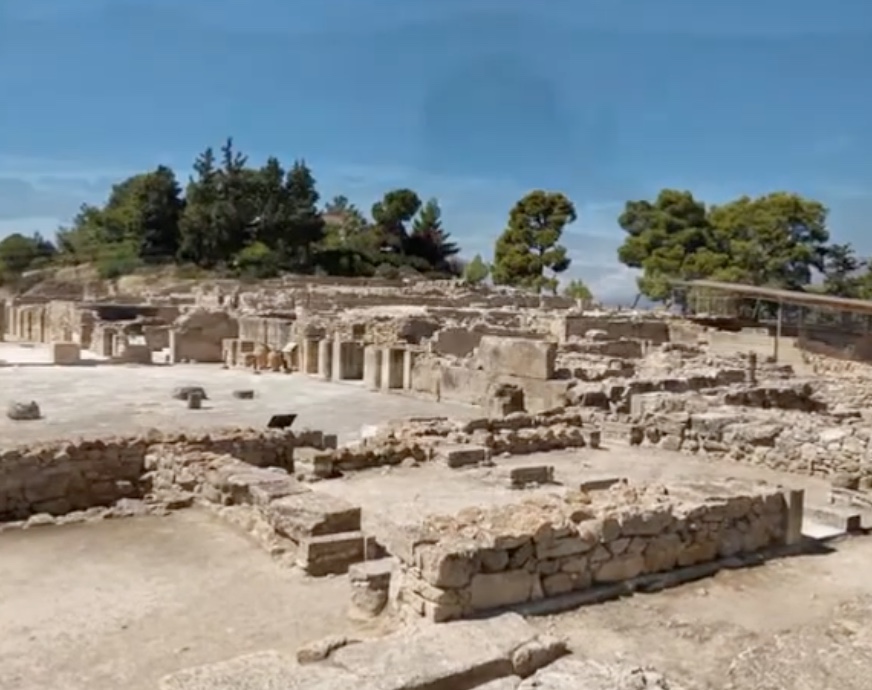
Like the other Minoan palaces, Phaistos is distinguished by an intricate plan: numerous rooms connected by corridors, staircases and small courts, built of dressed limestone and gypsum, rubble, mud brick and timber. Figures for its size vary according to where the boundary is drawn; a little over 8,000 square metres is often quoted for the building proper – about two thirds the size of Knossos – while the municipality speaks of some 18,000 for the complex as a whole. In either case Phaistos is the second-largest palace in Crete after Knossos.
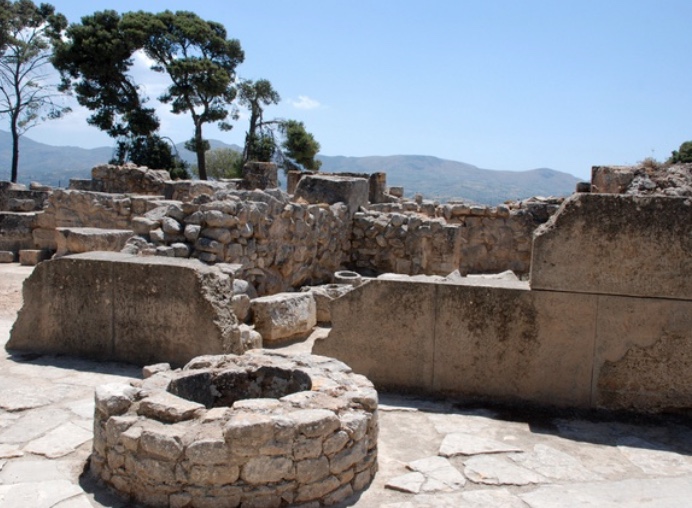
Although Phaistos ranks among the greatest monuments of the Minoan age, it differs in essential respects from its more famous counterpart at Knossos. No rebuilding on a grand scale took place here after the destructions, which makes the ground plan easier to follow and also affords an unobstructed view of Minoan architecture at one particular moment. The excavators showed restraint as well: instead of the coloured reconstructions in concrete that Evans had put up at Knossos, at Phaistos one sees the original masonry, merely consolidated with care and roofed over in places, with paths of beaten earth, stone walkways and handrails to guide the visitor. The absence of labyrinthine passages and the low degree of restoration make Phaistos a unique place in which to study Minoan civilisation in its earlier stage of development too – all the more so as large parts of the Old Palace lie exposed on the west side, where its façade and lower terrace were buried under the fill on which the New Palace was raised.
The main part of the palace unfolds around the central court, which served for ceremonies and public gatherings: a paved space roughly fifty metres long and well over twenty wide, aligned north to south, along whose long sides porticoes once stood, their roofs carried on alternating columns and pillars. The south-eastern corner has gone, lost with the edge of the hill. Around this court were grouped living and service rooms, storerooms, workshops and shrines. In the west wing the magazines with their man-high pithoi line both sides of a corridor – one of the jars bears an inscription in Linear A – and beside them lie cult rooms with benches along the walls, a small pillar crypt and stone blocks incised with the double axe; in the east wing the craftsmen worked, and there, in the middle of a small court, the remains of a horseshoe-shaped smelting furnace can be seen.
A peculiarity of the palace is its arrangement on several levels: the rooms lay at different heights and were linked by staircases and terraces. This not only allowed the sloping ground to be used with skill but also produced an imposing effect. Three great terraces were cut into the ridge for the Old Palace, and when the New Palace was built the level of the west court was raised by several metres, so that the two periods now lie one above the other like the steps of a stair.
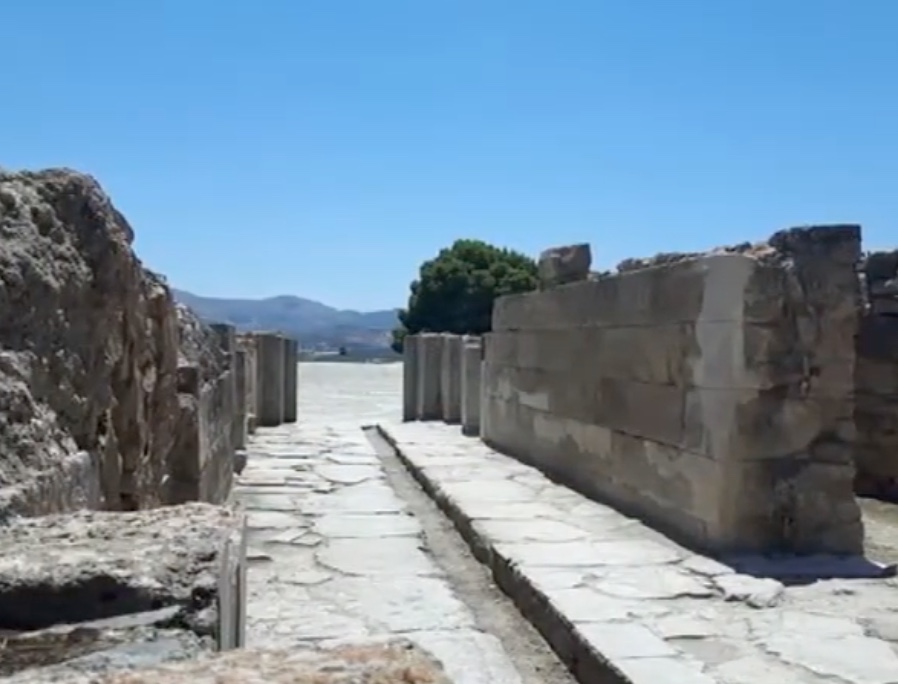
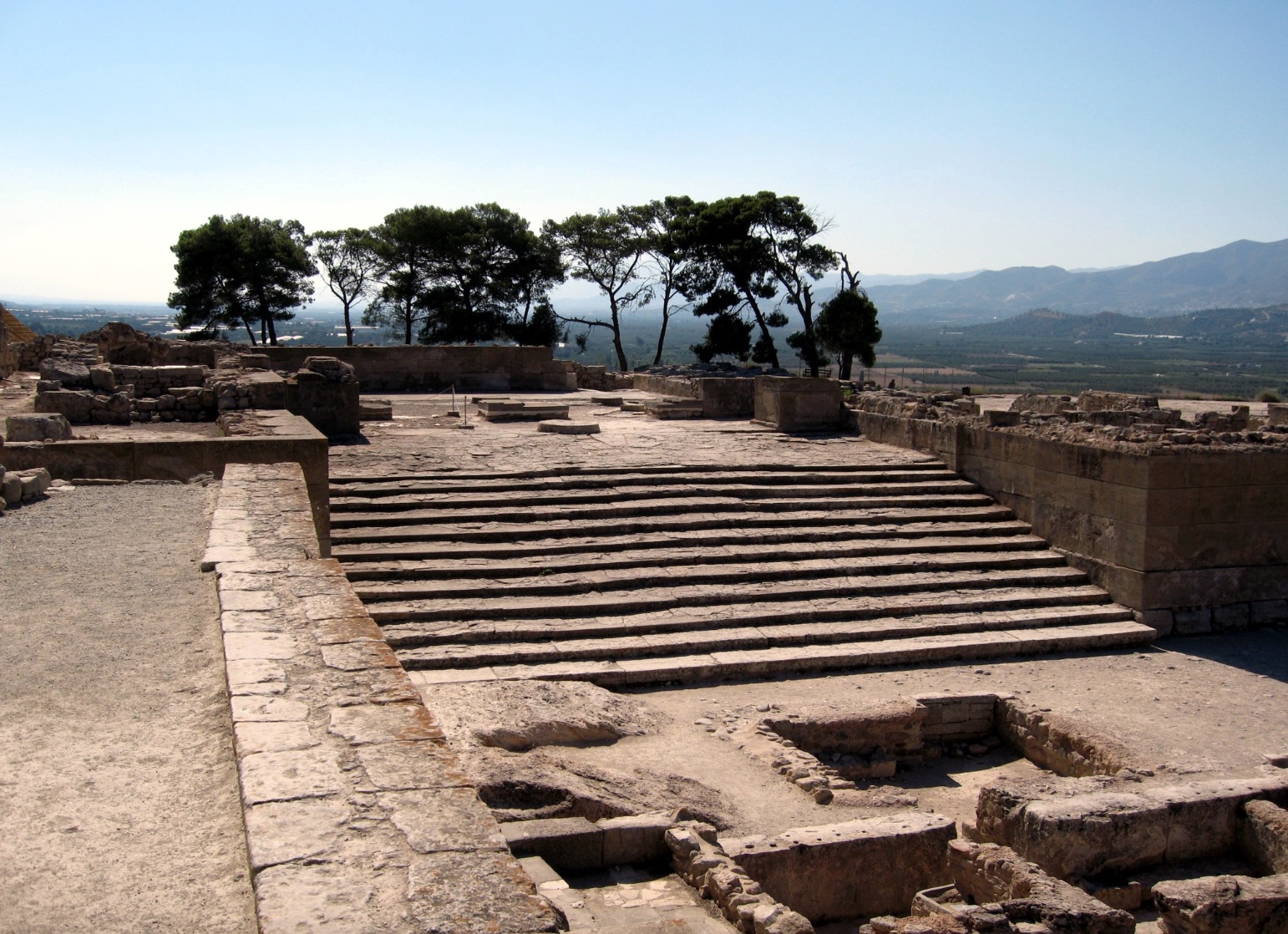
The visitor experiences this on entering. From the upper court, where a row of seventeen round sockets marks the timber columns of a vanished portico, one descends into the paved west court, which is crossed obliquely by a slightly raised processional way. Along its north side run eight broad steps, 22 metres long – the theatral area, from which processions and festivals were watched, and one of the oldest structures of its kind; beside them lie circular stone-lined pits, four in number, which are interpreted as granaries or as depositories for the remains of offerings. From here the monumental grand staircase, with its twelve shallow steps almost fourteen metres wide, leads up to the propylon, the state entrance of the New Palace; the treads are very slightly cambered so that rainwater runs off them. To the north, turned away from the bustle of the court and towards the coolness of Psiloritis, lay the living quarters of the rulers, known as the “Queen’s Megaron” and the “King’s Megaron”, with alabaster floors, light wells, a small peristyle court of four columns to a side and a lustral basin that is reckoned the best preserved in Crete. Further still to the north-east stand the buildings in which the disc was found.
Decoration and ornament
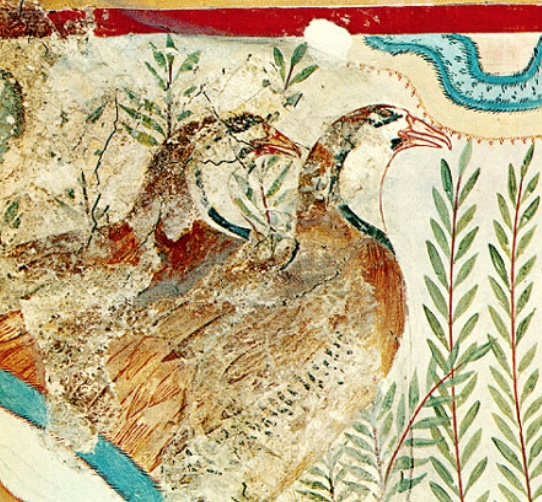
The walls of the palace were adorned with paintings showing cult scenes, motifs from nature, animals and people. Sadly many survive only in fragments – far fewer than at Knossos, for at Phaistos ornamental patterns and coloured plaster predominated, and figured scenes of the Knossian kind are all but absent from the New Palace; to these were added wall dados and floors of gypsum and alabaster, and in the Old Palace plastered benches and niches. Yet even these remnants reveal the high artistic skill of the Minoans.
Besides the frescoes, the palace yielded objects of daily life; pottery – including the most magnificent vessels of the Kamares style, polychrome ware named after the cave on Psiloritis where it was first found, some of it with walls as thin as eggshell in imitation of metal cups; jewellery; cult equipment bearing the sign of the double axe; and clay tablets in Linear A, some twenty-six of them, together with thousands of seal impressions on clay nodules. Two fine libation vessels, rhyta, came from the Queen’s Megaron. All of this bears witness to a highly developed administration. The finds are displayed in the Archaeological Museum of Heraklion.
Water supply and drainage
The palace of Phaistos possessed an advanced system of water supply with conduits and channels. As the hill itself has no spring, rainwater from the roofs and paved courts was collected in cisterns; stone gutters and pipes of fired clay carried it onward, and beneath the floors ran channels that took rain and waste water out of the palace. Even the steps of the grand staircase were laid with a slight fall to shed the rain, and the paved passage between the courts has its own gutter for rainwater. Additional water came from wells at the foot of the hill and from the nearby river, the Geropotamos, which crosses the Messara on its way to the Libyan Sea. In this way the inhabitants had clean water and, for that age, a remarkably high standard of hygiene.