The most complete guide to Crete: 221 places on the map, 23 routes and 49 articles — with photos, videos and the story behind every place. Everything is open and free: no sign-up, no paid sections and no advertising, open or hidden. You can install the guide on your smartphone as an app.
Routes drawn along real roads
Weather at every stop
Full-text search
“Near me” by geolocation
Create your own printable itinerary
Satellite, terrain, dark mode
Works offline
⌕
Searches 1.7 million characters of descriptions, not just names
—places
4regions
—routes
—with video
Search results
—
Interactive map
Find what is near you
Filters narrow the map and the list at once. Zoom out and pins group together.
Region
Category
Фильтры карты
Landmarks
Featured places
RegionCategory
Routes
Ready-made day trips
Individual places
Articles about landmarks
Vori – a traditional village of the Messara
Vori (Βώροι) is a village steeped in history in the fertile Messara Plain, only about two kilometres north of the Minoan palace of Phaistos and some sixty kilometres from Heraklion, a short way inland from Tymbaki, where the Geropotamos reaches the Libyan Sea. Since 1978 it has been protected as a traditional settlement: narrow lanes survive, along with stone houses with arched gateways and inner courtyards, and the building style of rural Crete. Venetian documents list Vori as the chief place of the administrative district of Pyrgiotissa – a role which, according to local accounts, the village kept into the 20th century; in Kastrofylakas’s census of 1583 it appears as “Vorus”, with 312 inhabitants. Later the village went on living from arable farming, olive trees, vines and crafts. In Ottoman times there were only three Turkish households here, and the census of 1881 records not a single Muslim inhabitant.
The spot has been settled far longer than the documents reach back. Local people speak of a village with five thousand years of history: Early Minoan sherds came to light by the church of St Onouphrios, remains of Hellenistic and Roman date can be seen in the village, and rescue excavations between 1978 and 1994 uncovered, among other things, a potter’s kiln of late antiquity. That is hardly surprising so close to Phaistos, whose town in Minoan times spread from the palace hill far out into the plain. The name is explained in two ways – either from the position north of Phaistos, whose inhabitants would have been the “northerners”, or from Voros, a legendary grandson of King Rhadamanthys, the mythical ruler whom tradition associates with Phaistos.
The Museum of Cretan Ethnology
The chief sight of Vori is the Museum of Cretan Ethnology (Μουσείο Κρητικής Εθνολογίας). It was founded in 1973 by the Cultural Association of the Messara, which had been formed in Vori a year earlier, and is housed in a traditional two-storey house made over to the association by the Stefanidis brothers; the building was fitted out between 1977 and 1982, with the backing of the Greek Ministry of Culture, and the permanent exhibition opened in 1988. Some three thousand objects from every part of the island tell of daily life in Crete from early times to the 20th century, with the emphasis on the last thousand years, the centuries of Byzantine, Venetian and Ottoman rule: of farming and food, of the home, of weaving and basketry, of pottery, metalwork and furniture-making, of crafts, trade and transport, of customs and the structure of the village community. In 1992 the museum received a special commendation from the European Museum Forum, under the auspices of the Council of Europe, in the competition for the European Museum of the Year Award. Attached to the museum is a research and conference centre, active since 1980, which studies Cretan culture and the island’s ecosystem through fieldwork in the villages; its findings have appeared in a series of publications since 1985, and an extension was added in 2001 with European funding.
The medieval churches of Vori
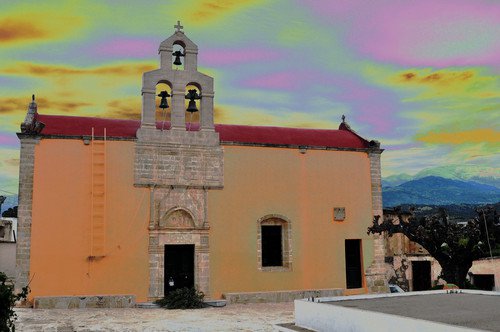
Churches of the 14th century survive in the village: that of St John the Baptist and that of St George Kontaras. Their medieval masonry and their dedications recall the Christian life of the Messara in the Byzantine tradition, carried on under Venetian rule and long before the Ottomans came. The church of the Presentation of the Virgin in the Temple dates from the 19th century. Also venerated is the Panagia Kardiotissa, once a metochi – a dependency – of Varsamonero Monastery, whose frescoes clearly betray Western influence; today it belongs to Kalyviani Monastery. To these may be added smaller chapels such as Agia Pelagia in the old quarter, Agios Fanourios, and the church of St Andrew of Crete, the hymnographer and archbishop of the island. The church of Christ keeps alive the memory of Emmanouil Nikolidakis, who was executed by the German occupation forces.
Excavators, writers and the Occupation
From 1898 Vori was the base of the Italian archaeologists around Federico Halbherr and Luigi Pernier, who began to excavate the palace of Phaistos in 1900 and worked there season after season. It was in the mission house, on the evening of 3 July 1908, that Pernier wrote the letter announcing the discovery of the Phaistos Disc, which had come out of a basement room north-east of the palace that day. The village was also the home of Alexandros Venetikos, who from 1935 to 1955 watched over the excavation site of Phaistos as its first archaeological guard. In the Second World War a German garrison was stationed in the village; the inhabitants were forced to work on the airfield at Tymbaki, and two men paid for their resistance with their lives.
Vori is easily visited together with Phaistos, Agia Triada and the other monuments of the Messara; the coffee houses around the village square are the place for a pause. According to local memory, Nikos Kazantzakis liked to come here: he stayed in the house of the family of his friend Charilaos Stefanidis. In this way the museum, the old churches and the stories of the inhabitants link the archaeological past of the valley with the culture of the Cretan hinterland today.