Melambes – the village of the Four Holy New Martyrs
The most complete guide to Crete: 221 places on the map, 23 routes and 49 articles — with photos, videos and the story behind every place. Everything is open and free: no sign-up, no paid sections and no advertising, open or hidden. You can install the guide on your smartphone as an app.
Routes drawn along real roads
Weather at every stop
Full-text search
“Near me” by geolocation
Create your own printable itinerary
Satellite, terrain, dark mode
Works offline
⌕
Searches 1.7 million characters of descriptions, not just names
—places
4regions
—routes
—with video
Search results
—
Interactive map
Find what is near you
Filters narrow the map and the list at once. Zoom out and pins group together.
Region
Category
Фильтры карты
Landmarks
Featured places
RegionCategory
Routes
Ready-made day trips
Individual places
Articles about landmarks
Melambes – a village of memory and resistance
Melambes (Μέλαμπες) lies at about 570 metres above sea level on the southern flank of the Psiloritis massif, high above the Libyan Sea. It sits in a fold of ground between Mount Kedros (1,777 m) to the west and the lower Vouvala (947 m), some 42 km by road south of Rethymno and 10 km from the coast at Agia Galini; from its slopes the eye travels north to the summits of Ida and south across the Messara Gulf and the south coast of Crete. Old churches and stone houses preserve the face of a mountain settlement, and three small rural monasteries – Agios Georgios and Agios Ioannis, both of the 14th and 15th centuries, and the partly ruined Agios Dimitrios – lie in the surrounding countryside. The village is first mentioned in writing in 1577, by the Venetian scholar Francesco Barozzi, and the Venetian census of 1583 counted 338 inhabitants. Geographical descriptions of the 19th century speak of 400 houses and many churches and call Melambes the largest and most populous village of the province; the census of 1881 recorded 1,002 people, against 467 in 2021. It was from here, too, that in 1884–85 the families went down to the sea to found what is now Agia Galini.
Melambes in the uprising of 1866–69
During the great Cretan uprising of 1866 to 1869 Melambes was a stronghold of the resistance. The leaders based here were Panos Koroneos, who chose the village as his headquarters, and Captain Michail Korakas, who stood nearby with some thousand fighters. Through the village passed the detachments that watched the Ottoman forces around Tymbaki and kept open the link to the south coast, by which arms and volunteers arrived from the Greek mainland. On 25 March 1867 the insurgents celebrated Greek Independence Day here together with the volunteers of the Maniot Petropoulakis. The village had already seen fighting in the earlier war of independence – the battle of Kako Ryaki was fought in its territory in 1822 – and according to local memory Melambes was destroyed several times in the years of struggle. The tradition did not end with the Ottomans: in 1898 Stratis and Stylianos Fotakis sat for the village in the parliament of the autonomous Cretan State, and in 1912 Melambes sent volunteers to the First Balkan War.
Michail Korakas (1797–1882), born at Pombia in the Messara, was one of the best-known commanders of the Cretan risings. In 1866 the revolutionary assembly entrusted him with the leadership of the eastern parts of the island. His tasks included raising the bands, keeping them supplied and co-ordinating the resistance; his memory therefore belongs to the whole story of Crete’s liberation rather than to any single battle.
The Four Holy New Martyrs of Melambes
A special place in the history of the village belongs to the four New Martyrs Angelis, Manouil, Georgios and Nikolaos. All were married sons of the village with children of their own, farmers of some standing, and all were related: Angelis and Manouil were brothers, Georgios and Nikolaos their cousins from the old Vlatakis family. Their grandfather had outwardly embraced Islam under Ottoman pressure and taken the name Retzepis, and the men themselves bore Turkish names in public. The families nevertheless held to Christianity: the children were baptised, marriages were blessed by the Orthodox rite, and membership of the Church was hidden from the authorities. When the uprising of 1821 broke out, the four openly joined the struggle.
After the revolt had been crushed they were seized by night in Melambes and taken on the pasha’s orders to Rethymno, where Mehmet Pasha pressed them to declare themselves Muslims. For ten days they lay there in dark cells, flogged and plied with promises. On 28 October 1824, after torture and their refusal to renounce Christ – “we were born Christians and we shall die Christians” – they were beheaded at the Megali Porta, the Great Gate of the city, the Venetian Porta Guora. A crier had announced the execution as a public spectacle, and the bodies were left lying outside the gate for three days before Christians were allowed to carry them off and bury them by the church of Agios Georgios, a dependency of Arkadi Monastery, among the gardens outside the walls; a year later Bishop Ioannikios of Rethymno had them exhumed and brought into the town. The Orthodox Church venerates the four as holy New Martyrs, and their memory falls on 28 October. Veneration began early: an icon by the Zakynthian painter Ioannis Frangopoulos was made in 1836, a service in their honour was printed in 1852, and in 1888 the village set about building a church of its own for them. They were formally entered in the calendar of saints by a synodal act of the Ecumenical Patriarchate of 29 August 1977, in the time of Metropolitan Titos Syllygardakis. On the site of the execution in Rethymno stands the Church of the Four Martyrs; the present building, the third on the spot, was completed in December 1975 and holds the relics of the saints, including their four skulls, while other relics are kept at Arkadi, in Melambes and in Athens.
The feast on 28 October
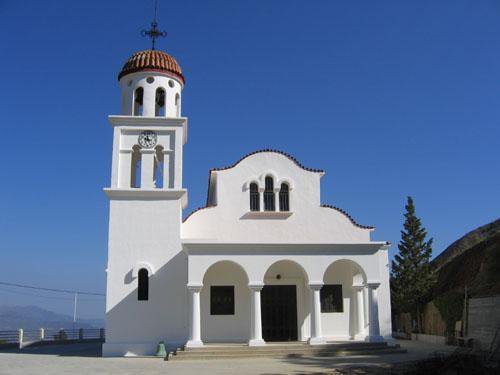
Every year on 28 October Melambes keeps a great panigiri in honour of its martyrs; the date coincides with the national holiday that recalls Greece’s “No” of 1940, so church and state are celebrated together. The Divine Liturgy and the memorial prayers are followed by a fair; there is singing and dancing, and visitors are entertained with the dishes of the village – local oil, wine, honey and cheese. The village’s own church of the Four Martyrs, built in 1952, is the focus, while the feast at the church of the Four Martyrs in Agia Galini also binds Melambes to the south coast, and the day is solemnly observed in Rethymno as well.
Melambes today
In the Second World War, too, Melambes stood on the side of resistance: from the end of May 1943 the leadership of the National Organisation of Rethymno under Colonel Christos Tzifakis found refuge here, and more than a hundred villagers are recorded as members of the Cretan resistance. Today the village keeps its mountain landscape, its old churches – among them Agios Georgios and the 14th-century Agia Paraskevi, with the Panagia of 1835 as the principal church – its narrow lanes and open panoramas. An energetic cultural association, a theatre group and a radio station of its own keep community life alive; a sports club has existed since 1962 and the school since 1930, and Melambes was among the first villages of Crete to campaign for feasts without the customary celebratory gunfire. Few places show so clearly how the lie of the land, the history of the uprisings and the veneration of the saints shape the memory of a community.