The most complete guide to Crete: 221 places on the map, 23 routes and 49 articles — with photos, videos and the story behind every place. No sign-up, no trackers.
Routes drawn along real roads
Weather at every stop
Full-text search
“Near me” by geolocation
Create your own printable itinerary
Satellite, terrain, dark mode
Works offline
⌕
Searches 1.7 million characters of descriptions, not just names
—places
4regions
—routes
—with video
Search results
—
Interactive map
Find what is near you
Filters narrow the map and the list at once. Zoom out and pins group together.
Region
Category
Фильтры карты
Landmarks
Featured places
RegionCategory
Routes
Ready-made day trips
Individual places
Articles about landmarks
Agia Galini – the “holy calm” on the Libyan Sea
Agia Galini (Αγία Γαλήνη) lies on the south coast of Crete, on a sheltered bay of the Libyan Sea at the far south-eastern corner of the Rethymno region, about 55 kilometres from Rethymno and 68 from Heraklion. The houses climb in tiers up an east-facing rocky point above the harbour, with the wide Bay of Messara opening beyond. The name is usually rendered “holy calm” or “holy serenity”. The place still lives from fishing, the olive and its visitors, some 650 people being resident all year round, yet its story reaches back to an ancient harbour, an early Christian tradition and the myths of Daedalus and Icarus.
Local tradition connects the name with the Empress Aelia Eudokia (c. 401–460), consort of Theodosius II. On a voyage to the Holy Land – the story is generally placed around 441 – her ship was caught in a storm; after a prayer to the Mother of God it found shelter in the quiet bay. Eudokia vowed to build a church and dedicate it to the Panagia Galini, the “Virgin of the Calm”. Another reading derives the name from the phrase αεί γαλήνη, “always calm”, and so stresses the natural shelter of the anchorage; the sea here is indeed almost always still. A third explanation looks to a St Galini, martyred at Corinth in the 3rd century and commemorated on 16 April.
Ancient Soulia – the port of Sybritos
In antiquity the site of the modern village was occupied by Soulia (Σουλία, also Soulina or Soulena), the seaport of the inland city of Sybritos in the Amari valley. It was the natural outlet of the fertile interior to the shipping lanes of the Libyan Sea, and the river Platys – also called the Amarianos, which rises below Thronos, the village on the site of Sybritos, and flows all year – marks the line of the old road between the two. In the ancient coastal itineraries Soulia appears as a well-protected anchorage; finds and later research associate it with remains of settlement, graves and fragments of temple architecture.
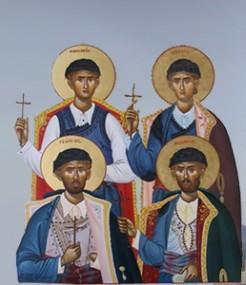
Artemis was worshipped here, as an inscription also attests, and the remains of her temple have been identified near the river. Two monolithic marble columns are attributed to it, later reused in a Christian church. After the conversion of the island a monastery of Christ is said to have risen over the ruins of the sanctuary. The columns stand opposite the church of the Four Martyrs, and recall how the Christian shrine grew into an older urban landscape. On the hill south-east of the present village traces of Soulia can be made out, and late Roman burials have come to light in the village itself.
The Roman ship and the finds in the bay
In the bay of Agia Galini, towards neighbouring Kokkinos Pyrgos, a sunken Roman ship of the 3rd century AD was discovered. The find was made in 1936, and the pieces were studied by the archaeologist Nikolaos Platon. Recovered were some 260 bronze coins – among them issues with the portraits of the emperors Gordian, Philip and Decius – statuettes, lamps and other objects of copper and bronze, as well as marble figures of Aphrodite and Eros and a bust of Demeter. They bear witness to the sea traffic and the material culture of Roman Crete; a considerable part is kept and shown in the Archaeological Museum of Rethymno.
The legend of the Empress Eudokia
A fine Byzantine legend is attached to Agia Galini. Aelia Eudokia – born Athenais, daughter of the Athenian sophist and teacher of rhetoric Leontius, and married to the Emperor Theodosius II on 7 June 421 – was overtaken at sea by a violent storm. She called on the Mother of God and vowed to raise a church if the ship were saved. It ran into the quiet bay of Soulia, and in commemoration, so local tradition holds, the church of the Panagia Galini, the “Virgin of the Calm”, was built. In time the name of the church passed to the settlement and became today’s Agia Galini. History knows the empress as a pilgrim and a poet: she travelled to Jerusalem in the spring of 438, withdrew there for good about 443, and died in the city on 20 October 460, leaving several thousand lines of Greek verse, among them biblical stories retold in Homeric hexameters.
The church of the Dormition of the Mother of God, cut into the rock by the cemetery, is also associated with Eudokia; it probably dates from the second Byzantine period and once belonged to a small monastery. The feast of the Panagia is kept here on 25 August. Liturgy and procession are part of it, the venerated icon is carried out, candles burn; all around there is a fair, with music and folk dancing. For the village this is more than a church festival: on this day local memory becomes a tradition shared by inhabitants and pilgrims.
The Cave of Daedalus and the myth of the wings
On the north-western edge of the village visitors are shown the Cave of Daedalus, also known as the Cave of Christofogiannakis – a chamber in the rock about a hundred metres long and ten metres in both width and height, where doves nest. According to Cretan tradition King Minos kept the ingenious master-builder Daedalus and his son Icarus prisoner here, so that they should not leave the island and build for any other ruler a palace to equal that of Knossos. Daedalus made wings of feathers bound together with wax, and escaped with Icarus through the air. Icarus climbed too near the sun, the wax melted, and the youth fell to his death; Daedalus flew on – and the memory of the son was preserved in the most famous of all myths of the human urge for freedom.
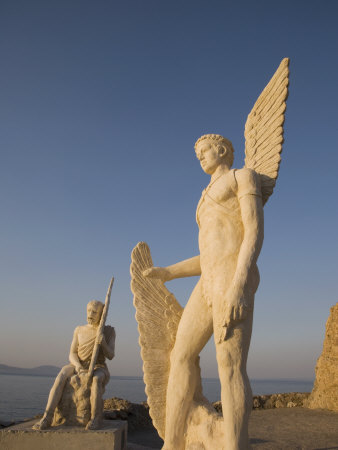
At the harbour stands the monument to Daedalus and Icarus, and close by a square has been laid out in honour of their flight; the two bronze figures, set on the rock above the quay, were unveiled on 11 July 2004, when the Olympic torch relay passed through the village. From here one looks out over the sea to the Paximadia, a pair of uninhabited islets some twelve kilometres offshore. A walk to these places shows how the ancient myth has become part of the modern image of Agia Galini.
Small coves and sea caves
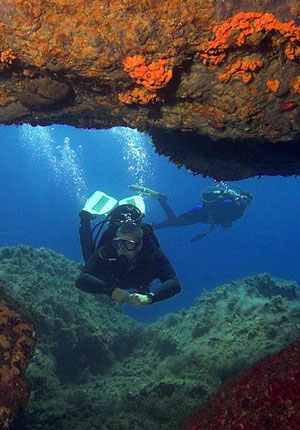
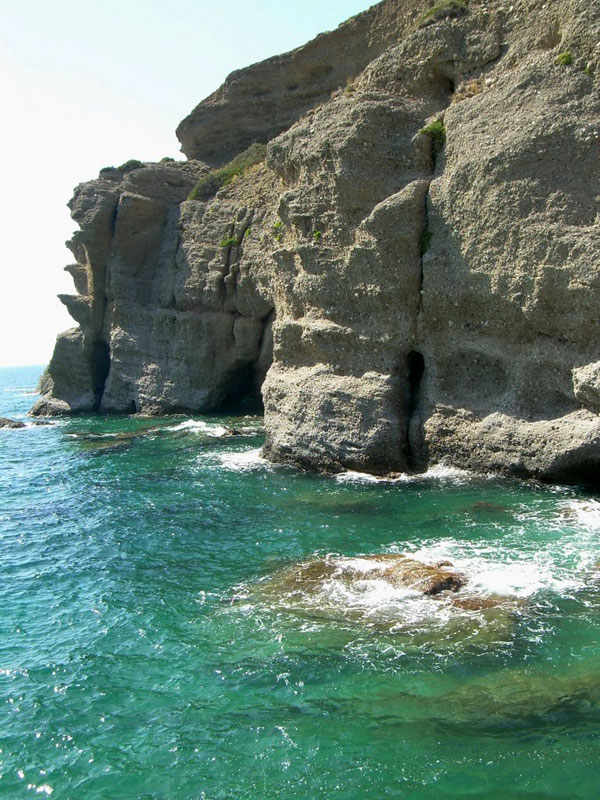
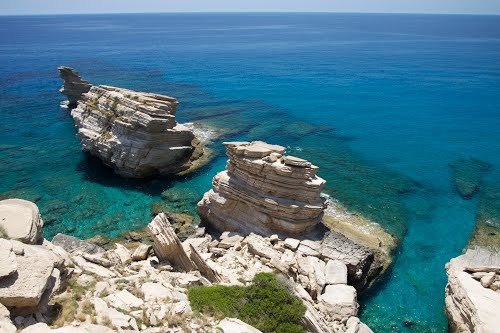
Sea caves open in the coastal cliffs, to be reached only from the water. The light thrown back by the sea alters the contours of the limestone walls in the course of the day; the best known, the “Blue Grotto”, recalls its famous namesake, and so the coast of Agia Galini is sometimes called the “little Capri of Crete”. Excursion boats from the harbour show the caves from the sea; no path leads into them.
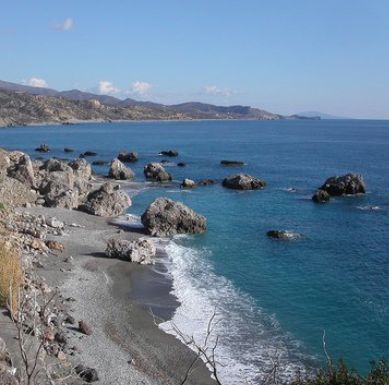
Further along the coast come small coves with fine shingle, clear water and a gently shelving bottom. Some are almost wholly enclosed by rocks; great boulders lie along the shore and lend the landscape something remote and quietly mysterious. The village’s own beach begins about 200 metres east of the port, by the mouth of the Platys, whose outflow keeps the water noticeably cool; a metal footbridge crosses the river to a second stretch of small pebbles that runs on for a kilometre, growing narrower and rockier as it goes. From its end a walk of an hour and a half to two hours along the shore leads to Kokkinos Pyrgos.
The cove of Agia Paraskevi
The little cove of Agia Paraskevi is known for its beach of fine shingle, its clean water and its calm shallows. It is chosen for a short stop in the course of a boat trip, and for a swim away from the main beach.
Agios Pavlos beach
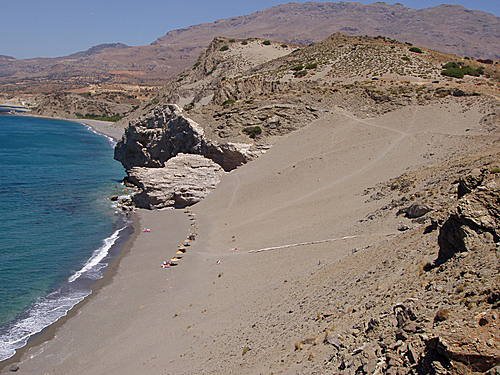
The Paralia tou Agiou Pavlou, the beach of St Paul, is a sandy beach framed by rocks. The wind blows more often here, and the sand gathers into small dunes. The beach thus keeps its natural appearance, and feels like a separate, quiet stretch of the south coast.