Chrysoskalitissa Monastery: the golden step above the Libyan Sea
The most complete guide to Crete: 221 places on the map, 23 routes and 49 articles — with photos, videos and the story behind every place. Everything is open and free: no sign-up, no paid sections and no advertising, open or hidden. You can install the guide on your smartphone as an app.
Routes drawn along real roads
Weather at every stop
Full-text search
“Near me” by geolocation
Create your own printable itinerary
Satellite, terrain, dark mode
Works offline
⌕
Searches 1.7 million characters of descriptions, not just names
—places
4regions
—routes
—with video
Search results
—
Interactive map
Find what is near you
Filters narrow the map and the list at once. Zoom out and pins group together.
Region
Category
Фильтры карты
Landmarks
Featured places
RegionCategory
Routes
Ready-made day trips
Individual places
Articles about landmarks
Chrysoskalitissa Monastery above the Libyan Sea
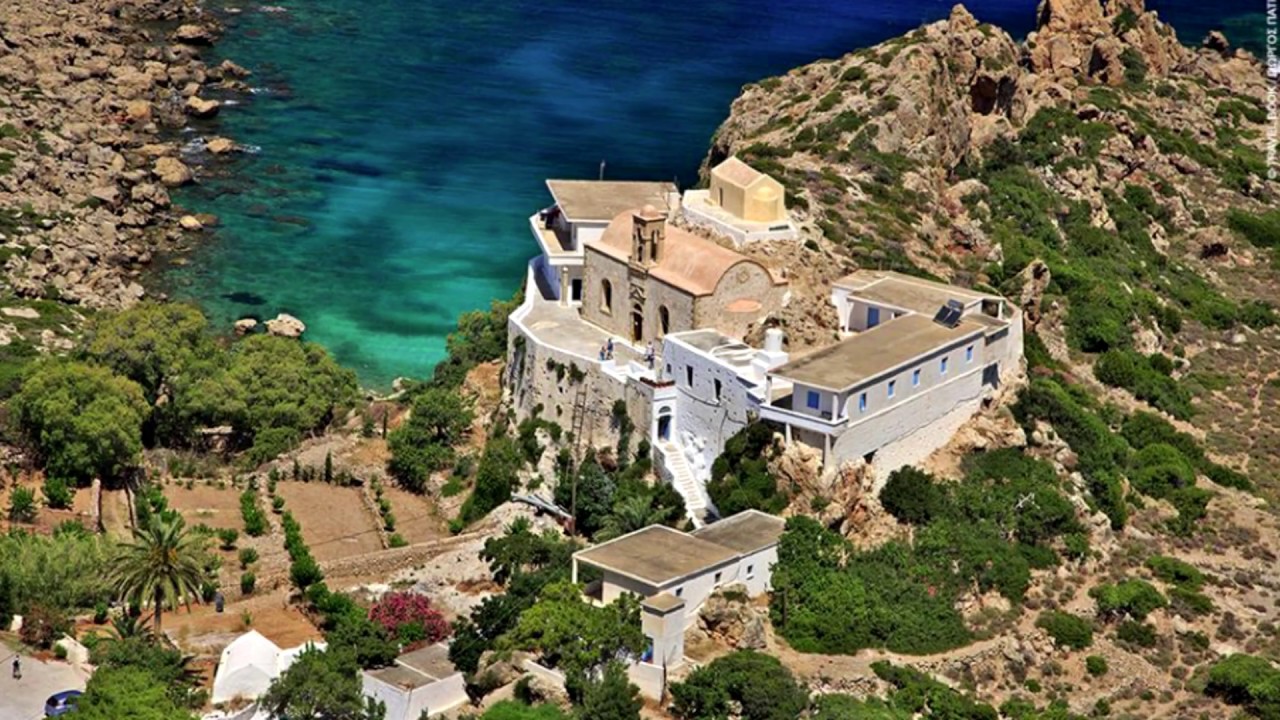
The monastery of the All-Holy Mother of God Chrysoskalitissa (Moni Panagias Chrysoskalitissas) sits on a white rock some thirty-five metres high on the far south-western coast of Crete, in the Innachori district of the municipality of Kissamos, a good seventy kilometres from Chania and only a few kilometres short of Elafonisi. Whitewashed to a dazzle and visible from a long way off, it looks like a fortress planted above the surf. A stone staircase climbs to the courtyard and to the katholikon, a church of two aisles dedicated to the Holy Trinity and to the Dormition of the Mother of God. From the top the view runs far out over the Libyan Sea, and the coves below, where late Neolithic and Early Minoan settlements and a Middle Minoan fishing village have been identified, have served as landing places for sailors from the west since prehistory. The monastery itself remains a living place of pilgrimage, under the Church of Crete and ultimately the Ecumenical Patriarchate of Constantinople.
The golden step and the name of the monastery
Chrysoskalitissa (Χρυσοσκαλίτισσα) means “Our Lady of the Golden Step”, from chrysos, gold, and skala, a stair. One version of the legend speaks of ninety steps, others of ninety-eight or a hundred; the last of them is said to be of gold, and shows itself only to those who are pure of heart – or, as the villagers put it, to true believers. Another tradition relates that at the Ottoman conquest the monks hid the treasures of the house beneath the step to save them from plunder. According to a further story the golden step was sold in the first years of Turkish rule, by the Patriarchate itself in some tellings, to raise the crushing tax demanded by the Sultan. Locally it is also said that the step was the gift of a corsair.
The history of the monastery
The exact date of foundation is unknown. The monastery is usually assigned to the 17th century, while the veneration of the place is held to be older. The earliest surviving written record dates from 1637. In a Venetian census of that year the house appears as “Madonna Ghunoskaletessa”, with a church built into the rock; it was an Orthodox monastery on the territory of the Republic of Venice.
Local memory has it that a coenobium, a community monastery, of St Nicholas stood here earlier, and with it is linked the burial, in 1527, of Georgios and Petros Kantanoleon – members of the family that led a rising against Venice in the early 16th century, an episode that later furnished the material for novels and plays. In the first period of Ottoman rule, it is said, the monastic estates were sold off and the place fell into desolation. Originally two small churches stood on the rock: one dedicated to the Dormition of the Virgin, the other, at the very top, to the Holy Trinity.
In the 19th century the monastery was rebuilt through the efforts of individual monks and of the people of the surrounding villages. Between 1831 and 1840 the abbot Ioannikios put up new buildings; in 1855 Manassis Karagiannakis from Askifou in Sfakia took the renewal in hand, and from a journey to Smyrna he brought back an icon of the Virgin sheathed in silver. After his death in 1866 the work was carried on by Emmanuil Kalitsounakis from Tsitsifia, who took the name Meletios on his ordination. The present church arose from the rebuilding of the old cave church at the end of the century: work began on 9 May 1894, was finished on 10 August, and the first liturgy was celebrated on 15 August, the feast of the Dormition.
The finding of the icon
According to tradition the icon of the Dormition was hidden in a cleft of the rock during the Iconoclast controversy, between 726 and 842, when the veneration of images was forbidden in the Byzantine Empire. Night after night a light like the flame of a candle appeared to a farmer of the district and showed him the place where the picture lay. When an attempt was made to carry the icon to another church, it returned to its original niche; this was understood as the Virgin’s instruction that the monastery was to be built precisely here. A similar tale is told of a stolen icon that found its own way back to its place.
The miraculous protection of the Mother of God
Stories of the Virgin’s miraculous help live on in the memory of Chrysoskalitissa. In 1824, after the massacre at Elafonisi at Easter, in which some 640 people who had taken refuge on the islet were killed, the Turkish-Egyptian troops of Ibrahim Pasha laid waste the churches and villages of the coast – ten churches are said to have been destroyed. When they stood before the deserted monastery they meant to raze it to the ground; but on the stair they were held back by a swarm of bees that had its nest in the niche of the shrine. The attackers fell back and the monastery remained unharmed. To the faithful this was a manifest intervention of the Mother of God. A kindlier legend tells that the sea carried a cask of wine to the foot of the rock when the builders asked for refreshment.
The monastery in the 20th century and today
In 1900 the authorities dissolved the monastic community – as they did those of several other Cretan monasteries – and sold part of the lands, attaching what remained to the monastery of Gonia near Kolymvari. Individual monks nevertheless went on living on the rock and kept the old building in repair; the abbot Grigorios Plokamakis, who presided over the house for decades, distinguished himself in February 1907 in the rescue of the shipwrecked from the Austrian steamer “Imperatrix”, which went down off Elafonisi, and 102 passengers were brought ashore alive by the monks and the villagers. In 1940 the monastery was refounded, and it has since sometimes been described as a convent of nuns. In 1943 the German occupiers drove the inhabitants out and set up a post here; the bullet marks on the iconostasis are said to date from British aircraft strafing the position in those years.
Today the monastery is open to pilgrims and visitors. Besides the church there are a small folk museum, with the tools and household things of the old monastic economy, and an ecclesiastical museum of icons, vestments and liturgical objects; wraps for visitors are kept by the entrance. If cells are free it is possible, by prior arrangement, to stay for a few days.
The visit is usually combined with the drive to Elafonisi, which lies only about five kilometres further south; coming from Chania the monastery is the last stop before the lagoon, and the rock is at its most beautiful in the low light of early morning or evening, when the whitewash glows against the sea. Whoever climbs the stair passes through a space in which the living rock, the monastic architecture, the icon of the Dormition and the memory of miraculous protection grow together into a single holy place.