Kakodiki: chestnut groves, springs and painted churches in Selino
The most complete guide to Crete: 221 places on the map, 23 routes and 49 articles — with photos, videos and the story behind every place. Everything is open and free: no sign-up, no paid sections and no advertising, open or hidden. You can install the guide on your smartphone as an app.
Routes drawn along real roads
Weather at every stop
Full-text search
“Near me” by geolocation
Create your own printable itinerary
Satellite, terrain, dark mode
Works offline
⌕
Searches 1.7 million characters of descriptions, not just names
—places
4regions
—routes
—with video
Search results
—
Interactive map
Find what is near you
Filters narrow the map and the list at once. Zoom out and pins group together.
Region
Category
Фильтры карты
Landmarks
Featured places
RegionCategory
Routes
Ready-made day trips
Individual places
Articles about landmarks
Kakodiki – chestnut groves and mountain springs
Kakodiki (Κακοδίκι) is a small community in the historic district of Selino, south of Kandanos and some 65 kilometres from Chania. It lies at about 450 metres in a green valley and has no single nucleus: instead a number of hamlets are strung out across the slopes, and the whole community numbers only a few hundred people. Chestnuts and olive trees clothe the hillsides, and water breaks out of the ground in countless places. Local people speak of roughly a hundred underground springs – a figure that nobody need count, but one that catches the character of the valley exactly. The water feeds a dense vegetation and a farming economy that still rests chiefly on olive oil and on the keeping of sheep and goats.
Through Kakodiki runs the Kakodikianos, which some call the Vlithianos after the neighbouring village of Vlithias. It is crossed by a small stone bridge of a single arch. Local craftsmen built it in 1903 by decision of the Cretan State, so that the villagers could get themselves and their animals across the river. It is a reminder of a time when rural infrastructure was made first and foremost for the daily life of the village. For many years the commercial life of the place was concentrated in the hamlet of Bailietika, until a new line for the road shifted it elsewhere.
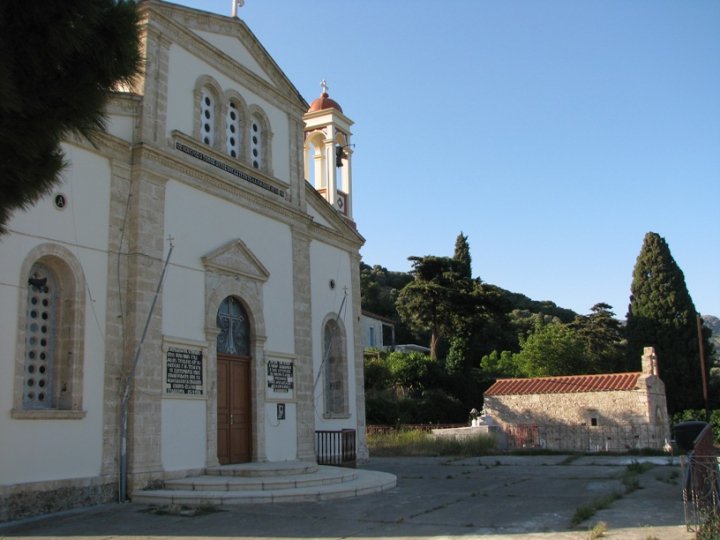
The churches of Kakodiki and the church of the Panagia
The country around Kakodiki is among the parts of Crete richest in medieval churches. Small chapels are scattered through the hamlets and side valleys; many date from the Byzantine or Venetian periods and carry frescoes of the 14th and 15th centuries. Among them are a church of Christ built between 1317 and 1338 and painted by Ioannis Pagomenos, the best-known church painter of Selino in his day, as well as a church dedicated to the Archangel Michael and the church of Agios Efstratios, put up around 1400. Pagomenos is documented from 1313/14 to 1340; his name appears in the dedicatory inscriptions of ten churches in western Crete, and about eight more are assigned to his workshop, which his son Nikolaos carried on into the 1360s. His manner is conservative and Byzantine, with Western touches confined to secondary details. The church of the Archangel Michael is the cemetery church: a long barrel-vaulted building with a pointed vault strengthened by three transverse arches on piers, and on the west side a late Gothic doorway of a kind seldom seen in the district. Inside, the archangel is painted on a markedly larger scale than the saints around him, and the west wall is given over to an extended Second Coming. It stands beside the church of Agia Triada, the Holy Trinity. None of this is a museum ensemble; it is a network of rural parish and field churches that still have their place in the church year.
A special place belongs to the church of the Panagia, the All-Holy Mother of God. Its paintings are dated to 1420, a year that fits the artistic milieu of Selino: an inscription with the same date survives in the church of the Archangel Michael. There is, besides, a small vaulted church of the Panagia in the hamlet of Kadros, at the spot called Kaouriana, dedicated to the Nativity of the Virgin, kept on 8 September, and known also as the Panagia Bitsiani; its frescoes are the work of Pagomenos, and include an enthroned Virgin among angels and a Betrayal in which two musicians in Venetian military dress play drum and horn. Individual panels, however, need to be looked at on the spot and attributed by a specialist.
The frescoes of the village churches of Selino were made for worship. The painting of sanctuary, vault and walls follows a coherent theological programme and is not a collection of separate pictures: typically Christ Pantocrator or the Virgin presides over the sanctuary, with the Communion of the Apostles and a row of officiating bishops below, scenes from the Gospels in the vault and standing saints at eye level along the walls. After so many centuries the paint layers are fragile, and the plaster should not be touched.
The tradition of the “bad judgement”
Kakodiki has a local tale from the age of pirate raids attached to it. The name is explained from the words for “bad” and “judgement”. The story goes that a traitor regarded as a danger to the whole district was put on trial – in one version at the spring of Agia Triada – and that even the pirates thought the sentence unjust: a “bad judgement”. The tale lives on by word of mouth and speaks of fear, of retribution and of the uneasy relations between the mountain villages and the coast. Philologists also allow a more sober explanation: the place may take its name from a Byzantine nickname for a judge “who judged badly”.
The village has known well-attested suffering too. During the rising of 1821 Ottoman troops, according to local tradition, killed about seventy women and children here; a single family is said to have lost 26 of its 33 members. And on 27 February 1897, in a house in the hamlet of Bailietika, the withdrawal of the Ottoman troops from Selino was signed.
Ancient Kantanos near Kakodiki
About two kilometres from Kakodiki lies the archaeological zone of ancient Kantanos, whose name lives on in modern Kandanos. The archaeologist Vasilios Theofanidis investigated a large Roman building here with a mosaic floor of some 900 square metres; it is interpreted as a praetorium or some other administrative centre. There are also scattered remains between Kadros and Vlithias – massive masonry, rock-cut tombs and traces of sanctuaries. The ancient city did not necessarily stand on the exact site of today’s Kandanos, and it is as well to keep archaeological Kantanos and the modern town apart.
The country is at its most impressive in spring and autumn, when green slopes and chestnut groves bring out the relief of the valley. The road goes on to Kandanos, to Plemeniana and on to the south coast. Those who want to see the inside of the churches do best to ask in the village: many are opened only for services or by arrangement.