Kedrodasos: the juniper grove and beach beside Elafonisi
The most complete guide to Crete: 221 places on the map, 23 routes and 49 articles — with photos, videos and the story behind every place. No sign-up, no trackers.
Routes drawn along real roads
Weather at every stop
Full-text search
“Near me” by geolocation
Create your own printable itinerary
Satellite, terrain, dark mode
Works offline
⌕
Searches 1.7 million characters of descriptions, not just names
—places
4regions
—routes
—with video
Search results
—
Interactive map
Find what is near you
Filters narrow the map and the list at once. Zoom out and pins group together.
Region
Category
Фильтры карты
Landmarks
Featured places
RegionCategory
Routes
Ready-made day trips
Individual places
Articles about landmarks
Kedrodasos: the juniper grove near Elafonisi
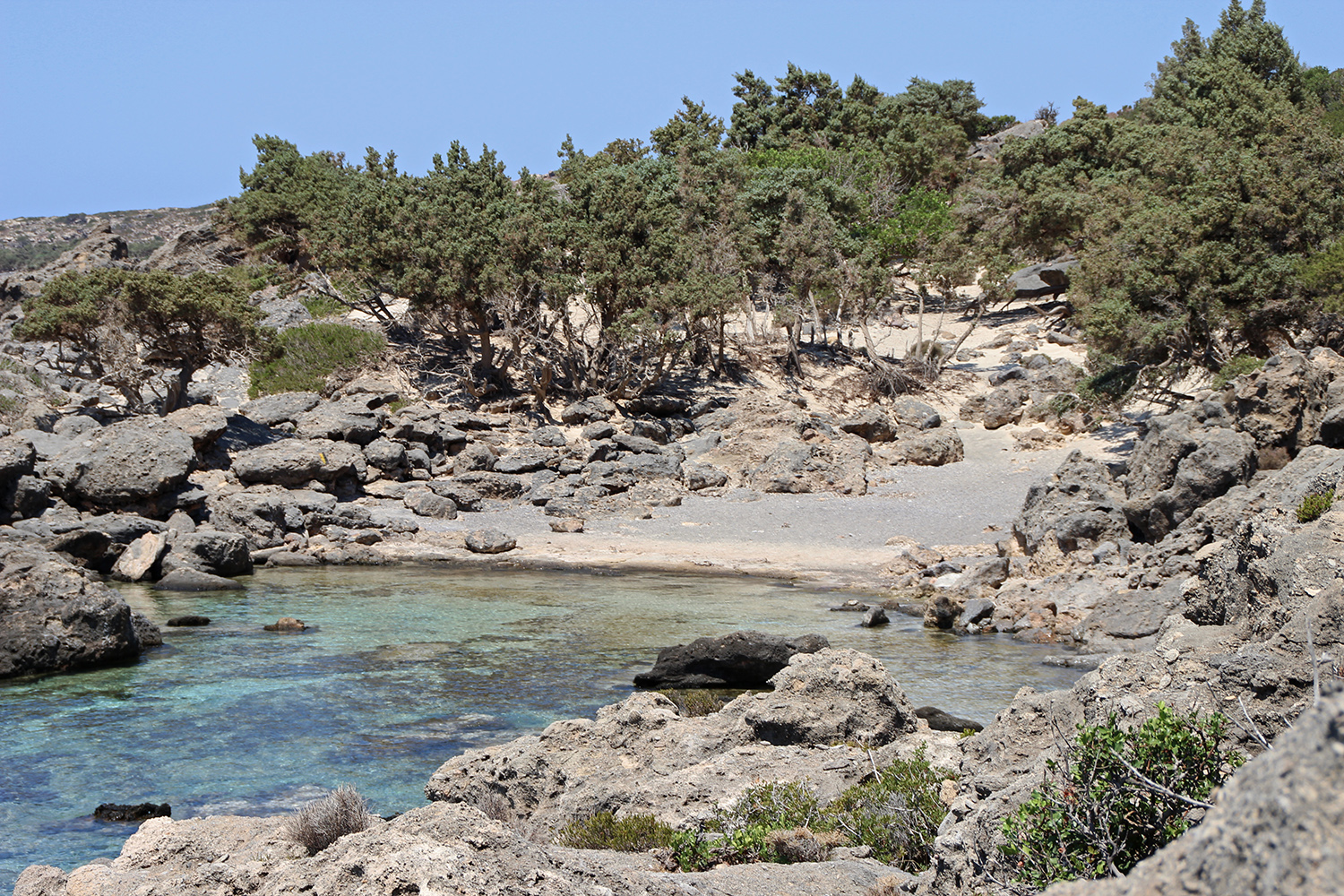
A good kilometre east of the lagoon of Elafonisi, and some seventy-six kilometres south-west of Chania in the old district of Selino, lies Kedrodasos (Κεδρόδασος), a small bay of glass-clear water where sandy and rocky stretches of shore alternate, the rock worn into smooth, flat slabs. It is quieter than its famous neighbour and draws those who are looking for space, wind and the chance of water sports; the shallow bottom and usually calm sea also make it good for snorkelling. The place has been called one of the last untouched paradises of Europe, and indeed everything that usually turns a beach into a resort is missing: no kiosk, no sunbeds, no shower. The bay is reached by a dirt track that winds between greenhouses and ends at a rough parking place, from which it is about ten minutes on foot – the last stretch is rough enough that a car with high clearance is an advantage – or on foot along the European long-distance path E4, which comes over from Elafonisi in roughly half an hour across rock and sand and can be followed by its black-and-yellow waymarks. Beyond Kedrodasos the same path continues east along the coast, past still lonelier coves, towards the chapel of Agios Ioannis and eventually Paleochora.
Why the “cedar forest” is really a juniper wood
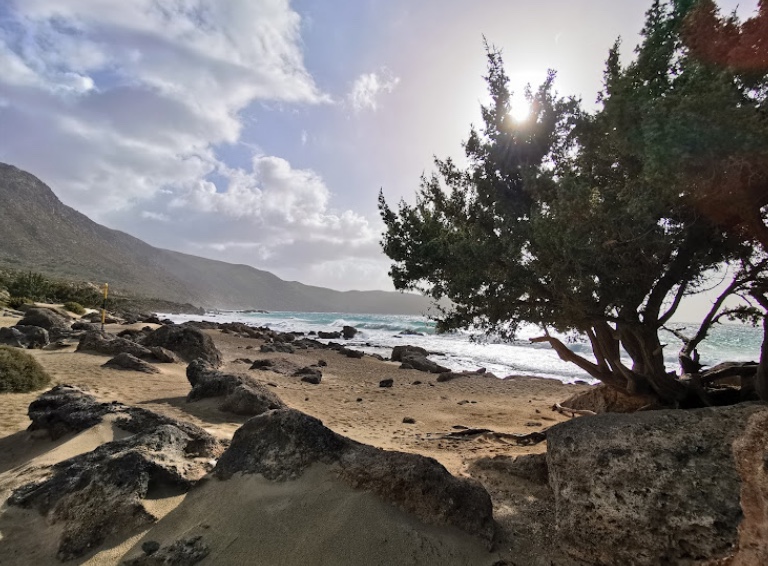
The name Kedrodasos means “cedar forest”. The trees that grow here, however, are not true cedars of the genus Cedrus but junipers: the large-fruited juniper Juniperus oxycedrus subsp. macrocarpa and the Phoenician juniper Juniperus phoenicea. In Greek the juniper has been called “kedros” since antiquity, and so the “cedar beaches” of Crete – whether here, on Gavdos or on the island of Chrysi – are without exception juniper groves. The stand at Kedrodasos covers about 110 stremmata, roughly eleven hectares, and forms a rare coastal wood on sand dunes that holds its own against the salt wind, drought and the shifting sand; the trees are small and twisted, rarely reaching the height they would attain in sheltered ground.
Dunes and a fragile ecosystem
The moving sand lays bare the roots of the junipers and gives the trees sculptural outlines; the wind-twisted trunks, bleached silver-grey, are among the most photographed subjects of the south-west coast. In summer heat and wind make them look withered, yet the living branches store moisture and go on growing. On the dunes grow marram grass Ammophila arenaria, the sea holly Eryngium maritimum and the sea daffodil Pancratium maritimum, whose white flowers rise from the bare sand in August and September. The junipers can reach eight metres; a broken-off branch, however, is not dry firewood but part of a living organism, and the resinous wood burns fiercely.
A Natura 2000 protected area
Together with Elafonisi and the adjoining coast, Kedrodasos belongs to the Natura 2000 site GR2540002. Protection covers the dunes, the juniper communities, rare plants and the marine habitats, including the seagrass meadows of Posidonia that serve as a nursery for countless fish and whose dead leaves wash up in brown drifts along the tideline. It is forbidden to tread on the roots, to break off branches, to drive on to the dunes or to light fires – a single spark in the resin-rich wood could destroy what took centuries to grow.
Visiting and relaxing
The shore is rocky in places, but there are sandy stretches for resting and bathing, and the seabed shelves gently. In windy weather the bay attracts surfers and kite-surfers, for the wind here can be strong even when the lagoon next door is sheltered. In summer you must bring your own water, food and sun protection: there is practically no infrastructure, and the shade of the juniper grove must become neither a camping ground nor a source of firewood. The pleasantest months are May, June and September, when even neighbouring Elafonisi draws breath, and the early morning, before the day visitors arrive from the Elafonisi car park, is the quietest time.
For decades Kedrodasos has been popular with devotees of free camping and naturism. A tent may be pitched only where it is permitted, and never beneath the trees or on their roots; wild camping is in principle forbidden in Greece and is increasingly penalised in protected areas, and signs at the beach say so plainly. Local conservationists ask, too, that every scrap of rubbish – down to the paper tissue – be carried away again, and that the beach be left cleaner than it was found. Careful treatment of the dunes preserves an ecosystem whose restoration would take decades.