Vlatos: the Ancient Plane Tree and the Park of Peace
The most complete guide to Crete: 221 places on the map, 23 routes and 49 articles — with photos, videos and the story behind every place. Everything is open and free: no sign-up, no paid sections and no advertising, open or hidden. You can install the guide on your smartphone as an app.
Routes drawn along real roads
Weather at every stop
Full-text search
“Near me” by geolocation
Create your own printable itinerary
Satellite, terrain, dark mode
Works offline
⌕
Searches 1.7 million characters of descriptions, not just names
—places
4regions
—routes
—with video
Search results
—
Interactive map
Find what is near you
Filters narrow the map and the list at once. Zoom out and pins group together.
Region
Category
Фильтры карты
Landmarks
Featured places
RegionCategory
Routes
Ready-made day trips
Individual places
Articles about landmarks
Vlatos and its ancient plane tree
Vlatos (Βλάτος) is a mountain village in the west of the Kissamos district, some 18 kilometres from the town of Kissamos and 54 from Chania, at about 380 metres above sea level. It lies in a wooded valley on the upper course of the Tiflos, the river that goes on to cut the Topolia Gorge, and clings to a hillside among olive groves, chestnut woods, vineyards and limestone slopes down which the water runs in small streams in spring. There is no single compact settlement: Vlatos is made up of eleven scattered old hamlets – Korakiana is one of them, Micheliana another – and it has kept the traditional way of life of the Innachorion, the secluded interior of western Crete, whose name derives from the “nine villages” (Ennia Choria).
The plane tree as a memory of wars
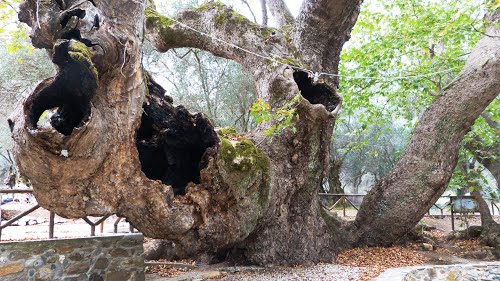
The great natural sight of Vlatos is an enormous old plane tree with a gaping hollow trunk, protected by the forestry authority as a natural monument; it was declared a monumental tree in 1978, and its age is put at 1,400 to 1,500 years. It is not the largest plane on Crete, but the girth of the trunk is formidable, and the whole tree leans so heavily to one side that it looks ready to topple. Villagers remember that people hid inside it at various times: first from their Ottoman pursuers, later from the German occupiers. The plane is no fortification but a natural refuge that has passed into the spoken history of the village – and a reminder of how the landscape itself helped people to come through the wars. It stands in the hamlet of Micheliana, by a spring in a damp valley bottom, with other planes round about and an old olive grove of trees many centuries old; in its shade it is cool even in August, and a small, old-fashioned taverna stands beside it.
Churches and parish life
The churches of St John, St Anthony, the Holy Trinity, St Constantine and St George survive in the surrounding country. Until 1968 the Holy Trinity was the principal parish church; since then the church of the Nativity of the Virgin, whose patronal feast falls on 8 September, has been the centre of the parish. The chapel of St Anthony lies close to the plane tree and is closely tied to the memory of the village community.
The church of St Anthony is dated to the 12th century, which makes it one of the oldest places of worship in the district. Local legend tells that St George barred the way into the village to a woman stricken with a grave illness and so saved the inhabitants from the plague; hence the particular devotion to the saint as protector of the community.
The Park of Peace
Above the village lies something one does not expect to find in the Cretan mountains: the Park of Peace (Parko Irinis). It was created in the 1970s as a joint reforestation scheme of the Vlatos cultural society, the Chania forestry directorate and Bavarian foresters, brought together through the Goethe-Institut. The cultural society, which goes by the name “New Horizons”, had itself been founded only in 1972, and it still looks after the park today. Conceived as an experimental plantation, it covers around a hundred hectares, where oaks, firs, planes and, by the local count, about 150 species of plants grow; it forms the core of a much wider reforested tract of some 20 square kilometres. Walking paths with resting places lead through it. The dedication runs, in substance: to science for study, to politicians for reflection, to visitors for stimulus and pleasure.
The stone church and cultural life today
The historic stone church of Vlatos is still a place of worship and at the same time the setting for the acoustic concerts of Vlatos Jazz. The music is played without amplification, by candlelight, and relies solely on the natural sound of the stone interior; the contemporary programme keeps its respect for the sacred character of the building. It is an intimate affair: some forty listeners find room inside, with a couple of dozen more seats outside the door. There is also a small folklore museum in the former primary school, kept by the cultural society and built up from gifts by the villagers, which in a section of its own shows the school day of past decades with benches, primers and wall maps.
Life in Vlatos today
The municipal rolls list around 350 inhabitants, but only about seventy people live in the village all year round. Among them are a few incomers from central Europe who have carefully restored old houses. People live from farming and from keeping a few animals at home, producing olive oil, chestnuts and wine; dried figs and preserved quinces are also among the local produce. Since 2018 Vlatos has also been known for the Vlatos Jazz Festival, organised by the cultural society, which on Sunday evenings from late June to late September brings international and Cretan musicians together and joins the rural scene to the cultural life of the present.
The lanes and paths round about make for good walking – to the plane tree, through the old hamlets, to the little churches and up into the Park of Peace; the cultural society is working on waymarked circular routes linking them all. Vlatos suits a quiet break on the way to Elafonisi and the other sights of Kissamos, and a visit combines easily with the neighbouring chestnut-wood settlement of Milia.