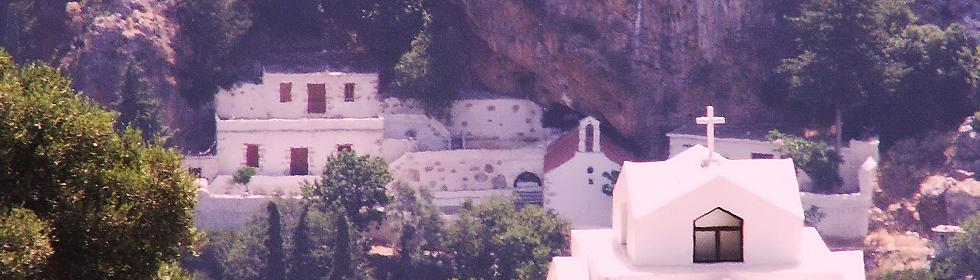
Azogires: cave sanctuaries and the monastery of the Ninety-Nine Holy Fathers
The most complete guide to Crete: 221 places on the map, 23 routes and 49 articles — with photos, videos and the story behind every place. Everything is open and free: no sign-up, no paid sections and no advertising, open or hidden. You can install the guide on your smartphone as an app.
Routes drawn along real roads
Weather at every stop
Full-text search
“Near me” by geolocation
Create your own printable itinerary
Satellite, terrain, dark mode
Works offline
⌕
Searches 1.7 million characters of descriptions, not just names
—places
4regions
—routes
—with video
Search results
—
Interactive map
Find what is near you
Filters narrow the map and the list at once. Zoom out and pins group together.
Region
Category
Фильтры карты
Landmarks
Featured places
RegionCategory
Routes
Ready-made day trips
Individual places
Articles about landmarks
Azogires – a valley of springs and cave sanctuaries
Azogires (Αζογυρές, also spelt Azogyres) lies about eight kilometres from Paleochora in a green valley at around 360 metres. The Azogirianos stream runs through the village; plane trees, olives and the running water make for a cool microclimate even in the hot months. The name is probably connected with the stinking bean trefoil (Anagyris foetida), which the Greeks call azogyros and which grows in this district. A stone arched bridge of old construction crosses the stream, and in and around the village there are seven churches and chapels, among them the church of Agios Theodoros near the village square, whose Byzantine frescoes are ascribed to Ioannis Pagomenos, the leading painter of 14th-century Selino.
The principal holy places of Azogires are the caves of Zoures and Charakas. They are known not simply as natural formations: their history weaves together ancient burials, early Christian asceticism and an Orthodox pilgrimage that is still alive today.
The Zoures cave and the Ninety-Nine Holy Fathers
The Zoures cave (also Soures) lies north-west of the village at about 535 metres; a track leads up towards it, and from the place where cars are left it is roughly half an hour on foot at an easy pace. The mouth is steep and rocky. Metal ladders lead down into the depths; inside there are a spring of running water, stalactites and a small church of the Ninety-Nine Holy Fathers, and the cave is said to continue on a second, lower level. The cave has been known since antiquity and is associated with the burial of persons of rank: archaeological traces in the neighbourhood point to earlier use, long before a Christian hermitage came into being here.
According to church tradition the ninety-nine fathers came to Crete from Egypt, Cyprus and Attaleia by way of the island of Gavdos. They settled in the caves and spent their lives in prayer and fasting. Ninety-eight of them ended their earthly lives here; the ninety-ninth was St John the Hermit (Agios Ioannis o Xenos, also called Erimitis), regarded as the founder of ascetic monasticism in Crete, who later withdrew to the Akrotiri peninsula and continued his life of austerity in a cave near Gouverneto Monastery, at the place known as Katholiko, where he is buried. The legend says that the fathers had promised one another to die on the same day – and so it fell out, when John met his death far away from them.
At the end of the 19th century and the beginning of the 20th the priest-monk Gavriil Papagrigorakis (1875–1930), a native of Rodovani, promoted the cult of the Holy Fathers. An energetic man, he revived the monastery and gave it an olive press and flour mills to live on. In the church precinct a stone terrace was laid out with a marble font, because the small cave chapel was not adequate for baptising the many pilgrims. Above the entrance to the cave the date 1010 survives, which local tradition connects with St John of Crete.
The Charakas cave and the monastery of the Holy Fathers
The Charakas cave lies south-east of Azogires. Originally it consisted of three chambers cut into the rock, which may have served as tombs in antiquity. Later a monastic establishment grew up here; by local account monks were living in the cave some seven hundred years ago. The surviving monastery of the Holy Fathers (Moni Agion Pateron), a few minutes’ walk below the village, was built in 1864. The ancient use of the cave as a burial place and its Christian monastic history thus belong to different periods, even if the two are perceived today as a single holy landscape.
The monastery has a small museum of church relics together with historical and folk objects, among them mementoes of the wars. Beside the monastery church, close to the spring and the stream, stands a plane tree with a tradition of its own: it is said to keep its leaves all year round, and the villagers see in this a sign of the Holy Fathers; they add that its gnarled branches form ninety-nine crosses, one for each of the monks, who are supposed to have gathered beneath it. Evergreen planes are a botanical peculiarity of Crete – a mutation of the oriental plane, Platanus orientalis, known from only about fifty trees on the island – and the one at Azogires has been declared a natural monument. In the village itself a folk museum shows heirlooms, costumes, old documents and weapons. Another cave bears the name of a priest, Papa-Karalis; it is said to have served in Ottoman times as a refuge and as a “secret school”.
Landscape and visiting Azogires
The road to Azogires runs through wooded country with springs and small ravines; below the village the stream forms pools and little waterfalls in the shade of the planes. The descent into the Zoures cave calls for care: the ladders can be damp, and inside it is very dark and clammy – a torch is indispensable, and a strong one, since a weak beam is of little use. Many visitors go no further than the entrance. Before setting out it is as well to find out whether caves and monastery are accessible. Azogires combines well with Paleochora, the mineral springs of Temenia or the mountain village of Rodovani, all of which can be reached in a quarter to half an hour.