Lissos – ancient port, healing sanctuary and churches in a lonely bay
The most complete guide to Crete: 221 places on the map, 23 routes and 49 articles — with photos, videos and the story behind every place. No sign-up, no trackers.
Routes drawn along real roads
Weather at every stop
Full-text search
“Near me” by geolocation
Create your own printable itinerary
Satellite, terrain, dark mode
Works offline
⌕
Searches 1.7 million characters of descriptions, not just names
—places
4regions
—routes
—with video
Search results
—
Interactive map
Find what is near you
Filters narrow the map and the list at once. Zoom out and pins group together.
Region
Category
Фильтры карты
Landmarks
Featured places
RegionCategory
Routes
Ready-made day trips
Individual places
Articles about landmarks
Lissos: ancient port and sanctuary on the south coast
Lissos (Λισσός, also Lisos) lies in the enclosed bay of Agios Kirikos, about three kilometres west of Sougia and a good 70 kilometres south of Chania. Today it is an uninhabited archaeological site with a narrow strip of pebbles by the sea, ringed by mountains and reachable only on foot or by boat; in antiquity, however, a harbour town stood here, bound to Elyros and the other poleis of south-western Crete, and in the end outstripping its mother city in the hills in importance. The city was founded in the Classical period and flourished until late antiquity; its position opposite Cyrene on the Libyan coast gave it a place on the trade routes of the Mediterranean. The site is reached on foot from Sougia in about an hour and a half, or by boat.
City, coins and the League of the Mountain People
The history of Lissos can be followed through inscriptions, coins and archaeological remains. In Hellenistic times, in the 3rd century BC, the city stood in alliance with Magas, king of Cyrene, and belonged to the Koinon ton Oreion, the League of the Mountain People, to which Syia, Poikilassos, Tarra, Hyrtakina and Elyros also belonged. Of the coastal towns of this stretch Lissos alone seems to have struck coins of its own – a sign of political independence and lively trade, sustained by trading and fishing fleets. On them appear images of the sea, a dolphin, a woman’s head and the attributes of the Dioskouroi; the cult of Diktynna held a particularly important place in the city.
The ancient geographers place Lissos between Syia and Kalamyde and connect it with the routes to Kantanos. The harbour served not only trade and fishing: the chief source of the city’s wealth became the sanctuary of Asklepios, to which the sick came from the whole of Crete. The position by the sea allowed pilgrims to arrive from different parts of the island and from the nearby coasts of Libya.
The Asklepieion of Lissos
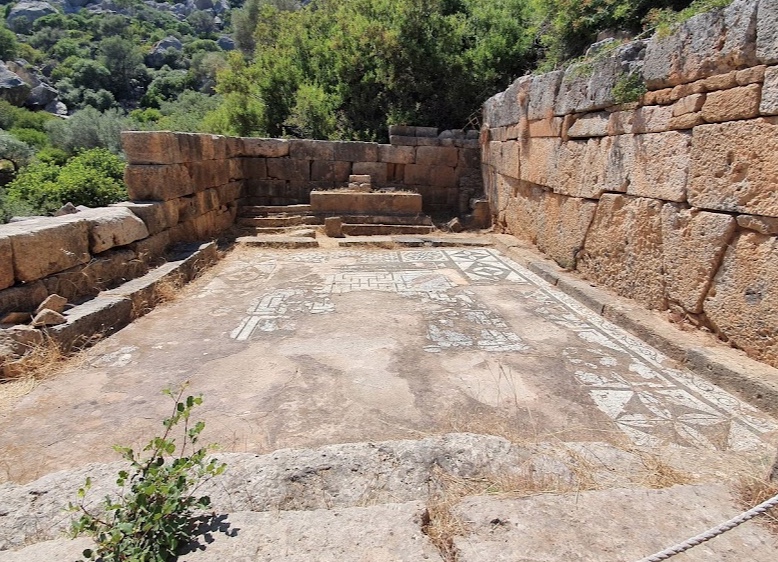
The sanctuary of Asklepios belongs to the Hellenistic period and was uncovered by the archaeologist Nikolaos Platon in the excavations of 1957 and 1958, which also revealed the theatre, the aqueduct, the cemetery, the baths and the early Christian basilicas. In the valley survive the temple, the spring, basins and rooms for the lodging of pilgrims, together with Roman baths. The small Doric temple leans against the slope; its floor carries a mosaic of Roman date with geometric patterns and pictures of animals, which can still be seen in place. In the temple were found numerous votive offerings and sculptures of Asklepios, Hygieia and Pluto, now kept in the Archaeological Museum of Chania; in the Roman period the sanctuary was refurbished, receiving its new mosaic floor and portraits of the emperor Tiberius and of Drusus. In the number of sculptures found Lissos ranks second in Crete only to Gortyn. The building has still not been fully published.
More recent research continues to clarify the layout of the city. From 2012 to 2015 a team from the University of Athens under Chrysanthos Kanellopoulos measured the many scattered architectural members of the temple and recorded them in three dimensions, so that each stone could be assigned its original place. In the 2020s – in the first excavation at Lissos for more than half a century, directed by Katerina Tzanakaki of the Ephorate of Antiquities of Chania and first announced in the autumn of 2022 – archaeologists uncovered part of a public building, probably a theatre or odeon that may also have served as a bouleuterion: part of the stage, fourteen rows of seats and two vaulted side chambers survive, and the building dates to the Roman period, between the 1st and the 4th century AD. The find shows that Lissos was not merely sanctuary and harbour but a fully fledged polis with a public life and organs of self-government.
The finds attest the far-reaching connections of Lissos: the forms of the temple and the artistic peculiarities of the sculptures are linked with Cyrene in North Africa and with Alexandria. The principal deity of the sanctuary may not have been Asklepios alone: inscriptions point to a particular veneration of Diktynna, the Cretan goddess of nature and the hunt.
From Roman times to the bishop’s seat
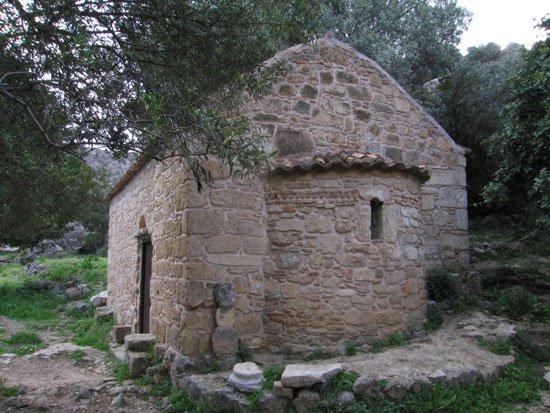
After its Hellenistic prime the city lived on through Roman and early Byzantine times. In the age of Hierokles, in the 6th century, Lissos is named as a bishop’s seat. On the site can be seen the remains of a small theatre, a necropolis, an aqueduct, baths and houses. On the western slope stand in rows the striking Roman tomb buildings with their barrel vaults, small free-standing houses of the dead – some fifty of them line the cliffside to the south-west. Beside the ancient buildings survive the ruins of early Christian basilicas, discovered in 1955, and the still-used church of Agios Kirikos, built over an older Christian place of worship near the Asklepieion; a short way off stands the chapel of the Panagia, a single-aisled vaulted church of the 14th century that occupies the sanctuary of the second basilica and has marble and limestone blocks from the early Christian church and other ancient public buildings set into its walls.
Between the 7th and the 9th century Lissos was probably abandoned: the city lost its former importance, sea routes and the political situation changed, and the end is ascribed to the raids of the Saracens in the 9th century. Its ecclesiastical memory, however, did not die. The church of Agios Kirikos, built on the site of an early Christian basilica of the 6th century, preserves a piece of the mosaic floor – one of the most telling witnesses to the late antique community – and keeps frescoes of its own; beneath the Panagia chapel the mosaic of the second basilica survives in fair condition some sixty centimetres below the present floor, and to the west traces remain of the atrium and the baptistery. On 15 July, the feast of St Kyrikos and his mother Julitta, the people of the district come on foot and by boat to the patronal festival in the otherwise deserted bay.
Getting there and walking round
One walks to Lissos from Sougia on the mountain path; the way takes about ninety minutes, or two hours at a leisurely pace, and in summer is best begun early in the morning. The crossing by boat is shorter, at around twenty minutes, and depends on the weather. There is no permanent settlement and no water on the spot, and the pebble beach offers a swim at the end of the walk. In the valley the bay, the ancient ruins, the Asklepieion, the necropolis, the baths, the remains of the basilicas and the church of Agios Kirikos open up one after another – a single archaeological landscape in which the history of harbour, healing cult and Christianity is joined together.