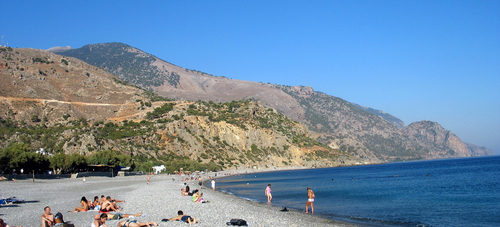
Sougia – ancient Syia and a long pebble bay on the Libyan Sea
The most complete guide to Crete: 221 places on the map, 23 routes and 49 articles — with photos, videos and the story behind every place. Everything is open and free: no sign-up, no paid sections and no advertising, open or hidden. You can install the guide on your smartphone as an app.
Routes drawn along real roads
Weather at every stop
Full-text search
“Near me” by geolocation
Create your own printable itinerary
Satellite, terrain, dark mode
Works offline
⌕
Searches 1.7 million characters of descriptions, not just names
—places
4regions
—routes
—with video
Search results
—
Interactive map
Find what is near you
Filters narrow the map and the list at once. Zoom out and pins group together.
Region
Category
Фильтры карты
Landmarks
Featured places
RegionCategory
Routes
Ready-made day trips
Individual places
Articles about landmarks
Sougia: the bay, the beach and ancient Syia
Sougia (Σούγια) lies on the south coast of the Chania district, roughly 70 kilometres from the city – about two hours by car – at the end of a road that drops from the wooded slopes of the White Mountains (Lefka Ori) to the Libyan Sea. Behind the village a wide bay opens, backed by a long pebble beach. It runs for some two kilometres eastwards from the small harbour and is one of the longest and most distinctive beaches in the south-west of Crete.
Sougia has kept the quiet face of a small coastal place; with the surrounding hamlets the community counts only a few hundred permanent residents – the census of 2021 recorded 131 people across its four villages – and the accommodation runs to a few hundred beds in small hotels and rooms to let, with a handful of tavernas, cafés and bars. The western end of the beach lies by the houses, tavernas and small pensions; the eastern end is quieter, has long been regarded as the more secluded, and is the part favoured by naturists. The shore is coarse pebble and gravel, the water deepens quickly, and there is scarcely any natural shade.
Ancient Syia – the port of Elyros
The ancient bay has been altered by natural forces. In the great earthquake of AD 365 the west of Crete was lifted by several metres – at Sougia the shoreline rose by some six metres – the coastline shifted, and the former harbour vanished beneath deposits and the reshaped ground, beyond the reach of archaeology. The present beach should therefore not be taken as a faithful image of the ancient port; it is a new landscape, formed on the site of an old anchorage.
Modern Sougia has inherited the site of ancient Syia – Συία in Greek, sometimes also called Syba or Syva. Stephanus of Byzantium describes it as a small city of Crete and the port of Elyros, and the anonymous Stadiasmus, an ancient coastal itinerary, places the large harbour of Syva six stades west of Poikilassos. In antiquity, then, it was the seaport of Dorian Elyros in the interior of Selino, and it grew on the strength of a sheltered harbour and the abundant timber of the hills behind. Through Syia Elyros had access to the sea lanes of the Libyan Sea; nearby ran the routes to Lissos and Poikilassos. The present bay was thus not merely a convenient beach but part of the territory and trading network of ancient Crete. The ruins show that the town enjoyed its greatest prosperity in Roman times – the remains of an aqueduct, which brought water from the north, from the direction of Agios Pavlos, still stand up to five metres high and crossed the river bed on vaulted arches, and cisterns served houses and baths – but no systematic excavation of the town has yet taken place.
Of Syia’s former importance there remain parts of a Roman aqueduct, of houses and of early Christian buildings; scattered foundations lie chiefly east of the stream bed. Mosaic floors have been found in the vicinity, and the church of Agios Panteleimon stands on the site of an older basilica and keeps a piece of its mosaic decoration. The best-known floor came to light after the Second World War: a woman of the village is said, following a dream, to have dug near the shore and found a splendid mosaic of geometric patterns and animals – birds, peacocks, fish and deer – within a border of ivy leaves, whose preservation was then taken in hand by the archaeologist Anastasios Orlandos, who investigated the building, known as Basilica A, in 1952. A mosaic from the village church is now displayed in the Archaeological Museum of Chania. The mosaics are dated to the 6th century. Three or four early Christian basilicas have been identified in the area of Sougia, two of them with their apses and stretches of mosaic floor still preserved; they testify that the settlement lived on after the end of antiquity. Only after the 7th century did it lose importance – Saracen raids are blamed for its destruction – without its being certain whether it was ever wholly abandoned; the modern village was in effect resettled only after the Second World War.
Sougia and the paths of its surroundings
The village lies at the mouth of the Agia Irini gorge: the Agiirinotis stream runs down to the sea, and the road to Sougia leads over slopes of pine and oak. The gorge itself is about seven and a half kilometres long and takes some three hours to walk through. From the bay the path to ancient Lissos sets out, about five kilometres there and back on a track that forms part of the European long-distance footpath E4; it climbs through the small gorge of Lissos and takes an hour and a half to two hours each way. Lissos is known for its sanctuary of Asklepios with its healing spring, and also had a theatre and baths; Sougia is therefore a good base from which to get to know the archaeological sites of southern Selino. Local legend, moreover, places the cave of the Cyclops Polyphemus of the Odyssey in these hills.
In summer small boats sail from Sougia to Paleochora, Agia Roumeli, Loutro, Chora Sfakion, the island of Gavdos and other places on the south coast. The sea link complements the overland route through the Agia Irini gorge and makes the bay the natural gateway to a part of western Crete that is otherwise hard to reach.
Sougia today
Today Sougia combines a long pebble beach, the quiet of a small settlement and a many-layered historical setting. One can rest by the sea, walk the E4 to Lissos or into the Agia Irini gorge, and seek out the traces of ancient Syia and the early Christian basilicas; besides Agios Panteleimon, the chapel of Agios Antonios – about two hours’ walk eastwards along the E4 towards Agia Roumeli – is among the churches of the district, and near the hamlet of Moni the so-called pyramid of Sougia, a curious rock formation, draws the inquisitive. The beach is open and almost without shelter from the sun. The boats run only in season, and the walk to Lissos should be begun early in the morning in summer.