Rodovani and ancient Elyros – Selino’s forgotten city
The most complete guide to Crete: 221 places on the map, 23 routes and 49 articles — with photos, videos and the story behind every place. Everything is open and free: no sign-up, no paid sections and no advertising, open or hidden. You can install the guide on your smartphone as an app.
Routes drawn along real roads
Weather at every stop
Full-text search
“Near me” by geolocation
Create your own printable itinerary
Satellite, terrain, dark mode
Works offline
⌕
Searches 1.7 million characters of descriptions, not just names
—places
4regions
—routes
—with video
Search results
—
Interactive map
Find what is near you
Filters narrow the map and the list at once. Zoom out and pins group together.
Region
Category
Фильтры карты
Landmarks
Featured places
RegionCategory
Routes
Ready-made day trips
Individual places
Articles about landmarks
Rodovani and ancient Elyros
The name Rodovani (Ροδοβάνι) is first recorded in the Venetian census of 1583, when the settlement was counted together with Agriles and the monastery of Moni Christogerako; in later times it became the seat of a community of its own, which today also takes in the hamlets of Agriles, Kamaria, Livada and Maza. The whole community numbered fewer than two hundred people at the census of 2021, with under seventy of them living in Rodovani itself. The local economy still turns on the olive tree, on bee-keeping, and on the mountain roads that run down to Sougia and Paleochora; neighbouring Maza is known for its Muscat wine.
Rodovani is a mountain village of the municipality of Kantanos–Selino, some sixty kilometres from Chania and a little to the west of the main road that runs from Chania through Alikianos to Sougia. It lies among the south-western foothills of the White Mountains (Lefka Ori), and its surroundings are known for their honey, their olive groves and the old network of paths that leads down to Sougia and Paleochora. The present village is small, but its history is bound up with one of the most important cities of south-western Crete – ancient Elyros.
East of Rodovani, barely five hundred metres from the houses, the ruins of Elyros (Έλυρος) lie on the hill of Kefala. The city came to prominence in the Archaic period and carried particular weight in Hellenistic and Roman times; it was the most important ancient city of south-western Crete, and estimates of its population at its height run to some sixteen thousand people. It had a reputation as a centre of industry and trade, and above all for the manufacture of weapons. Elyros kept its independence, struck its own coinage, fought a war with Kydonia in the 3rd century BC and in that same century joined Hyrtakina, Lissos, Poikilassos and Tarra in the League of the Oreioi, the “mountain people”, whose common coinage sealed the alliance. In 183 BC it appears among the thirty Cretan cities that concluded a treaty with Eumenes II of Pergamon. Its seaports were Lissos and Syia, the modern Sougia; in this way Elyros linked the mountain country with the south coast.
The coins carry the legend of the Elyrians (ΕΛΥΡΙΟΝ) and show on one side the head of a wild goat with a spearhead, on the other a bee. Robert Pashley, who came to know the honey of Rodovani on his travels, saw in it the explanation of this device – bee-keeping has evidently a very long history here.
The archaeological site comprises the remains of houses, cisterns and a necropolis, together with stretches of the city wall of Classical and Hellenistic date, traces of a theatre, and parts of a Roman aqueduct that brought water to the city from springs higher up near Livada. Systematic excavation has so far concentrated on public buildings: a limited campaign by the municipality in 2002–2003 uncovered the theatre, which belongs to the late 1st to 3rd century AD. A well-known find is the Roman statue of the so-called Philosopher of Elyros, discovered on the site of the early Christian basilica and now in the Archaeological Museum of Chania. The surviving coins and inscriptions speak of developed urban life, not of a small settlement. The mention of Elyros in the history of Rodovani is therefore no passing reference to a few ruins: the present village stands on the edge of what was once a political and economic centre.
The churches of Rodovani and the church of the Panagia
In Byzantine times Elyros and its district remained an ecclesiastical centre. In Rodovani and the neighbouring settlements stand churches of Byzantine and Venetian date: Agios Georgios, Agios Ioannis, Agia Paraskevi and the church of the Panagia, the Mother of God, and to the south-west of the village the medieval church of Panagia Kalomiriani. In many of them the frescoes are lost or survive only in fragments – those of Kalomiriani were defaced as late as 1942 – yet the very density of churches shows how rich the religious life of Selino once was. In Livada, a short way off, the church of Agios Prokopios keeps wall paintings of the mid 14th century.
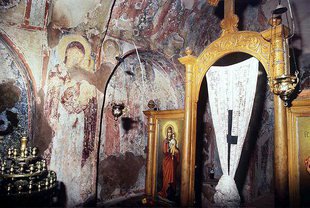
The church of the Panagia holds a special place. It stands in the middle of the ancient city, over an early Christian basilica whose mosaic floor survives in part; the basilica dates from the 5th or 6th century, and the mosaics came to light during building work on the site in 1963. The medieval church itself is dated to about 1250, and it is thought to occupy the place of an earlier temple of Apollo. According to local tradition, the present church was built with endowments from the Kantanoleon family. Inside, frescoes have survived on which not only saints are depicted but also the faces of the donors – the people who gave the means for the building and decoration of the church. The painting is thus at once a work of church art and a historical record of local society.
Georgios Kantanoleon and the memory of the revolt
The name of Georgios Kantanoleon is bound up with the church of the Panagia. He is remembered as the leader of a great revolt of the Cretan Christians against Venetian rule, dated variously to 1527 and to 1570; the story of the revolt has come down to us through different chronicles and later traditions.
Kantanoleon came from an influential family of Selino; his seat is associated with Koustogerako, a mountain village at 510 metres above Sougia. In the accounts of the revolt he appears as a landowner and military leader who succeeded in uniting the people of the district; the rising is described as a popular movement rooted in the grievances of the rural population over taxation and the abuses of Venetian officials, which began in 1523 in the Kerameia district near Chania with some six hundred armed men and spread to Sfakia, Selino and the mountains of Kydonia. The Venetian authorities crushed the movement, in the fuller accounts by a campaign of October 1527 that ended it within a month; the leader himself, also known as Lysogiorgis, was taken after a betrayal and executed. Koustogerako was burnt by the Venetians, twice, for being his birthplace, and villages that had supported the rising – Kerameia, Alikambos, Meskla – were razed. So the donor memorial in the church touches the political history of Crete without being absorbed into it: the fresco preserves above all the memory of a man and his family.
Rodovani today
Today Rodovani is a quiet mountain village and a convenient base for Elyros, Lissos, Sougia and the gorges of the south. One does not come for the archaeological ruins alone: the route links the ancient city, Byzantine churches, frescoes with donor portraits and the living rural culture of western Crete – and anyone who has the chance takes home a jar of the local honey. The village has a café, a grocer’s and a few rooms to let. The paths to the hill of Kefala and to the small churches lead through mountainous country; the site itself is unfenced and the walk from the village takes only a few minutes, but access to the churches, which are usually kept locked, should be arranged beforehand by asking in the village.