Plemeniana – a Selino village with the middle Byzantine church of St George and a frescoed church of the Saviour
The most complete guide to Crete: 221 places on the map, 23 routes and 49 articles — with photos, videos and the story behind every place. Everything is open and free: no sign-up, no paid sections and no advertising, open or hidden. You can install the guide on your smartphone as an app.
Routes drawn along real roads
Weather at every stop
Full-text search
“Near me” by geolocation
Create your own printable itinerary
Satellite, terrain, dark mode
Works offline
⌕
Searches 1.7 million characters of descriptions, not just names
—places
4regions
—routes
—with video
Search results
—
Interactive map
Find what is near you
Filters narrow the map and the list at once. Zoom out and pins group together.
Region
Category
Фильтры карты
Landmarks
Featured places
RegionCategory
Routes
Ready-made day trips
Individual places
Articles about landmarks
Plemeniana – a village on the road to Paleochora
Plemeniana (Πλεμενιανά) lies on the road from Kandanos to Paleochora, in the historic district of Selino, about three kilometres south-west of Kandanos, at the point where the road to Elafonisi and the west coast branches off. From here tracks also lead to Strovles, Kakodiki and the western shore. In the old travellers’ accounts the village was a halt on the route south; today it is a small community in which farming and stock-raising carry on among olive groves and vineyards. The valley belongs to the great, rain-fed olive country around Kandanos, reckoned the wettest corner of Crete, whose groves are among the oldest on the island – the same hills in which the painted churches of Kakodiki and Anisaraki lie within a few kilometres of one another.
In the days of the Cretan State, between 1898 and 1913, Plemeniana formed one administrative commune together with Kandanos, Kakodiki and Strovles. The historical records assign it to the district of Kandanos and to a network of thirteen neighbouring villages; today it belongs to the municipal unit of Kandanos within the municipality of Kantanos–Selino. The village is said once to have had nine churches – a sign of the weight that parish life carried in a comparatively small population. The village also shared the fate of 1941 with its surroundings: the villages around Kandanos lay within the zone of the fighting of 23 to 25 May, when the people of Selino held up the German column on the road to Paleochora, and of the reprisals that followed on 3 June, when Kandanos itself was burned and razed.
The church of St George
The principal sight of Plemeniana is the church of St George. It is a single-aisled, barrel-vaulted building of the middle Byzantine period; the present structure is assigned roughly to the 11th to 14th centuries. The western part was enlarged before 1900, which is why the church cannot be dated to a single year: its present form grew gradually, along with the growth of the parish, in the manner of so many Cretan village churches whose old core was lengthened westward as the congregation outgrew it.
The frescoes and the layout of the church are bound up with the religious life of the community and with the artistic tradition of western Crete, where in the 13th and 14th centuries village congregations commissioned painted interiors from travelling masters such as Ioannis Pagomenos and his workshop, active in the valleys of Selino between the 1310s and the 1350s. It is worth looking at the vault, the figures of the saints and the traces of successive repairs. The church is still used for worship. The key is usually to be had in the village; a torch is useful, since the interior is dim.
The church of the Saviour and its frescoes
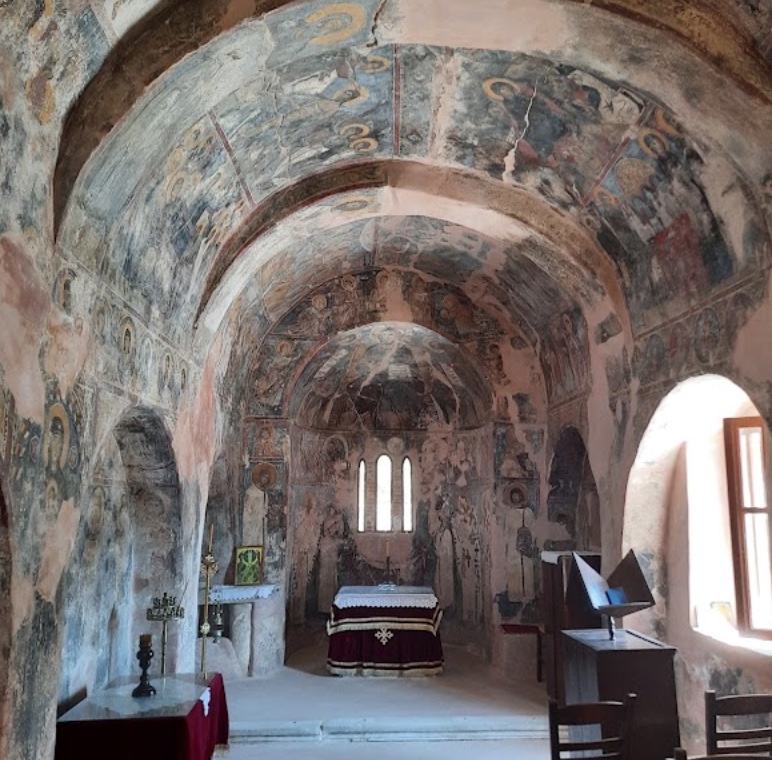
The village has a second church easily confused with the first, the church of the Transfiguration of the Saviour (Metamorfosi tou Sotira). It stands outside the village in an olive grove, reached by turning off the Kandanos road just beyond the junction for Elafonisi, and serves as the cemetery church, with the graves in its courtyard. It too is a long, barrel-vaulted hall of the middle Byzantine period, noticeably larger than the usual single-aisled chapels of Selino, ending in a broad semicircular apse; its west wall was taken down before 1900 and replaced by an extension. The rubble masonry is interspersed with brick and holds reused marble and stone members of older buildings – the church stands on the site of an early Christian basilica of the 5th or 6th century, whose carved pieces can be seen built into the walls and lying about the courtyard; a toothed brick band runs round the apse, and the restoration brought to light a three-arched window of the original build. Two painters furnished the interior: the first, towards the end of the 13th century, the east wall and the apse, in a manner that carries on the strong tradition of the preceding period; the second, in the 14th century, the rest of the space, in the more popular idiom of his day – and a third hand has been distinguished, with marked Western influence in its technique. Twenty-three large scenes from the life of Christ – among them the Transfiguration, the Baptism, the Nativity, the Presentation in the Temple, the Last Supper and the Dormition of the Virgin – thirty-six full-length saints and further busts survive in satisfactory condition after conservation, and the recent restoration has made the building one of the best-kept monuments of the district. In the neighbourhood of Plemeniana scholars also look for the cathedral church of medieval Kantanos, a church of Christ of the 14th and 15th centuries over older foundations.
Plemeniana and the historic route through Selino
From Plemeniana the road goes on to Kandanos, to its Byzantine churches, its gorge and the memorials of the German occupation, and afterwards down to Paleochora on the Libyan Sea, about twelve kilometres to the south; westward the road runs by Strovles and Elos towards Elafonisi. The small village opens up Selino not as a sequence of individual sights but as a connected web of villages, tracks, parishes and fields that has grown over centuries – a landscape in which almost every hamlet keeps a painted chapel, and in which the two churches of Plemeniana are among the oldest.