Elafonisi: the pink-sand lagoon and the memory of an island
The most complete guide to Crete: 221 places on the map, 23 routes and 49 articles — with photos, videos and the story behind every place. No sign-up, no trackers.
Routes drawn along real roads
Weather at every stop
Full-text search
“Near me” by geolocation
Create your own printable itinerary
Satellite, terrain, dark mode
Works offline
⌕
Searches 1.7 million characters of descriptions, not just names
—places
4regions
—routes
—with video
Search results
—
Interactive map
Find what is near you
Filters narrow the map and the list at once. Zoom out and pins group together.
Region
Category
Фильтры карты
Landmarks
Featured places
RegionCategory
Routes
Ready-made day trips
Individual places
Articles about landmarks
Elafonisi: pink sand and the memory of an island
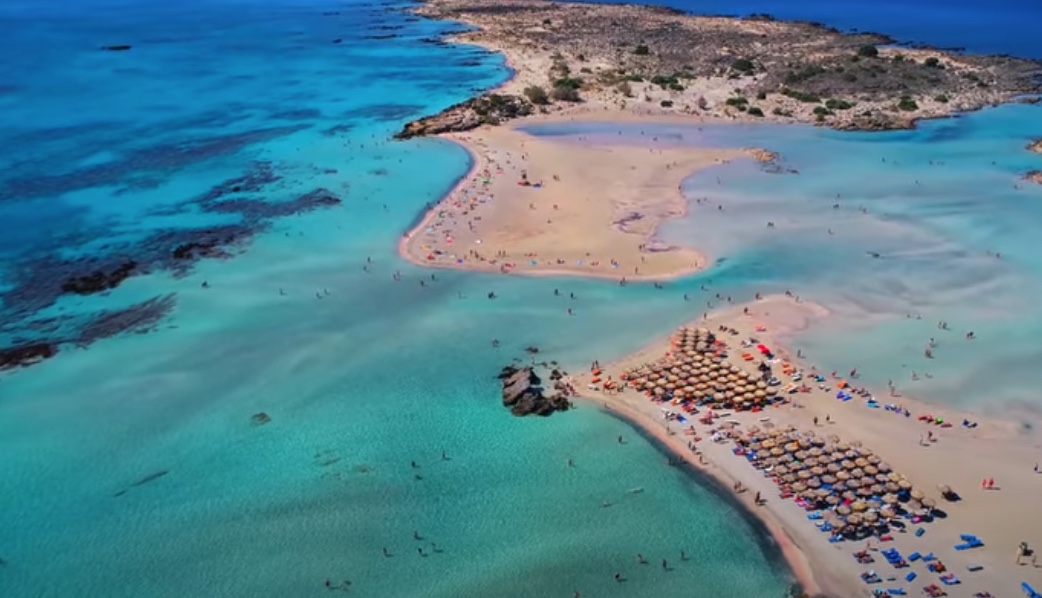
Elafonisi (Ελαφονήσι, Lafonisi in local speech) lies at the south-western tip of Crete, about five kilometres south of the monastery of Chrysoskalitissa and some seventy-five kilometres from Chania, in the municipality of Kissamos. A shallow arm of the sea barely 150 metres wide, its water seldom above the knee and rarely more than a metre deep, separates the islet – only about 0.3 square kilometres in area and 39 metres high – from the west coast; in calm weather you simply wade across, and when the sand banks build up after a spell of settled weather the channel sometimes closes altogether and you can cross dry-shod. The islet is in fact an oblong peninsula that the sea cuts in two, with a sheltered lagoon on its landward side and open beaches facing the Libyan Sea. White sand, turquoise water and low dunes have made Elafonisi one of the most unmistakable landscapes of Crete. The name is commonly read as “deer island”, although there were never any deer here; another explanation derives “Lafonisi” from lafyra, the booty of the pirates who once made these waters unsafe.
Why the sand shimmers pink
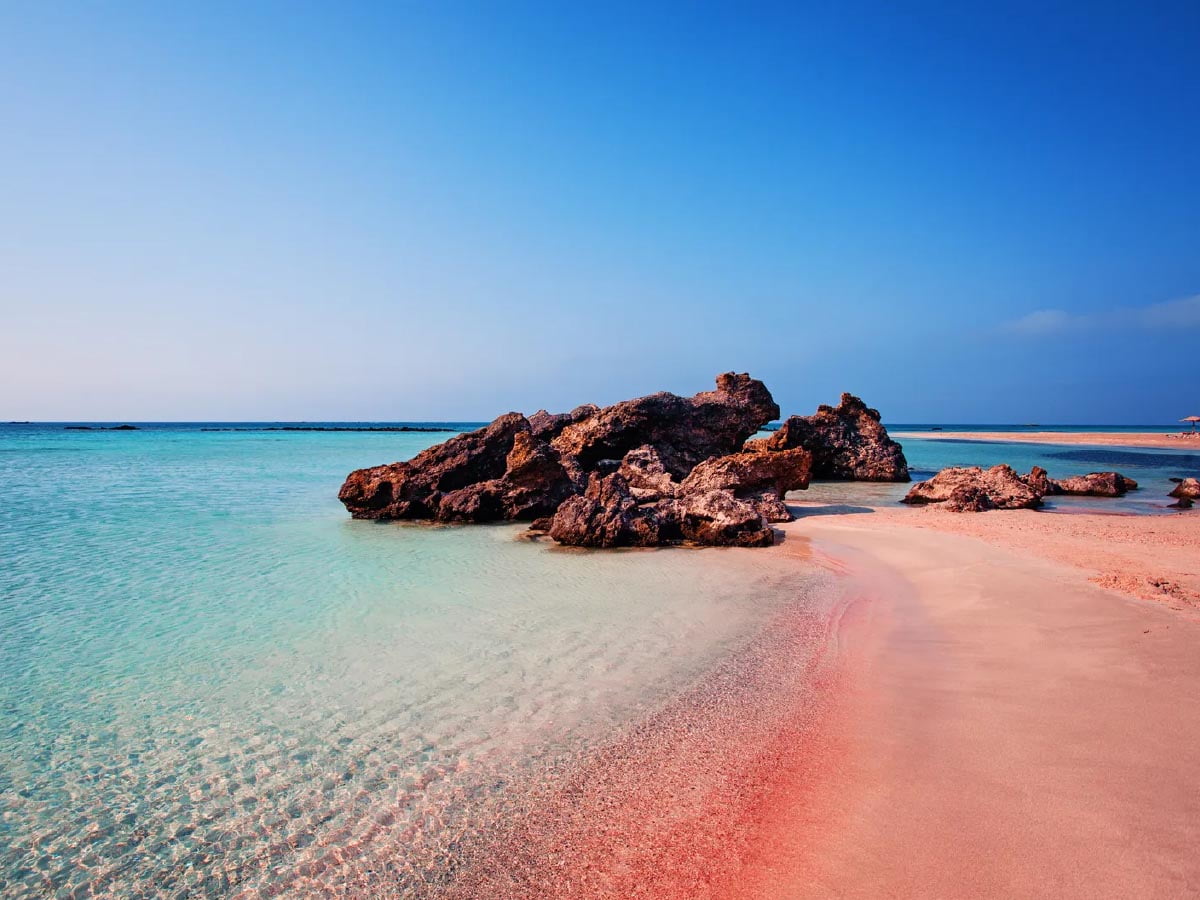
The pink shimmer arises where the pale sand is mixed with crushed shell, fragments of coral and the remains of microscopic marine organisms, among them foraminifera, whose reddish tests are ground down by the surf after they die; the pigmented organisms live in association with the seaweed of the shallows, and tide and wave carry their remains ashore. The colour changes with moisture, light and the force of the waves; it is strongest as a narrow fringe along the waterline and after a storm, and visitors who arrive expecting a uniformly rose-coloured beach are often surprised by how subtle it is on a dry, bright afternoon. In local speech Elafonisi is the “blood-coloured beach” – an image that keeps alive the memory of the tragedy of the 19th century.
The memory of the massacre of 1824
On Easter Sunday 1824 – 18 April by the Gregorian calendar, in the first week of April by the Julian calendar then in use in Greece – hundreds of civilians from the districts of Kissamos and Selino had taken refuge on Elafonisi: women, children and the old, together with about forty armed men. They were waiting for a ship that was to carry them to the Ionian Islands, then under British protection. Egyptian troops fighting on the side of the Ottoman Empire, under Ibrahim Pasha, occupied the shore opposite; when one of the horsemen – in another version a runaway horse – crossed the ford, the hiding place was discovered. A bloodbath followed. Some 640 people were killed; about 120 survivors were sold in the slave markets of Egypt.
On the highest point of Elafonisi a plaque commemorates the dead. The tragedy was an episode of the Cretan struggle for liberation, one of a series of reprisals that the Turkish-Egyptian army carried out along this coast in the same weeks, when ten churches of the district are said to have been destroyed. Popular interpretation traces the pink colour of the sand to the blood of the victims; the natural origin of the hue and the historical memory exist here side by side, without cancelling each other out.
Dunes and plant life
On the dunes grow marram grass, Ammophila arenaria, the sea daffodil – the “sea lily”, Pancratium maritimum, which flowers white in August and September – and the large-fruited juniper Juniperus oxycedrus subsp. macrocarpa, whose stands are now fenced off. Other sand plants include Anthyllis hermanniae, Silene sedoides, Lotus creticus subsp. cytisoides, Ipomoea stolonifera, Orobanche versicolor and Plantago squarrosa. On rocky ground thrive the shrubby orache Atriplex halimus, rock samphire Crithmum maritimum, Inula crithmoides, the caper Capparis orientalis, the tree spurge Euphorbia dendroides and the Phoenician juniper; the fig, Ficus carica, also occurs. A twenty-minute walk eastwards along the coast leads to Kedrodasos, the “cedar forest”, where the junipers form a genuine wood behind quieter beaches.
A phrygana survives in the interior of the islet, the low thorny cushion scrub of the south, with thyme, white thyme and wild marjoram. The species Androcymbium rechingeri and Centaurea pumilio, native only to a small area of western Crete, are particularly endangered by trampling and visitor pressure; the little Androcymbium flowers in December and January, when hardly anyone is here to see it.
Animal life and coastal protection
Elafonisi is a breeding place of terns; yellow-legged gulls and other seabirds can be seen as well, and in spring and autumn migrating birds rest here on their way between Africa and Europe. The Mediterranean monk seal lives in the surrounding waters, and on the beaches the loggerhead turtle Caretta caretta occasionally lays its eggs. On the islet and the neighbouring coasts there are Cretan wild cats, Erhard’s wall lizard Podarcis erhardii and larger lizards; in stony places one meets snakes. The protection, however, is directed above all at the dunes and the rare plants.
The wreck of the “Imperatrix” and the lighthouse
On 22 February 1907 – by the old calendar then in force in Greece, in the night of 9 to 10 February – the 118-metre passenger steamer “Imperatrix” of the Austrian Lloyd, bound from Trieste for Bombay with some 140 people on board, ran on to the reefs off Elafonisi in a storm. In a strong north-westerly thirty-eight people who had tried to reach the shore in a lifeboat lost their lives, Austrian seamen and Indian stokers; they were buried on the island. The monks of Chrysoskalitissa under their abbot Grigorios Plokamakis, who waded chest-deep into the surf, the people of the district and the crew of the Russian gunboat “Khivinets” all took part in rescuing the survivors, and 102 passengers were brought ashore alive.
A large wooden cross preserves the memory of the dead, and a chapel of St Nicholas, patron of sailors, was built in their memory. The “Imperatrix” herself still lies on the seabed off the rocks of the islet, barely a hundred metres from the shore. After the disaster a lighthouse was built on one of the hills, which entered service in 1922. It is one of the curious turns of fate on this coast that among its first keepers was the Russian admiral Nikolai Filosofov, who had commanded the “Khivinets” in 1907 and after the Revolution had come to Greece as a refugee: where he had once rescued the shipwrecked, he is said to have remarked, he was himself rescued as a castaway of life. The old lighthouse was destroyed by the Germans in the Second World War; today a modern metal tower replaces it, and a newer light at Agia Irini, further up the coast, carries a beam visible some thirty miles out to sea.
Notes for the visit
In high summer thousands come every day; anyone who wants the lagoon in quiet should choose May, June or September and the early morning or late afternoon hours, and from late October until April the beach is almost empty. Car parks, a few tavernas, showers and a limited number of sunbeds are to be found on the Cretan side; on the islet itself there is nothing – and so it should remain. The drive from Chania takes a good hour and a half by narrow, winding roads through the Topolia Gorge and Elos, and in season there are buses from Chania and a boat from Paleochora, which leaves in the morning and returns in the late afternoon. The eastern beach by the car park is the organised and the busiest part; the western shore and the far side of the islet are quieter, and walkers can follow the E4 European path west along the coast towards Paleochora. The often brisk west wind makes a sunshade that will not blow away a sensible precaution, and on windy days the sand stings.
Elafonisi is not merely a beach but a protected natural landscape and a place of archaeological and historical significance. Whoever visits it with care helps to preserve the dunes, the rare plants and the memory of the people whose fate is bound up with this coast.