Katsomatados and the Cave of Agia Sofia in the Topolia Gorge
The most complete guide to Crete: 221 places on the map, 23 routes and 49 articles — with photos, videos and the story behind every place. Everything is open and free: no sign-up, no paid sections and no advertising, open or hidden. You can install the guide on your smartphone as an app.
Routes drawn along real roads
Weather at every stop
Full-text search
“Near me” by geolocation
Create your own printable itinerary
Satellite, terrain, dark mode
Works offline
⌕
Searches 1.7 million characters of descriptions, not just names
—places
4regions
—routes
—with video
Search results
—
Interactive map
Find what is near you
Filters narrow the map and the list at once. Zoom out and pins group together.
Region
Category
Фильтры карты
Landmarks
Featured places
RegionCategory
Routes
Ready-made day trips
Individual places
Articles about landmarks
Katsomatados and the Cave of the Wisdom of God
At the hamlet of Katsomatados, in Greek Κατσοματάδω, the Topolia Gorge (Topoliano Farangi) begins. The narrow rocky defile runs for about a kilometre and a half between Topolia and Katsomatados, on the western outliers of the White Mountains and some 47 kilometres from Chania. Its walls, which rise sheer for as much as 300 metres and at the tightest point stand only a few metres apart, are grown over with plane trees, wild olives, oleander, thyme and other scrub, and numerous caves open in the limestone. The country road to Elafonisi clings high on the western slope and at the narrowest point squeezes through a single-lane tunnel controlled by traffic lights – 110 metres long, four metres wide and dug by hand in 1920, when Eleftherios Venizelos was prime minister. Far below, the Tiflos stream roars in winter.
The cave of Agia Sofia
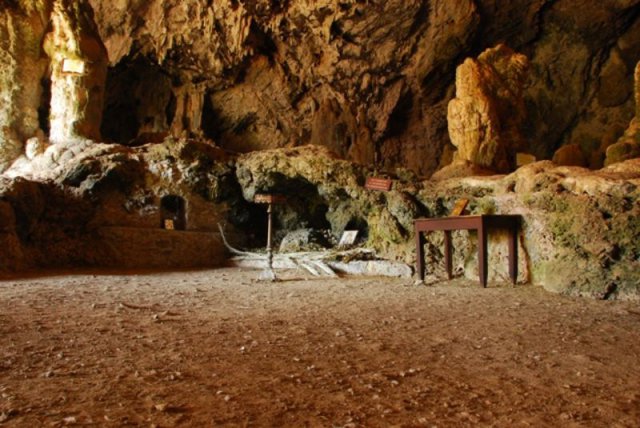
The best-known cave in the gorge is the Spilaio tis Theou Sofias, the “Cave of the Wisdom of God”, Agia Sofia for short. It opens on the western slope north of Katsomatados at about 285 metres above sea level. The great arch of the entrance is some twenty-five metres wide and ten high; the chamber behind it reaches a height of up to twenty metres and measures roughly seventy metres by seventy. Inside stand whole groups of stalactites and stalagmites, which the water circulating in the limestone has built up over thousands of years, though the cave today is for the most part dry; some of the columns have names of their own in local speech, and one mark in the rock is shown as the hoofprint of St George’s horse. The cave consists of two chambers lying on different levels.
The church in the rock
Against the left-hand wall of the entrance chamber stands the little church of Agia Sofia. The rock forms one of its walls, so that chapel and cave appear as one space; the entrance area has been carefully levelled for the pilgrims. The patronal feast is kept on the Tuesday of Bright Week, that is the Tuesday after Easter, when the Orthodox Church is still celebrating the joy of the Resurrection; a second feast is held on 24 December. On Easter Tuesday the people of the surrounding villages climb up for the liturgy, and the chamber fills with candlelight and incense.
The legend of the icon from Constantinople
According to local tradition, Cretan fighters – others say Cretan merchants and seamen – rescued the icon of the Wisdom of God from Justinian’s great church after the fall of Constantinople in 1453, to save it from desecration. The current carried the image to the rocks of Topolia, it found its way into the cave, where it was discovered wedged in the rock, and on that spot the church was set up. Some tellers add that the image was painted by St John the Evangelist himself. Another version tells of a shepherd who for several nights saw a light shining in the rock, found the icon and told the villagers of his discovery.
The memory of Bishop Michail Psaromilingos
The cave is also bound up with the memory of Michail Psaromilingos, Bishop of Kissamos, whom local tradition places in the Venetian period, in the 14th century. In one of the chambers, screened off by flowstone formations, visitors are shown the “Despotiko” – the place where the bishop is said to have hidden with his brother and met a martyr’s death. A darker version of the story has it that the bishop himself persuaded his nephew, a wanted rebel, to kill him and the young man’s own father, so that they should not fall alive into the hands of their pursuers – a sacrifice for the freedom of Crete that has hallowed the cave still further in popular feeling. In 1915, when the forecourt was being cleared, two beheaded skeletons came to light; church memory connects them with the Psaromilingos family and records that they were laid to rest beneath the altar.
The cave as a natural monument
Pottery from the Neolithic, from Early and Late Minoan, Classical, Hellenistic and Roman times has been found in the cave, together with a clay figurine of the 4th century BC, which turned up in 1963; the finds show that people have been coming here for some eight and a half thousand years – as a dwelling, a refuge and probably from early on as a place of cult. The cave is also home to the rare cellar spider Pholcus creticus, a species with a tiny range, known only from this one cave. Formations and living creatures alike must therefore be neither damaged nor taken away.
Practical notes for the visit
From a lay-by on the road a short, steep flight of a good two hundred steps leads up to the cave in about ten minutes; on the way the view opens into the gorge. Inside it is dim, the floor uneven and in places damp – closed shoes and care are called for, and a torch is useful. The path is not suitable for wheelchairs. The barriers must not be crossed: the cave is at once a natural monument and a place of prayer. Admission is free; a candle or a small donation is welcome.
The gorge itself can be walked on a path along the stream bed in an hour to an hour and a half; the going is over boulders, loose gravel and uneven ground. In winter and spring it may carry water, and by June the bed is usually dry. Griffon vultures circle above the cliffs, and in the tavernas of Katsomatados what reaches the table is what the district yields: chestnuts, honey, cheese and olive oil.
The drive to Katsomatados combines conveniently with a visit to Topolia, the gorge and other places of historic interest in western Crete on the way to Elafonisi. Ancient tradition, too, has left its mark on the ravine: local lore associates it with the goddess Britomartis and with Talos, the bronze giant who guarded Crete.