Floria – frescoed churches and a battlefield of 1941 in the hills of Selino
The most complete guide to Crete: 221 places on the map, 23 routes and 49 articles — with photos, videos and the story behind every place. No sign-up, no trackers.
Routes drawn along real roads
Weather at every stop
Full-text search
“Near me” by geolocation
Create your own printable itinerary
Satellite, terrain, dark mode
Works offline
⌕
Searches 1.7 million characters of descriptions, not just names
—places
4regions
—routes
—with video
Search results
—
Interactive map
Find what is near you
Filters narrow the map and the list at once. Zoom out and pins group together.
Region
Category
Фильтры карты
Landmarks
Featured places
RegionCategory
Routes
Ready-made day trips
Individual places
Articles about landmarks
Floria – a mountain village of Selino
Floria (Φλώρια) is an old village in the district of Selino, on the road between Kakopetros and Kandanos, some 48 kilometres south-west of Chania and about 650 metres above sea level; it belongs today to the municipality of Kantanos–Selino. The village is made up of two parts, Ano Floria and Kato Floria, the upper and the lower village, and the most recent census counted only about sixty permanent residents. Around it lie wooded slopes and fertile ground on which cereals, vines, chestnuts and olives thrive; the name is usually traced to the Latin and Italian fiore, “flower”, and taken to refer to the abundance of blossom in the district. That very fertility explains why a sizeable Muslim population settled here under Ottoman rule; around 1890 the Turkish landowners sold their estates to prosperous Cretans. Floria has kept the look of a mountain village and makes a natural halt on the way to the gorges of the south coast – the road that passes through it is the old route from Tavronitis on the north coast over the hills to Kandanos and Paleochora, the same road along which the fighting of 1941 took place.
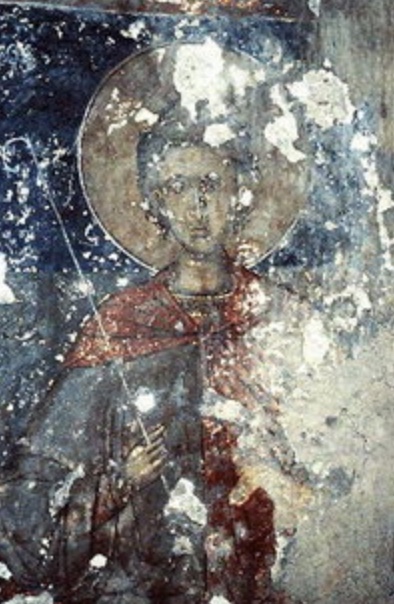
Floria has two churches of particular importance for the history of the district: the church of the Holy Fathers (Agii Pateres) in Ano Floria and the church of St George at Kato Floria. The church of the Holy Fathers is placed in the 15th century, its building dated to about 1462. In it survive frescoes associated with the name of Xenos Digenis, one of the notable masters of Cretan church painting – an itinerant painter from the Peloponnese, a native of the castle town of Mouchli in Arcadia, whose signed works are found on Crete and on the mainland alike. His Cretan work in the Chania region belongs to the years around 1470; later he is documented at the monastery of Myrtia in Aetolia, where a signed inscription of 1491 records him, and in 1493 at the church of the Dormition at Frastana in the Pogoni district of Epirus. His manner blends the Cretan painting of the 15th century with the late Palaiologan tradition, and his influence can be followed through the travelling painters of western Greece for a generation after him. Most of the paintings at Floria are now damaged.
The church of St George is a single-aisled, barrel-vaulted building of the Venetian period, its nave divided into two bays by a transverse arch; a modern wooden iconostasis now closes off the sanctuary. Its cycle of frescoes is dated to the year 1497 and is the work of Georgios Provatopoulos: the dedicatory inscription names him, with the painter’s customary humility, as the “sinner” Georgios Provatopoulos who both designed and painted the church, and gives the day of completion as 28 July of the Byzantine year 7007, that is 1497. The same inscription records the donors: Stamatis Floriotis with his wife and children, Nestor Floriotis and his family, and a whole clan of Floriotis kinsmen – Georgios, Stamatis, Theodoros, Ioannis and Petros – who evidently took their surname from the village itself. In the sanctuary Christ Pantokrator presides over four officiating bishops, among them St Basil and St John Chrysostom; the vault carries the Ascension, with the Annunciation and the Nativity; in the nave are scenes from the martyrdom of St George – the cauldron, the wheel, the beheading – alongside the Transfiguration, the Raising of Lazarus and the Dormition of the Virgin, and a gallery of mounted military saints and monastic figures, the best-preserved part of the whole. Soot has darkened much of the rest. The paintings speak the language of late Byzantine iconography as it continued to develop in the particular artistic milieu of Venetian Crete – a few decades after the fall of Constantinople, when the island had become the principal refuge of Orthodox painting.
The name of the church of the Holy Fathers has a collective meaning. In Orthodox tradition the “Holy Fathers” are the teachers of the Church and the defenders of its faith; the dedication therefore honours not a single saint but a whole succession of ecclesiastical masters – the Fathers of the Ecumenical Councils are commemorated under this title in the church calendar. In Selino the name also calls to mind the 99 Holy Fathers, the hermits gathered around St John the Hermit (Agios Ioannis o Xenos, “the Stranger”), whom the Cretan Church commemorates on 7 October; the tradition of these ascetics is strong in the whole west of the island, where many a chapel and cave is linked with them. Both churches bear witness to the survival of the local community through the centuries of Venetian and Ottoman rule.
Floria and the resistance to the German occupation
In the first weeks of the German assault on Crete the people of Floria took part in the armed resistance. On 23 May 1941 – the fourth day of the battle, the day after the mountain troops had landed at Maleme – a motorised German detachment of the 5th Mountain Division, men of the 55th Motorcycle Battalion and the 95th Anti-Tank Battalion riding motorcycles with machine guns mounted on their sidecars, pushed south from Maleme towards Kandanos and the coast at Paleochora. Near the village they ran into men from Selino and Kissamos who had decided, quite spontaneously, to bar the way; armed with obsolete muskets, scythes, sticks and stones, and helped by the gendarmes of Selino, they inflicted painful losses on the column, and the fighting went on in the gorge of Kandanos on 24 and 25 May. In August of the same year local fighters burned six German vehicles at the spot called Anavos. The occupation authorities answered by setting fire to Floria twice – on 25 May 1941 and, with devastating consequences, on 15 August 1944. Villagers were executed, others deported to concentration camps.
On the main square stands a memorial to the inhabitants of Floria who lost their lives during the occupation; among the names are also a soldier of the Balkan War of 1913 and a man who fell in the campaign against the Italians in Albania in 1940–41, so that the monument gathers the whole century’s sacrifice. The memorial and the commemorations attached to it recall not merely individual executions and acts of destruction but the fate of all Selino, where resistance brought collective retribution. In the surroundings there is also a German memorial to fallen soldiers, set up by the 5th Mountain Division for the dead of the 95th Battalion in the very weeks of the fighting and restored since by German veterans; it stands by the road directly opposite the Greek monument, which is inscribed in Greek simply as the Floria Greek Memorial to the Fallen. It is one of the few German war memorials on Crete, still attracts German visitors and has repeatedly been the object of controversy. Its presence reflects a difficult and painful layer of post-war remembrance.
What there is to see, and where the road leads on
In Floria one can visit the church of St George, the church of the Holy Fathers and the memorial to the victims of the occupation, with the German monument across the road from it; afterwards the journey continues to Kandanos, back to Kakopetros or on to the passes of the south – Kandanos lies only about ten kilometres down the valley, and Paleochora on the Libyan Sea some 25 kilometres beyond it. The frescoes are in churches where services are still held; it is best to ask beforehand whether the interior is open – often a neighbour or the kafenion keeps the key. The painted interior of St George rewards a long look with a torch, since the soot-darkened scenes emerge only slowly. The village is pleasantest in spring, when the slopes that gave it its name are in flower, and in autumn, when the chestnuts ripen.