Sfakia – the mountain country: Anopoli, Loutro and Aradena
The most complete guide to Crete: 221 places on the map, 23 routes and 49 articles — with photos, videos and the story behind every place. No sign-up, no trackers.
Routes drawn along real roads
Weather at every stop
Full-text search
“Near me” by geolocation
Create your own printable itinerary
Satellite, terrain, dark mode
Works offline
⌕
Searches 1.7 million characters of descriptions, not just names
—places
4regions
—routes
—with video
Search results
—
Interactive map
Find what is near you
Filters narrow the map and the list at once. Zoom out and pins group together.
Region
Category
Фильтры карты
Landmarks
Featured places
RegionCategory
Routes
Ready-made day trips
Individual places
Articles about landmarks
Sfakia – the mountain country of Crete
Sfakia (Σφακιά) is a historic district in the south-west of Crete, cut off from the rest of the island by the White Mountains, by gorges and by arduous passes. The word “Chora” in the name Chora Sfakion denotes the chief settlement, but literally it means “land” or “country”. For the Sfakians it is this second sense that holds good: what is meant is not merely a village but an entire mountain world, with its hamlets, harbours, customs and historical memory.
Geographical seclusion bred a strong sense of community. For centuries the Sfakians kept to their rules of hospitality, the solidarity of the family and a code of honour of their own. Popular memory also preserves the blood feud, the vendetta; it is a historical custom and not a description of the people who live here now. Black clothing, enclosed paved courtyards, wells, bread ovens and the gun in the old house belong to the traditional picture of Sfakia. Present-day Chora Sfakion has changed markedly on account of its harbour, from which the ferries leave for Loutro, Agia Roumeli and the island of Gavdos, yet the mountain villages keep the old way of building and of living.
Papa Georgios Chiotakis and the memory of Sfakia
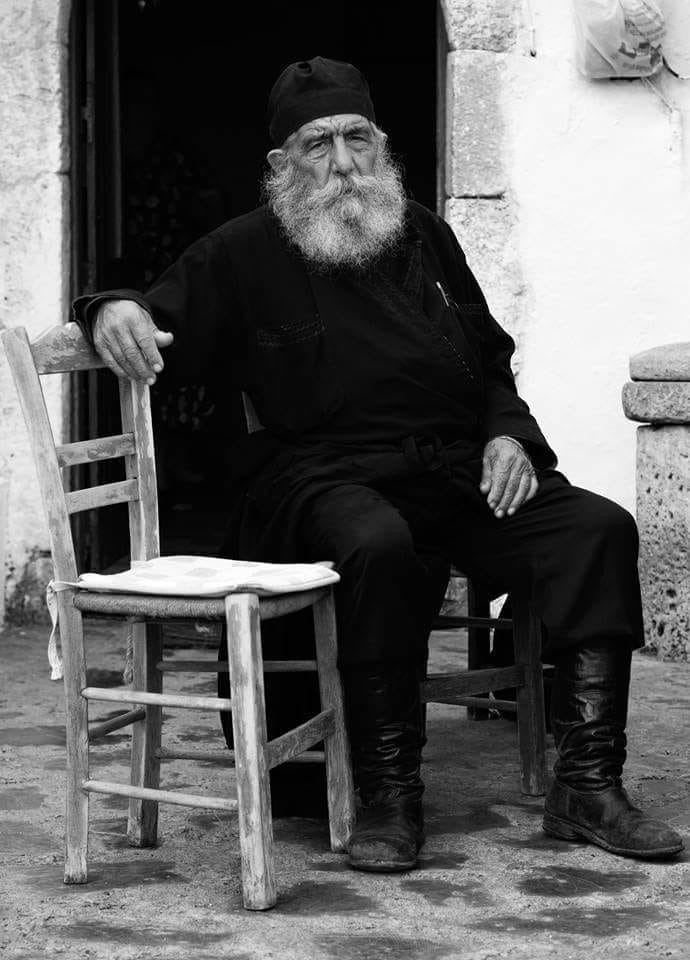
Part of the local story is the priest Georgios Chiotakis, known in Sfakia as Barba-Georgios. During the German occupation he held services in the churches of remote villages so that the liturgy and the commemoration of the dead should not lapse. He was the father of twelve children and a spiritual counsellor to many. Local tradition relates that St Porphyrios, on a visit to Sfakia, struck up a friendship with him; once, it is said, Barba-Georgios carried the aged monk across a river on his shoulders, and on the way back the two found themselves on the far bank dry-shod – an episode handed down as one of the marvels of the district’s religious memory.
His sayings have come down as evidence of a home-grown ethical outlook: education, he held, does not of itself make a man wise; the official Church and the state are there to serve the people; and land must not become unrestricted property. He called for reconciliation committees to be set up to forestall blood vengeance, and distinguished between carrying arms and the responsibility of knowing how to handle them. These words show not the romance of the vendetta but an attempt to put a stop to it.
Among the sentences recorded of Barba-Georgios are these: “All those who enslave society today hold university diplomas and take the people for a stupid mass that the current carries wherever it will. Progress does not need much; a little is enough. But it is just that little which many lack.” He said: “There is nothing crooked in Orthodoxy, though there are crooked people”; “Property and theft are one and the same offence. A man may be the user of the land, but not its owner”; and, in the words of Scripture: “The land shall not be sold for ever: for the land is mine; for ye are strangers and sojourners with me” (Leviticus 25:23, King James Version). Of the bearing of arms he said: “To carry weapons is not right, but instruction in the art of handling a weapon is a national duty. He who settles on victory beforehand in order to fight is a fool. The moment I enter the fight I am already the victor.”
Anopoli and the legacy of Daskalogiannis
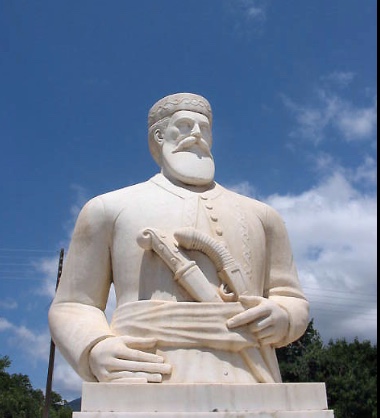
Anopoli (Ανώπολη) is a mountain settlement beside an ancient city, lying some 600 metres up on a fertile plateau and reached from Chora Sfakion by a boldly winding road of twelve to thirteen kilometres. The village is scattered over eleven hamlets. Its valley is ringed by the summits of the White Mountains, and from the hill of St Catherine the view opens over the Libyan Sea, with Loutro directly below. In the middle of the village, on the square, stands the monument to Ioannis Vlachos, known as Daskalogiannis; Chania’s international airport also bears his name. Close by are the church of St Catherine and old paths leading to the ancient walls. The bakeries and tavernas of the place offer Sfakiani pita and paximadi with sesame and herbs. The inhabitants live by stock-raising, the olive, bee-keeping and, increasingly, by walkers.
Ancient Anopolis was an independent city that struck its own coins and is recorded as an ally of Eumenes II of Pergamon; it flourished in Roman and Byzantine times. Its ruins lie on St Catherine’s hill to the west and south-west of the modern village, where a stretch of Cyclopean wall survives on the northern side. Under Venice the district was a seat of resistance: after the suppression of the Kallergis revolt of 1365 the Venetians, according to tradition, destroyed Anopoli utterly and forbade all settlement and grazing for a hundred years. It was laid waste a second time in 1770.
The rising of 1770
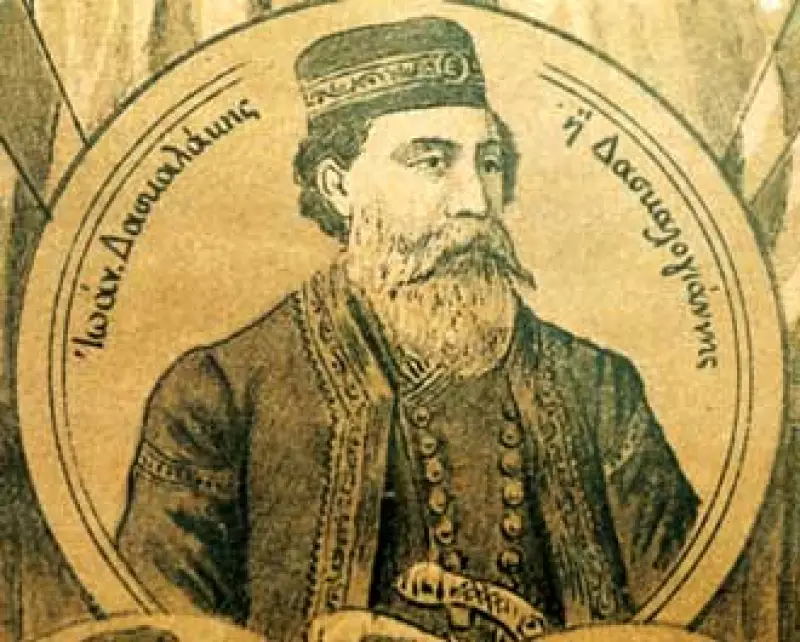
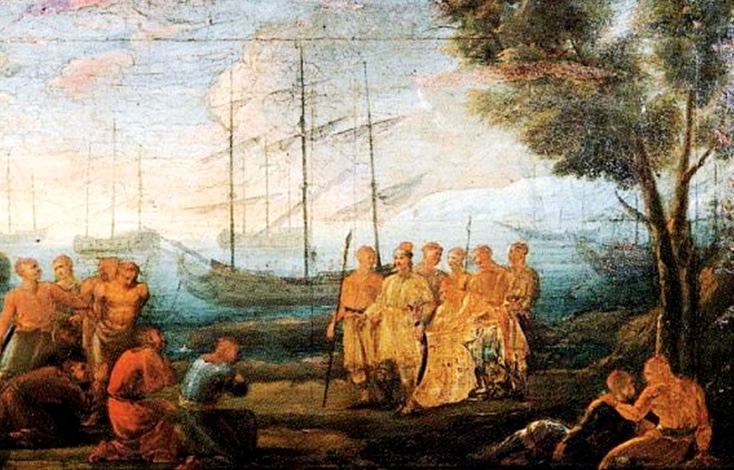
Ioannis Vlachos was born at Anopoli around 1725, into a family connected with seaborne trade and with Moldavia; the byname Daskalogiannis – “Giannis the teacher” – points to his education. His father, himself a prosperous shipowner, had sent him abroad to study, probably to Italy. He became a wealthy shipowner in his turn, with four three-masted vessels that traded in the ports of the Mediterranean and the Black Sea. In 1770, during the Russo-Turkish War and the Orlov revolt, he sent Sfakians to the Peloponnese in support of the movement and then put himself at the head of the rising in Sfakia itself, trusting in Russian promises of help that proved empty. Anopoli raised the flag in March; some 1,300 men were under arms, and the rebels are even said to have set up a mint in a sea cave west of Chora Sfakion. They refused to pay the poll tax and forced the Ottoman garrisons to withdraw into the fortresses. When a large army arrived, the Ottoman troops destroyed the villages; the Sfakians fell back into the mountains and carried on the struggle as a guerrilla war.
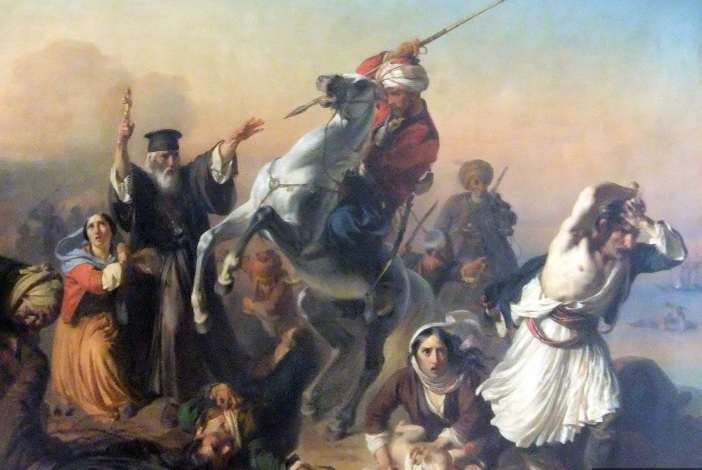
By the winter of 1770–71 the population was exhausted. Daskalogiannis agreed to give himself up, in the hope of halting further bloodshed and saving the inhabitants; he surrendered at Frangokastello, and some seventy-five other leading men, priests among them, were lured into captivity and taken to the capital with him. On 17 June 1771 he was executed in Chandax; Cretan tradition relates that he was flayed alive in public view, and that his brother, forced to watch, lost his reason. Folk songs – above all the long ballad of the cheese-maker Barba-Pantzelios, taken down in 1786 – and the annual commemorations at Anopoli, held on the first Sunday after 17 June, have kept his memory alive. His sacrifice became one of the symbols of Crete’s later struggle for freedom.
Tradition describes the execution of Daskalogiannis in vivid images of imprisonment and a martyr’s death. Chandax is the old name of Candia, the present-day Heraklion.
Loutro and ancient Phoenix
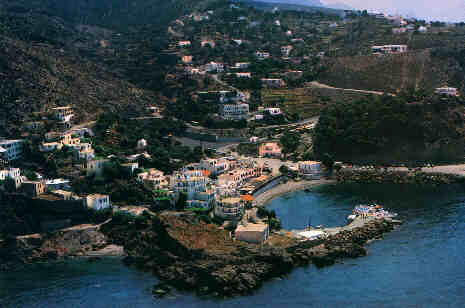
Loutro (Λουτρό) is a small coastal village of white houses with blue shutters, set like an amphitheatre round a sheltered bay. There is no road; one arrives on foot – by the steep path down from Anopoli, say, or along the E4 coastal trail – or by boat from Chora Sfakion in about twenty minutes. Above Loutro, on the promontory, lie the remains of the ancient harbour of Phoenix, the trading station of Anopolis and the territory of Aradena, through which shipping between east and west passed. It was one of the very few natural harbours on the south coast of Crete and the only one safe at all seasons, and it is the Phenice of the Acts of the Apostles, where the ship carrying St Paul to Rome hoped to winter but which it never reached. The site has not been excavated: sherds and fragments of columns lie scattered over the cape, alongside the ruins of medieval buildings, a Turkish fort and two chapels, and the bay to the west still carries the old name as Finikas. The monastery of the Mother of God is linked in local memory with the activity of the government of Sfakia during the rising of 1821.
Aradena – gorge, bridge and churches
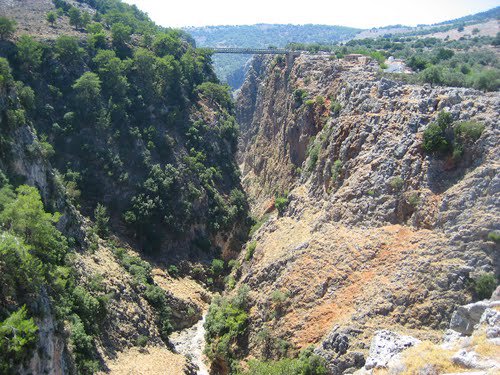
Aradena (Αράδαινα), the ancient Aradin, lies three and a half kilometres beyond Anopoli at about 520 metres and is all but deserted; local memory puts this down to a vendetta lasting years which, the story goes, flared up around the middle of the 20th century over a trifle – a quarrel about a goat’s bell. Like Anopolis, the ancient town was independent and had its own coinage, and like Anopoli the village was devastated in 1770. What remains are the ruins of the ancient city in the locality of Pessoporta and the restored church of the Archangel Michael, known locally as Astratigos, which dates from the 14th century, stands over the remains of an Early Christian basilica and preserves wall paintings; its feast is 8 November. The village sits on the lip of a deep gorge crossed by the steel Vardinogiannis Bridge, the gift in 1986 of the family of that name, which comes from neighbouring Agios Ioannis. It hangs 138 metres above the bed and is reckoned the highest bungee-jumping site in Greece.
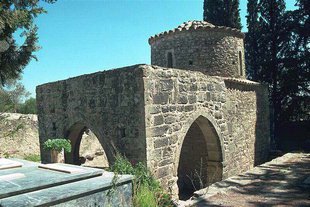
At Agios Ioannis the Byzantine churches of St John, the Mother of God and St Paul survive, with wall paintings. In the courtyard of St Paul’s rises a spring which local tradition holds to be hallowed: the Apostle Paul is said to have baptised pagans here during his stay in Crete. From the village one looks out over the Libyan Sea and the snow-covered peaks of the White Mountains; according to the traditional account, the road to Frangokastello continues from here.
The myth of Akakallis and the sun god
Sfakian tradition connects the district with the myth of Akakallis – a nymph who caught the eye of Apollo. In the poetic retelling, their encounter in the sanctuary at Tarra delayed the sunrise: the world sank into cold and dread until the god returned to his heavenly chariot. In another version the hero is called Helios. This is not history but a mythical reading of the particular bond between Sfakia and sunlight, sea and sacred gorges.
Anopoli and Aradena are among the ancient cities of Sfakia named in the sources of antiquity. Their outlet to the sea was Phoenix – on the site of modern Loutro, which was accordingly regarded as the “lower town” of Anopolis. The shoreline there stood between about 3.7 and 6 metres higher in antiquity than it does now, so that the ancient anchorage was rather differently shaped, and an inscription set up by an Alexandrian shipowner in the 2nd century AD shows the kind of traffic that called. In Byzantine times Phoenix remained an important harbour and the seat of a bishop; today Loutro keeps this tie to the sea, although it can be reached only on foot or by boat.
The name Sfakia is explained in various ways: it is linked both with the local word sfaka for the oleander and with ancient names of the district. More important is that under Venetian and Ottoman rule alike the region retained communal institutions of its own. Its history therefore consists not only of armed risings but also of an intricate web of ties of kinship, church and economy.