Amiras: the memorial to the victims of Nazism in Viannos
The most complete guide to Crete: 221 places on the map, 23 routes and 49 articles — with photos, videos and the story behind every place. Everything is open and free: no sign-up, no paid sections and no advertising, open or hidden. You can install the guide on your smartphone as an app.
Routes drawn along real roads
Weather at every stop
Full-text search
“Near me” by geolocation
Create your own printable itinerary
Satellite, terrain, dark mode
Works offline
⌕
Searches 1.7 million characters of descriptions, not just names
—places
4regions
—routes
—with video
Search results
—
Interactive map
Find what is near you
Filters narrow the map and the list at once. Zoom out and pins group together.
Region
Category
Фильтры карты
Landmarks
Featured places
RegionCategory
Routes
Ready-made day trips
Individual places
Articles about landmarks
The memorial at the Amiras–Arvi junction
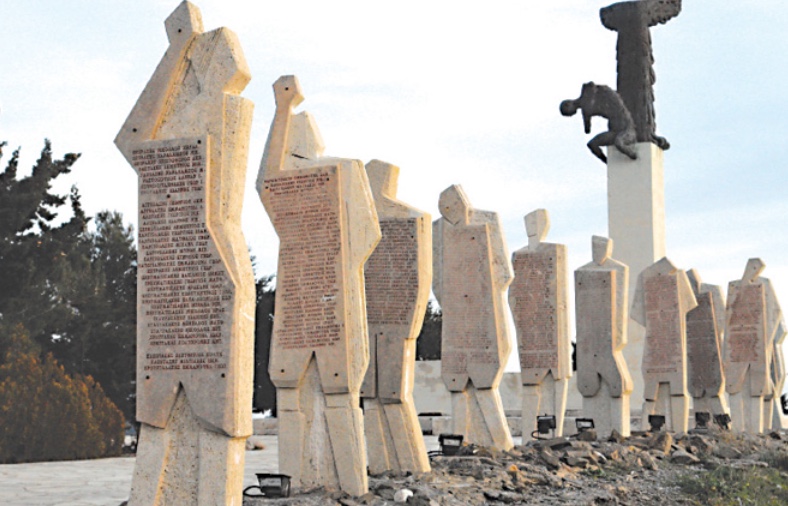
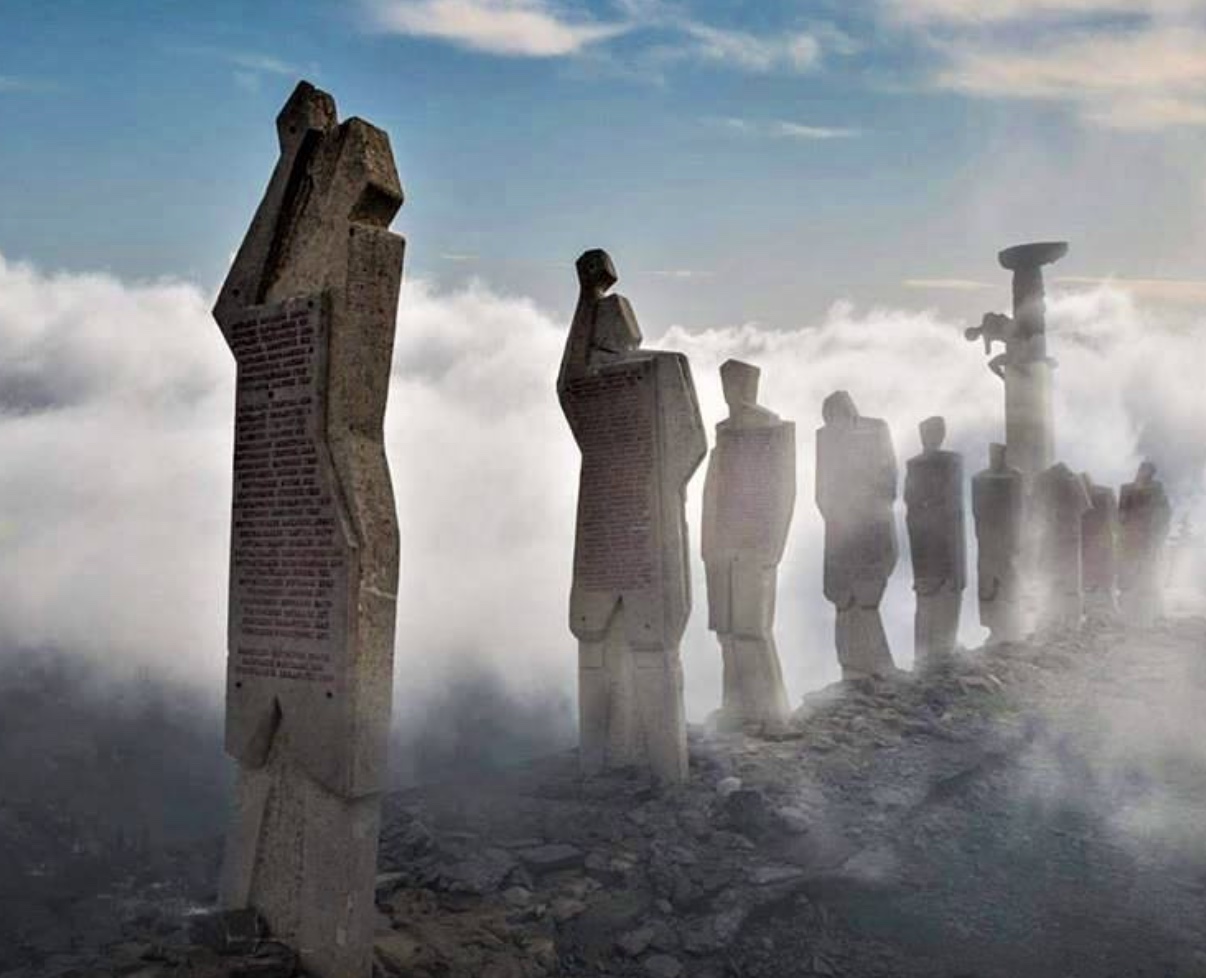
About 6.5 kilometres from Ano Viannos, where the road to Arvi leaves the main road at Amiras, rises a memorial to 1,181 inhabitants of this district who are said to have been shot by the German occupying forces on 14 September 1943. The monument stands in the very landscape in which the events of the “Holocaust of Viannos” took place. It does not commemorate a single engagement but the systematic destruction of the civilian population. The design, by the Heraklion-born sculptor Yiannis Parmakelis working with Antonis Pavlakis, is deliberately plain: a central column in marble, stone and concrete carries the figure of a fighter bowed at the feet of a winged Victory, and around it stand eleven further pillars with human figures, some raising a clenched fist, on which the names of the dead are inscribed. Broad slopes of olive grove, pasture and scrub, with the heights of the Dikti Mountains behind, give it a setting that invites a pause for thought rather than a long stay. A small museum beside the monument documents the occupation and the resistance; there is room to park at the roadside, and the memorial itself can be visited at any hour.
The reprisal operation of September 1943
The operation was the German command’s answer to the activity of the Cretan resistance. After Italy’s surrender, announced on 8 September 1943, the partisan bands in the Dikti Mountains grew stronger and bolder; the Italian commander in eastern Crete, General Angelico Carta, was smuggled off the island to Egypt, and many Cretans believed an Allied landing to be only days away. The band of Manolis Bandouvas took part in fighting near Kato Symi in which German soldiers were killed: on 10 September his men attacked a German outpost there and killed its two soldiers, and two days later an infantry company sent to investigate was beaten off after a battle that lasted until late afternoon, with heavy losses and a dozen men taken prisoner. The command under General Friedrich-Wilhelm Müller, notorious on the island as the “Butcher of Crete”, thereupon ordered the district of Viannos to be destroyed: males over the age of 16 and anyone found in the open country, whatever their age or sex, were to be shot without trial. After the engagement at Kato Symi the German units – drawn from the 65th Infantry Regiment of the 22nd Air Landing Division – began a wide-ranging operation against the villages of Viannos and western Ierapetra. In the days that followed, inhabitants of Amiras, Kato Symi, Pefkos and many other places were shot, and the houses and farms of numerous villages were burnt to the ground. More than 2,000 German soldiers are said to have taken part; about a thousand houses were destroyed, livestock was killed and the villages were plundered. Some two hundred people were taken hostage, and the survivors were forbidden to bury their dead or to return to their homes.
Manolis Bandouvas and the Cretan resistance
Manolis Bandouvas, born in 1897 at Ano Asites in the hills south-west of Heraklion, was one of the leaders of the Cretan resistance movement and at this time had his hideouts in the mountains of Viannos. A veteran of the First World War, the Asia Minor campaign and the Battle of Crete, he swore in his first armed band as early as June 1941. His group brought together fighters of differing political allegiances and kept in touch with the Allied representatives on the island – the British agents of the Special Operations Executive, who gave him the code name “Bo-peep”. The story of Bandouvas helps to explain the military background to the tragedy; the memorial itself, however, is dedicated first and foremost to the unarmed people who lost their lives in the course of the reprisals.
Numbers of victims and remembrance
The figure of 1,181 relates to the victims of the reprisals in the wider area of Viannos and Ierapetra. The total depends on which villages and which periods of the occupation are counted; the number most often cited is around 460 to 500 murdered in the days of the main operation alone. The massacre is regarded as one of the largest of civilians in occupied Greece, second only to Kalavryta. After the liberation a commission for the investigation of war crimes, whose members included Nikos Kazantzakis, travelled round Crete from the end of June to early August 1945 and recorded witness statements and evidence. General Müller, captured by the Red Army in East Prussia and handed over to Greece, was sentenced to death by a Greek military court in December 1946 and shot on 20 May 1947, together with Bruno Bräuer, another former commander of the island; no one else was ever brought to justice for Viannos. For local memory 14 September remains the common day of mourning; every year commemorations with the laying of wreaths are held at the places where the killings took place.
A place of remembrance
The memorial impresses by its restraint. It should be understood as a place of memory, where the geography of southern Crete meets the history of occupation, resistance and civil courage. Visitors to the district can combine the memorial with a drive through the villages of Viannos, nearly all of which have their own memorial tablets and chapels for the dead.