Panagia Kardiotissa: the icon of Kera and its journey from Crete to Rome
The most complete guide to Crete: 221 places on the map, 23 routes and 49 articles — with photos, videos and the story behind every place. No sign-up, no trackers.
Routes drawn along real roads
Weather at every stop
Full-text search
“Near me” by geolocation
Create your own printable itinerary
Satellite, terrain, dark mode
Works offline
⌕
Searches 1.7 million characters of descriptions, not just names
—places
4regions
—routes
—with video
Search results
—
Interactive map
Find what is near you
Filters narrow the map and the list at once. Zoom out and pins group together.
Region
Category
Фильтры карты
Landmarks
Featured places
RegionCategory
Routes
Ready-made day trips
Individual places
Articles about landmarks
An image that joins two churches
There are few images before which Orthodox and Catholic Christians pray with the same fervour. This icon is one of them. According to tradition it was painted long before the schism of 1054, and so, in the eyes of the faithful, it preserves something of the invisible unity of Christendom: in the East it is called Panagia Kardiotissa (Παναγία Καρδιώτισσα), the Mother of God of the Heart, in the West Our Lady – or Our Mother – of Perpetual Help. It once stood in the monastery of Kera on the northern slope of Dikti; today it hangs above the high altar of the Redemptorist church of Sant’Alfonso on the Esquiline in Rome – and between those two places lies a story that reads like a novel.
Kera Kardiotissa Monastery below Dikti
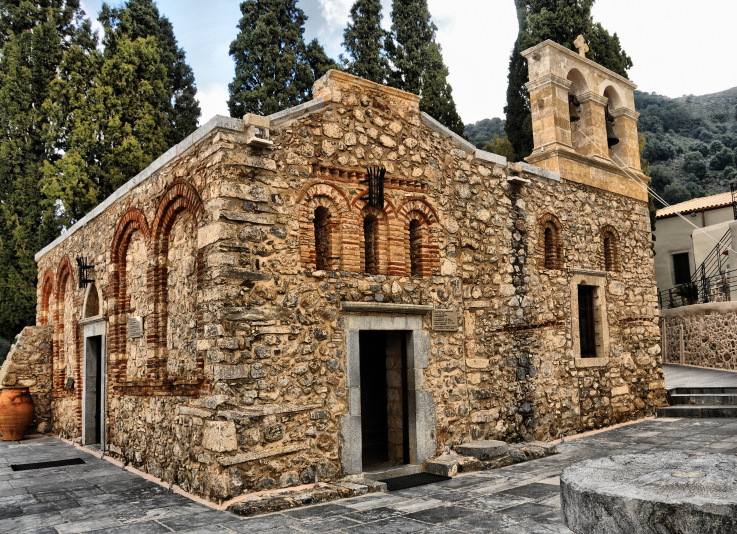
A few kilometres short of the pass by which one reaches the Lasithi Plateau, at an altitude of 630 metres, lies the monastery of Panagia Kardiotissa (Μονή Κεράς Καρδιωτίσσης). It sits close to the village of Kera – there is an Upper and a Lower Kera, both named after it – in lush green mountain country of cypresses, walnut trees and planes, some fifty kilometres south-east of Heraklion on the road that climbs from the Pediada district, and is among the oldest monasteries in Crete. It is dedicated to the Nativity of the Mother of God and keeps its patronal feast on 8 September, when pilgrims from all over eastern Crete, many of them on foot, make their way up the mountain.
Nobody knows exactly when the monastery was founded. It is first mentioned in a document of 1333, in which it appears as a possession of the Patriarchate of Constantinople – by then, under Venetian rule, a Latin institution. There is much to suggest that it is older than the Venetian period and goes back to the second Byzantine era of the island, that is, to the time between the expulsion of the Saracens by Nikephoros Phokas (961) and the Venetian takeover of Crete at the beginning of the 13th century. The Cretan historian Stergios Spanakis supposed that it was the miracle-working icon that first prompted the foundation: on this view the monastery grew up around the image.
Of the old complex essentially only the monastery church survives, an irregular building that has grown by accretion and in which four phases can be read. At the beginning there was a small single-nave chapel roofed with a pointed barrel vault, the present sanctuary. Its frescoes, from the first decade of the 14th century, show an unusual programme: seven scenes taken exclusively from the life of the Virgin. Later a barrel-vaulted room was added on the north, three parallel rooms on the west and finally a broad transverse narthex, whose façade with blind arches of brick and inset ceramics follows Byzantine models. In the central and southern annexes paintings from the years around 1320 survive – the Gospel cycle and a large Last Judgement – and in the northern part fine frescoes of the early 15th century, among them a St George on horseback, only partly preserved. The painting covers every surface of the interior, though much of it has darkened and suffered with time. On a pier of the south room a “servant of God Kali” is shown in the manner of a funerary portrait; she was presumably the donor of the extensions.
Two names for one image
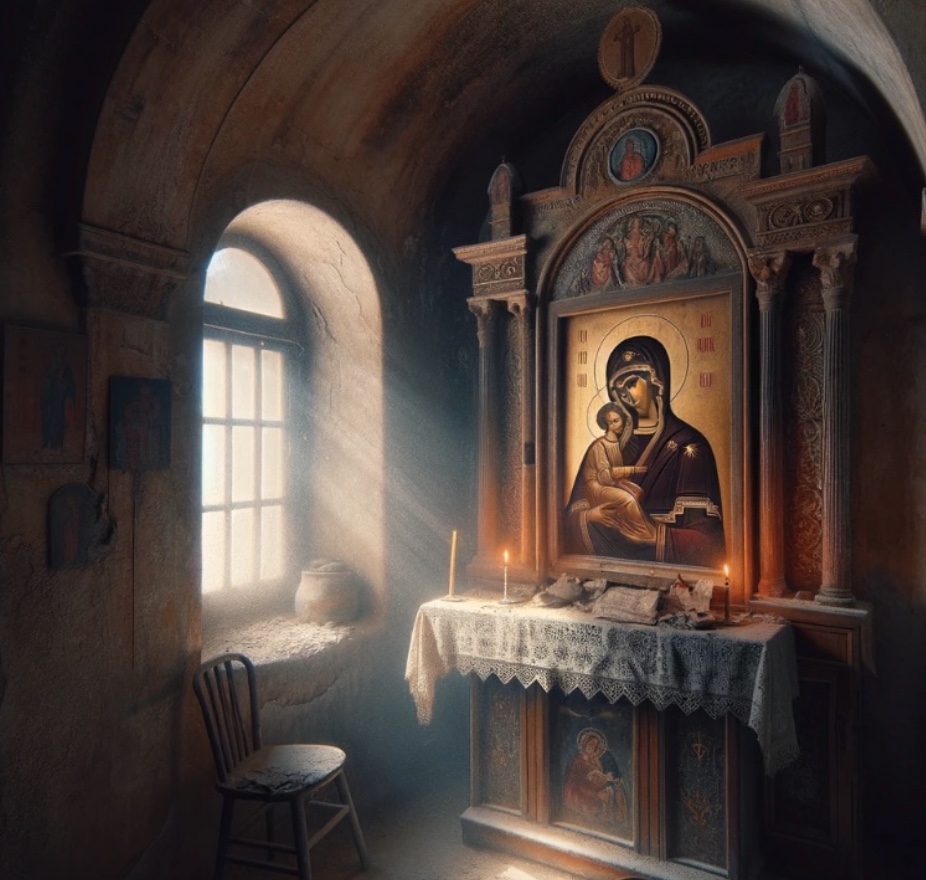
Inseparable from this monastery is one of the loveliest icons of the Christian world: the miracle-working image of Panagia Kardiotissa. Monastic tradition ascribes it to St Lazarus, a monk and icon painter who lived at the time of the iconoclast controversy. The icon shows the Mother of God pressing the Child to her heart – hence the epithet the Cretans gave her. That the wonder-working power of the image was widely known as early as the late Middle Ages is attested by the Florentine cleric and traveller Cristoforo Buondelmonti, who toured Crete in 1415 and reports the miracles of the Madonna of Kera; as late as 1837 the English traveller Robert Pashley noted down similar tales. The legend had it that the icon had been carried off or stolen more than once, and each time had come home of its own accord.
What the icon shows
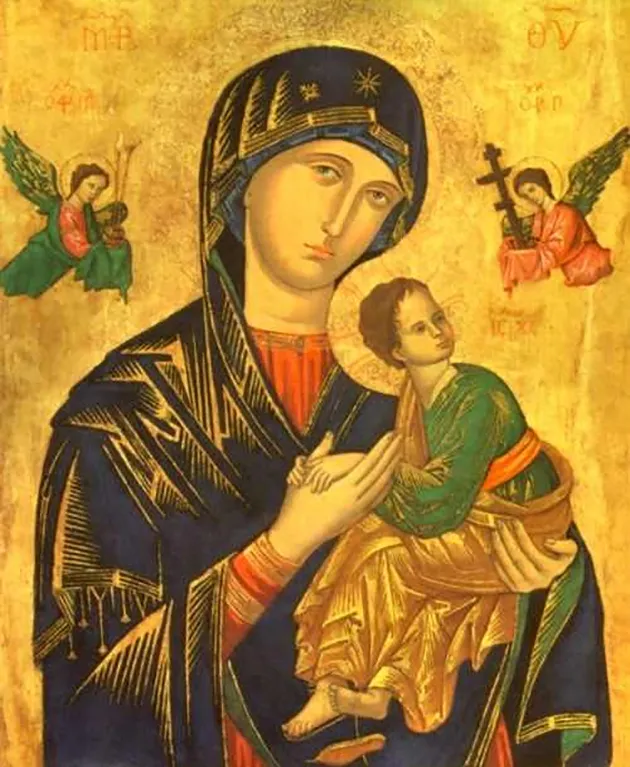
It shows a young and beautiful Mother of God in a dark robe against a gold ground, her head inclined towards the Child. She grieves, for she knows her own fate and that of her son; the dark outer garment, the maphorion, is read as a sign of mourning, the red of the tunic beneath as a reference to the sacrifice. The Redemptorists, who have the icon in their keeping, read the colours a little differently: the dark blue veil as virginal purity, the red tunic as a mother’s love, the green lining of the mantle as humility, while the Child’s green tunic stands for the Incarnation and his cloak of gold for his divinity. On either side of her head hover two archangels, holding out to the Child the instruments of the Passion – one the lance and sponge, the other the cross and nails. The little Jesus looks across in alarm at the angel with the cross, takes refuge in his mother’s arms and clasps her right hand with both of his; in the hasty movement the sandal on his right foot has come loose and hangs by a single strap, so that the sole of the foot is turned to the viewer – a detail in which commentators see his humanity. Greek abbreviations identify the figures: ΜΡ ΘΥ for “Mother of God”, IC XC for “Jesus Christ”, and ΟΑΜ and ΟΑΓ for the archangels Michael and Gabriel.
Art history calls this type the “Mother of God of the Passion” and counts it among the variants of the Hodegetria, “she who shows the way”. The little wooden panel in Rome, of walnut and measuring only about 52 by 42 centimetres, is regarded by most specialists as a work of the Cretan school of painting of the late Middle Ages; it is occasionally attributed to the circle of Andreas Ritzos (1421–1492), who worked in Candia, while others have thought of the 12th century. When the icon was examined and restored in the Vatican Museums in the 1990s, with X-rays, infra-red and ultraviolet light, radiocarbon analysis placed the wood between the 14th and the later 15th century; the same study concluded that the painted surface had been thoroughly reworked much later. Pious tradition, on the other hand, traces it back to the 9th century. The two views stand side by side, and one does well not to play them off against each other: the one tells of the making of a work of art, the other of the love that has been shown it for centuries.
The legend of the chain and the column
The icon came to Crete, so it is said, in the stormy years of iconoclasm, when the opponents of the veneration of images destroyed every icon they could lay hands on. It was brought to the island – presumably from Constantinople – and hidden in the remote mountain monastery; the popular version even has it that the image grew wings and flew to Crete of its own accord. The iconoclast emperor Theophilos (813–842, sole ruler from 829) heard of its miracles and gave orders that it should be tracked down and brought back to Constantinople, so that he might destroy it with his own hands.
Twice the holy image escaped its pursuers and returned to its church. The third time, so that it should not “flee” again, it was fastened with a heavy chain to a marble column – with the result that the icon came home to the monastery complete with column and chain. Column and chain can be seen there to this day: the column stands in the monastery courtyard, surrounded by a railing, and the chain is kept in the church, beside the icon to the left of the screen. Many pilgrims wind it around their bodies in the hope of relief from their ailments. The icon itself, however, is no longer there. In its place, since 1735, another image of the Virgin has been venerated, the work of an unknown painter, which the faithful hold to be just as miraculous and full of grace. In 1982 this image too was carried off by art thieves, but the culprits were caught and the icon came back. And the original?
The incredible journey of a Cretan icon
Its story has been traced by the Cretan author Michalis Vrettakis in a brilliantly told study. He sums it up thus: it is the incredible story and journey of the Cretan icon of Panagia Kardiotissa from the monastery of Kera near Heraklion – bound up with a repentant thief, two Catholic orders, Napoleon’s troops, three popes, the vision of an innocent girl and the unfailing memory of a monk. For sixty years the image was forgotten; it was redeemed for fifty papal scudi; it has borne four different names; and today it is to be found in thousands of churches on all five continents. Millions of Christians in more than 82 countries venerate it, more than any other Christian icon. Schools, colleges, universities, hospitals, clinics and sports clubs bear its name; it is regarded as the patron of states, dioceses and cities – Haiti among the countries, Leeds and Middlesbrough among the English dioceses – and as the heavenly patron of countless places of worship.
This icon, Vrettakis continues, has crossed the frontiers of states and bound together cultures, languages and rites the world over. The faithful see in it the perpetual helper of the poor, the sick and the weak, and venerate it as an emblem of love and of hope.
But let us begin at the beginning
At the end of the 15th century Crete had been under Venetian rule for almost three hundred years; Candia, the present Heraklion, was a flourishing place of trade, from which wine, oil, cheese and, not least, icons in great numbers were shipped to Italy. It is in this world of merchants and ships that the first act is set.
The theft of 1498
According to tradition, in the year 1498 a wine merchant – a Greek by some accounts – stole the Cretan icon and took it to Italy. He did so on the pretext that it must not fall into the hands of the Turks, who in those decades were conquering the lands of the eastern Mediterranean step by step. Constantinople had fallen in 1453, Euboea in 1470; the fear was thus not plucked out of the air, even if Crete itself was to remain Venetian for another century and a half. The Roman tradition, written down on a tablet that later hung beside the icon, says only that it was taken from a church in Crete where it had long been honoured for its many miracles.
Storm and rescue at sea
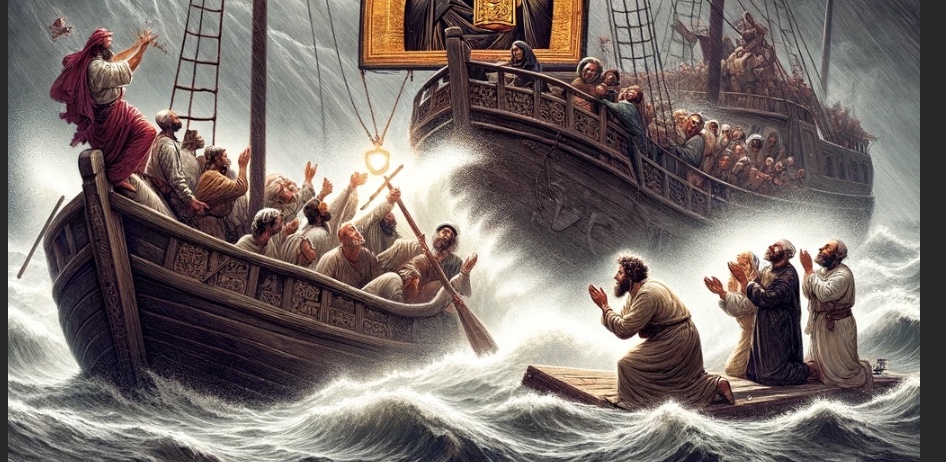
During the crossing a violent storm suddenly broke, and the ship was in danger of sinking. Amid the tears of the terrified passengers the merchant brought out the icon; all fell on their knees before it and implored the Mother of God to save them – and the sea grew calm. The voyage, the old account adds, dragged on for a year before the merchant finally reached Rome. And so Mary, as they say in Crete with a touch of wistful confidence, had decided this time to leave the island for a while. The while has become more than five hundred years, yet she will return. Until then another image of the Mother of God, likewise miraculous, keeps watch in the monastery. Let us go back, then, to the story of the original.
The merchant’s remorse
Having arrived in Rome, the merchant fell gravely ill. On his sickbed he recognised the sin of his theft, repented of it and confided in a friend with whom he had found lodging: he told him about the holy icon and asked him to have it set up in a church in the city, where everyone might venerate it. The friend promised, and the merchant died. But the friend’s wife could not bring herself to part with the beautiful picture, and so, despite the promise, it stayed hanging in the family’s house.
The apparition of the Mother of God
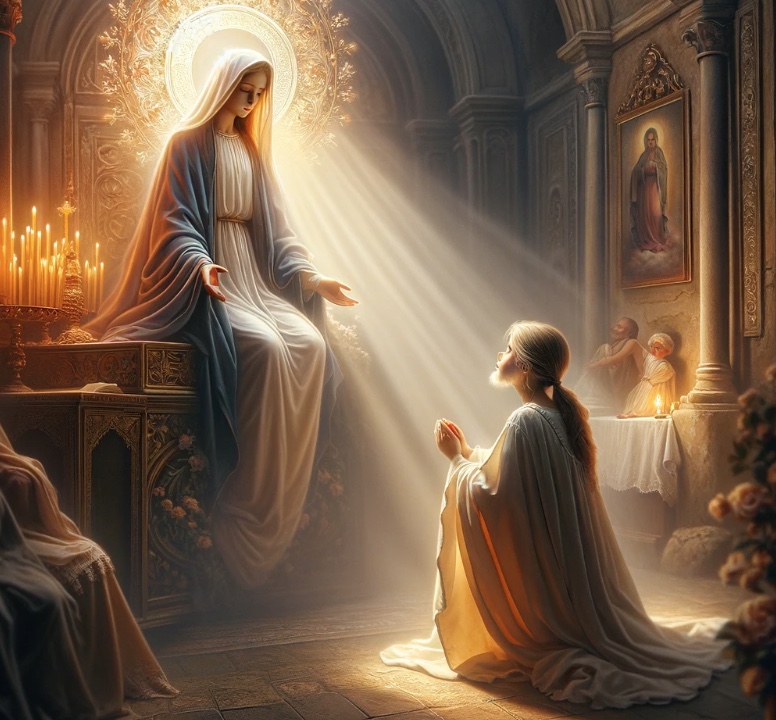
Then the All-Holy Virgin appeared in a vision to the little daughter of the house, who was only six years old. She charged the child to tell her mother and grandfather the will of heaven: her image was to be taken to the church of St Matthew, which stood on the Esquiline, one of the seven hills of Rome – on the Via Merulana, half-way between the two great basilicas of Santa Maria Maggiore and San Giovanni in Laterano. San Matteo was counted among the ancient titular churches of the city.
The translation to San Matteo
Obeying the will of the Mother of God, the girl’s mother turned to the Augustinian hermits who served San Matteo. The order accepted the icon and on 27 March 1499 carried it in solemn procession to the church, where at first it took the name of its new home: the Madonna of San Matteo. Even during the translation a miracle is said to have occurred, the healing of a child. Fra Mariano of Florence, writing in 1518, is among the earliest to record the image in its new church.
From the Madonna of Help to Perpetual Help
The icon was set up behind the high altar of San Matteo, and year after year the memory of its miraculous translation was kept on 27 March. Beside it hung a parchment telling the story of its wanderings, in Latin and in Italian; a copy is preserved in the Vatican Library, and the text was transcribed by Roman antiquaries of the 17th century. As devotion to the Byzantine icon from Crete grew among the Romans, a new name took hold: the Madonna of Help (Madonna del Soccorso) – the sign of an inextinguishable hope for all who turned to her. For three hundred years people from the whole of Italy came on pilgrimage to her, and in 1708 Cardinal Francesco Nerli formally declared the image renowned for its miracles.
In this the foreign image fitted into a familiar idea. The Western type of the Madonna del Soccorso, known since 1306 and spread from Palermo by the Augustinians, showed Mary rescuing a child from the Evil One; in popular feeling the Byzantine icon slipped effortlessly into that frame.
In 1572 Gregory XIII was elected pope. Among his projects was the completion of the decoration of St Peter’s, in particular of the Gregorian Chapel on the south side of the basilica, which is named after him. The pope, who had a special devotion to the Madonna of Help, chose for this chapel a 12th-century image known by that very name. To rule out any confusion with the Madonna of Help at San Matteo, the latter was given a new title in 1579: the Madonna of Perpetual Help. At the same time the Augustinians placed over the door of their church the Latin inscription “Deiparae Virgini Mariae succursus perpetui” – “To the God-bearer and Virgin Mary of perpetual help”. Since then the icon has been called the Madonna del Perpetuo Soccorso, in English Our Lady of Perpetual Help.
With the new name the image had, as it were, acquired a new calling: it was to be for all the faithful a sign of constant help and constant protection. Here lies the seed of that worldwide fame and affection which later made it the patron of innumerable churches.
Napoleon, the destruction of San Matteo and sixty years of oblivion
In the course of Napoleon’s Italian campaign, which reached the Papal States in 1797, French troops occupied Rome – they entered the city in 1798 under General Louis-Alexandre Berthier – and Pope Pius VI was forced into exile. Because the occupiers wished to build defensive works, the demolition of numerous buildings, convents and churches was decreed – among them San Matteo, which had already been reported as crumbling a generation earlier and was now razed to the ground.
The Augustinians who had lived there were scattered. Those who stayed in Rome – they were for the most part Irish friars – found shelter, after a temporary stay at Sant’Eusebio, in a small house attached to the church of Santa Maria in Posterula, not far from the Tiber. The icon of Perpetual Help, which they had only just managed to save, went with them. But since another miraculous image was already venerated in that church, room was found for it only in a small private chapel on the upper floor. There it remained for more than sixty years – without prayers, without veneration, without so much as a lamp burning before it, covered in dust and wholly given over to oblivion.
This was the time when the whirl of political events and wars in the first decades of the 19th century – Napoleonic wars, risings, revolutions – shook Italy and the whole of Europe. Almost everyone had forgotten the image, with one exception: the Augustinian lay brother Agostino Orsetti, who had lived at San Matteo as a young man and had come to Posterula after its destruction. He had never ceased to pray before it. Almost blind in old age, he told his young friend Michele Marchi, who helped there as an altar boy, over and over again, decades after the event, that in the chapel upstairs hung a miraculous image, the Madonna del Perpetuo Soccorso, rescued from the ruined church of San Matteo – he was never to forget it. Orsetti died in 1853; Marchi, born in 1829, was accepted by the Redemptorists in 1855 and took his vows in the congregation on 25 March 1857.
The Redemptorists and the rediscovery
The Congregation of the Most Holy Redeemer had been founded on 9 November 1732 by Alfonso Maria de Liguori at Scala, a little hill town in the Kingdom of Naples above Amalfi, and was approved by Pope Benedict XIV in 1749. Its aim was to carry the teaching of Christ, through popular missions and preaching, to poor and neglected communities. It founded houses, chapels, parishes, oratories, churches and monasteries and, with the support of the Church, spread across the rest of Italy, Europe and North America – north of the Alps chiefly through the work of the Austrian Clement Maria Hofbauer, who joined in 1785: to Poland in 1786, Germany in 1793, Switzerland in 1818, Portugal in 1826, Austria in 1827, Belgium in 1831, the United States in 1832, the Netherlands in 1836, the British Isles in 1843 and on to many other countries. Its founder was canonised in 1839 and declared a Doctor of the Church in 1871; today the congregation has well over four thousand members in more than a hundred countries.
In January 1855 the order acquired a property in Rome on the Via Merulana, the Villa Caserta, in order to move its generalate to the Eternal City and to build there a new church and house in honour of its founder Alfonso de Liguori. The neo-Gothic building, a rarity in Rome, was completed before the 1850s were out; the generalate is still there, at Via Merulana 31. With the purchase the fathers’ interest in the history of their new quarter was aroused.
The impulse came from a sermon by the Jesuit Francesco Blosi, who in 1863, preaching in a series of Marian Saturday sermons, recalled that in this district the church of San Matteo had once stood, also called the church of the Virgin of Perpetual Help. To this were added accounts by writers on Roman antiquities, who mentioned a church in what was now the garden of the house, with an old and much-venerated icon of Mary, famous for its miracles; the chronicler of the community who came upon them was none other than Marchi. Then Father Marchi remembered the tales of his friend Orsetti – and declared that he knew where this image was.
On the strength of this information the Superior General of the order, Father Nicholas Mauron, approached Pope Pius IX with the request that the icon be made over to them, so that it might be set up once more in the place where it had stood for three hundred years. The pope granted the request and, in a note written in his own hand on 11 December 1865, entrusted the image to the Redemptorists, on condition that they gave the Augustinians a fitting picture in exchange – and joined to it the wish that was to become the watchword of a whole movement: “Fatela conoscere a tutto il mondo”, make her known throughout the world.
Fifty scudi for a miraculous image
In January 1866 the order took possession of the icon: on the 19th, Fathers Marchi and Ernesto Bresciani presented the pope’s letter at Posterula and carried the panel away. The church there received another image of the Virgin in its place – an exact copy of the icon was handed over that June – together with fifty scudi, the coin of the Papal States. The little panel, marked by time and neglect, was first carefully restored by the Polish painter Leopold Nowotny (1822–1870) before it was shown to the public.
The homecoming to the Via Merulana
On 26 April 1866 the icon was carried in splendid procession to the church of Sant’Alfonso, accompanied by thousands of the faithful who had answered a special invitation (invito sacro) issued by the Cardinal Vicar of Rome, Costantino Patrizi. On 5 May the pope himself came to pray before the image. The icon has remained in Sant’Alfonso ever since. The pope was presented with the first faithful copy of the Cretan icon, which he hung in his bedroom. On 23 June 1867 the image was solemnly crowned on behalf of the Vatican Chapter. Since then the Mother of Perpetual Help has been the patron of the Redemptorists; her feast was fixed in 1876 on 27 June.
“Make her known throughout the world”
From that moment the order pursued a carefully considered plan to draw the attention of the faithful to the icon and to spread its veneration not only in Rome and Italy but far beyond. That such a plan was needed was obvious: an image that had hung in obscurity for sixty years had become as good as unknown. First the icon was solemnly installed beneath a veil on a small throne in Sant’Alfonso. The “unveiling” took place only on fixed days of the week, the month and the year; this lent the image particular value and, in a mood of expectancy and solemnity, drew ever more visitors. Before long it was thought a privilege to be allowed to take part in the devotions before the icon.
For its dissemination every means the age afforded was used: newspapers, photographs, medals, postcards, faithful copies, even the image embroidered on the vestments of fathers and priests were to make known the old icon that had, in effect, been “found again”. In Sant’Alfonso prayers and petitions now rose to the Mother of Perpetual Help, as they did on the other feasts of Mary and throughout May, the month dedicated to her. Preachers told of her miracles.
The printing of devotional pictures in every form and size quickly took off on an enormous scale. Ten years after the icon’s return to the Via Merulana 176,000 pictures had been printed, and besides them more than 420,000 small images on thin paper, distributed chiefly to the sick; they came as chromolithographs and wood engravings, gilded and in colour. By 1902 publishers in Italy, France, Austria and Germany had produced an estimated 4.5 million pictures and more, not counting the 200,000 printed in Rome in that year alone. The number of small pictures and medals issued in the larger European countries exceeded 55 million.
At the same time the Swiss painter Jakob Wüger (1829–1892), a native of the canton of Thurgau who had come to Rome in 1863 to study with the Nazarene painters, was commissioned to make faithful copies in his Roman studio; he later entered the Benedictine abbey of Beuron, took his vows there in 1871 as Brother Gabriel and became, with Peter Lenz and Fridolin Steiner, one of the founders of the Beuron school of art. The first 400 went to the countries with the largest communities of the order, above all to the German-speaking lands. The first copy to leave Italy was sent in 1867 to the convent chapel at Argentan in Normandy. Among the earliest and best-known churches that soon became local centres of the devotion are those at Perth in Scotland (1869), Boston (1871), Paris (1874), Granada (1879), New York (1887), Montevideo (1889), Vienna (1889), Madrid (1892), Valparaíso (1903) and in the Swiss Rhône valley (1932), and also Leoben in Styria (1846). By 1966 a further 128 Redemptorist churches dedicated to the Mother of Perpetual Help had been built around the world, most of them in Brazil and in the United States, with thirteen each.
Books, confraternities and a beleaguered pope
It was just as important to set down in writing the history of the icon, its miracles and its fame. Between 1866 and 1916 the first books, studies and monographs appeared, translated into several languages; the first was by Ernesto Bresciani – one of the two fathers who had fetched the icon from Posterula – the “Cenni storici sull’antica e prodigiosa Immagine della Madonna del Perpetuo Soccorso” (Rome 1866). By 1926 some 2.7 million copies of books and pamphlets about the Mother of Perpetual Help had been printed. In 1876, moreover, the pope established the “Confraternity of St Alphonsus and the Most Blessed Virgin of Perpetual Help”, whose members – among them the pope himself, in whose bedroom, after all, one of the first copies hung – made it their particular task to spread the veneration of the icon. In 1925 the confraternity numbered 1,250 branches throughout the world with millions of members. With the same aim religious associations arose in many countries; the most important was founded in Chile in 1878 for the whole of South America. And not least, the miracles ascribed to the Mother of God awakened in the faithful the wish to know the image and to own it themselves: pilgrims from abroad acquired icons for themselves, for relatives and the sick, for churches and convents.
All this took place against a sombre background. The foundation of the Italian state in 1861 and the shrinking of papal territory that went with it; the laws of 1866 suppressing the Catholic orders on the Italian peninsula – only those in the Papal States were exempt; the law of 1867 on the sale of church property, which in practice amounted to expropriation; and the excommunication that Pius IX pronounced on the monarchy and the Italian politicians: all this exposed the Catholic Church and its head to sharp criticism in those years. Pius IX has gone down in history, among other things, for the dogma of papal infallibility proclaimed in 1870. In the words of Vincenzo La Mendola of the Redemptorist Historical Institute, the new devotion to Mary as “Perpetual Help” proved the ideal answer to the needs of a Christian community which, well into the early 20th century, was living through profound and violent upheavals.
The Perpetual Novena
The devotion received a decisive push when, in 1927, a novena was introduced into public worship at St Louis in the United States. This nine-day devotion became known as the “Perpetual Novena” because, beyond the customary nine days, it provided special prayers every Wednesday, all the year round. By 1930 it had been introduced in thirty churches in St Louis and Detroit; over the following 25 years it spread to nearly 2,000 churches in the United States and Canada and, on the eve of the Second World War, had already become a mass movement. The weekly novena is still prayed today before the original in Sant’Alfonso in Rome.
From Haiti to the Philippines
In Haiti a smallpox epidemic died out surprisingly quickly in 1882; the people of Port-au-Prince gave thanks for it to the Mother of Perpetual Help, and the icon was declared the official patron of the country – a patronage formally confirmed by Rome in 1942, under Pius XII. For the centenary in 1982 Haiti issued commemorative stamps and other printed matter bearing the image of the Cretan icon. In many parts of Spain and Latin America the custom has been kept since 1950 of passing the image from family to family; it stays 24 hours in each house (Visita Domiciliaria).
Nowhere, however, is the icon venerated more fervently than in the Philippines, a country with more than 90 million Christians – at home and among Filipinos all over the world. The Redemptorists arrived there in 1906, bringing with them a copy of the icon made in Germany. The National Shrine of Our Mother of Perpetual Help in Greater Manila, Baclaran Church in Parañaque, remains open round the clock by special permission of the Holy See – as it has done since 1958, the year the present building, designed by the architect César Concio, was consecrated – because the crowds for the Perpetual Novena every Wednesday could not otherwise be accommodated. The first novena there was held on Wednesday 23 June 1948 with seventy people; the church now seats 2,000 and holds some 11,000 with those standing, and Wednesday is known locally as “Baclaran Day”. John Paul II said Mass there in 1981. One meets the image there in public places too, in shops and businesses and, as a matter of course, in people’s homes. A university, and hospitals, colleges and clinics besides, bear the name of Perpetual Help and use the icon as their emblem.
What has remained at Kera
Anyone who visits the monastery on Dikti today finds a quiet courtyard bright with flowers, where nuns live, the small, rambling church with its darkened frescoes, the icon of 1735 in its silver casing, the chain and the column, and a small museum of ecclesiastical objects. A copy of the Roman original is said to hang in the church of St Matthew in Heraklion. Photography is not allowed inside the church. The approach is by an asphalt road throughout, and the visit combines well with the drive up to the Lasithi Plateau, whose pass lies only a few hairpin bends above. The atmosphere is at its best on the eve of 8 September, when vespers are sung and the courtyard is full of pilgrims – and one understands that an image can remain present even in the place it left half a millennium ago.