The most complete guide to Crete: 221 places on the map, 23 routes and 49 articles — with photos, videos and the story behind every place. No sign-up, no trackers.
Routes drawn along real roads
Weather at every stop
Full-text search
“Near me” by geolocation
Create your own printable itinerary
Satellite, terrain, dark mode
Works offline
⌕
Searches 1.7 million characters of descriptions, not just names
—places
4regions
—routes
—with video
Search results
—
Interactive map
Find what is near you
Filters narrow the map and the list at once. Zoom out and pins group together.
Region
Category
Фильтры карты
Landmarks
Featured places
RegionCategory
Routes
Ready-made day trips
Individual places
Articles about landmarks
Resort and ancient town
Malia (Μάλια) lies 34 kilometres east of Heraklion on a fertile coastal plain between the sea and the Selena massif, and is one of the big tourist centres of the north coast. Administratively it belongs to the municipality of Hersonissos, together with the neighbouring resort of Stalida and the hill villages of Mochos and Krasi. Some six kilometres of sand, hotels, restaurants and night-time bars draw visitors from all over the world, and since the 1990s the town has been known above all to young British holidaymakers; Dimokratias Street, the road down to the beach, is where that side of Malia is concentrated. Beyond the strip, however, another landscape begins: the old village south of the main road with its narrow lanes and stone houses, the churches, the gardens in which bananas and the plain’s much-prized potatoes are grown, and, three kilometres further east, the archaeological zone of ancient Malia.
One of the four palatial centres of Crete
The ancient town grew up in the Bronze Age – the site was occupied from the middle of the third millennium BC – and flourished between about 1900 and 1450 BC. The palace, the third largest on the island by area at some 7,500 square metres, was a seat of administration, cult and economic life; around it lay residential quarters, workshops, storerooms, streets and cemeteries. It stood a little over a kilometre from the shore, about twenty metres above sea level, with a strip of marsh between it and the sea that seems to have been there since Minoan times. The Cretan archaeologist Iosif Chatzidakis discovered the palace and made the first soundings in 1915; since the early 1920s the French School at Athens has dug here, at first under Fernand Chapouthier, who directed the work from 1922 to 1936, and without a real break ever since. The finds include the three scripts of Bronze Age Crete: Cretan Hieroglyphic documents, Linear A tablets and roundels, and stirrup jars inscribed in Linear B. The ancient name of the town is nevertheless unknown. The modern place name is usually derived from the Greek word omalia, “level ground”. In 2025 Malia was inscribed on the UNESCO World Heritage List as one of the Minoan Palatial Centres.
Sarpedon in Cretan legend
Mythical tradition links the kingdom of Malia with Sarpedon, son of Zeus and Europa and brother of Minos and Rhadamanthys. According to the legend he fell out with Minos and went to Asia Minor, where he ruled over the Lycians. Herodotus tells the story as a struggle for the Cretan throne, which Minos won, driving Sarpedon and his followers out to the land of the Milyans, later called Lycia; in Apollodorus the brothers quarrel instead over a beautiful boy, Miletus, and Sarpedon joins Cilix in a war against the Lycians before becoming their king. To reconcile this Sarpedon with the Lycian prince of the same name who dies before Troy in the Iliad, some ancient writers had Zeus grant him a life of three generations. He is a figure of poetry and myth, not the attested biography of a ruler. All the same, the legend explains why Malia is drawn into the cycle of stories about Crete, Europa and the Minoan royal houses.
How the palace was laid out
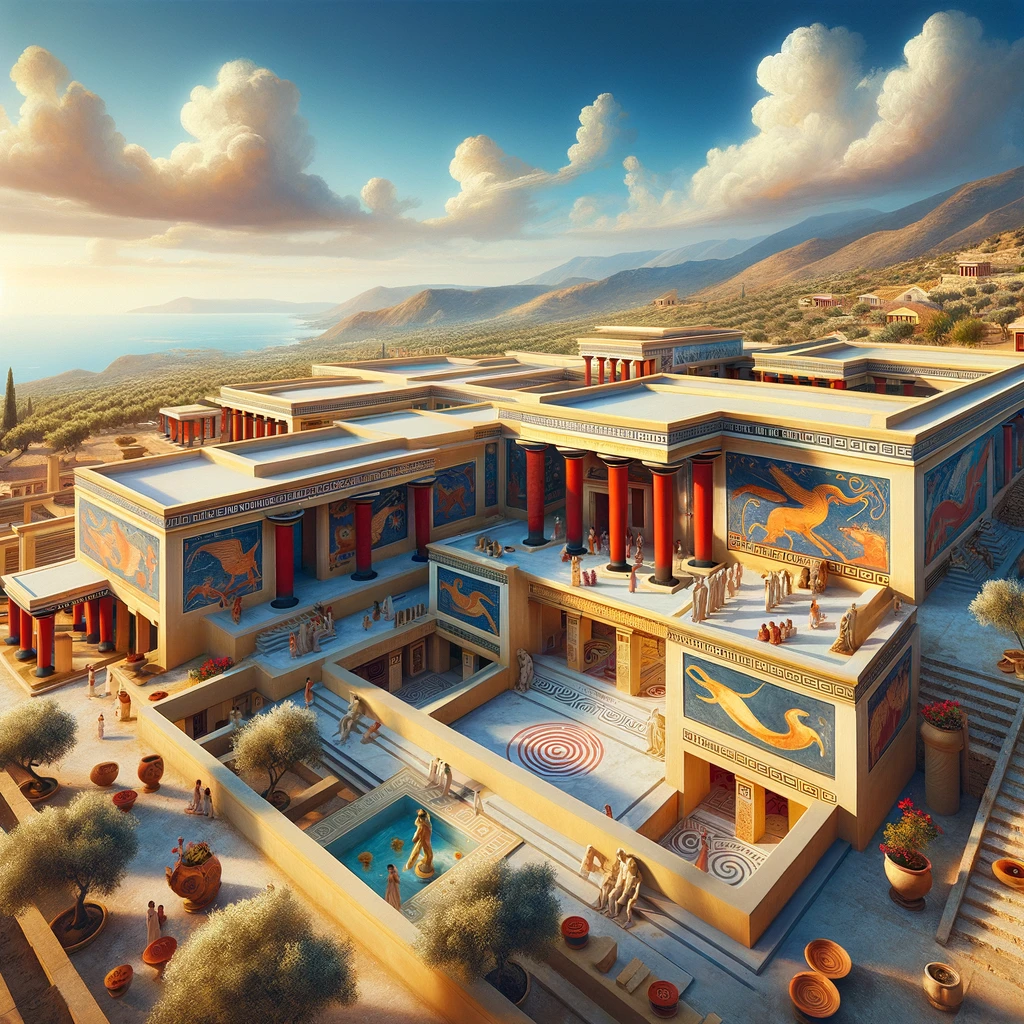
The palace of Malia measured roughly 80 by 100 metres and was arranged around an elongated Central Court, 48 metres long and 23 wide, running north–south, with porticoes along two of its sides; besides it there were a North Court and a north-west court, ceremonial rooms, shrines, storerooms lined with pithoi, workshops, living quarters, drains and installations for managing water. The west wing held the rooms for assemblies and rites – a raised loggia opening on to the court, reached by four steps and linked by a staircase to a small treasury behind, and a crypt with two massive pillars, one of them incised with the sign of the double axe – while on the east side lay storerooms and working areas. The six east magazines still show the low benches on which the jars stood and the channels in the floor that led spilt oil or wine to a collecting hole. In the middle of the court is a sacrificial pit with four supports for a grating, a feature found in no other Minoan palace, and at its south-west corner the celebrated kernos: a round stone slab 90 centimetres across with a hollow in the centre and 34 small depressions around the rim, in which the first fruits of the harvest were probably laid. Beside it stand eight circular granaries, the kouloures – a name borrowed from the round Greek bread, first given by Arthur Evans to similar pits at Knossos; Chapouthier, who uncovered them, took them for cisterns, but as they are not waterproofed most scholars now see them as silos for grain. The plan shows that the palace was not a closed “castle” but the hub of a town and of a far-reaching system for managing goods. Part of that town is Quartier Mu, some 200 metres to the west of the palace: around 3,000 square metres of houses and workshops from the Old Palace period – two large buildings and a group of house-workshops, among them that of a seal-cutter, where hoards of metal tools and documents in Cretan Hieroglyphic came to light – and now under a protective roof. The palace and the quarter are best seen together, and there is very little shade on the way round.
Chrysolakkos and the golden bees
North-east of the palace, close to the sea, lies the necropolis of Chrysolakkos, the “gold pit”. In 1880 local people found gold objects here, and after fresh finds in 1915 the site was investigated systematically. What the French excavators uncovered is a rectangular enclosure of about 30 by 39 metres, built of dressed stone and divided into many small chambers – a burial enclosure of the Old Palace period. Among its most famous pieces is the gold pendant with two bees, facing one another as they place a drop of honey in a comb; it is dated to about 1800–1700 BC and kept in the Heraklion Archaeological Museum. The jewel was found in 1930 and first published by Pierre Demargne; it is only 4.6 centimetres high and 4.4 wide, with three small discs hanging from the wings and the tips of the bodies, and it is often called the best-known piece of Minoan jewellery. Whether the insects are really bees is disputed – wasps have been proposed as well. The name “gold pit” comes from the richness of the finds and not from any actual gold mine. From the palace itself come a stone sceptre-axe in the shape of a leopard and a ceremonial sword with a pommel of rock crystal, its ivory hilt once sheathed in gold leaf; both were found in a room of the west wing and are regarded, like the swords from the north wing, as insignia of rank rather than weapons for use. They too are displayed in Heraklion.
Destruction and rebuilding of the palace
The palace was destroyed in several stages. At the end of the Old Palace period, around 1700 BC, a severe earthquake and a fire wiped out the earlier buildings, which had been constructed largely of mudbrick; around 1650 BC the new palace, whose walls one sees today, rose on the same spot, now with façades of ashlar sandstone. The final crisis of the Minoan centres around 1450 BC had a whole tangle of causes. The eruption of Thera took place earlier, in the 17th or 16th century BC according to scientific dating, and its consequences do not readily account for every destruction at Malia. In Mycenaean times only a small shrine was installed among the ruins, although parts of the town went on being lived in, were destroyed again in the 14th century BC and finally abandoned around 1250 BC.
Panagia Galatiani and the legend of the milk
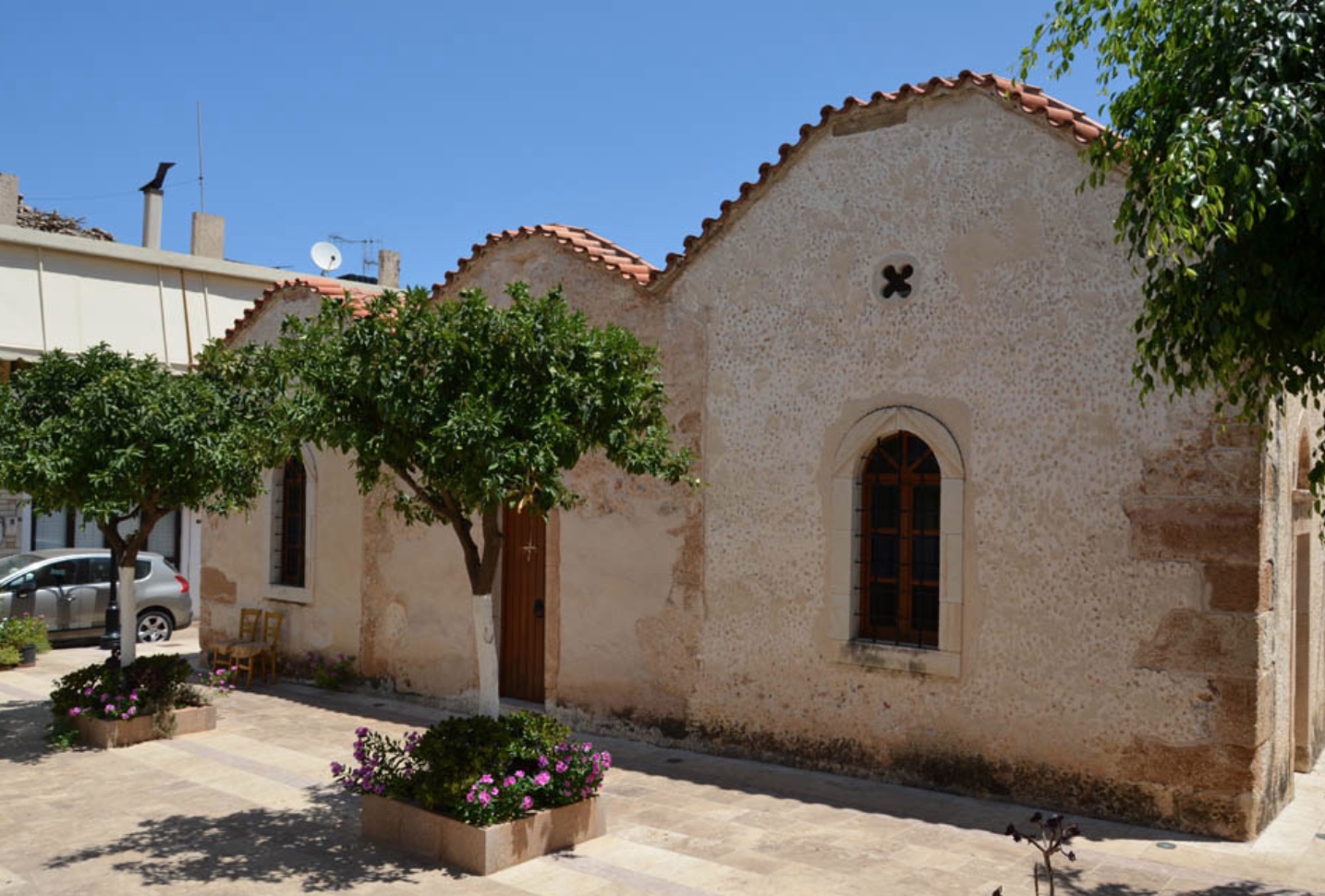
Outstanding among the Christian monuments of Malia is the church dedicated to the Dormition of the Mother of God, known as Panagia Galatiani, which stands in the heart of the old village. Local tradition explains the name by the word gala, “milk”: during the building, it is said, milk brought by villagers and shepherds was used in place of water. There is a practical kernel to the tale, for mixing milk into mortar and plaster to make them more durable was a widespread habit in Crete; another explanation refers the name to an icon of the Virgin giving suck. This legend belongs to the memory of the church and takes nothing from its historical importance as a place where services are held to this day. The building is a three-aisled basilica; originally it had a single nave, and only in the late Venetian period were the north and south aisles added, with further alterations in the 19th century – the bell tower bears the date 1898, and an old well stands beside it. Architectural fragments built into the church were brought from the ruins of an Early Christian basilica nearby. The old central nave carries 14th-century frescoes of high quality with scenes from the lives of Christ and the Virgin, reduced to the essential figures – the Crucifixion, for instance, shows only Christ, Mary and John. Unusually large is the Last Judgement, which takes up the whole west wall and parts of the side walls, with the Twelve Apostles holding open books. In addition there is a carved wooden icon screen of the 19th century and a collection of icons from the 15th to the 19th century, among them works in the manner of the Cretan School such as a beheaded John the Baptist and a Deesis.
The churches of Malia and Agios Georgios at Loutra
In the town and its surroundings also stand the churches of St John the Baptist, of the Archangels and of St Demetrius (Agios Dimitrios), the last a building of Byzantine date which, like the Galatiani, is a listed monument. At the locality of Loutra, on a terrace about a kilometre south-east of the village beside the road to the sea, rises the church of St George with its rich fresco decoration; scholars distinguish several building phases and stress the quality of the painting. The vault is divided into three bays by transverse arches, an arrangement uncommon in eastern Crete, and the belfry over the south door is dated 1893 by an inscription. Attached to this church are stories of St George protecting wayfarers from the Nereids and other dangers of the road – evidence of how closely, in Cretan folk belief, the Christian saints and the old spirits of nature dwell side by side.
Malia today
At Malia an archaeological walk, a day on the beach and an encounter with church tradition can all be combined. In the morning one visits the palace and Chrysolakkos – both lie open to the sun, so the early hours are the most pleasant; there is a car park at the entrance, three kilometres east of the town. At midday it is down to the sea, for instance to the quieter Potamos beach below the excavation, about a kilometre from the palace, a long stretch of fine sand with shallow water that is often ruffled by waves. Behind its eastern end extends a small wetland, the Malia marsh, a refuge for birds and rare shore plants, where in winter a clear stream runs to within a few metres of the surf and freshwater springs rise in the sea itself; in late summer and autumn the white sea daffodils flower on the dunes. Afterwards one climbs to the churches and into the old lanes, where the resort gives way to a slower rhythm of Cretan life.