Panagia Gouverniotissa: the frescoed monastery church above Potamies
The most complete guide to Crete: 221 places on the map, 23 routes and 49 articles — with photos, videos and the story behind every place. Everything is open and free: no sign-up, no paid sections and no advertising, open or hidden. You can install the guide on your smartphone as an app.
Routes drawn along real roads
Weather at every stop
Full-text search
“Near me” by geolocation
Create your own printable itinerary
Satellite, terrain, dark mode
Works offline
⌕
Searches 1.7 million characters of descriptions, not just names
—places
4regions
—routes
—with video
Search results
—
Interactive map
Find what is near you
Filters narrow the map and the list at once. Zoom out and pins group together.
Region
Category
Фильтры карты
Landmarks
Featured places
RegionCategory
Routes
Ready-made day trips
Individual places
Articles about landmarks
Setting and first impressions
The village of Potamies lies some 33 kilometres east of Heraklion and about ten kilometres inland from Hersonissos, on the road that climbs to the Lasithi Plateau. Above it, on a low hill among olive groves and cypresses on the north-western edge of the village, stands the former monastery of the Panagia Gouverniotissa (Παναγία Γκουβερνιώτισσα). A surfaced road runs right up to it. The view takes in the valley of Langada and reaches as far as the Aposelemis reservoir. No monks have lived here for a very long time, and the cells whose remains surround the courtyard, with their old bread ovens, are mostly work of the 19th century; what survives is one of the finest painted churches of the Pediada district, around which a small cultural centre has grown up in recent years. Potamies is unusually rich in such things: the frescoed 14th-century church of Christ the Saviour stands barely 300 metres away, and that of St George not much further off.
The interior and its frescoes
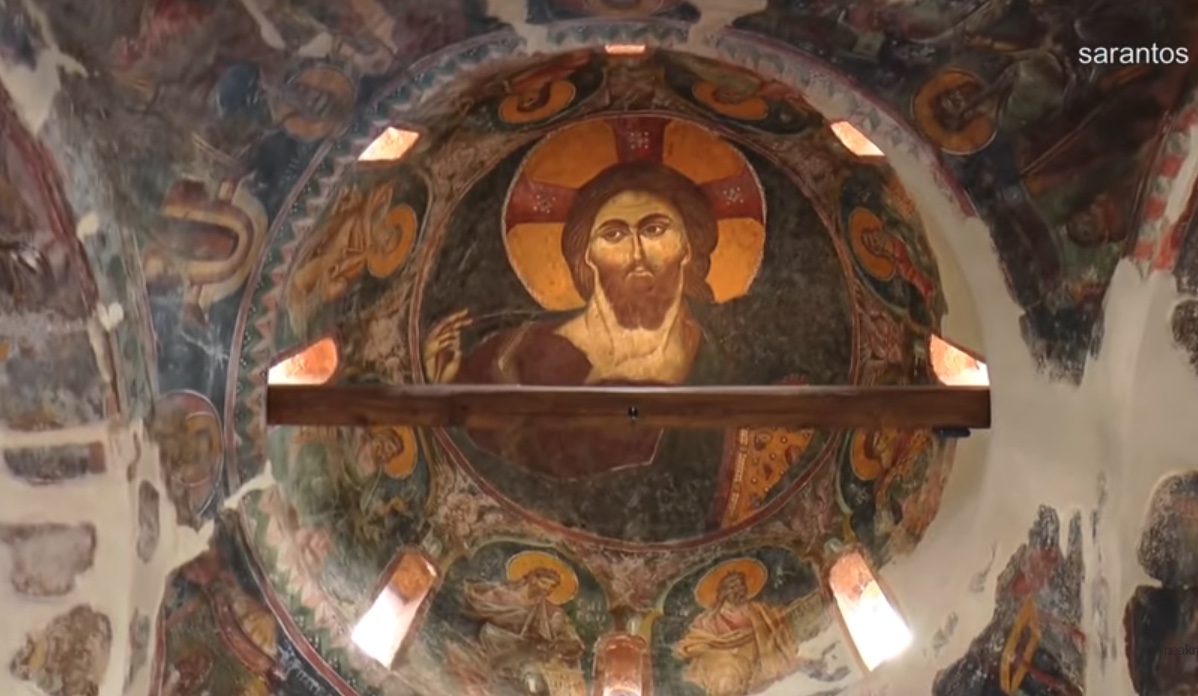
To step inside is to be drawn at once into an atmosphere of mystery, and for a moment to lose one’s sense of the world outside. The building is small: a domed church on the plan of a free cross, its four short arms – the western one a little longer than the others – gathered about a tall drum, which from outside has something of the look of an Orthodox priest’s cylindrical hat. Timber tie-beams brace the structure. From the eight narrow slits of the drum a mild, almost sweet light falls into the nave, as though from a window in heaven. The first thing to catch the eye is the mighty image of the Pantokrator: the dome is filled entirely by the figure of the Ruler of All, a bust on a more than human scale. Beneath him the prophets stand full length around the drum, and the four evangelists sit in the pendentives.
The sanctuary shows the Last Supper, and in the apse the Virgin appears as the Platytera, attended by angels, above the Communion of the Apostles; on the west wall is a large Dormition of the Mother of God with a group of angels on the left – the image of the feast to which the church is dedicated. The vaults carry a Christological cycle of rare quality, built around the twelve great feasts; it includes the Dream of Joseph and the Flight into Egypt, miracles of healing such as those of the blind man and of the paralytic at Capernaum (these now badly worn), and from the Passion the Betrayal, the Denial of Peter, the Mocking of Christ, the Crucifixion and the women bearing myrrh to the tomb. An unusually full cycle of the life of the Virgin occupies the north arm. Standing saints, men and women, are ranged along the lowest register. The wooden icons that once adorned the church are holy relics of inestimable value; it borders on the miraculous that they should have outlasted the centuries and all the calamities that have swept over Crete.
Foundation and Byzantine inheritance
Local tradition holds that the monastery was founded in 961, under Nikephoros Phokas; the claim rests on an inscription once legible on the walls but no longer preserved. Since the 820s – 823 or 824 is the date usually given – Crete had been in the hands of the Saracens, a large band of exiles from Muslim Spain who conquered the island, laid out the fortress of Chandax on the site of modern Heraklion as their capital, and used it as a base for raiding Byzantine territory by sea. Nikephoros Phokas landed in the autumn of 960 and, after eight months of fighting, took Chandax on 6 March 961, capturing the emir, Abd al-Aziz. Crete was reorganised as a regular province of the empire, with a military governor seated at Chandax, and missionaries such as Nikon “the Metanoeite” and John Xenos set about restoring the Christian faith. In the years that followed, numerous noble families from Constantinople came to Crete, settled here and received extensive lands.
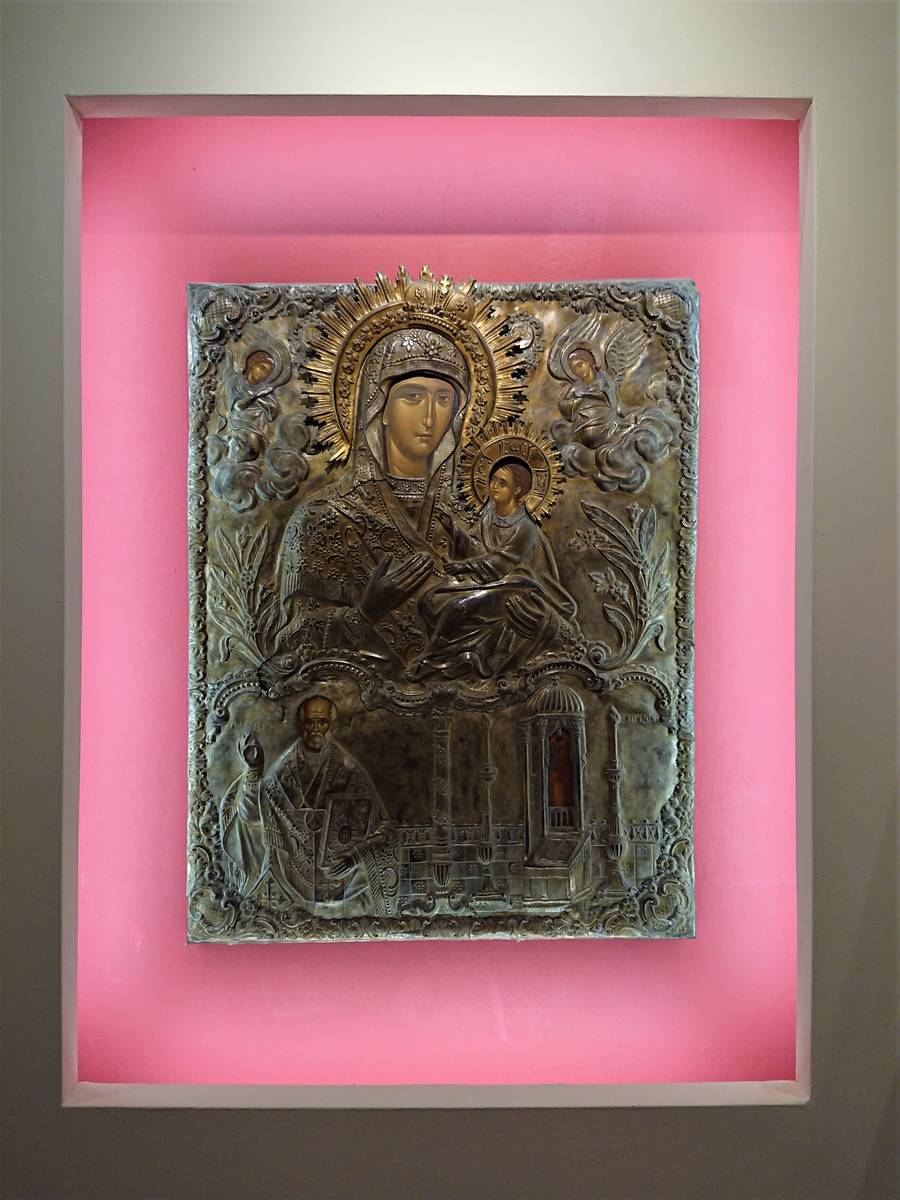
One of these noblemen is said to have chosen the spot where the monastery now stands, which local people also call “Panagios Tafos”, the Holy Sepulchre; the chapel he built was given the name Panagia Gouverniotissa. As evidence of the house’s ties with Constantinople, it is said that the portable icons of the screen were painted in the imperial capital and brought from there to the monastery. Like other aristocrats who came to the island to strengthen its Greek element, this man commanded troops; a large territory was probably subject to him, perhaps the whole east of what is now the prefecture of Heraklion. The word “governo” – administration, government – lives on in the name of the church to this day. Another and more devout reading takes the Virgin herself to be the “Governor”, the one who steers and protects.
Scholars take a more sober view. The monastery is securely attested only in the first century of Venetian rule, and the present building is generally assigned to the 14th century. Its exquisite frescoes are mostly dated to the third quarter of that century, the years between 1350 and 1375; some authors propose a date as early as about 1320. Their vivid realism and appetite for narrative have led some to link the painters with the workshops of Macedonia, and there are echoes of manuscript illumination. They show strikingly how deeply the Palaiologan style of the capital had penetrated the monuments of Venetian-ruled Crete, while at the same time taking up pictorial motifs from the Latin West – which is why the church is counted among the most important painted monuments on the island.
Venetian feudal lords
After the Venetian conquest of the island, Potamies and its monastery formed part of the fief of Marco Gradenigo. When Venice raised a new tax for the upkeep of the port of Candia in August 1363, the Venetian settlers rose against the mother city and proclaimed the short-lived Republic of St Titus, admitting Greeks to its councils; Gradenigo was placed at the head of the revolt and declared governor of Crete. An expeditionary force under the condottiere Luchino dal Verme retook the capital on 10 May 1364, and Gradenigo was beheaded in Chandax. The fief passed to the nobleman Lorenzo Maripiero, in whose possession it is recorded in a ducal document of 1368. Around the middle of the 16th century the owner is attested as Francesco Demezo; he made over the church and its estates to the priest-monks Makarios and Parthenios Kontaris, so that he might be remembered there in prayer. So began the monastery’s golden age, in which the buildings were renewed and outstanding icons were given to it.
The Ottoman period and the fate of the estates
Contrary to common belief, the gravest damage does not belong to the period of Ottoman rule. The exarch of the day showed foresight: he came to terms with the Turks and obtained an undertaking that forbade any violence against the church or the monastery’s property. The story told locally places this during the long siege of Candia (1647–1669), when the monk Nikolas Magafouris won the favour of the Turkish pasha by telling him of a dream in which he had seen him conquer the whole of Crete. It is notable, too, that the keys of the monastery were handed down from father to son until about 1830; best known among these keepers was the Magafourakis family. Its last representative, the priest Michalis Magafourakis, bequeathed the monastery – at some point between 1826 and 1830 – to the Patriarchate of Jerusalem. Oral tradition explains that he was childless and wished to know the house in the care of a great Orthodox centre.
As a metochi – a dependency – of the Holy Sepulchre, the monastery took a lively part in the life of the district in the 19th century: it paid annual contributions towards teachers’ salaries at schools in the Heraklion area, and after the rising of 1866 sent money to the town for the relief of the poor and of families left destitute.
The monastery suffered its worst destruction only after Ottoman rule had ended. Its “administration” was entrusted to a monk sent out by the Brotherhood of the Holy Sepulchre. Among other things, the archives record, he let the monastery’s fields go untilled and turned them into pasture. From about 1900 the villagers’ confidence in the representatives of the Patriarchate ebbed away, and disputes over the ownership of the land followed. In 1928 the community addressed a memorandum to five persons of high rank, among them the Patriarch of Jerusalem and the Greek prime minister, Eleftherios Venizelos. The quarrel assumed such proportions that the monastery of the Mother of God Gouverniotissa, with all its buildings and its entire agricultural property, was handed over to the agricultural cooperative of Potamies. The land was afterwards – perhaps not until 1937 – divided among seventy landless farmers; the church passed to the parish of the village.
Decay and return to life
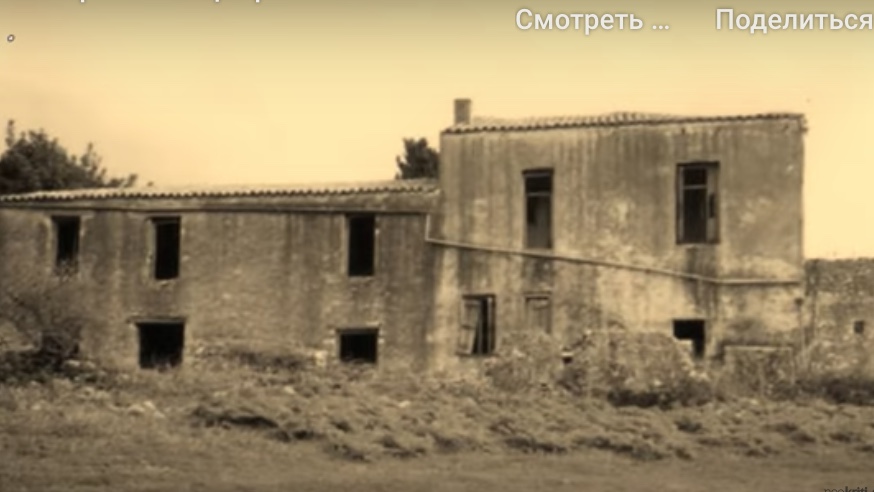
None of the new masters, however, troubled to maintain the monastery or its treasures. From 1928 until 2010 the complex stood abandoned. Shepherds stored fodder for their animals in the rooms, the roofs began to leak, and damp did grievous harm to the paintings. Matters changed only in 2010, when a group of enthusiastic volunteers – banded together in the Culture and Development Association “Gouverniotissa” under its chairman, Manolis Argyrakis – took the revival in hand and breathed new life into one of the oldest monastic complexes in the country.
Restoration and the display of the treasures
The helpers’ most pressing task was to secure and conserve the old frescoes; only then did they turn their efforts to rebuilding the ranges of 19th-century cells and to making this piece of architectural heritage better known. The volunteers worked without any payment and handled no money themselves: all costs were paid by the sponsors directly to the qualified conservators engaged for the work. The Ephorate of Byzantine Antiquities, under whose supervision the work was carried out, the Region of Crete and the municipality supported the project, which is regarded on the island as without precedent.
The exhibits
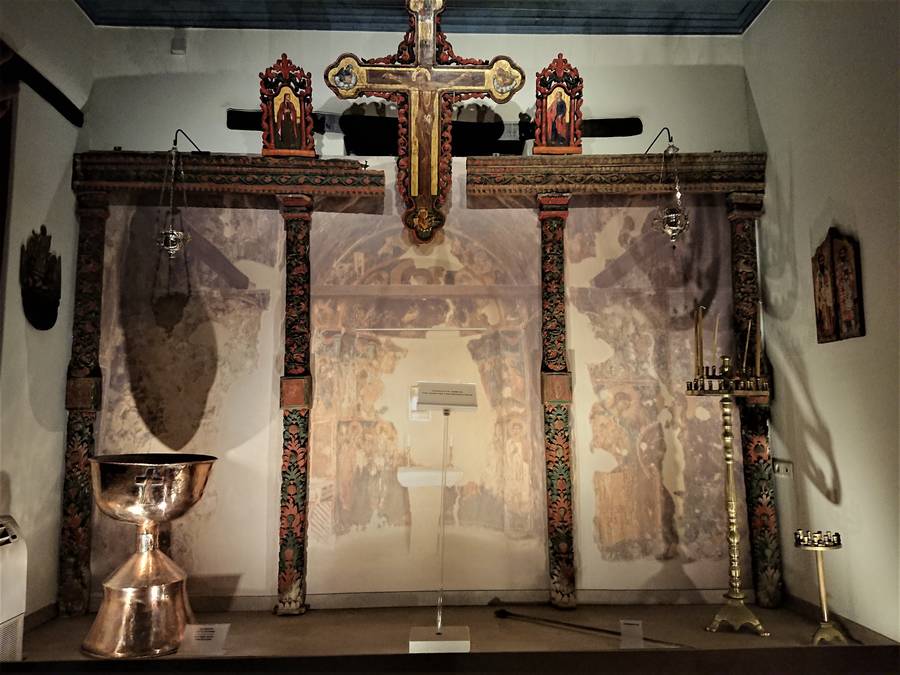
Thanks to these labours, the exhibition rooms hold some exceptional pieces besides the restored frescoes and the church itself: a communion chalice bearing the stamp of its Venetian maker, the codex of the monastery from about 1800, a Gospel book of 1776, and a Gospel in the edition of the preacher Chairetis, a spiritual companion of Ioannis Kapodistrias, the first head of state of Greece after its liberation from the Turks. There are also photographic exhibitions, a workshop for icon painting, a room for changing shows, and a folklore corner that recreates a Cretan household of the early 20th century.
The monastery today
In a comparatively short time the Gouverniotissa has become a popular destination: year after year hundreds of visitors come to admire the splendid frescoes and to pay tribute to the work of the volunteers. There is a small botanical garden planted with the medicinal and aromatic herbs of Crete, and a pleasant place to sit over a drink; in summer the courtyard is the setting for concerts by well-known Greek singers and other cultural events. Many visitors combine the excursion with a detour to the Aposelemis reservoir, one of the largest hydraulic works on the island – a rock-fill dam 61 metres high and 660 metres long, finished in 2012, which supplies Heraklion and Agios Nikolaos with drinking water and has drowned the hamlet of Sfendyli, whose houses reappear when the level falls – and with the onward drive to the Lasithi Plateau, once famous for its thousands of windmills as the “largest wind farm in the world”.
Beside the church grows a small lemon tree to which an old custom is attached: until the early 20th century pilgrims would pick its leaves as a token of blessing, make amulets of them or burn them like incense; they gathered the unripe fruit to be blessed, and they tied strips of cloth from the clothes of their sick into the branches.