Arkalochori: the sacred cave and the church of the Archangel Michael
The most complete guide to Crete: 221 places on the map, 23 routes and 49 articles — with photos, videos and the story behind every place. Everything is open and free: no sign-up, no paid sections and no advertising, open or hidden. You can install the guide on your smartphone as an app.
Routes drawn along real roads
Weather at every stop
Full-text search
“Near me” by geolocation
Create your own printable itinerary
Satellite, terrain, dark mode
Works offline
⌕
Searches 1.7 million characters of descriptions, not just names
—places
4regions
—routes
—with video
Search results
—
Interactive map
Find what is near you
Filters narrow the map and the list at once. Zoom out and pins group together.
Region
Category
Фильтры карты
Landmarks
Featured places
RegionCategory
Routes
Ready-made day trips
Individual places
Articles about landmarks
Arkalochori: the sacred cave and the church of the Archangel Michael
Arkalochori (Αρκαλοχώρι) lies a good thirty kilometres south-east of Heraklion at an altitude of about 400 metres, in the middle of the gently rolling hill country of the Pediada, where olive groves, vineyards and cornfields succeed one another. With some 3,900 inhabitants it is the seat of the municipality of Minoa Pediada and has always been the market for the surrounding villages. Under the Ottomans it was already the chief place of a district of 24 villages, and its weekly market for grain, livestock and goods of every kind drew traders from the provinces of both Heraklion and Lasithi; the Saturday market is still the busiest day of the week. In the Venetian census of 1583 the village appears as “Arcaloghori”, with 160 inhabitants. The name is derived either from “arkalos”, the Cretan dialect word for a badger, or – as many think more likely – from the ancient city of Arkadia, which lay in this area. The Minoans were here long before: three kilometres to the north, at Galatas, a palace of the Minoan period has been excavated.
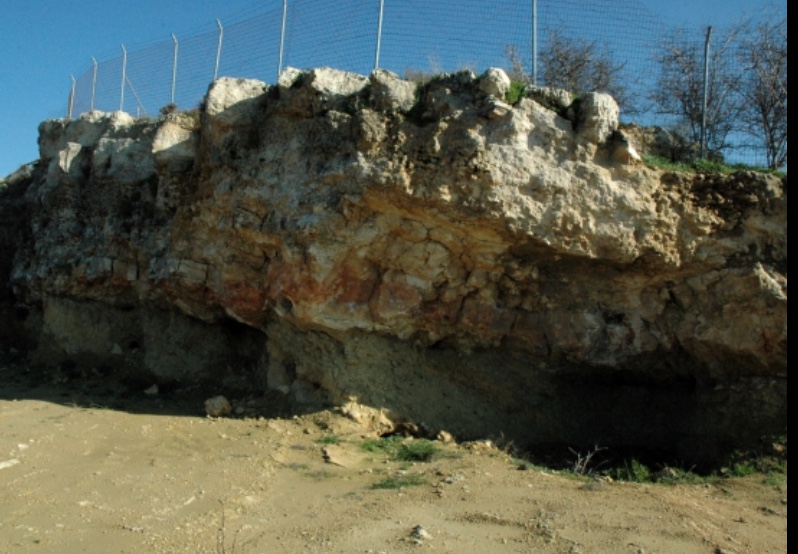
South-west of the town, on the slope of the hill of Profitis Ilias, is the mouth of an unremarkable-looking cave that ranks among the most important cult places of Minoan Crete. It was used for religious purposes from Early Minoan times, from about 2500 BC, and the offerings ceased around 1450 BC. Archaeologists recovered bronze swords, daggers and knives here, together with double axes of bronze, silver and gold, some of them engraved with patterns and written signs. The Heraklion Archaeological Museum describes the hoard, most of which dates from between 1700 and 1450 BC, as the largest assemblage of Minoan metal objects found on the island.
Discovery and excavation
The story of the discovery is an object lesson in how vulnerable archaeological sites are. Villagers came upon the bronzes first and sold them as scrap to dealers in Heraklion. In 1912 Iosif Chatzidakis carried out a first official excavation; afterwards the cave again fell into the hands of clandestine diggers, and some of the pieces found their way on to the art market and into museums abroad. Only in the 1930s did Spyridon Marinatos and Nikolaos Platon investigate the site systematically. The present entrance is only about 70 centimetres wide and 1.60 metres high. Originally the cave consisted of several larger and smaller interconnecting chambers, whose roof collapsed around 1500 BC; illicit digging and landslips did further damage in the 20th century, and what remains of the roof now rests on three concrete pillars. There is little to see inside, and the visit is best thought of as a short walk up the hill to the spot from which the finds came.
The finds form one of the most important collections of Minoan weapons and cult objects. Among the things counted were 53 bronze sword blades, including one 1.055 metres long that is held to be the longest bronze sword of Greek prehistory, and votive double axes up to 70 centimetres across; nineteen of these, one of them silver, came from the first excavation alone. There were also small axes of gold and silver foil – twenty-five gold and seven silver ones in all – potsherds and the remains of wooden shafts. Best known is the so-called Arkalochori Axe, a double-axe head of cast bronze about 24 centimetres across, made around 1650 BC and engraved in its central part with fifteen signs, which recall those of the Phaistos Disc; a second axe bears signs in the Linear A script. Whether the fifteen signs are real writing is disputed – some scholars regard them as an imitation inscription cut by someone who could not read. The pieces are on display in the Heraklion Archaeological Museum.
Some of the offerings had been deliberately hidden, or were buried beneath the rubble when the entrance fell in. The traces of destruction might be connected with the conflicts of the Late Minoan period, but no particular warlike event can be demonstrated; an earthquake, or the consequences of the volcanic eruption of Thera, is the likelier cause. Because it was chiefly weapons that were dedicated, Marinatos supposed a warlike deity; he even considered recognising here the cave in which Rhea was said to have given birth to Zeus. That the weapons were offerings rather than arms for use is suggested by the swords themselves, which have neither hilts nor the rivet holes needed to attach them. An alternative reading sees the hoard as valuable imported metal hidden away in a time of crisis and never recovered. Pieces of raw copper, ingots and an unfinished sword indicate, moreover, that metal was worked nearby. The cave is occasionally linked with the “labyrinth” and the cult of the double axe – that is a scholarly hypothesis, not a secure identification with the labyrinth of legend.
The church of the Archangel and the parish feasts
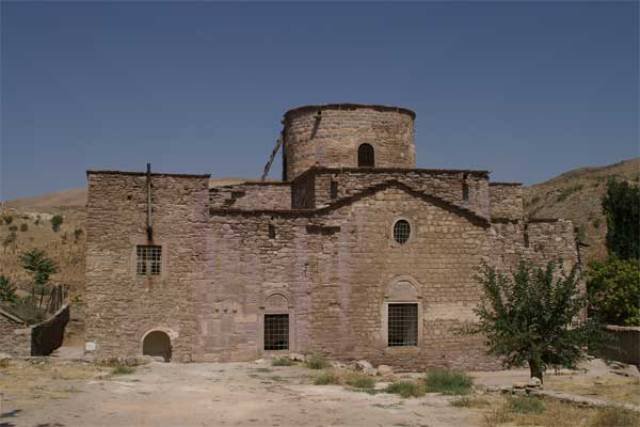
Just outside the town – about 150 metres beyond the last houses, in the old cemetery – stands the church of the Archangel Michael (Μιχαήλ Αρχάγγελος), a Byzantine funerary church on a cross-vaulted plan with a square narthex added in front of it, which is lit by an unusual conical dome and originally opened through arches that were later walled up. Its frescoes date from the 14th and 15th centuries, the oldest parts perhaps from the late 13th, and the narthex was painted around the middle of the 14th. In the narthex one can make out the Evangelists in the pendentives beneath a Pantocrator, the Presentation of the Virgin in the Temple from a cycle of her life, the Hospitality of Abraham and the Three Children in the fiery furnace; in the church itself there are saints, the Entry into Jerusalem, the Baptism of Christ, the Betrayal of Judas, the Descent from the Cross, the Ascension and the Annunciation, together with episodes from the story of the archangel, among them Joshua before Jericho and the Miracle at Chonae. The building was badly shaken in 2021 and is in need of thorough restoration. Two panigiria are celebrated in Arkalochori: on 6 August for the Transfiguration of Christ and on 21 May in memory of Saints Constantine and Helen, Equal to the Apostles. A panigiri combines church service, procession, communal meal and village fair.
The most recent chapter in the town’s history is the severe earthquake of 27 September 2021, which struck at 9.17 in the morning with a magnitude of 6.0, at a depth of only about six kilometres. It damaged some four fifths of the buildings in Arkalochori, left a great many houses in the district uninhabitable and injured 36 people; some two thousand aftershocks followed. The little chapel of the Prophet Elijah on the hill above the cave collapsed and buried a man who was working inside it; his son was hurt beside him. The chapel was rebuilt by the diocese together with the Ministry of Culture and consecrated anew exactly one year later, on 27 September 2022; since then the townspeople have regarded it as a sign of a new beginning.