The most complete guide to Crete: 221 places on the map, 23 routes and 49 articles — with photos, videos and the story behind every place. No sign-up, no trackers.
Routes drawn along real roads
Weather at every stop
Full-text search
“Near me” by geolocation
Create your own printable itinerary
Satellite, terrain, dark mode
Works offline
⌕
Searches 1.7 million characters of descriptions, not just names
—places
4regions
—routes
—with video
Search results
—
Interactive map
Find what is near you
Filters narrow the map and the list at once. Zoom out and pins group together.
Region
Category
Фильтры карты
Landmarks
Featured places
RegionCategory
Routes
Ready-made day trips
Individual places
Articles about landmarks
Thrapsano: a village of potters and flower growers
Thrapsano lies in the rolling country of the central Heraklion district, some thirty kilometres south-east of the city, about five and a half kilometres from Kastelli to the east and a little under five from Arkalochori to the south. It stands at roughly 340 metres, surrounded by vines and olive trees, and has close on a thousand inhabitants. What the village lives by is plain from the moment you drive in: storage jars as tall as a man stand drying in rows outside the workshops, and the yards are stacked with flowerpots, jugs and bowls. Inside, the masters pass on the inherited ways of building, hand-painting and firing to the younger generation – and are, as a rule, quite happy to be watched while they do it. Most of the workshops are strung along the roads leading into the village.
Pithoi, travelling workshops and the “vendema”
Thrapsano first appears in writing in 1379, in a document from the ducal archive of Candia, and under the Venetians it was a fief of the Cornaro family; the census of 1583 counted 468 inhabitants. The potting tradition is a good deal older than any of this – the shapes of the big storage vessels recall at once the pithoi of the Minoan palaces, and the villagers like to think of themselves as heirs of the Minoan potters. Venetian documents and local memory alike hand down the picture of a “village of potters”. The masters used the clay of the surrounding country to make pithoi, jugs, pots and containers for oil and wine. In former times teams of craftsmen, the “takimia”, travelled across the island and made the large vessels on the spot, since they could scarcely be transported: the roads were bad and the jars fragile. This summer migration was known as the vendema. It began in spring – traditionally on 21 May – and lasted until mid-September, ending on the feast of the Holy Cross. A team would look for a place with good clay, water and firewood, build a kiln, supply a whole valley with jars and then move on. When the trade was recorded in the mid-20th century, some thirty to thirty-five teams, about two hundred men or half the male population of the village, set out each year, and between them they made around 15,000 jars a season. The remains of well over a hundred and fifty such seasonal kilns have been traced across Crete.
A takimi consisted of six men with clearly defined duties: the master, who was also the business head of the team, and his assistant, who prepared the coils of clay; the man who turned the wheel; the clay-worker, who pounded and sieved the raw earth; the fireman, who cut and brought in the wood and tended the kiln; and a carrier. They worked at a row of ten or more simple turntables – one for each jar – set side by side in a trench. The master walked from vessel to vessel adding a ring to each in turn, so that a whole line of pithoi rose together. In a working day of twelve hours a good team finished between ten and sixteen jars, each of which took about sixty kilograms of clay.
Prosperity, crisis and a living heritage
The craft reached its height between 1920 and 1960; until the 1940s pottery was the main occupation of the village. Production fell during the German occupation and recovered afterwards. Later, tin and plastic drove earthenware storage vessels out of Cretan households, the vendema came to an end in the 1960s, and from the 1970s the potters settled in permanent workshops around the village and turned to garden ceramics and ornamental pieces. Today’s workshops use electric wheels and modern kilns but keep to the traditional shapes and ornaments. The Greek Ministry of Culture has entered the pottery tradition of Thrapsano in the National Inventory of Intangible Cultural Heritage. Every year in July – around the 17th – the village holds a potters’ festival lasting several days, with demonstrations, exhibitions and music, and a pottery centre with exhibition rooms and working space documents the craft.
Carnations, churches and a pond
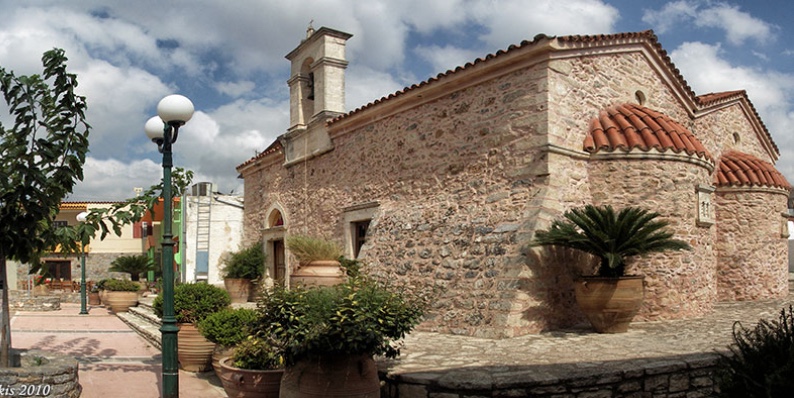
Besides ceramics, the villagers grow flowers, carnations above all, in glasshouses and in the open, and have their own growers’ co-operative. Thrapsano thus combines two specialisms, one of the workshop and one of the land: clay, water, fire and tillage are still part of the everyday scene. The village has thirteen churches and chapels. The old ones in the centre are worth seeing, first among them the church of the Holy Cross (Timios Stavros), whose feast in mid-September is the main festival of the year; others are dedicated to the Transfiguration and to the Panagia, among them the Panagia Pigadiotissa, named after a well about which stories of miraculous rescues are told. On the edge of the village is the little pond of Livada, which owes its existence to the potters themselves – it fills the hollow from which generations of them dug their clay – and where waterfowl rest in spring and autumn. Anyone wanting to take a piece home does best to buy direct from the workshops; the larger ones will also ship bulky vessels.