Apostoli (Apostoloi): the Amari Village of the Ten Saints
The most complete guide to Crete: 221 places on the map, 23 routes and 49 articles — with photos, videos and the story behind every place. No sign-up, no trackers.
Routes drawn along real roads
Weather at every stop
Full-text search
“Near me” by geolocation
Create your own printable itinerary
Satellite, terrain, dark mode
Works offline
⌕
Searches 1.7 million characters of descriptions, not just names
—places
4regions
—routes
—with video
Search results
—
Interactive map
Find what is near you
Filters narrow the map and the list at once. Zoom out and pins group together.
Region
Category
Фильтры карты
Landmarks
Featured places
RegionCategory
Routes
Ready-made day trips
Individual places
Articles about landmarks
Apostoli and the memory of the Ten Saints
The village of Apostoli (Αποστόλοι) lies in the Amari district of the prefecture of Rethymno, about 30 kilometres south-east of the town of Rethymno and roughly 500 metres above sea level, at the point where the Amarianos and the Stavromana part company – the latter running north-west to feed the Potami reservoir. This is the northern threshold of the Amari, the 25-kilometre valley between Psiloritis and Kedros that forms the natural passage from the north coast to the Messara Plain. The village has about 200 inhabitants, the community as a whole around 300; people live chiefly from farming – olive oil, wine, carobs, cereals – and from stock-raising.
The village took its name from a church of the Ten Saints, who are venerated on Crete as martyrs of the 3rd century. According to local tradition the Christians hid from persecution in the woods here, but were seized and taken to Gortyn, where they suffered martyrdom around the year 249, in the reign of the emperor Decius. The Lives add that they were tortured for thirty days before being beheaded at a spot called Alonia, “the threshing floor”.
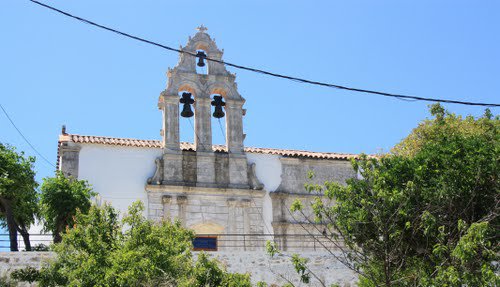
The old church fell into decay over time. In 1888 a new church was built on its site, and the tall bell tower followed in 1905. Some accounts name the apostles Peter and Paul as patrons of this church; at all events the present building preserves the memory of the dedication from which the village name derives. That the settlement already existed in Byzantine times is likely; a legend has Nikephoros II Phokas pass this way in 961, the year in which – still a general, two years before he took the throne – he captured Chandax and brought some 135 years of Arab rule on Crete to an end.
The church of St Nicholas and its 14th-century frescoes
Apostoli also has an older church, dedicated to St Nicholas: a small single-nave building in the village cemetery, and the most important of the several churches here. Its wall paintings of the 14th century are of considerable artistic value, though they have suffered severe damage, and date from a period when Cretan village churches were being zealously decorated with Byzantine frescoes. They include numerous scenes of the punishment of the damned.
Apostoli and the commemoration of the martyrs of Gortyn
The name Apostoli has nothing to do with the Twelve Apostles: it goes back to the local church of the Αγιοι Δέκα (“Ten Saints”), dedicated to the ten Cretan martyrs. According to the tradition of the Church they suffered at Gortyn during the persecution under Decius. Their relics are said to have been taken up from the burial place at Alonia and moved to Gortyn by St Paul of Gortyn around 312. Later their commemoration spread across the entire island, and small churches and chapels became points in a shared Cretan geography of saints.
The church of the Ten Saints
The old church fell into ruin in the course of time, and in 1888 a new building was put up in its place. The tall bell tower was completed in 1905. The present church keeps the dedication to the Ten Saints and remains the chief landmark of the village; its history links local worship with the commemoration of the martyrs of the whole Cretan Church.
The church of St Nicholas
The older church of St Nicholas, with frescoes of the 14th century, has survived in Apostoli; it stands among the graves of the cemetery and is easily reached by road. The paintings are of considerable artistic worth and belong to the period of Venetian rule, when the Orthodox painters of Crete carried on the Byzantine iconographic tradition in the village churches. The village also possesses another Byzantine church, that of St Spyridon, likewise with wall paintings.
Nicholas of Myra is regarded as protector of sailors, travellers and all who look for safety on a journey. His cult is especially widespread on Crete, where village churches linked the mountain settlements with the harbours and sea routes. At Apostoli the image of the saint stands beside an old fresco programme of the 14th century.
Apostoli in the church landscape of Crete
The village shows how a small community on Crete kept alive the memory of several ages at once: the Roman martyrs of Gortyn, medieval fresco painting and the church-building of the late 19th century. Apostoli is therefore not merely a name on the map but a place where local tradition meets the history of the Cretan Church. Agia Fotini, the modern centre of the valley, is only a kilometre further on, and the hill of ancient Sybrita above Thronos is close by.
More recent history has left its mark too: during the resistance to the German occupation of 1940 to 1944 there was fighting near the village in which, according to local accounts, about 30 German soldiers were killed; a monument close to the village commemorates it.