Ano Viannos: a mountain village above the Libyan Sea
The most complete guide to Crete: 221 places on the map, 23 routes and 49 articles — with photos, videos and the story behind every place. No sign-up, no trackers.
Routes drawn along real roads
Weather at every stop
Full-text search
“Near me” by geolocation
Create your own printable itinerary
Satellite, terrain, dark mode
Works offline
⌕
Searches 1.7 million characters of descriptions, not just names
—places
4regions
—routes
—with video
Search results
—
Interactive map
Find what is near you
Filters narrow the map and the list at once. Zoom out and pins group together.
Region
Category
Фильтры карты
Landmarks
Featured places
RegionCategory
Routes
Ready-made day trips
Individual places
Articles about landmarks
A mountain village above the Libyan Sea
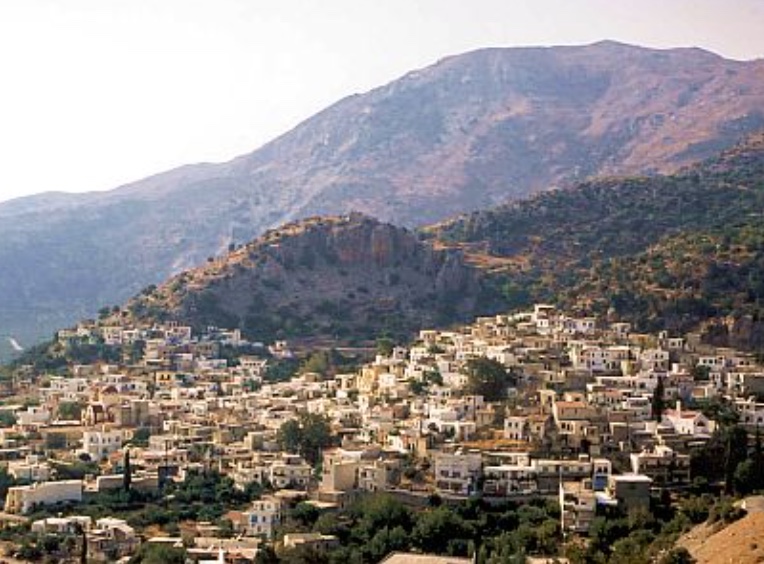
Ano Viannos (Άνω Βιάννος) lies about 560 metres above the sea, a good sixty kilometres south-east of Heraklion and just under forty west of Ierapetra, on the southern flank of the Dikti range. The village is surrounded by stands of oak, centuries-old plane trees and groves of olive and myrtle, and streams run through the country round about. From here one looks out over a broad, fertile shelf of farmland, planted mostly with olives, and beyond it the Libyan Sea: it is the interplay of mountain relief, water and good soil that gives this landscape its character. The houses climb the slope like the tiers of a theatre, and anyone standing on one of the upper terraces late in the afternoon sees the silver-grey of the olive trees merge into the blue of the sea. The municipality of which it is the seat covers some 220 square kilometres of mountain and coast and has fewer than 4,500 inhabitants, so that the sense of space is part of the experience.
Architecture and everyday life
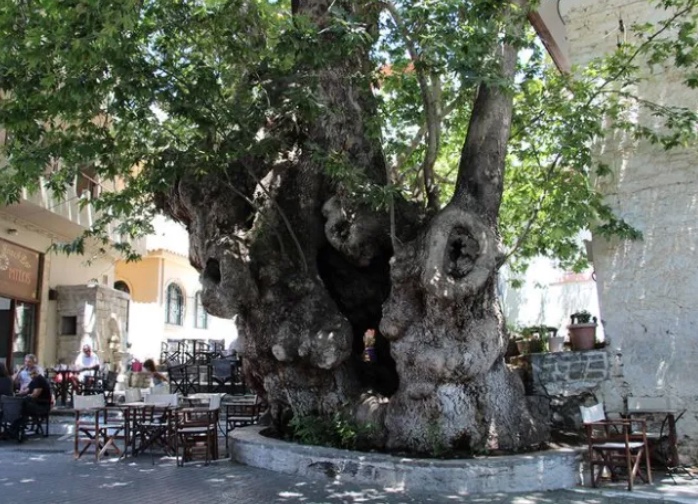
Ano Viannos has kept the look of a large Cretan village: stone houses with tiled roofs, paved courtyards and narrow lanes, and springs laid out as small public spaces. There are several squares, tavernas and kafenia where one can try dishes made from the produce of the surrounding farms. The centre of village life is the main square with its ancient plane tree, under which people have met for generations; right beside it stands an old watermill, now restored. The lanes are steep and often stepped, so the village is best explored on foot, leaving the car on the through road. With about a thousand inhabitants by the usual reckoning – the census of 2021 recorded 694 permanent residents – who live chiefly from the olive and from stock-raising in the mountains, the village is to this day the centre of an entire upland district and not just a stopping place for people passing through. It was larger once: the Venetian census of 1583 counted 1,006 souls, and that of 1881 1,253, of whom 918 were Christians and 335 Muslims.
From ancient Biennos to the present village
The history of Viannos reaches far back into antiquity. The city of Biennos (Βιέννος), which is mentioned by ancient authors – Stephanus of Byzantium among them – and attested by coins, lay in the area of the present settlement; local scholars look for it on the hill of Korakia directly above the village, where Archaic and Minoan sherds have been picked up. Its urban ruins have not so far been uncovered by systematic excavation. The coins show the head of Artemis on one side and a flower on the other. The name is traced either to the legendary founder Biennos, one of the Kouretes, or to the mythical struggle of Poseidon’s sons Otus and Ephialtes with the god Ares. In time the city fell under the sway of its powerful neighbour Hierapytna, the modern Ierapetra, though it kept an identity of its own and appears as the seat of a bishop down to the 9th century AD. Older Minoan tomb finds are known in the neighbourhood, and when the primary school was built a Roman cemetery came to light, from which comes a gold necklace with lily-shaped beads.
The history of the community
The Middle Ages and the Ottoman period have left their mark on the church architecture and on the plan of the village. The municipal chronicle of Viannos records the rebuilding of the settlements after the Arab raids of the 9th century, the Venetian period and the building of many churches down to the middle of the 17th century. In the 19th century the district was one of the centres of Cretan resistance to Ottoman rule; in the risings of 1822 and 1866 Ano Viannos was destroyed completely by Ottoman troops, and each time it was rebuilt on the same ground. Here the memory of these events is bound up with the daily life of a rural community.
The churches of St Pelagia and St George
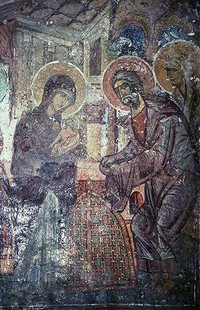
The church of St Pelagia – in the Cretan dialect Αία Πελαγία (Aía Pelagía) – holds a special place. Her veneration is rooted in local parish tradition, and the church, set in the upper part of the village above quiet lanes and reached only on foot, is part of the historic picture of Ano Viannos; the climb is rewarded with a wide view over the roofs. The small 14th-century building contains frescoes which an inscription at the entrance dates to the year 1360 and attributes to two brothers, Nikoletos and Kostas. Alongside the scenes from the life of Christ – Nativity, Baptism, Last Supper, Crucifixion, Resurrection, Ascension – they show in the vault three pictures from the life of the saint: giving away her possessions, being tempted, and living as an ascetic. A young lute-player recalls her past as an actress. St Bartholomew, carrying his own flayed skin, makes a powerful impression, as do the punishments of the damned near the entrance, among them the perjurer, the miser, the slanderer and the witch. In Ottoman times the eyes of many of the saints were scratched out; the paintings are nonetheless comparatively well preserved.
The church of St George (Άγιος Γεώργιος) is known for its 14th-century frescoes. Its history preserves the memory of changing rulers: according to the local account it was turned into a mosque in the Ottoman period – when, as the census figures show, a quarter or more of the villagers were Muslim – and later returned to the Christian community. During alterations old Christian graves were found in the courtyard, an indication that a church with a burial ground stood here earlier still. On the edge of the village, on the road to the monastery of Agia Moni, there stands beneath plane trees another chapel of St George, known as “Platanitis”: a single barrel-vaulted room which, according to its inscription, was founded by Georgios Damoros in 1401 and painted by the priest Ioannis Mousouros, with scenes of the Passion, nine pictures from the life of St George and four scenes from Genesis. Damp has done the paintings great harm. The village has several other old churches besides – of the Archangel Michael, whose frescoes are damaged, of Agia Marina, Agios Dimitrios and Agia Aikaterini.
Ioannis Kondylakis and literary memory
Associated with Ano Viannos is Ioannis Kondylakis (1861–1920), writer, journalist and one of the notable figures of Cretan literature. He was born in the Viannos district into a family of insurgents; during the rising of 1866 the family fled for some years to Piraeus. He went to school in Heraklion and then in Athens, and after completing his studies at the Varvakio there in 1884 – the year in which his story “The Cretan Orphan” won a competition held by the magazine “Estia” – he enrolled in the philosophy faculty but never took a degree. He was for a short time a village schoolmaster at Modi in western Crete, before turning wholly to the press, writing for “Estia”, “Asty” and “Skrip” and, for two decades under the name “Diavatis” – the passer-by – daily columns for the paper “Embros”. He portrayed the people, the language and the customs of Crete, most famously in the novel “Patouchas” (1892) and in the story “When I was a Schoolmaster” (1916); he also wrote of the poor of Athens, published “First Love” in 1919 and translated the complete works of Lucian. His work has fixed the Cretan countryside in the public and literary memory of Greece; he is regarded as the father of the Greek newspaper column and was the first president of the Athens journalists’ union. He died in hospital in Heraklion on 25 July 1920. His monument stands in the main square of the village, and the municipality honours him with a programme of cultural events, the “Kondylakia”.
Remembering the Holocaust of Viannos
In September 1943 Viannos and the neighbouring villages became the scene of mass reprisals by the German occupying forces. After clashes with resistance groups at Kato Symi, punitive operations, shootings and destruction followed from 14 to 16 September, carried out by more than two thousand soldiers in some twenty villages; in all, hundreds of civilians lost their lives in Viannos and in the adjoining territory of Ierapetra, and about a thousand buildings were burnt. The report of a Greek commission, which in the summer of 1945 included the writer Nikos Kazantzakis, lists 401 dead in three days; the municipality today commemorates 461 people executed, and in Ano Viannos itself the number of those shot is put at 114. This tragedy is known as the Holocaust of Viannos and stands at the centre of the community’s memory today.
What there is to see today
Ano Viannos rewards a visit as a historic mountain village: a walk across the squares and to the springs can be combined with a look at the churches, the museums – including the folklore museum, opened in 1996, with its farm tools, loom, embroideries, old photographs and wartime relics – and the places of remembrance. The roads round about lead to the monastery of Agia Moni, dedicated to the Dormition of the Virgin, to gorges such as that of Kavousi, which runs down to Keratokambos, to olive groves and to the south coast of Crete.