Gramvousa: fortress, pirates and the memory of the uprising
The most complete guide to Crete: 221 places on the map, 23 routes and 49 articles — with photos, videos and the story behind every place. No sign-up, no trackers.
Routes drawn along real roads
Weather at every stop
Full-text search
“Near me” by geolocation
Create your own printable itinerary
Satellite, terrain, dark mode
Works offline
⌕
Searches 1.7 million characters of descriptions, not just names
—places
4regions
—routes
—with video
Search results
—
Interactive map
Find what is near you
Filters narrow the map and the list at once. Zoom out and pins group together.
Region
Category
Фильтры карты
Landmarks
Featured places
RegionCategory
Routes
Ready-made day trips
Individual places
Articles about landmarks
Gramvousa: fortress, pirates and the memory of the uprising
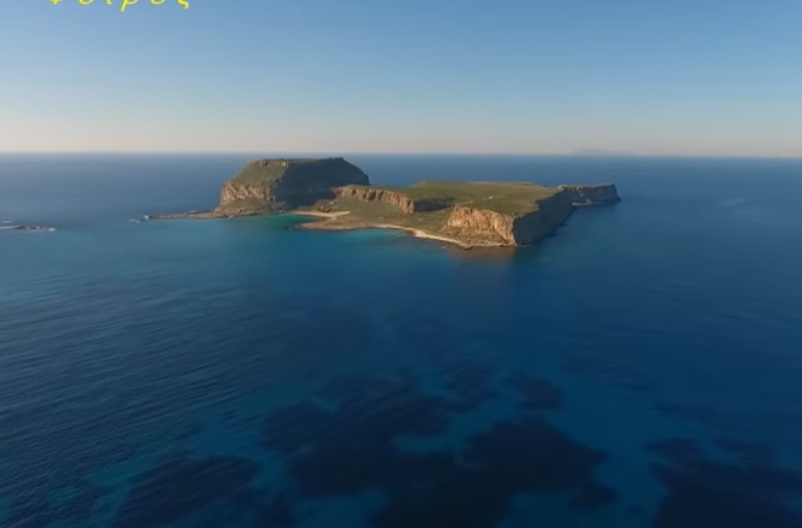
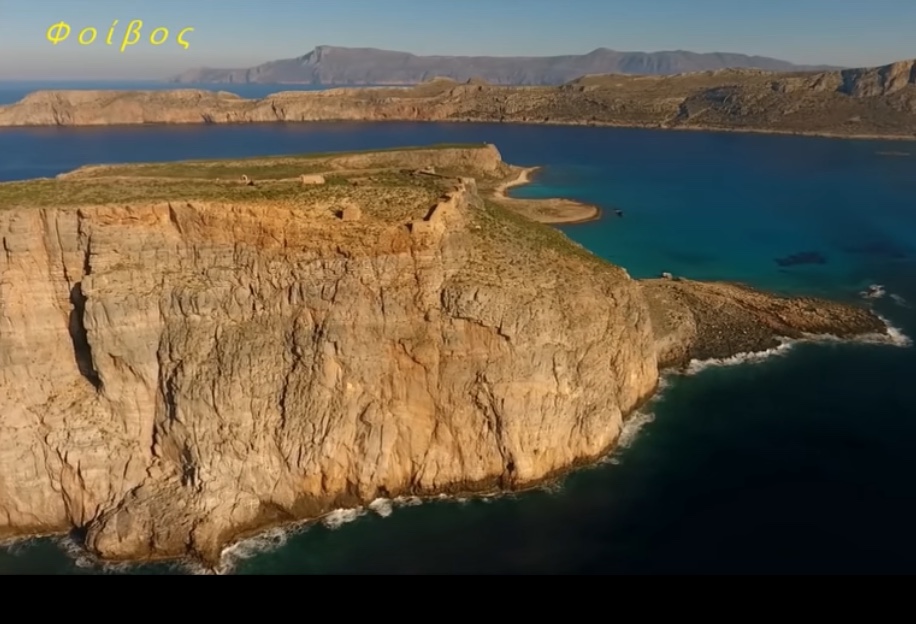
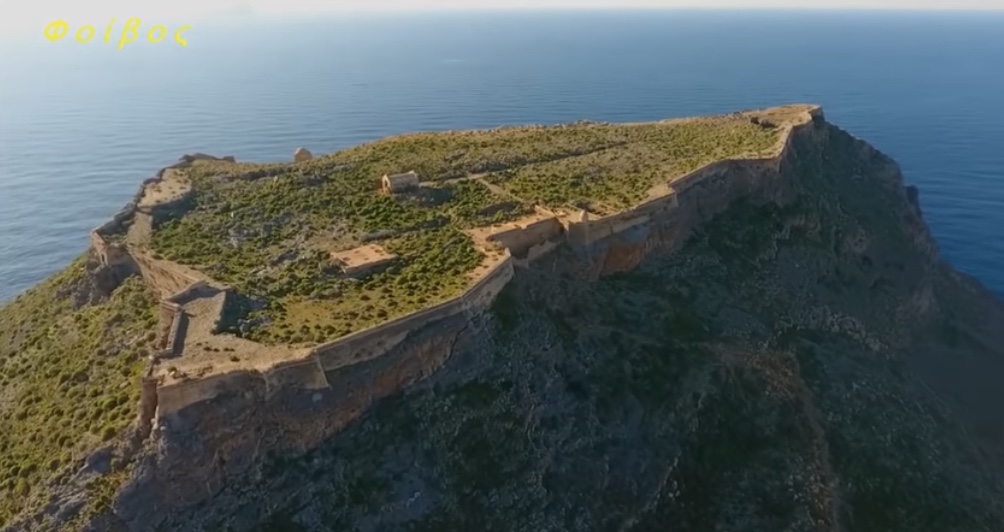
Gramvousa is an island off the north-western tip of Crete, at the entrance to the Gulf of Kissamos and some 20 kilometres north-west of the town of that name. A Venetian fortress rises above the natural harbour; around it survive the remains of barracks, cisterns, a church and other buildings. Gramvousa is often called the “island of Odysseus and the pirates”: the one belongs to mythological tradition, the other to the documented history of the 19th century. Today the uninhabited island, together with the lagoon of Balos about two nautical miles away, is a nature reserve within the Natura 2000 network – more than 400 plant species and over 100 species of birds have been recorded here, and the Mediterranean monk seal and the loggerhead turtle frequent its waters. It can be reached only by sea: in season excursion boats make the crossing from the port of Kissamos in about an hour, and staying overnight is not permitted.
Odysseus, Aeolus and the ancient name Korykos
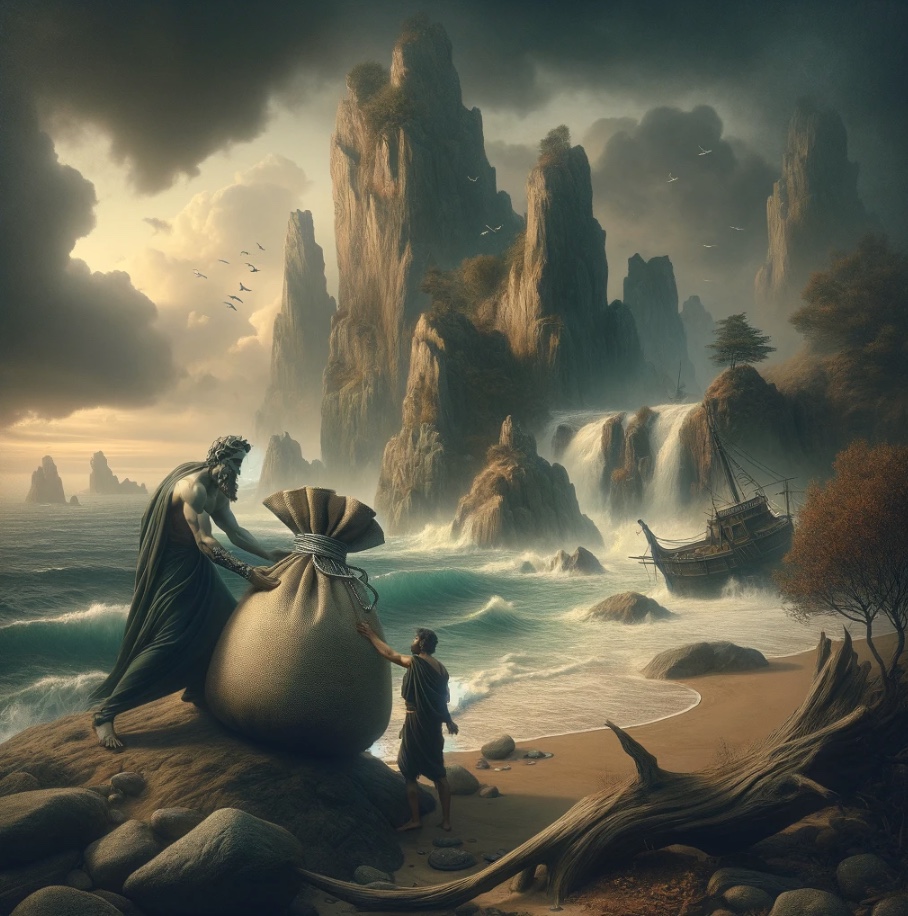
According to a late tradition, Gramvousa was one of the places where Odysseus put in on his way home to Ithaca. It is identified with the island of Aeolus, lord of the winds, who gave Odysseus a skin in which the winds were shut up and told him not to open it until he had reached home. In antiquity the island was called Korykos; the name is usually explained as “leather bag” or “leather sack”, which chimes with the story of Aeolus. The present name is put down by local legend to a woman called Vousa, the wife of a pirate chief, who is said to have escaped when the pirates were rounded up.
The myth of Aeolus is no historical evidence that Odysseus ever stopped here. But it helps one to understand why an island with violent winds and a sheltered anchorage should have found its place in the literary geography of the Aegean – anyone who stands on deck here when the meltemi is blowing needs no further explanation.
The Venetian fortress of 1579–1584
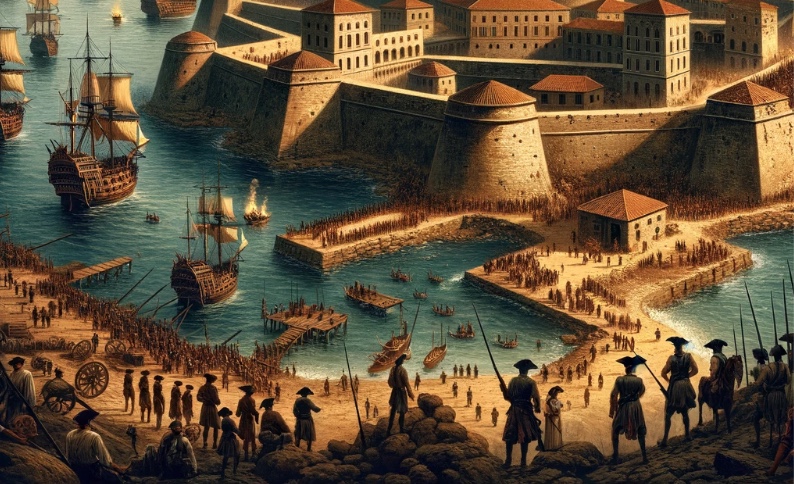
The fortress of Gramvousa was built between 1579 and 1584 to the designs of the military engineer Latino Orsini. It stands some 137 metres above the harbour on a rock that drops almost sheer on three sides, so that only the landward side needed heavy fortification; the plan is roughly triangular. Together with the fortresses of Souda and Spinalonga it formed part of the Republic of Venice’s system of island strongholds. Its task was to protect the sea lanes and to preserve bases for the Serenissima even after an Ottoman conquest of Crete.
After the fall of Candia on 16 September 1669, Venice kept Gramvousa, Souda and Spinalonga under the terms of the surrender. These fortresses remained Venetian enclaves, kept trade going, offered a refuge to Christian fugitives from Crete, and were meant to serve as footholds should war with the Ottomans break out again.
The passing of the fortress to the Ottomans
At the end of the 17th century – in 1691, during the Morean War – the fortress passed to the Ottomans after the Venetian garrison capitulated. Its commander, De la Giocca, is said to have handed it over in return for a reward and afterwards to have settled in Constantinople, where he went by the nickname “Captain Gramvousas”; the details of the story are to be read in the context of the Venetian–Ottoman war and the struggle for the sea routes, not as an isolated episode of treachery. The new masters armed the rock heavily, with 66 long-range cannon and a strong garrison.
Gramvousa and piracy
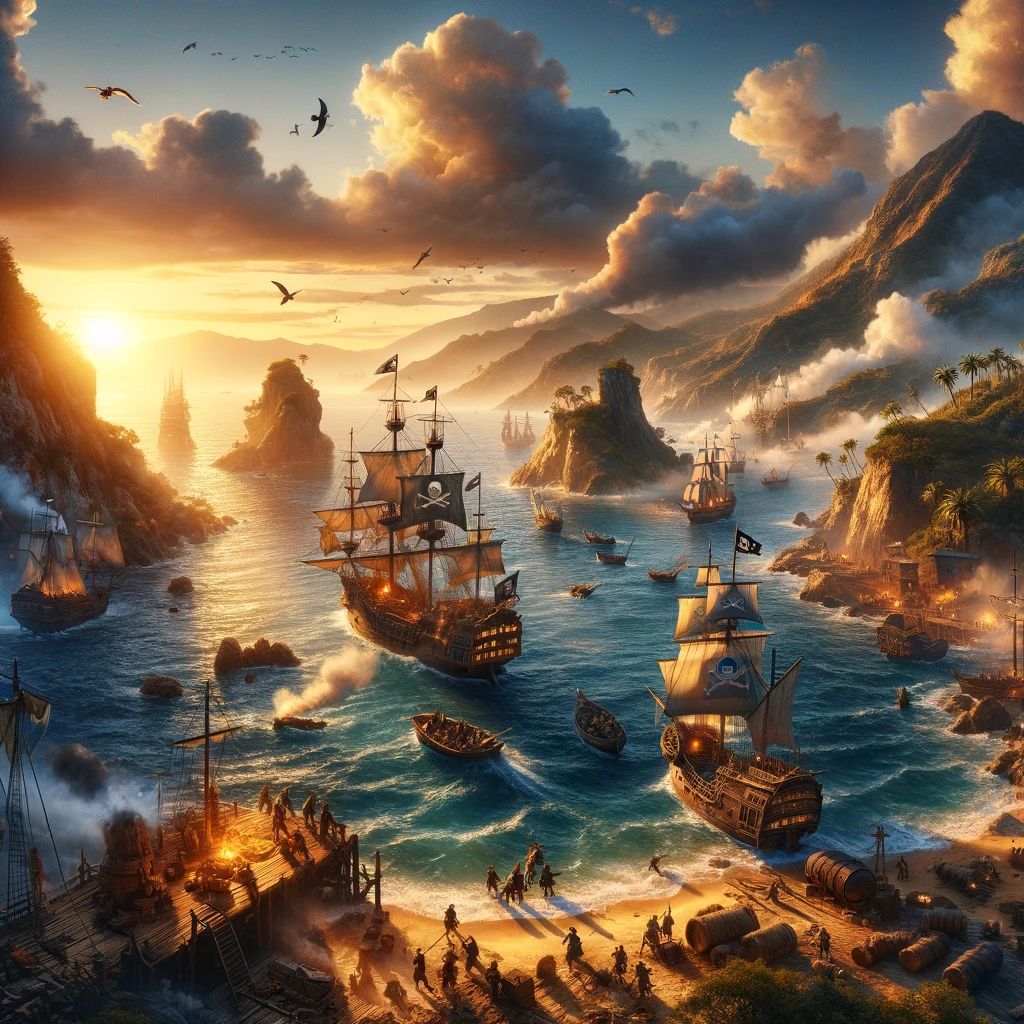
The strategic position of the island made it possible to watch the strait between Crete and the Peloponnese. In the 18th and 19th centuries Gramvousa became the base of flotillas that fell upon ships carrying supplies to the Ottoman ports. In conditions of war and blockade the line between privateering, military sorties and common piracy was often blurred: the same men could see themselves as freedom fighters and yet remain a menace to merchants.
In August 1825 the Cretan insurgents took the fortress, and Gramvousa became a centre of the revolution on the island – for almost two years, from 1825 to 1827, it was the only liberated piece of Crete, and the men on the rock held out under blockade for more than two years in all. More than three thousand people found refuge here; the Cretan Council met, a school was set up, and the church of Panagia Kleftrina, “the Virgin of the Thieves” – the dedication is also explained as honouring the wives of the klephts – became the spiritual heart of the settlement. The seafarers are said to have made over a tenth of their plunder to her. Ships put out from the fortress to bring in food and weapons, for the bare rock fed nobody. Some of these voyages counted as a continuation of the struggle for freedom, but the attacks on merchant vessels, Turkish, Egyptian and European alike – in September and October 1827 alone 81 ships are said to have been plundered – made Gramvousa a danger to international shipping.
The klephts fought on land, the pirates at sea, and the armatoloi were armed bands to whom the Ottoman authorities at times entrusted the keeping of order. These terms cannot be mechanically rendered as “thieves”, “sea robbers” and “police”: their meaning shifted with the fortunes of war, with the local balance of power and with the attitude of the population.
The night parties of the insurgents on Gramvousa were known as Kalisperides – after the Greek greeting “kalispera” (καλησπέρα), good evening. The name alludes to their nocturnal forays into the Cretan hinterland. The pirate and privateer vessels kept the fortress supplied with arms and food, but their raids weighed heavily on international trade.
The end of the pirate years
In January 1828, at the instigation of the government of Ioannis Kapodistrias, an Anglo-French squadron occupied the fortress and rooted out the pirate base; Alexandros Mavrokordatos accompanied the fleet as Greek plenipotentiary. The demand was for the surrender of twelve named pirates, of the ships and of the fortress; the small pirate fleet was broken up, the fort passed under British control, and several men were brought to trial. The operation was not without cost to the Royal Navy: on 31 January 1828 the frigate HMS Cambrian was lost off Gramvousa after colliding with another British warship. The allies declared that they were acting against piracy and not against the Cretans’ struggle for freedom – indeed it was at Gramvousa, on 5 January 1828, that Hatzimichalis Dalianis landed with 700 men on his way to carry the fight further into Crete. Attempts by the insurgents to win back the rock, notably in 1830, came to nothing. On 21 January 1831 the fortress was handed over to the Egyptian administration; after that Gramvousa lost its former importance and gradually fell into ruin. It was still a garrisoned strongpoint in 1878, however, when the Cretan rebels, lacking artillery, were unable to take it.
The ship “Dimitrios P.”
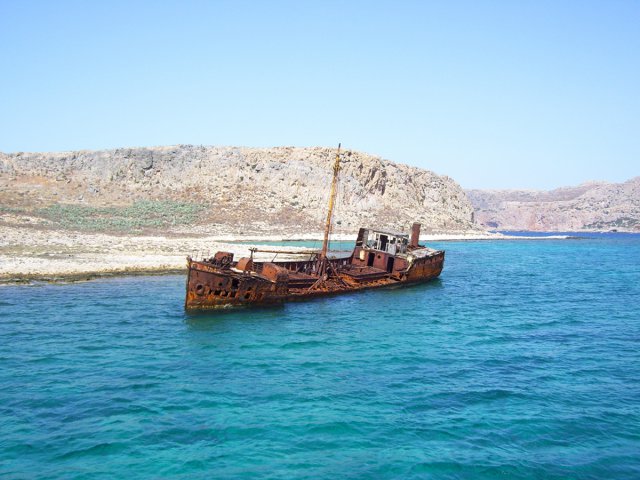
The most recent landmark of the island is the freighter “Dimitrios P.”, a motor vessel 146 feet (about 44 metres) long. On 30 December 1967 she sailed from Chalkida for North Africa with a cargo of 440 tonnes of cement, and put into the bay of Imeri Gramvousa to shelter from the storm. On 8 January 1968, early in the afternoon, the anchor chain parted and the ship was thrown on to the rocks on the south side of the island, some 200 metres offshore. The crew were saved – they were taken off two days later by the Greek destroyer “Ierax” – while the hull stayed where it lay and is now regarded, rust-red against the turquoise water, as part of the island landscape.
The climb to the fortress follows a stony, shadeless path and takes about twenty minutes; stout shoes and water are advisable. From the top the view opens over the lagoon of Balos, the bay with the wreck, the open sea and the west coast of Crete. Down below, the western bay beneath the castle is where the boats land and where most visitors swim, off a beach of sand and rock with a few tamarisks for shade and a seabed that rewards a mask and snorkel. Fortress and shipwreck are best looked at together: the one shows the military history of a maritime frontier, the other the island’s enduring dependence on wind and navigation.