Spinalonga: Fortress, Settlement and Island of the Leprosy Patients
The most complete guide to Crete: 221 places on the map, 23 routes and 49 articles — with photos, videos and the story behind every place. Everything is open and free: no sign-up, no paid sections and no advertising, open or hidden. You can install the guide on your smartphone as an app.
Routes drawn along real roads
Weather at every stop
Full-text search
“Near me” by geolocation
Create your own printable itinerary
Satellite, terrain, dark mode
Works offline
⌕
Searches 1.7 million characters of descriptions, not just names
—places
4regions
—routes
—with video
Search results
—
Interactive map
Find what is near you
Filters narrow the map and the list at once. Zoom out and pins group together.
Region
Category
Фильтры карты
Landmarks
Featured places
RegionCategory
Routes
Ready-made day trips
Individual places
Articles about landmarks
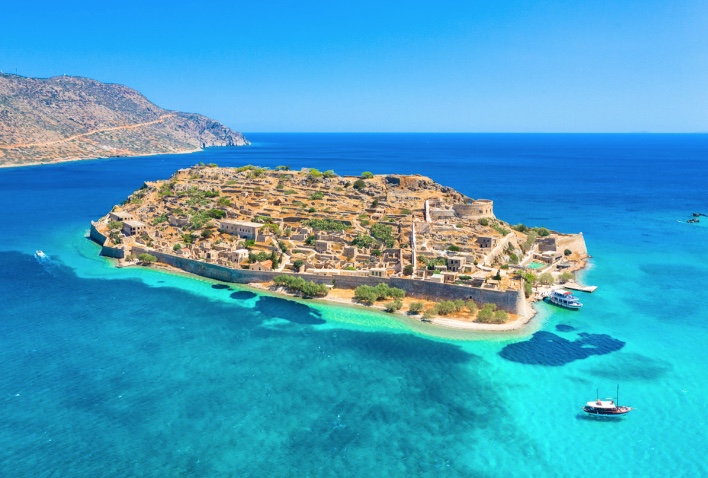
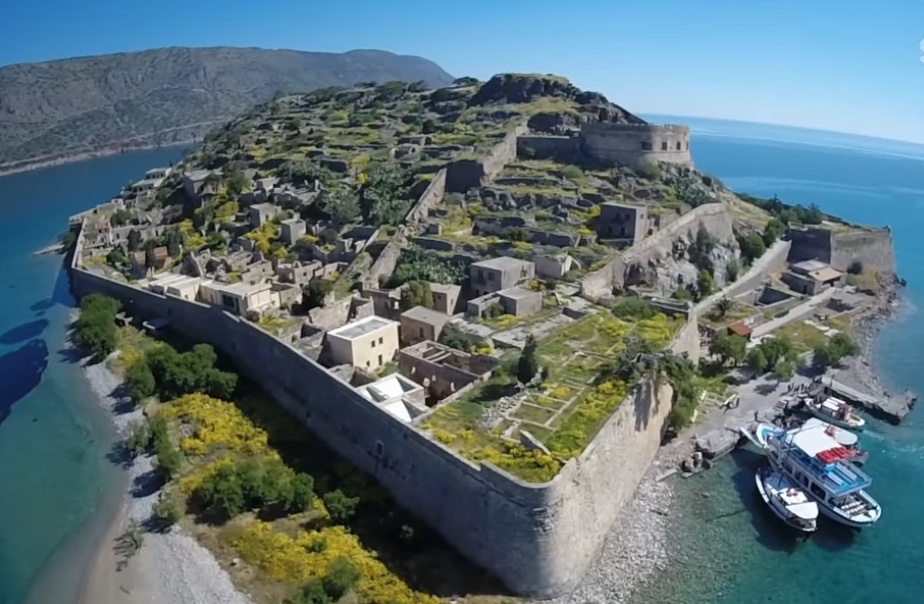
Above the calm water of the Gulf of Mirabello rise the walls of Spinalonga (Σπιναλόγκα). The small rocky island, barely eight and a half hectares in extent and some fifty metres high at its summit, lies at the mouth of the natural harbour of Elounda, directly opposite the fishing village of Plaka, from which it is separated by about 750 metres of water. From a distance it looks like an impregnable ship of stone that has dropped anchor for good off the north-east coast of Crete.
The world knows Spinalonga chiefly as the island of the lepers – one of the last places of refuge in Europe for people shut out of society on account of their illness. Yet the leper colony was only one chapter in its history, if the most dramatic. Before it there was a Venetian fortress here, a sanctuary for insurgents and a lively small Ottoman town. Each age has left the island its own walls, houses, paths and memories. That is what draws several hundred thousand visitors across the water every year and makes Spinalonga the most visited archaeological site on Crete after Knossos; since 2014 the fortress has stood on Greece’s tentative list for UNESCO World Heritage status.
From ancient Olous to Venetian Crete
Whoever held Spinalonga commanded the entrance to the harbour, and so the island served for defence even in antiquity. It belonged to the territory of Olous, a flourishing ancient city whose remains lie near the present village of Elounda – partly under water, at the narrow isthmus of Poros, where on a calm day lines of walls can be made out in the shallows. Through Olous ran trade routes that linked the east of Crete with the islands of the Aegean and the ports of the Mediterranean. The people of Olous had already fortified the rock, which guarded the northern approach to their harbour; it was on the ruins of this ancient acropolis that the Venetians later built.
After the Fourth Crusade, at the beginning of the 13th century, Crete passed to the Republic of Venice. For the Serenissima the island was far more than an overseas possession: it was the principal support on the sea route between the Adriatic and the eastern Mediterranean. Of particular value were the sheltered harbour of Elounda and the neighbouring salt works, laid out in the 15th century, whose shallow basins can still be seen on the shore of the lagoon.
Was the island once a peninsula?
According to an old tradition Spinalonga was formerly joined by a narrow neck of land to the neighbouring peninsula of Kolokytha. The Venetian cartographer Vincenzo Coronelli, who published his description of the island towards the end of the 17th century, reports that in 1526 the Venetians cut a channel at this point and so made the fortified rock an island in its own right.
Possibly it was then that Spinalonga acquired its present outline. The water became an additional wall: from then on it was impossible to approach the fortress unobserved or to attack it by surprise from the land. The strait between the island and the tip of Kolokytha is still narrow and shallow, and the excursion boats from Elounda pass close beside it.
Where the name Spinalonga comes from
Legends cling to the name as well. It is often traced to the Italian words spina longa – ‘long thorn’. The elongated rock before the harbour mouth, with its spine of limestone, may indeed have put the Venetians in mind of a point.
Another explanation tells of a linguistic misunderstanding. The Venetians, it is said, misheard the Greek phrase ‘stin Olounda’ (στην Ολούντα) – ‘in Olounda’, ‘to Olounda’ – and gradually reshaped it into Spinalonga, a sound more familiar to Italian ears. The old name of an island in the Venetian lagoon may have played its part: the island now called the Giudecca was once known as Spinalonga too. Under the Ottomans the name was worn down further, to Spirlonga, and a local tale duly appeared to explain it by a pair of lovers called Spiros and Longa.
In the 20th century the island was given the official name Kalydon (Καλυδών). It appears in documents and on maps, but has hardly caught on in everyday use. For locals and travellers alike the island has remained Spinalonga – a name it shares, confusingly, with the Kolokytha peninsula, which is sometimes called Great Spinalonga.
The birth of a sea fortress
In the second half of the 16th century the Ottoman Empire extended its influence ever further in the eastern Mediterranean. After the loss of Cyprus in 1571 it was clear to the Venetians that Crete might be the next target, and they set about fortifying the island’s most important harbours and bays. Planning for Spinalonga began as early as 1574, when the island was surveyed at the suggestion of the provveditore generale Giacomo Foscarini.
The building work proper fell in the years 1579 to 1586. The design is associated with the military engineers Genese Bressani and Latino Orsini. Bressani was entrusted with the project in 1578, and on 15 July 1579 the provveditore generale Luca Michiel laid the foundation stone, an event recorded in two inscriptions on the walls. The engineers applied the bastioned system, then the latest thing in fortification, and adapted it with great skill to the uneven, rocky ground. The stone was quarried on Spinalonga itself, on Kolokytha and around Elounda.
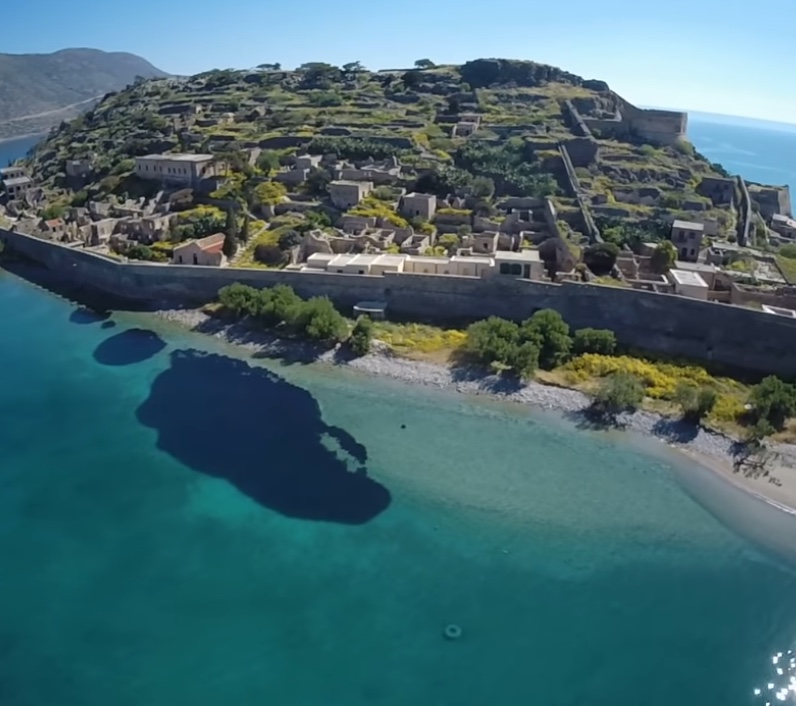
The walls follow the outline of the island, and the defensive works lie on several levels one above the other: one ring down at the water’s edge, a second on the crest of the rock – added from 1584, after Orsini had pointed out how vulnerable the lower circuit was from above – and between them cross-walls that close off the slope. Bastions and semicircular gun platforms – the great ‘half-moons’, the Mezzaluna Michiel and the Mezzaluna Moceniga, named after Venetian officials – made it possible to rake the approaches from the sea with crossfire. With some 35 guns, Spinalonga was reckoned one of the strongest sea fortresses in the Mediterranean. Inside were barracks, magazines, churches, service buildings and cisterns for rainwater. The island has no springs of its own; in a siege, therefore, the supply of water could decide the fate of the garrison.
The Cretan War and the last Venetian bulwark
In 1645 the Cretan War broke out between Venice and the Ottoman Empire. It lasted almost a quarter of a century and became one of the gravest conflicts in the island’s history. The further the Ottoman troops advanced, the more refugees from the lost districts Spinalonga took in. Cretan insurgents, the Chainides, also found shelter here and carried on the resistance from the fortress, slipping across to the mainland to raid and returning to the safety of its walls.
In 1669, after a siege of more than twenty years, Candia – the present Heraklion – fell. Almost the whole of Crete came under Ottoman rule, but by the terms of the surrender Venice kept three island fortresses, Spinalonga, Souda and Gramvousa, which watched over her shipping lanes to the Levant. For almost half a century more the banner of St Mark flew over the fortress, and a Christian community grew up inside it: the church of St Panteleimon was founded in 1709, only six years before the end.
In 1715 Ottoman troops laid siege to Spinalonga. After three months the fortress capitulated and the Venetian garrison left the island; the inhabitants had been promised safe passage to Corfu, but the terms were not honoured, and some six hundred of those who remained behind were taken captive. So ended the Venetian chapter of its history – and with it the last Venetian military presence on Crete.
An Ottoman town behind fortress walls
After 1715 Muslim families settled inside the fortress, at first largely the households of the garrison – janissaries, gunners and armourers, some three hundred men in all. The new inhabitants fitted out the Venetian buildings as dwellings and workshops, and not infrequently built their own houses on the old stone foundations. By 1830 some eighty families were living on the island.
In the 19th century the settlement grew rapidly: behind the walls merchants and seamen felt safer than in many a coastal village, and during the Cretan risings of 1866 and 1878 Muslim families from the villages of Mirabello fled here for protection. By 1881 the island had 1,112 inhabitants. Spinalonga had become the largest Muslim trading place on the Gulf of Mirabello, with around two hundred houses and some twenty-five shops and workshops, a mosque, coffee houses and schools. Its merchants and shipowners dealt in olive oil, almonds and carobs – and, towards the end, in contraband.
The surviving two-storey houses, with their symmetrical façades and large doorways, their walled yards and private cisterns, recall the time when a busy small town of the eastern Mediterranean existed inside a military fortress. The best of them line the main street that runs north from the entrance tunnel, the old market street of the Ottoman town.
The Cretan uprisings and the decline of the Ottoman settlement
Towards the end of the 19th century the familiar order of Spinalonga began to break down. The Cretan uprisings, the waning of Ottoman power and the intervention of the European powers prompted the Muslim population to leave the island.
The year 1897 was especially tense. A further uprising swelled into an international crisis in which Great Britain, France, Russia and Italy intervened. They stationed troops on Crete and divided the island into zones of responsibility. Lasithi, with the Gulf of Mirabello and Spinalonga, fell within the French zone; it was French troops who, in 1897–98, cut the little canal through the isthmus at Poros that still separates Kolokytha from the mainland.
After the withdrawal of the Ottoman army and the foundation of the autonomous Cretan State the exodus continued. Houses and shops emptied, and the once bustling trading place gradually turned into a silent fortress. A few families held out until 1903, some of them living by smuggling.
The Cretan State and union with Greece
In 1898 the Ottoman troops left Crete. Formally the island still acknowledged the suzerainty of the Sultan, but in fact it became an autonomous state under the protection of the European powers. At its head, as High Commissioner, was placed Prince George of Greece, a son of King George I. Crete acquired its own government, a parliament, laws, public authorities, a currency – the Cretan drachma – and a gendarmerie.
The majority of the Orthodox, Greek-speaking population stood for enosis, union with Greece. In 1905 the supporters of Eleftherios Venizelos rose at the village of Therisso, in the foothills of the White Mountains south of Chania, demanding political reforms and more resolute steps towards union. The following year Prince George resigned his office.
In 1908 the Cretan deputies unilaterally declared union with Greece; it was recognised internationally, however, only after the Balkan Wars. On 1 December 1913 the Greek flag was ceremonially raised on the Firkas fortress at Chania, in the presence of King Constantine and of Venizelos, by then prime minister of Greece.
The founding of the leper colony
In 1903 the government of the Cretan State resolved to set up a leper colony on Spinalonga; the law was passed on 30 May of that year. The first patients, 251 of them, arrived in October 1904. There had been people with leprosy on Crete before; many lived at Meskinia outside the gates of Heraklion – in poverty, almost without medical help and under constant pressure from those around them.
At the beginning of the 20th century leprosy aroused an almost superstitious dread. To the authorities, isolation seemed the only means of protecting the population – a view urged on them by the Danish dermatologist Edvard Ehlers, who had studied the disease on Crete. Spinalonga was an obvious choice, with its position in the sea, its fortress walls and its empty houses. At the same time, as people on Crete observe to this day, the decision hastened the departure of the last Muslim families.
After the union of Crete with Greece, patients from other parts of the country were sent to the island as well. On arrival their names were struck from the registers of their home towns, and a yellow flag flew from the summit of the rock as a warning. For decades Spinalonga became the enforced home of hundreds of exiles and went down in history as the island of the lepers – a name more closely bound up with Hansen’s disease, the world over, than that of any other place.
Dante’s Gate
The new arrivals entered the settlement through a vaulted stone passage that later came to be called Dante’s Gate. Associated with it is the line from the third canto of the Inferno, in the “Divine Comedy”: “Abandon all hope, ye who enter here.” Whether such an inscription ever really stood there, nobody knows; but the tradition has preserved the feeling of those who crossed the boundary of the leper colony for the first time. Behind the gate, home, family and the former life were left behind. Visitors today land at a jetty on the western shore and walk through the same curving tunnel into the main street.
The first decades of isolation
The patients were lodged in the houses of the former Ottoman settlement. Many of the buildings were half ruined; there was a lack of water, of medicines and of the simplest comforts. No one was allowed to leave the island of his own accord, fishing was permitted only within a couple of hundred metres of the shore, and state support barely covered the bare necessities. For the first two decades there was no hospital at all: a doctor took up his post only in 1925, and in 1928 the former mosque was repaired to serve as an infirmary. Doctors, orderlies and officials went back to the mainland before sunset – the night belonged to the patients alone.
Food and water came from the opposite shore, to supplement the rain collected in the old cisterns. Plaka played a special part: its boatmen ferried people and goods across, traders supplied the patients, and individual villagers helped to keep the island’s economy going. Whatever left the island was fumigated with sulphur first.
Yet even in the harshest conditions people made themselves at home in their houses, followed a trade, grew plants in small yards and opened shops. Friendships formed on the island, marriages were contracted – more than 170 are recorded – and families founded. If a child was born healthy, it could be separated from its parents and placed in care outside Spinalonga. A film document of 1927, however, also shows healthy children sharing the exile of their sick parents.
The church of St Panteleimon
The church of St Panteleimon (Agios Panteleimonas), a building of Venetian date on the main street, became a spiritual centre of the community. Tradition preserves the story of a priest who served on the island although he did not himself suffer from leprosy. He was the priest-monk Chrysanthos Katsoulogiannakis, of the brotherhood of Toplou Monastery near Sitia, a small, ascetic man with a white beard, who came to Spinalonga in 1947 as successor to Father Meletios Vourgouris. He visited the sick in their houses, gave them his hand, supported the poorest from his modest means and administered communion to them without shrinking from contact.
According to tradition the priest was in no hurry to clean the communion spoon after the service; he drank what remained in the chalice from which the sick had received, and so showed that he regarded his congregation as neither unclean nor outcast. For the inhabitants there was more compassion in this simple gesture than in many official speeches. When the colony was closed, Father Chrysanthos stayed on alone on the island for some years in order to say the memorial prayers at the graves, as Orthodox custom requires at fixed intervals up to the fifth year after a burial – until some time between 1959 and 1962. After that he withdrew on grounds of age to Toplou Monastery, where he died in 1972. In Greece he is called the “saint of the lepers”.
Epaminondas Remoundakis
On 11 March 1936 a twenty-one-year-old named Epaminondas Remoundakis landed on Spinalonga. He had been born on 4 August 1914 at Agia Triada in the district of Sitia, the sixth child of his family, and was in the third year of a law degree at the University of Athens. The disease had shown itself when he was still a schoolboy – it was diagnosed when he was twelve – and in 1931 he had slipped away from his village by boat to escape compulsory segregation. In the capital he lived unrecognised for more than four years, receiving treatment at the Pasteur Institute, until the police arrested him on 18 October 1935 and committed him to the leper hospital of Agia Varvara near Athens. From there he chose of his own accord to go to the island where his sister Maria was already confined. Of the degree he never finished he spoke later as of a dream that he had seen and touched and that had very nearly been his.
Resignation and squalor were not things Remoundakis was prepared to accept. Until then, by most accounts, the islanders had lived with little sense of community, each household intent on its own survival, on its rations, on cards and drink. Within months of his arrival, and largely through his energy, the patients formed the “Brotherhood of the Sick of Spinalonga – St Panteleimon”. It was an association run by the sick themselves, and it demanded decent sanitation, reliable supplies and proper medical care – and, in time, the right to marry and to carry on a trade.
How the islanders transformed their island
At the Brotherhood’s insistence the lanes were cleaned and the houses put in order, and a regular service was set up to keep the public spaces swept. A medical orderly service, a laundry and rooms for disinfection were organised, and a dentist came across to hold surgeries. Workshops opened, and with them a barber’s shop, a coffee house, a library and common rooms. A path was cut right round the island outside the walls, so that for the first time the inhabitants could walk the full circuit of their rock, with sea air and an open horizon.
Loudspeakers were fixed along the main street, carrying announcements and music – classical music, as often as not. A generator supplied the island with electricity and lit the lanes at night, at a time when many of the villages on the opposite shore still went to bed by lamplight. There were plays and film screenings, a school and a small newspaper.
Lanes and courtyards were whitewashed, curtains hung at the windows and flowers stood on the sills. People worked, quarrelled, celebrated, fell in love and helped their neighbours. The island of lepers became a small town whose inhabitants refused to be counted as dead by the rest of the world.
Spinalonga under the Occupation
In the Second World War German and Italian troops occupied Crete, and from 1941 no more patients were sent to the island. Supplies to Spinalonga deteriorated; food and medicines ran short, and a good many of the sick died of malnutrition. Yet fear of leprosy drew an invisible line around the island which even the occupiers did not cross unless they had to.
A great many stories cling to these years. It was said that the islanders listened in secret to the broadcasts from London and Cairo and heard the news before the people of occupied Crete did. There was talk of boats from Plaka slipping across at night with food, and of men who tried to swim the 750 metres to the mainland in search of something to eat – some of whom, it is recorded, were shot by the occupying forces when they came ashore. Of Remoundakis it is told that he shouted so desperately at the Italian soldiers who had come to take the priest and the children off the island that his palate, already weakened by the disease, tore, and he lost most of his voice.
Some of these tales have hardened into legend with time, and it is now hard to separate documented testimony from what has simply been handed down. They convey the mood of the war years well enough, all the same: hunger, isolation and the island’s constant dependence on its lifeline to the shore opposite.
The cure and the hope of going home
The 1940s brought the turning point in the treatment of leprosy. The sulphone drugs entered medicine – compounds able to suppress Mycobacterium leprae, the bacterium that causes the disease – and from 1948 the new treatment was being given on Spinalonga itself. Before that the patients had had little beyond folk remedies and, from the late 1920s, a preparation or two of limited value. For the islanders the new medicine meant more than feeling better: for the first time there was a reasoned hope of leaving.
The damage done by years of illness could not, however, be undone at a stroke. In some the nerves were already destroyed, the eyesight clouded or the limbs crippled; Remoundakis himself went blind in 1947, on the very eve of the cure. Nor did the prejudices of the outside world vanish overnight. In their years of segregation many had lost house, property and all contact with their families.
The closing of the leper colony
As effective treatment became general, the patients were transferred to the institution of Agia Varvara near Athens or went back to life on the mainland. In July 1957 the colony was closed for good, a little over half a century after the first 251 patients had been landed in October 1904, and the island fell silent. The last person to leave was the priest, Chrysanthos Katsoulogiannakis, who stayed on alone until 1962 so that the memorial services which Orthodox custom requires for the dead in the years after burial should not go unsaid.
Epaminondas Remoundakis was taken to Agia Varvara together with his wife Tasia (Anastasia), whom he had married on the island, and there both lived until their deaths; his came on 24 January 1978. He had already lost his sight, but he went on campaigning against the discrimination suffered by those who had survived Hansen’s disease. In later life he dictated his memoirs – in 1972 the ethnologist Maurice Born recorded him at length – and they were published after his death under the title “Eagle Without Wings” (Αετός χωρίς φτερά). A French edition, translated by Born and Marianne Gabriel, appeared in 2015.
Spinalonga after 1957
After the closure, houses, workshops and wards stood empty. For a while people preferred not to remember the island at all: the fear of the disease, and the shame at the years of enforced segregation, were still too strong. A number of the colony’s buildings were pulled down or left to collapse in this period, so that what the visitor sees today is the Venetian and Ottoman shell rather more than the 20th-century town that lived inside it.
In 1976 Spinalonga was declared an archaeological site. Survey, consolidation and restoration began, and continue to this day. In January 2014 Greece entered the “Fortress of Spinalonga” on its Tentative List for UNESCO World Heritage status – as an outstanding monument of bastioned military architecture, and as a place that commemorates human segregation and endurance. The rock measures barely 85,000 square metres, yet it has become one of the most visited archaeological sites in Crete – by most reckonings second only to Knossos – with several hundred thousand visitors a year.
Victoria Hislop and the novel “The Island”
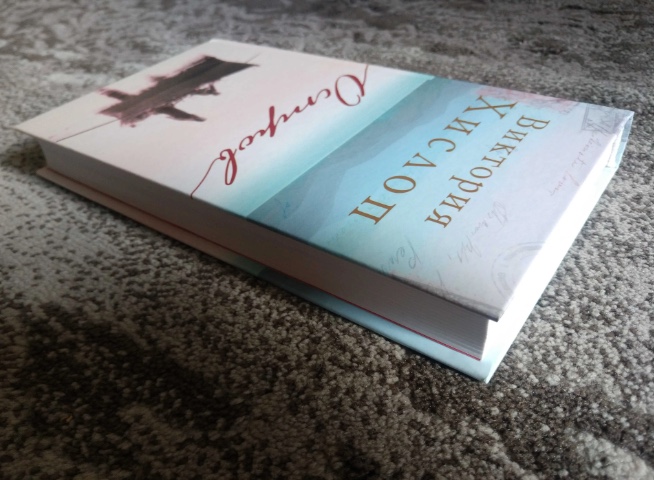
Spinalonga owes its present fame to “The Island”, the first novel of the British writer Victoria Hislop, published in June 2005. At its centre is the story of several generations of one family whose fate is bound up with Plaka and the leper colony: a young Englishwoman, Alexis Fielding, comes to Crete and learns from an old family friend, Fotini, what her mother has never told her – the history of her great-grandmother Eleni and of Eleni’s daughters Anna and Maria.
The novel is not a documentary chronicle: its characters are invented, and the historical circumstances serve as the backdrop to a family drama. The book became an international bestseller, was translated into some twenty-five languages and earned its author the Newcomer of the Year prize at the British Book Awards of 2007. It has introduced millions of readers to the story of Spinalonga.
The Greek television series “To Nisi”
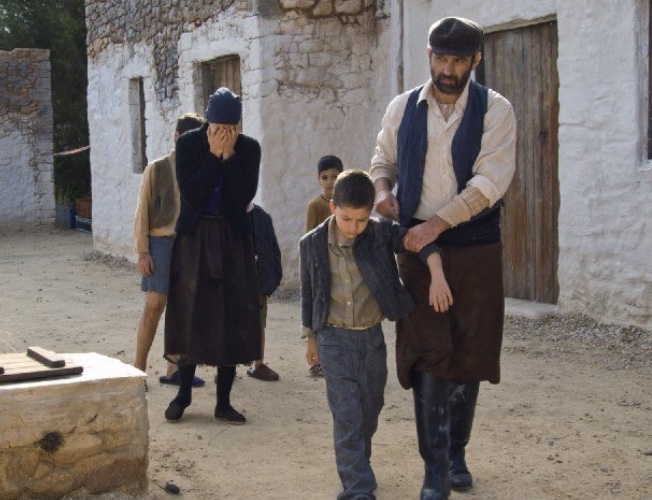
In the autumn of 2010 the Greek channel Mega broadcast a twenty-six-part adaptation of the novel, “To Nisi” (Το Νησί, “The Island”); the first episode went out on 11 October. Shooting had begun in December 2009 and took place in Plaka, on Spinalonga, in upper Elounda and in Agios Nikolaos. With a budget of about four million euros it was the most expensive production Greek television had yet attempted. Victoria Hislop was closely involved, and the screenwriter Mirella Papaikonomou, with her approval, enlarged the plot of the book with new characters and storylines.
The series became a cultural event in Greece. The lanes, boats and houses of Spinalonga were on screen again; the island’s story entered the memory of a new generation, and the number of travellers wanting to see the place rose markedly.
Werner Herzog’s “Last Words”
A place apart in the island’s cultural history belongs to Werner Herzog’s short film “Last Words” (“Letzte Worte”) of 1968. It runs to thirteen minutes, was shot in two days on Crete and Spinalonga while Herzog was at work on his first feature, “Signs of Life”, and was edited in a single day; the camera was Thomas Mauch’s. Its hero is an old musician who, we are told, was removed by force from the abandoned island of Spinalonga. Now he lives on Crete, plays the lyra at night in a bar and repeats that he will not say another word.
The part was played by the Cretan lyra player Antonis Papadakis, known as Kareklas, with Lefteris Daskalakis beside him on the bouzouki. The story of the last inhabitant hovers in the film on the border between rumour, invention and play-acting. The characters repeat the same sentences in long takes until the words have almost lost their meaning, and the hero’s silence – he says more than anyone, all of it a refusal to speak – turns out to be more eloquent than everything the others have to tell. Herzog was not the first film-maker on the rock: the Greek director Lila Kourkoulakou had shown her documentary “The Island of Silence” at the Venice Film Festival in 1959, and “L’Ordre”, which Jean-Daniel Pollet made with Maurice Born, followed in 1973.
There are stories that cannot be explained in plain speech. Sometimes one can only repeat them until the words turn into music – or play them on the lyra, as Herzog’s hero does.
How to look at Spinalonga today
Spinalonga reveals itself by degrees. Look first at the walls and bastions, which follow the lie of the rock and were laid out by Venetian engineers in the late 16th century. Then at the houses of the Ottoman settlement along the narrow lanes – some two hundred of them by 1881, when more than a thousand Muslims lived here on Venetian foundations. After that, turn to the hospital buildings, the church and the places bound up with the daily life of the sick – as far as the little cemetery at the southern tip, the quietest corner of the island.
Seen in this way, the island ceases to be the stage set for a single tragic legend. What takes shape instead is a place used over the centuries by soldiers, merchants, sailors, refugees, families and people banished here on account of their illness.
The name “island of lepers” keeps its force, and recalls a time when a diagnosis was a sentence. Behind that name, though, one has to see the individual men and women – with their trades, their characters, their loves, their faith and their hopes. Society banished them behind fortress walls, but could not take from them the will to live and to be heard.