Aretiou Monastery: Silence, a Cave and Cretan Icon Painting
The most complete guide to Crete: 221 places on the map, 23 routes and 49 articles — with photos, videos and the story behind every place. Everything is open and free: no sign-up, no paid sections and no advertising, open or hidden. You can install the guide on your smartphone as an app.
Routes drawn along real roads
Weather at every stop
Full-text search
“Near me” by geolocation
Create your own printable itinerary
Satellite, terrain, dark mode
Works offline
⌕
Searches 1.7 million characters of descriptions, not just names
—places
4regions
—routes
—with video
Search results
—
Interactive map
Find what is near you
Filters narrow the map and the list at once. Zoom out and pins group together.
Region
Category
Фильтры карты
Landmarks
Featured places
RegionCategory
Routes
Ready-made day trips
Individual places
Articles about landmarks
Aretiou Monastery: the Holy Trinity, a cave church and the memory of eastern Crete
Take the road north-east out of Neapoli and after about eleven kilometres you reach the hill village of Karydi; a little beyond it, in a secluded valley some 530 metres above sea level, lies the monastery of Aretiou. From Agios Nikolaos it is a drive of roughly 25 kilometres, and the road is asphalted all the way to the gate. The country up here is dry and stony – this is the upland of Upper Mirabello, between Neapoli and the heights above Elounda and Plaka – yet around the monastery olives, almond trees and cypresses grow, with old oaks nearby, and on clear days you sense the sea to the north without ever hearing it. The seclusion was never an accident. Far from the main routes, a community could pray here, farm its land and still keep in touch with the villages of the plateau. The monastery still receives its visitors with a stillness now found in very few places on Crete.
Its official name is the Holy Monastery of the Holy Trinity of Aretiou (Ιερά Μονή Αγίας Τριάδος Αρετίου) – you will also see it referred to simply as Areti – and it belongs to the Metropolis of Petra and Cherronisos. The monastery was founded towards the end of the 16th century, between 1580 and 1596, under Venetian rule, when many new houses were founded on Crete and older ones revived. The founder is held to be Markos Papadopoulos, a wealthy landowner. Around 1600 he bequeathed the monastery extensive estates, among them fields of some forty mouzouria – an old Cretan measure of land reckoned by the quantity of seed needed to sow it – and so secured the livelihood of twelve monks. That twelve brothers were provided for is no coincidence: the number alludes to the twelve Apostles, and it recurs at several points in the monastery.
In its first centuries Aretiou was not only a place of prayer but an important agricultural centre. Fields, vineyards, olive groves and pastures belonged to it; the monks tilled the land and kept livestock, and were closely bound up with the villages of Upper Mirabello. An oil mill and a dairy stood outside the walls, a wine press within. The monastery reached its height in the 17th century, when its records show a busy traffic in land and goods, when it took seven smaller monasteries of the district under its wing, and when a workshop of icon painters is said to have been active here. It was counted among the most important fortified monasteries of the island. One fine witness to that age survives: the bell tower of dressed stone bears an inscription with the date 1618, and its bell has thus been ringing over the valley for more than four hundred years. Even after the Ottoman conquest the house kept a certain independence of spirit – in 1723 it is recorded as supplying fighters, or pirates, who were harrying the Turks.
In 1821, at the outbreak of the Cretan uprising against Ottoman rule, the monastery was plundered by Turkish troops and set on fire. The rich library was lost as well, with its deeds and books from the Venetian period, and so were the monastery’s relics – a loss that leaves the history of the house full of gaps to this day. Yet monastic life did not come to an end: by 1844 the buildings had been repaired and the community was functioning again. When Crete rose against the Ottomans once more in 1878, the monastery’s tenants supplied the insurgents and the refugees with bread, oil and other provisions. Around 1880–81 the buildings were thoroughly renewed, and the monastery church was given the form it has today.
The main church and the chapel of St Lazarus
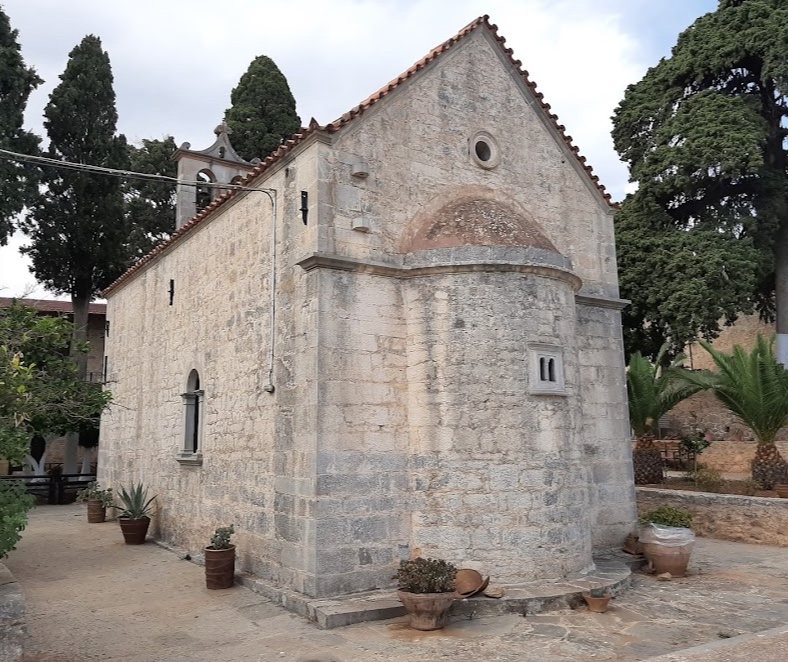
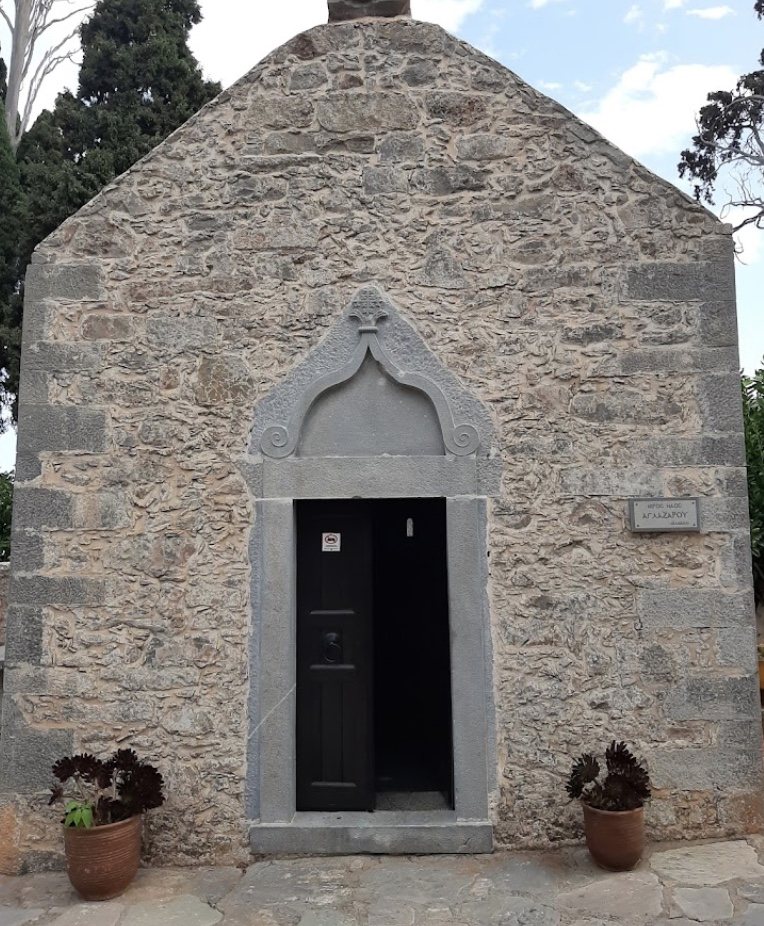
The heart of the complex is the katholikon, the main church, dedicated to the Holy Trinity. It is a plain, single-aisled building under a pointed barrel vault, with a pointed apse and a carefully carved stone doorway whose arch is likewise pointed – a form typical of Cretan monasteries of the Venetian period, and one whose austerity has a beauty of its own. It stands in the upper, central courtyard, with the two-storey ranges of cells around it. To the south-east, in the middle of the same court, stands the little chapel of St Lazarus, also a building of Venetian date. Scholars think that it was originally a funerary chapel, in which the monks who died here were laid to rest and remembered in prayer.
The chapel of St Lazarus is regarded as the only church in the whole of Crete dedicated to this saint. Its presence gives the monastery a character of its own. Lazarus of Bethany, the brother of Martha and Mary, whom Christ called back to life after four days in the tomb, as the eleventh chapter of St John’s Gospel relates, stands in Orthodox devotion for the overcoming of death and the hope of resurrection; the Church keeps his feast on Lazarus Saturday, the eve of Palm Sunday, at the threshold of Holy Week. So at Aretiou the remembrance of the dead is joined to the confidence of Easter – a thought that makes itself felt with particular force in the seclusion of this valley.
Inside the main church a carved and gilded wooden iconostasis has survived, adorned with icons of the 19th century. It is crowned by a cross supported by two elaborately carved wooden dragons – a motif that makes visible the victory of the Cross over evil. Beneath it runs the cycle of the Dodekaorton, the twelve great feasts of the Church year, on twelve separate panels. Among the most venerated icons are the Holy Trinity, the Mother of God as “Lady of the Angels”, Pentecost, St Nicholas, the Dormition of the Mother of God, the Annunciation, the Raising of Lazarus, and Saints Eulampios and Eulampia. Some of the panels date from the 17th century and are attributed to the Cretan School; three of them – the Holy Trinity, the Lady of the Angels and the Pentecost – are thought to be by the hand of one and the same anonymous painter.
Cave, defensive walls and monastic architecture
What distinguishes Aretiou is the intelligent use it makes of the terrain. The monastery is built on sloping ground, and part of the precinct leans against a stretch of rock with a natural cave, so that the stone itself becomes part of the sacred space. The rock gave coolness in summer, shelter from the wind and the seclusion that silent prayer demands. Anyone who knows the cave churches of Crete will recognise here an age-old tradition: hundreds of caves on the island bear the names of saints, and many of them shelter small chapels to this day. In a district as dry as this one, water mattered as much as shelter, and the monks collected the winter rain in cisterns that can still be seen in the courtyard.
The complex itself follows the type of the fortified monastery, which had proved its worth on Crete in unsettled times. The two courtyards lie at different levels. The lower, southern one, entered through a covered gateway, was the working yard, and from it you reach large vaulted storerooms, the stable, the wine press and the workshops. The upper court, around the church, is enclosed by two-storey buildings with the monks’ cells, the kitchen, the bakery, the refectory and a smithy. Religious life, living quarters, storage and farming were brought together here under one roof – the monastery was at once a house of God, a farm estate and a place of refuge. A small chapel of St Makarios has been added in recent years.
In the walled courtyard stand twelve ancient cypresses. Tradition has it that they symbolise the twelve Apostles – the same number as the brothers for whom the founder provided – and anyone who walks between their dark, slender trunks will understand why this is counted among the most impressive monastery courtyards of eastern Crete.
The legends of Aretiou
Stories of a treasure, said to have been hidden in Venetian times, are attached to the monastery. According to one legend the Venetians knew of a cauldron full of coins buried not far from the monastery, but believed it to be cursed and did not dare to raise it. A Cretan who happened to overhear their conversation forestalled them and found the cauldron. Prudently, he tied the lid to a donkey; when the animal pulled it away it fell dead on the spot. The farmer himself, however, became a rich man – and in one version of the tale it was he who, in gratitude, built the monastery with the money. In this story the memory of the Venetian period, the tales of hidden riches of which Cretans are so fond, and the notion of a curse that guards foreign gold are all fused together.
Aretiou today
After decades of decline the monastery was dissolved and abandoned around 1930, and it suffered further damage during the German occupation in the Second World War. In 1955 and 1956 monastic life returned, and from 1991 and through the 1990s the entire complex was thoroughly restored under the care of the Metropolis of Petra and Cherronisos. Today Aretiou is once again a living Orthodox monastery. The church of the Holy Trinity, the chapel of St Lazarus, the old icons and the monastic buildings have been preserved; a small museum and a monastery shop round off the visit. It combines well with the neighbouring monastery of Kardamoutsa, dedicated to the Holy Cross, or with the descent to the coast at Plaka, opposite Spinalonga.
The monastery keeps its patronal festival on Whit Sunday, the feast of the Holy Trinity, on the fiftieth day after Easter by the Orthodox calendar, and on the following Whit Monday, the day of the Holy Spirit. Then the courtyard, usually so quiet, fills with the faithful from the surrounding villages. But the journey is worth making on ordinary days too: at Aretiou the history of Venetian Crete, the memory of the uprisings, the economy of the old monasteries, the architecture of the cave churches and the art of the Cretan School all meet.