The most complete guide to Crete: 221 places on the map, 23 routes and 49 articles — with photos, videos and the story behind every place. Everything is open and free: no sign-up, no paid sections and no advertising, open or hidden. You can install the guide on your smartphone as an app.
Routes drawn along real roads
Weather at every stop
Full-text search
“Near me” by geolocation
Create your own printable itinerary
Satellite, terrain, dark mode
Works offline
⌕
Searches 1.7 million characters of descriptions, not just names
—places
4regions
—routes
—with video
Search results
—
Interactive map
Find what is near you
Filters narrow the map and the list at once. Zoom out and pins group together.
Region
Category
Фильтры карты
Landmarks
Featured places
RegionCategory
Routes
Ready-made day trips
Individual places
Articles about landmarks
Agios Nikolaos: harbour, lake and the history of Mirabello
Agios Nikolaos is built on several hills on the western shore of Mirabello Bay, the largest bay on Crete, some 64 kilometres east of Heraklion and its airport. The present town, home to about 13,600 people, has grown round a good natural harbour, but its history does not begin with tourism: there was a Minoan anchorage north of today’s port, and the ancient settlement of Lato pros Kamara served the Dorian hill city of Lato, ten kilometres inland near Kritsa, as its outlet to the sea. In the Hellenistic period, above all in the 3rd century BC, the port outstripped its mother city, whose inhabitants gradually moved down to the coast; it struck its own coins and flourished into Roman times. Scarcely anything of all this is visible in the townscape, because the modern town has been built over the ancient one – time and again building work brings walls and graves to light.
The fortress of Mirabello
The Venetian period is bound up with the fortress of Mirabello, said to have been built in 1206 on the hill of Kefali by the Genoese adventurer Enrico Pescatore, a corsair by trade, when he was contesting the island with the Venetians. After the earthquake of 1303 the walls were repaired; in the 16th century the castle came through pirate attacks – that of 1537 left it badly damaged – and was remodelled to plans by the military architect Michele Sanmicheli. Among other things it served as a store for the salt won from the pans at nearby Elounda. In 1646 the garrison surrendered it to the Ottomans, and later the work was razed. Administrative buildings now stand on the spot, so that little but the shape of the hill remains of the castle. Under the Ottomans the place was all but deserted, though carobs and other local produce continued to be shipped from the harbour; on the maps there appear only the field names Mandraki for the harbour and Gialos for the shore.
Lake Voulismeni
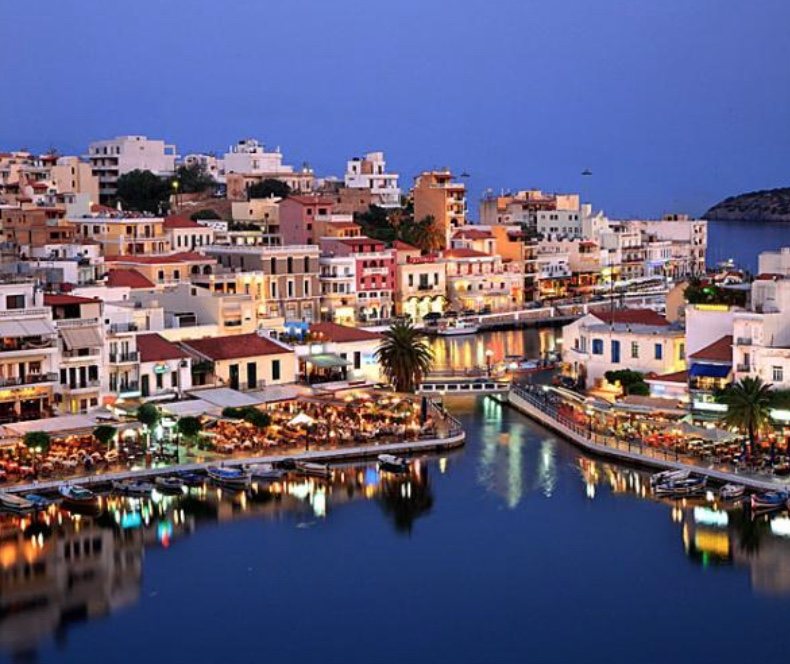
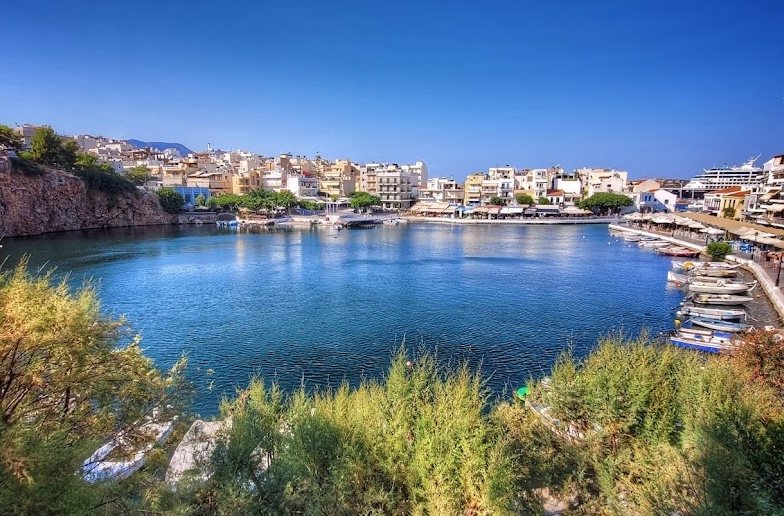
The emblem of the town is Lake Voulismeni, a small, almost perfectly circular and very deep lagoon right in the centre, some 137 metres across and overhung by a reddish cliff. Only between 1867 and 1871, under the Ottoman governor Kostis Adosidis Pasha, was it joined to the harbour by a short channel, which French troops cut afresh between 1905 and 1907; since then fishing boats have rocked on what was once stagnant water. The greatest depth is about 64 metres. The basin is attributed to geological collapse – faulting and the dissolving of the limestone breccia in which it lies – and not to a volcanic crater in the strict sense: there is no igneous rock anywhere near it. Legend knows better: Athena and Artemis are said to have bathed here, and for a long time the lake was held to be bottomless. Cafés and restaurants line the shore, a promenade leads round the water, and the little park above the cliff has the best view. On Easter night, when most of the town gathers round the lake at midnight and fireworks go up, the effigy of Judas is burnt on a raft in the middle of the water.
From harbour village to capital
In the 19th century the settlement began to grow as a harbour and administrative centre. From the late 1860s the abandoned hamlet of Mandraki was resettled by incomers from various parts of Crete, chiefly from Kritsa and from Sfakia, joined by merchant seamen from the east of the island; in 1904 Agios Nikolaos became capital of the district of Lasithi. In the 20th century tourism made it a holiday resort of international repute – from the 1960s, when film-makers and artists discovered the bay for themselves, Jules Dassin and the Disney studio among them, the latter for The Moon-Spinners; the first large hotel opened after 1965. The proximity of Elounda and the island of Spinalonga did the rest.
The church of St Nicholas from which the town takes its name stands on a small peninsula north of the harbour, by the cove where ships anchored in Byzantine and Venetian times. The plain domed, single-aisled building is among the oldest churches on Crete, probably put up before the Arab conquest of the 820s: beneath the frescoes of the 14th century there survive remains of an aniconic, purely ornamental scheme of painting, ascribed to the period of Iconoclasm and with scarcely a parallel on the island. The saint’s day is kept on 6 December. The Archaeological Museum, founded in 1969 and reopened in 2024 after a long renovation, brings together finds from eastern Crete from the Neolithic to the Roman period, among them the rich material from the Early Minoan cemetery of Agia Fotia near Sitia, with its vases and several hundred bronze blades; the “Goddess of Myrtos”, a vessel in female form of c. 2500–2300 BC from Fournou Koryfi; and the skull of a young man – an athlete, to judge by his golden olive wreath – from the Roman cemetery of the town itself, buried in the 1st century AD with a coin for Charon. A small folk museum by the harbour shows weavings and household goods of the Mirabello district.
For bathing there are the town beaches of Kitroplatia – “citron square”, a reminder of the fruit once shipped from here – and Ammos, as well as the bay of Almyros to the south, where a cool stream runs through a reed bed into the sea. In summer excursion boats leave the harbour for Spinalonga; in the evening the town belongs to the strollers who wander between the lake, the harbour mole and the stepped lanes of the hills.