Therisso – the Village of Eleftherios Venizelos’s Revolt
The most complete guide to Crete: 221 places on the map, 23 routes and 49 articles — with photos, videos and the story behind every place. Everything is open and free: no sign-up, no paid sections and no advertising, open or hidden. You can install the guide on your smartphone as an app.
Routes drawn along real roads
Weather at every stop
Full-text search
“Near me” by geolocation
Create your own printable itinerary
Satellite, terrain, dark mode
Works offline
⌕
Searches 1.7 million characters of descriptions, not just names
—places
4regions
—routes
—with video
Search results
—
Interactive map
Find what is near you
Filters narrow the map and the list at once. Zoom out and pins group together.
Region
Category
Фильтры карты
Landmarks
Featured places
RegionCategory
Routes
Ready-made day trips
Individual places
Articles about landmarks
Therisso – the village of Eleftherios Venizelos’s revolt
Beyond the gorge the road reaches Therisso (Θέρισο), a mountain village at the north-western foot of the White Mountains, set among plane trees and green slopes. From the centre of Chania it is about 16 kilometres, and the village stands at 580 metres. Therisso Gorge, some six kilometres long and threaded by a narrow asphalt road, is the natural way in, and the drive up through it is a sight in its own right. At the census of 2011 the village had only 113 inhabitants, and ten years later 120, but at weekends it fills with day-trippers from Chania, who come for the cooler air as much as for the food: the family-run tavernas serve Cretan mountain cooking – cheese above all, meat from the grill, smoked apaki and sausages, syglino, which is pork preserved in its own fat, and creamy staka.
Why Therisso is linked with Venizelos
Tourist literature likes to call Therisso the home of Venizelos; it is more accurate to speak of the place his family and his politics came from. Eleftherios Venizelos was born on 23 August 1864 at Mournies near Chania; it was the family of his mother, Styliani Ploumidaki, that came from Therisso. Here, on 10 March 1905 by the old calendar then in use – 23 March by the new – he began the armed movement against the regime of Prince George, together with Konstantinos Foumis, a former public prosecutor and deputy who took charge of the insurgents’ finances, and Konstantinos Manos, a former mayor of Chania, who saw to military matters.
Venizelos was not turning against the Greek people, nor did he wish to overthrow the Greek monarchy. His quarrel was with the policy of the High Commissioner of the autonomous Cretan State, who kept the island in its international dependence and, in the eyes of his opponents, ruled it in an almost absolutist manner while union with Greece was put off. The breach was an old one: the prince had dismissed Venizelos from his government in March 1901. Therisso was chosen because it was a natural fortress, hard to reach and yet on the very doorstep of Chania, approached only through a narrow gorge lined with caves – a part the village had already played in earlier risings.
From the revolt of 1905 to the union of Crete
The insurgents demanded political renewal and declared Enosis (Ένωσις), the union of Crete with Greece, to be the supreme goal. The Protecting Powers were divided. Russia stood behind the prince: Russian troops marched into the hills with the Cretan gendarmerie, and in August the gunboat Khrabry shelled the insurgents who had seized the customs house at Kastelli, while Britain confined itself to gestures and France and Italy avoided acting against the rebels and looked for a political settlement. A first meeting with the consuls, in July in the monastery near Mournies, came to nothing, and the martial law the Powers declared at the end of that month made little impression in the west of the island, which the insurgents controlled. With winter approaching and money running short, Venizelos let it be known that he would lay down arms on honourable terms. On 2 November 1905, old style, an agreement ending the revolt was signed in the monastery near Mournies; the camp at Therisso was broken up, an amnesty was proclaimed, and those gendarmes who had deserted to the rebels were allowed to leave for Greece. International pressure on Prince George grew; in September 1906 he resigned and left the island aboard the Greek battleship Psara, and was succeeded by Alexandros Zaimis, a former prime minister of Greece. Crete then received a more stable form of self-government, with a new constitution and a reorganised militia under Greek officers that was meant to allow the foreign troops to go home, and in October 1908 the Cretans unilaterally declared their union with Greece.
The final seal in international law came only later: after the Balkan Wars, Crete officially became part of Greece in 1913. The Therisso revolt was therefore no instant “reunification”, but it was a decisive political stage on the way there – and at the same time the moment at which Venizelos became known beyond Crete. In October 1910 King George I, the father of the prince he had driven from the island, called on him to form a government in Athens.
Eleftherios Venizelos: early years and political career
The Venizelos family had moved to Crete after the rising in the Peloponnese, from which the name derives. The father, Kyriakos Venizelos, a merchant, took part in the Cretan liberation movement, and after the revolt of 1866 the family had to leave the island, living on Kythira and then on Syros until an amnesty allowed them back in 1872. Eleftherios finished school at Ermoupoli on Syros, studied at the University of Athens, graduated from the faculty of law in 1886, returned to Crete and worked as a lawyer, journalist and politician; he first stood for election in 1889.
In the rising of 1896–1897 he was among the leading figures, and made his name at the insurgents’ camp on the Akrotiri peninsula, within sight of the warships of the Powers. After Cretan autonomy had been established, Venizelos helped to draft the first constitution of the Cretan State and held, in Prince George’s government, the post of councillor – in effect minister – for justice, from 1899 to 1901. He promoted the creation of the gendarmerie and the reform of the courts, but came increasingly into conflict with the prince over the question of the island’s future: Venizelos wanted Cretan institutions and a Cretan force built up first, the prince preferred to negotiate union personally at the courts of Europe.
After moving into Greek politics Venizelos was prime minister several times between 1910 and 1933. His reforms, beginning with the revision of the constitution in 1911, reached into state administration, education, agriculture and the army. During the Balkan Wars of 1912–1913 his diplomacy contributed greatly to the enlargement of Greek territory, which roughly doubled. His insistence on entering the First World War on the side of the Allies, against the will of King Constantine, split the country in what became known as the National Schism. He died in Paris on 18 March 1936, in exile after a failed coup by his supporters; in Greece and in Crete his memory is bound up with the modernisation of the state and with the struggle to unite the island with the mainland.
Places of memory in Therisso
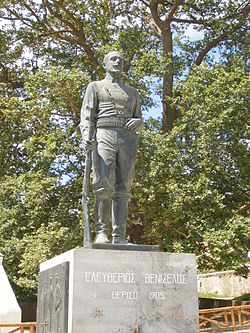
In the village stands the former headquarters of the movement of 1905, now a museum and historical centre; the exhibition shows documents, weapons and objects connected with the revolt. On the village square a statue commemorates Venizelos. Close by is the church of St George (Agios Georgios), dating from the second half of the 16th century: local tradition links it with the secret deliberations of the leaders, and it was here that the revolution and the union with Greece are said to have been proclaimed.
The surroundings also recall the fighting of 1866 and earlier Cretan risings against Ottoman rule; it is said that 300 insurgents once held the entrance of the gorge against 5,000 Ottoman soldiers under Latif Pasha. In August 1821 and again in August 1822 Therisso was destroyed by Turkish-Cretan and Egyptian troops; the English traveller Robert Pashley counted 82 families here in 1834, eighty Christian and two Muslim. At the end of September 1866 Mustafa Naili Pasha had the village burnt down, on 26 March 1867 a solemn service was held here for 2,000 armed fighters under Ioannis Zymvrakakis, and in December 1867 Ottoman troops occupied the place, before winter weather and the attacks of the insurgents forced them to withdraw in January 1868.
The 20th century has left its traces too. In the Second World War Therisso was the seat of the ELAS resistance in the Chania area; on 7 November 1943 an agreement on cooperation between the resistance organisations was concluded here. A small Museum of the National Resistance shows weapons, mementoes of the fighters and newspapers from the years 1941 to 1945.
Therisso thus joins a journey through nature to the political history of Crete: the road through the gorge leads to a village where the memory of Venizelos lives on not only in the museum but in the landscape itself, which was chosen in 1905 for the beginning of the movement.