Arkadi Monastery: the road from Rethymno through Adele, Maroulas and Amnatos
The most complete guide to Crete: 221 places on the map, 23 routes and 49 articles — with photos, videos and the story behind every place. Everything is open and free: no sign-up, no paid sections and no advertising, open or hidden. You can install the guide on your smartphone as an app.
Routes drawn along real roads
Weather at every stop
Full-text search
“Near me” by geolocation
Create your own printable itinerary
Satellite, terrain, dark mode
Works offline
⌕
Searches 1.7 million characters of descriptions, not just names
—places
4regions
—routes
—with video
Search results
—
Interactive map
Find what is near you
Filters narrow the map and the list at once. Zoom out and pins group together.
Region
Category
Фильтры карты
Landmarks
Featured places
RegionCategory
Routes
Ready-made day trips
Individual places
Articles about landmarks
The goal of this route is Arkadi Monastery (Moni Arkadiou), which every Cretan regards as the emblem of the island’s struggle for freedom. Few places in Crete are so deeply lodged in the collective memory: it was here that the revolt of 1866 turned into an act of self-sacrifice, and from here that news of Crete’s suffering reached the whole of Europe. The monastery stands on a fertile plateau some 23 kilometres south-east of Rethymno and about 500 metres above the sea, so the drive is a steady climb from the coast into the foothills. We leave Rethymno heading east and follow the national road towards Heraklion before turning off into the hill country.
The route from Rethymno to Arkadi Monastery
Across the coastal plain and into the hinterland
The road first crosses a fertile plain, thickly planted with citrus trees, orchards and vineyards. Before long we reach the coastal strip east of the town, which is well developed for tourism and offers excellent conditions for every kind of water sport. Some stretches of the long sandy beaches, however, are closed to bathers: this is where the loggerhead turtle (Caretta caretta) lays its eggs, a threatened sea turtle under strict state protection. It is the largest of the hard-shelled turtles – a full-grown adult has a shell around 90 centimetres long and weighs about 135 kilograms – and it is classed as vulnerable on the international Red List. Greece has the most important nesting grounds in the Mediterranean, and the beaches around Rethymno are among the principal ones. Nesting lasts from May to August: a female comes ashore at night, spends an hour or two digging her nest and laying, and returns several times in a season, leaving on average rather more than a hundred eggs each time. The young hatch some eighty days later, usually after dark, and are easily led astray by artificial light, which draws them inland instead of towards the water. That is why, in the summer months, conservationists mark the nests and ask visitors to keep their distance and not to shine lights on the sand at night. After about seven kilometres we come to a junction and turn onto the country road to Adele.
The miracle and the memory of Arkadi
In the tradition of the Church and of Cretan history the deed of the defenders is regarded as a willing testimony to freedom and to loyalty to their homeland. The monastery keeps relics, weapons, documents and other objects connected with the revolt, and the refectory, where thirty-six of the insurgents were cut down, still shows the marks of bullets and blades in the wood of its tables and benches. The commemorative tradition of the community joins the liturgical remembrance of the fallen to the history of the Cretan revolution: every year on 8 November the anniversary is marked with a service, the laying of wreaths and ceremonies that draw people from all over Crete.
Adele
Adele lies about eight kilometres east of Rethymno at an altitude of some 70 metres, set among olive groves and vineyards. According to local tradition the place was founded in Roman times and took its name from its first inhabitant, a certain Adel; finds in the surrounding fields show that people were living here much earlier still, in the 14th century BC. The village is securely attested in the Venetian period, from 1577 onwards: the register of Kastrofylakas, a Venetian census, lists it with 154 inhabitants. Under Ottoman rule the population was mixed but overwhelmingly Christian – the census of 1881 counted 245 Christians and 15 Muslims.
The place is dear to all Cretans, for it was the home of Kostis Giaboudakis, who in 1866 is said to have set fire to the powder magazine at Arkadi and so inflicted heavy losses on the enemy. His bust stands in the village square, and another in the monastery itself. In later years, too, Adele remained a scene of armed conflict, both in the risings of 1866 to 1869 and between 1896 and 1898; in the Second World War German troops shot eighteen villagers, who are commemorated today by a mausoleum. Their remains have since been identified individually by DNA analysis. The parish church of Agios Panteleimon was built about 150 years ago, and stories of miraculous happenings have gathered around its construction; the village has three further churches, dedicated to Agios Nikolaos, the Agioi Anargyroi and the Zoodochos Pigi.
The surrounding country is rich in archaeology: at a spot called Damiri a Minoan tholos tomb was discovered, of Late Minoan date, and at Pyrgos excavators uncovered an entire Minoan residential complex. The village is also known for its extensive olive plantations, which local opinion holds to be among the largest on the whole island; the growers’ cooperative, founded in 1967, runs its own olive mill. Just before the far end of the village a road branches off to the right and takes us to the traditional village of Maroulas.
Maroulas
Maroulas lies only about ten kilometres from Rethymno, at an altitude of some 240 metres, on a fortified hill between two stream beds, with a wide view across the plain to the sea. Tradition has it that the village was laid out by the Venetians in the 13th century; it is recorded in writing from 1577, and finds point to settlement as early as Minoan times – two cemeteries of the palatial period have come to light nearby, and the objects from them are shown in the Archaeological Museum of Rethymno. The buildings have largely kept their original form, so that the place has the air of an open-air museum and carries the visitor back to Venetian Crete. The state has placed the entire settlement under protection as a listed traditional village.
The lanes are very narrow, the façades carry the family coats of arms of their former owners, and vaulted gateways (portares) mark the entrances to the houses of the nobility. Most striking of all are the two surviving defensive towers of the Venetian period, later used by the Ottomans as well: massive, square tower-houses of rubble masonry, crowned with battlements, with narrow window slits and loopholes. In Greece dwelling towers of this kind are otherwise familiar chiefly from the Mani. Alongside them are old olive presses, a mill and Venetian churches, while the chapel of the Prophet Elias stands on the hilltop looking out to sea. The village is best explored on foot, leaving the car at its edge. After the First World War and the Greco-Turkish War, refugees from Asia Minor settled here too, from 1922 onwards.
The settlement owes its name to a legend: a shepherdess called Marouli, or Maroula, is said to have come upon a spring of cool water while grazing her sheep, and it still flows today. In a small wood near the village there is also a mineral spring, whose water, according to local belief, is good for the digestion and helps with intestinal complaints.
From Maroulas we return to Adele and continue southwards. We pass through the villages of Pigi, Loutra and Kyriana; after that the road begins to climb along the north-eastern flank of the hill mass above Rethymno, and we reach Amnatos.
Amnatos
The village lies at a little over 300 metres, 17 kilometres south-east of Rethymno, on rocky ground amid luxuriant vegetation. From here there is a magnificent panorama of Rethymno, the Sea of Crete and the broad plains all around, with Psiloritis rising inland. The area has been inhabited since antiquity: an inscription bearing the place name Amnatos has been found, and some scholars locate here the ancient city of Tripodos, said to have existed before the Minoan era. The name Amnatos itself, on the other hand, is thought to be of Minoan origin.
The place enjoyed its heyday under Venetian rule, when it was called Amnato. From that period come the fortress-like layout of the village core and numerous buildings with coats of arms and inscriptions on their façades. One of these houses, on the square, has been restored: the Palazzo Sanguinazzo (Megaro Sanguinazzo). The Latin inscription over its doorway is worth noticing: Initium sapientiae timor Domini – “The fear of the LORD is the beginning of wisdom” (Psalm 111:10, King James Version). Under Ottoman rule the Muslim inhabitants built a mosque with a minaret, which the English traveller Robert Pashley described; outside the village the ruin of a Turkish fort bears witness to the same period. Amnatos lived through the most tragic chapter of its history in 1866, when the village was set on fire and completely destroyed. It has never regained its former size: the community numbered 653 people in 1940 and fewer than 200 at the census of 2021.
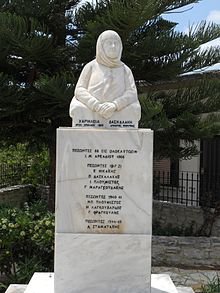
Many inhabitants of Amnatos were among those shut up in Arkadi in 1866. A monument on the square therefore honours the mother who lost all her sons in the fight against the Ottomans: it commemorates Charikleia Daskalaki, who perished in the monastery with her three sons, and all the village’s dead. Two museums repay a visit – the folk museum and the Municipal Museum of the History of Greek Education. Then there is the traditional kafeneion on the square, known throughout the district for its sweets. Those without a car can come this far by the KTEL bus that runs from Rethymno through Amnatos to the monastery. Only four kilometres now separate us from the end of our route, Arkadi Monastery.
Arkadi Monastery
The most famous monastery in Crete – the scene of the self-sacrifice of the Cretan insurgents in their fight against the Ottomans
Find on the map
Introduction
On the green slopes of Crete, some 500 metres above the calm blue sea and about 23 kilometres south-east of Rethymno, lies a place full of history and of an unbending will to be free: Arkadi Monastery. It stands on a fertile plateau among vineyards, olive groves and woods of pine and cypress, on the edge of a gorge that runs down towards the coast at Stavromenos. The site is more than a square of stone walls; it is an emblem of resistance and courage, a beacon for generations who look to the past for their bearings. On the way there one comes upon an Ottoman bridge of 1685 – a prelude, as it were, to a history in which periods and cultures run into one another.
History
There are differing traditions about the monastery’s beginnings. One holds that its history goes back to the 5th century and that the name derives from the Eastern Roman emperor Arcadius (395–408), in whose reign the empire finally divided into an eastern and a western half – the beginning of the era later called Byzantine. Another version credits the emperor Heraclius. The monastery itself states that it was founded around the 11th century by a monk named Arkadios; originally a small church of SS Constantine and Helen stood here, and an inscription of the 14th century confirms that a church dedicated to St Constantine existed on the spot by then.
Over the centuries the community grew into a centre of spiritual life and learning. The present two-aisled church was completed in 1587, after some twenty-five years of building under the abbot Klimis Chortatzis, and by about 1600 the fortified monastic complex was finished. In the 17th century Arkadi was a respected scriptorium: monks copied manuscripts, among them works of ancient Greek thinkers, and so helped to ensure that many texts survive to this day; the copies also brought the monastery a considerable income. Its library came to hold more than a thousand volumes, with Homer, Pindar, Thucydides and Strabo beside the religious works. When the Ottomans took Rethymno in 1648 the monastery was plundered and the abbot, Simon Chalkiopoulos, fled with his monks to Vrontisi; they were allowed back on swearing allegiance to Hussein Pasha, who granted them the rare privilege of ringing their bell, so that the Turks knew Arkadi as Çanlı Manastır, the monastery of the bell. It prospered: the French botanist Joseph Pitton de Tournefort judged it the richest and finest monastery in Crete, with a hundred monks, large yields of oil and at least 200 barrels of wine in its cellars each year. In the 18th century the brotherhood maintained a workshop for gold embroidery, in which liturgical vestments were made for churches in many countries; the stables outside the gate were added in 1714 by the abbot Neophytos Drossas. Harder times followed. A later visitor, Franz Wilhelm Sieber, found only eight priests and twelve monks and the books in a sorry state, and in 1822 the monastery was sacked by Turkish soldiers before Cretan fighters scaled the walls and drove them out.
Architectural heritage
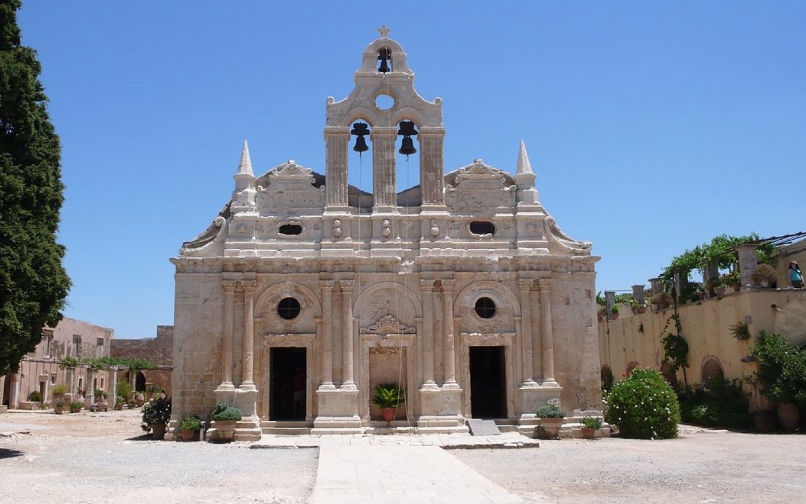
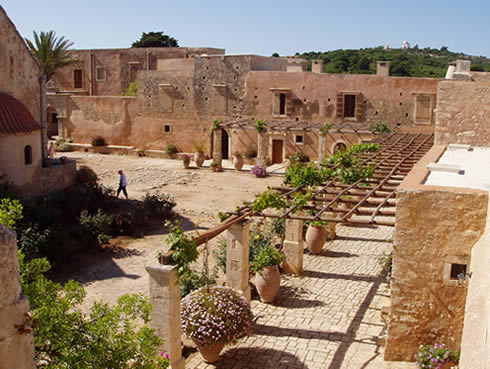
Arkadi Monastery is an architectural masterpiece in which the styles of different periods combine into a coherent whole. The complex forms a fortress-like quadrangle around an inner courtyard – its walls between 67 and 78.5 metres long, the eastern one 1.2 metres thick – and in the middle rises the church with its two aisles, one dedicated to the Transfiguration of Christ, the other to SS Constantine and Helen. The façade, completed in the 16th century, is often described as Baroque, but owes more to the Venetian late Renaissance and to Mannerism, and has been compared with the designs of Sebastiano Serlio and Andrea Palladio; its appeal lies in elegance and balance. Four pairs of Corinthian columns carry the lower storey, with a few lingering Gothic touches among the classical forms. In every detail – from the coupled columns to the carved reliefs – one senses the will to beauty and perfection.
The ranges of monks’ cells and the wine cellar, which in the hour of trial served as a powder magazine, tell of the variety of monastic life. The cellar was a vaulted room 21 metres long and 5.4 metres wide; the long refectory on the north side dates from 1687. The church, preserved without essential change since 1587, is a living witness to Venetian influence on the island, though its cypress-wood iconostasis is a replacement of 1902 for the one lost in the fire. Its majestic façade, with classical portals and a double gable, is crowned by a two-tiered bell gable that seems to reach for the sky. The west gate through which most visitors enter was rebuilt in 1870 on the old lines. Outside the walls, about 60 metres to the west, stands an octagonal former windmill that now serves as an ossuary: here rest the bones of the defenders of 1866, the skulls still bearing the marks of bullets and sword cuts.
The monastery in the revolt of 1866
The revolt of 1866 has gone down in history as the high point of the courage and readiness for sacrifice shown by the Cretans in their struggle for freedom. Arkadi became the focus of the rising and was transformed from a place of prayer into a stronghold of resistance; its abbot had been chosen in May of that year to represent the Rethymno district on the revolutionary committee, and the Ottoman governor had repeatedly threatened to destroy the monastery unless the committee dispersed. Abbot Gavriil Marinakis led the defence, supported by the officer Ioannis Dimakopoulos from the Peloponnese, who had come with a few dozen volunteers and was made commander of the garrison. Panos Koronaios, the commander-in-chief for the Rethymno district, had advised pulling down the stables outside the gate so that they could not shelter an attacker, but he was overruled. On 8 November 1866 there were about 964 people behind the walls – monks and laymen, among them many women and children – united in the aim of throwing off the Ottoman yoke.
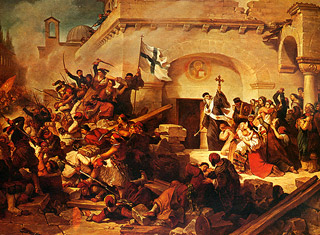
The siege by the vastly superior Ottoman army showed not only the military preponderance of the attackers but also the unbroken will to freedom of the Greeks. The first day’s assault was directed at the west gate, which had been barricaded from the start, and seven Cretans holding the windmill outside were killed when it was set alight. Messengers slipped out to seek help, but every approach had been closed. On the second day the west gate was broken open by cannon fire and the troops poured into the courtyard, where the defenders, their ammunition spent, fought on with bayonets. Preferring death to captivity, those trapped inside blew up the powder magazine – and with it themselves and a great many of the attackers. Some 846 Greeks lost their lives and 114 were taken prisoner, while only three or four escaped; Ottoman losses are put at between 1,500 and 3,000 men. The abbot did not survive, and the prisoners were marched to Rethymno, where the men were held for a year. The deed shook the world and set off a wave of support for the Cretan struggle for independence. Victor Hugo, in impassioned letters, compared Arkadi with Missolonghi and Psara, and Giuseppe Garibaldi also took the side of the Cretans, a number of his followers coming to fight on the island.
The monastery today
Today the monastery is open to all who wish to draw near to its great past and its heroic spirit. A museum keeps exhibits from the time of the foundation to the 20th century – manuscripts, gold embroideries, liturgical vessels, weapons and mementoes of the tragic and exalted chapters of Cretan history. The powder magazine with its collapsed vault can also be visited; only a small section of the vaulting at the west end survived the blast, and an inscription set into the wall in 1930 recalls the flame in which the Cretans died for freedom. The guest wing in the north-west corner is of 1904–06 and replaced the abbot’s quarters destroyed in the siege. No one leaves this place unmoved, for every stone, every corner here tells of the fight for freedom and of the unbending will of a people that longed for independence.
At the same time Arkadi remains a spiritual centre, a destination for pilgrims and a place of deep veneration, a reminder of how much it matters to preserve the memory of the past for generations to come. The great feasts of the monastery are 21 May (SS Constantine and Helen), 6 August (the Transfiguration of Christ) and 8 November, the day of remembrance of the Holocaust of Arkadi. Services are held daily in the early morning and the late afternoon.