Ancient Eleutherna: from Rethymno to the city of Homer’s age
The most complete guide to Crete: 221 places on the map, 23 routes and 49 articles — with photos, videos and the story behind every place. Everything is open and free: no sign-up, no paid sections and no advertising, open or hidden. You can install the guide on your smartphone as an app.
Routes drawn along real roads
Weather at every stop
Full-text search
“Near me” by geolocation
Create your own printable itinerary
Satellite, terrain, dark mode
Works offline
⌕
Searches 1.7 million characters of descriptions, not just names
—places
4regions
—routes
—with video
Search results
—
Interactive map
Find what is near you
Filters narrow the map and the list at once. Zoom out and pins group together.
Region
Category
Фильтры карты
Landmarks
Featured places
RegionCategory
Routes
Ready-made day trips
Individual places
Articles about landmarks
From Rethymno to ancient Eleutherna – with detours to the villages and Arsani Monastery
On the road from Rethymno to the monastery
From Rethymno to ancient Eleutherna
We leave Rethymno heading east on the Heraklion road and pass first through the town’s seaside suburbs. Their fine sandy beaches are laid out with sunbeds and umbrellas, and the water is remarkably clean and clear: the hotels along the shore have modern biological treatment plants, so that nothing fouls the sea. The road keeps company with a seemingly endless beach some twelve kilometres long – one of the longest in Crete. Some stretches offer everything needed for an easy day by the sea and for water sports; those drawn to diving will find well-equipped centres that hire out gear and whose instructors take beginners through the basics. It should be borne in mind, though, that on this open stretch of coast the north wind often throws up heavy surf; red flags are to be taken seriously.
Perivolia
Perivolia is a well-developed resort with hotel complexes and private houses where rooms can be had cheaply. The sandy beach is set up for water sports of every kind. In the course of its history Perivolia has twice been destroyed: in 1896 by the Turks and in 1941 by the German invaders – in the fighting of May that year a battalion of German paratroops, dropped east of Rethymno, was pinned down in the village for days. Each time the place was rebuilt; today it is a suburb of Rethymno that has all but merged with the town. The name – “the gardens” – recalls the orchards and vegetable plots that once supplied the town from here.
Misiria
Misiria is the next suburb of Rethymno, with a splendid beach of fine sand and a well-developed tourist infrastructure. The name is thought to be of Arabic origin: Egyptian slaves are said to have worked here for a time – Misr is the Arabic name for Egypt, and Cairo to this day has a quarter called Misr al-Qadima, “Old Cairo”. Hotels, tavernas and shops line the seafront road.
Platanes
The place, only five kilometres from Rethymno, is known not just for its splendid sandy beach but also for its many bars and restaurants, which make for lively summer nights. A little above the coast lies the old village, where a quieter and more authentic Crete shows itself. The ridge behind it was one of the two heights from which Australian infantry defended the Rethymno airstrip in May 1941.
Stavromenos
A holiday village with a small but very picturesque beach between rocks. Nearby stands the church of the Holy Cross (Ekklisia tou Agiou Stavrou), from which the place takes its name – Stavromenos means “the Crucified”. Above the shore, on a hill, archaeologists have uncovered a large ancient settlement whose beginnings go back to Minoan times, around the 20th century BC. What the ancient town was called is still not settled – Allaria and Agrion have both been proposed. Whatever its name, it stood on the coast controlled by Eleutherna and was one of that city’s outlets to the sea. The excavations continue to this day.
Whole residential quarters, workshops and cemeteries of the Classical, Hellenistic and Roman periods have been brought to light, as well as a large bath complex in the coastal strip between Sfakaki and Stavromenos. Excavation and the analysis of olive stones from the soil suggest that olive oil was being pressed here some 4,000 years ago and used as the base for a range of scented oils for unguents; the people of this coast evidently mastered that demanding craft early. The archaeologists also found extensive remains of early Byzantine date: houses with spacious rooms, with basins, with mosaic-paved courtyards and numerous statues. One can only marvel at the level of civilisation reached by those who have lived in this district since Minoan times.
In the Second World War there was a military airstrip near Stavromenos – it lay by the village of Pigi, about thirteen kilometres east of Rethymno – around which bitter fighting took place during the German invasion of May 1941. The defence of the Rethymno airfield by Greek and Australian troops is among the memorable episodes of the Battle of Crete. From 20 May Lieutenant-Colonel Ian Campbell, with two Australian battalions, the 2/1st and 2/11th, and the Greek 4th and 5th Regiments, held the strip against some 1,700 men of the German 2nd Parachute Regiment; one group of paratroops barricaded itself in the olive-oil factory at Stavromenos. Cut off after the Allied withdrawal elsewhere on the island, Campbell surrendered on 29 May; 96 Australians had been killed. A memorial in the village commemorates the Greeks and Australians who fell. At the far end of Stavromenos we turn south at the junction and drive to Pangalochori. In this village, on 3 June 1941, Damianos Kallergis of Arsani Monastery was executed by the German occupiers for helping those who resisted.
Arsani Monastery
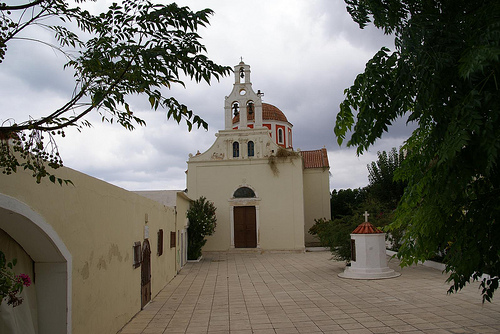
Arsani Monastery (Moni Arsaniou) is a place steeped in history, where old tradition, the struggle for freedom and the cultural heritage of Crete come together. It stands on a level terrace of about one hectare just outside Pangalochori, north of the famous Arkadi Monastery and some eleven or twelve kilometres east of Rethymno, with a wide view of the Sea of Crete, and is dedicated to St George. A surfaced road leads to the gate.
Find on the map
Foundation and first buildings
On present knowledge the beginnings of the monastery go back to the second half of the 16th century, that is, to Venetian times; the first written evidence dates from around 1600, a manuscript of 1601 confirming that the house already existed. The oldest surviving building date, 1645, is on the lintel of the refectory door. A year later, after the fall of Rethymno in 1646, the monastery was laid waste by the Ottomans and probably stood empty for a while, but it recovered quickly: in 1654 it received its first patriarchal sigillion and became stauropegial, that is, directly subject to the Patriarch of Constantinople – a step in which Bishop Neophytos Patelaros was instrumental. The present main church was built in 1888 on the foundations of the old one, and so carries on a spiritual tradition reaching far back into the past. Legends cling to the name: according to one, a monk called Arsenios founded the monastery; according to another it bears the name of Arsinoe, a lady of rank who devoted her fortune to building it in honour of St George. A third explanation derives it from a nearby headland once called Arsinoon.
Architecture
The main church is built on a cross-shaped plan with a central dome and is a notable example of the architecture of its day. It has the features typical of church building at the close of the 19th century, combining inherited methods with new ones. The wood-carving is the work of Vasilios Vlastos; the frescoes were painted by Georgios Christidis of Rethymno between 1987 and 1990, so that the interior, unusually for Crete, shows a complete modern cycle in the Byzantine manner. The monastery is not only a place of prayer and retreat but also a monument to the craftsmen who raised its walls. In the course of restoration a Venetian assembly room was also reinstated, and the complex now houses a conference centre.
In the struggle for freedom
Arsani Monastery was closely bound up with the events in which Crete fought to free itself from Turkish rule. Its monks, Gavriil Klados among them, took part in the resistance, and the Ottomans answered in kind: the buildings were wrecked in 1866 and burnt and looted in 1896. The tragic fate of Klados, who lost his life near Adele in 1897, in the last of the risings – local tradition says the Turks beheaded him and set his head on a stake as a warning – became an emblem of courage and self-sacrifice in the fight for the island’s freedom. The warning missed its mark: it only hardened the people’s will to resist. At the beginning of the 19th century the monastery, under Ottoman pressure, was deep in debt and had only a handful of monks left; an English traveller who visited in 1834 confirmed its poverty but noted that it kept a school. Reconstituted in 1903, it later paid almost the whole cost of the girls’ grammar school in Rethymno and about half that of the boys’.
In the Second World War
During the German occupation of Crete the monastery became a centre of resistance. It gave refuge to partisans and served as a collecting point for important intelligence; Damianos Kallergis, shot at Pangalochori in the first days of the occupation, paid for such help with his life. The spirit of defiance that prevailed here in those years recalls the unbending love of liberty of the Cretans. Between 1970 and 1975 the monastery was thoroughly restored.
The monastery today
Today Arsani is not only a place of spiritual retreat but also a living museum that preserves the island’s rich history. After the restoration it opened its doors to visitors who wish to learn about its distinguished past; since 1971 there has been an ecclesiastical museum with manuscripts, liturgical vessels and icons from the monasteries of the district. The many exhibits tell of the part the monastery has played in history – from the fight for independence to the Second World War.
In the now abandoned chapel of St Nicholas archaeologists came upon valuable evidence of the Late Minoan period, which shows how far back the links of this spot with the early history of the region go. Arsani remains a living emblem of historical memory and practised piety, and draws lovers of history and the faithful alike from all over the world.
Ancient Eleutherna
Eleutherna is an ancient Cretan city whose history runs from the 9th century BC to the 9th century AD; traces of habitation go back further still – obsidian blades and Early Minoan pottery show that people were living on the ridge well before 2000 BC.
Find on the map
Introduction
At about 380 metres, on the north-western foothills of Psiloritis (Mount Ida), some 25 kilometres south-east of Rethymno and eight north-east of Arkadi Monastery, extends the ancient city-state of Eleutherna, whose roots go back to the 9th century BC, when Dorians settled here. Tradition names as its founder Eleuther, one of the Kouretes – those mythical beings who, the story goes, guarded the infant Zeus in the Idaean Cave; others derive the name from an epithet of the goddess Demeter. The connection with the cave was more than legend, for Eleutherna controlled the approach to the sanctuary high on the mountain. The city bore a double name, Apollonia and Eleutherna, and lived through many ages – from brilliant prosperity to inevitable decline under the onslaught of foreign conquerors.
The history of the excavations
Archaeological investigation of Eleutherna began in 1929 with the British School at Athens under Humfry Payne – a short campaign remembered in the memoirs of his wife, the writer Dilys Powell – and has been carried on systematically since 1985 by the University of Crete. Three scholars divided the ground between them: Nikolaos Stampolidis excavated the necropolis of Orthi Petra, Athanasios Kalpaxis the core of the city on the hill of Pyrgi, and Petros Themelis the area of Katsivelos, with Hellenistic walls, Roman buildings, baths and an Early Christian basilica with mosaic decoration. The excavations have laid bare an extensive urban area and shown how many-layered and rich its deposits are – an important chapter in the archaeology of Crete.
Architecture and history
Eleutherna possessed an imposing acropolis, protected by massive walls, on a narrow spur between two stream gorges, shielded by the mountains to the south yet with access to the sea, and it had its own quarry, which supplied the stone for its buildings. Thanks to its position and, it is said, a fleet of its own – its harbours were at Stavromenos and Panormos – the city flourished as a centre of trade and vied in wealth and power with Knossos, one of the greatest centres of ancient Cretan civilisation. It was a quarrel begun by Eleutherna, which accused the Rhodians of murdering its leader Timarchos, that set off the Lyttian War of 220 BC. The famous “Lady of Auxerre” in the Louvre, incidentally, is carved from Eleutherna limestone; a near-identical kore of about 650 BC was found here, and in 2004 the Louvre lent its statue to Athens to be shown beside the Eleutherna finds.
Rise and decline
Eleutherna came into being in the Geometric period, around the 9th century BC, and reached its peak as a centre of trade and culture in the 8th and 7th centuries BC – the very time in which the Homeric epics took shape and were written down. Its prosperity was interrupted in 67 BC, when it fell under Roman rule in the campaigns of Quintus Caecilius Metellus; Dio Cassius tells how the city was betrayed, a brick tower in its walls having been soaked with vinegar to make it crumble. The city nonetheless went on thriving, acquired baths and an aqueduct, and in the first centuries AD became the seat of a bishop. The great earthquake of 365 did severe damage, raids followed in the late 8th century under the caliph Harun al-Rashid, and a further earthquake struck in 796. In the 9th century the Arab conquest put an end to what remained of its wealth. After the Byzantine general and later emperor Nikephoros Phokas had freed Crete from the Arabs in 961, the inhabitants founded a new settlement close to the old city, which exists to this day as Archaia Eleutherna.
Late Geometric and Archaic graves
On the western slope of the city hill, in the area of Orthi Petra, the archaeologists discovered graves of the Geometric period (from the 9th century BC) and of the Archaic period (around 600 BC). They allow the development of burial customs and the changes in society to be traced. A sensation was caused by the burial of a warrior of about thirty, who was cremated – together with his wife and a captive who had apparently been sacrificed; it calls to mind at once the funeral of Patroclus in Book 23 of the “Iliad”. In a collective tomb lay a priestess of 72, buried seated, and three young women aged 13, 16 and 28, all with exceptional gold jewellery; the Archaeological Institute of America counted the find among the ten most important discoveries of 2009, and study of the teeth has shown the four to have been related in the female line – a “dynasty of priestesses”. Among the finds are also a bronze parade shield (820–720 BC) that covered the ashes of a warrior, and even a charred bunch of grapes from the pyre.
The hill of Nisi
Excavations on the hill of Nisi (Lofos Nisi) uncovered a whole quarter of a Hellenistic settlement which its inhabitants abandoned at the beginning of the Roman period. A telling detail is that every house had its own system for collecting rainwater – evidence of the highly developed engineering of the age.
Present state and finds
The area of ancient Eleutherna and its surroundings is now designated a protected archaeological zone. The University of Crete’s research goes on, opening one new chapter after another in the history of this singular place. The city centre on the hill of Pyrgi continues to spring surprises: Hellenistic enclosure walls, an ancient bridge, great cisterns hewn out of the rock and a residential complex of the same period, as well as a temple built in the 7th century BC and in use until the 2nd century AD. On 19 June 2016 the Museum of Ancient Eleutherna was opened below the excavations, the first site museum in Crete, designed by the architect Dimitris Koutsogiannis. Its three rooms deal in turn with the city’s contacts abroad – imports from Attica, the Cyclades, Cyprus, Phoenicia and Egypt – with its cults, including the limestone “Lady of Eleutherna”, and with the necropolis of Orthi Petra; a visit is the ideal complement to a walk round the site. The paths are steep and hot in summer.
Christian monuments and graves
On the eastern slope of the hill the remains of the Early Christian basilica of the Archangel Michael were found, built between AD 430 and 450. The church, destroyed in the 7th century, stands on the site of a still older Greek sanctuary that was in use in the first decades of our era. Near the basilica 42 Christian graves were discovered – cist graves covered with roof tiles – which bear witness to the early influence of Christianity in this district. The latest coin from the site, a bronze follis of Leo III and Constantine V struck between 735 and 741, shows that people were still living here on the eve of the Arab conquest.
The village of Archaia Eleutherna
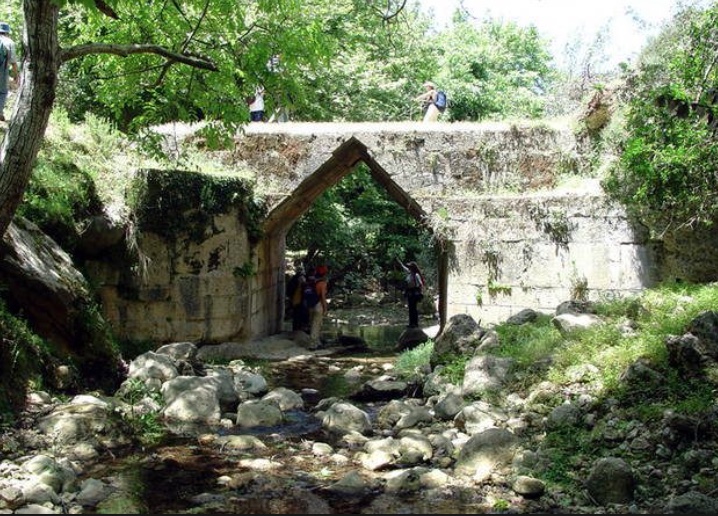
Only three kilometres from the excavations lies the village of Archaia Eleutherna, surrounded by cypresses and olive trees; its houses show three styles: Venetian, Arab and Ottoman. Below it stands the best-preserved ancient structure at Eleutherna: the Hellenistic bridge, which has stood here intact for over 2,000 years. By way of the European long-distance path E4 and the Lankos gorge it is possible to walk all the way to Margarites.
The village of Margarites
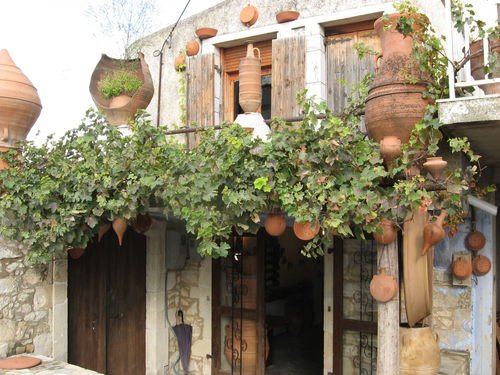
Margarites is a handsome village on the northern foot of Psiloritis at about 300 metres, with an old tradition of pottery that local people trace back to Minoan times. Its hand-made wares – tableware, jugs and large storage jars, produced in the inherited manner – are famous throughout Crete. Some sixteen potters’ workshops and galleries are at work here today. Unlike those of Thrapsano, the island’s other great pottery centre, they were already permanently established before the Second World War; they lie in the southern quarter, formerly called Tsikaladia. The clay comes from the surrounding country: red clay is found everywhere, while finer sorts are fetched from Stenolakkos and from the Orne area. Traditionally pots were thrown on the kick wheel and fired in a wood-burning kiln; they were decorated with painting, incised comb patterns, stamped ornament and applied relief bands. The name is explained by the many marguerites that grow round about, or by the medieval word “magarikon” for an earthenware vessel.
The spot where Margarites stands today was already inhabited in Minoan times; north-east of the village lies an important Late Minoan tholos tomb of about 1350 BC. In the 9th century AD the Saracens destroyed the settlement; after the liberation of the island by the Byzantine emperor Nikephoros Phokas it was rebuilt in the 10th century. In 1332 the Venetians burnt the village down because its people had risen against heavy taxation. From Venetian times half-ruined manor houses survive, with fine shutters, hidden coats of arms and inner courtyards, strung along narrow lanes spanned by arches. In 1829–1830 Margarites was the seat of the Revolutionary Council, and the village was the birthplace of Gavriil Marinakis, abbot of Arkadi Monastery at the time of the tragedy of 1866.
From Byzantine times date the churches of the Transfiguration of Christ (Metamorfosis tou Sotiros), of the Archangel Michael (tou Archangelou Michail) and of the Panagia Perdikiotissa. The oldest church in the village is that of St John the Theologian, with a plain stone iconostasis; the church of the Panagia has a fine wooden one, and it is here that the village holds its principal festival on 15 August, the Dormition of the Virgin, with a procession, music and dancing. On the eastern edge lies the little monastery of the Saviour, which has been a metochion – a dependency – of the Athonite monastery of Karakallou since the 16th century. To the south of the village a small park with benches looks out into the gorge – at sunset an especially atmospheric place in which to bring this route to a close.