Knossos, Archanes and the Kazantzakis Museum: a route south of Heraklion
The most complete guide to Crete: 221 places on the map, 23 routes and 49 articles — with photos, videos and the story behind every place. Everything is open and free: no sign-up, no paid sections and no advertising, open or hidden. You can install the guide on your smartphone as an app.
Routes drawn along real roads
Weather at every stop
Full-text search
“Near me” by geolocation
Create your own printable itinerary
Satellite, terrain, dark mode
Works offline
⌕
Searches 1.7 million characters of descriptions, not just names
—places
4regions
—routes
—with video
Search results
—
Interactive map
Find what is near you
Filters narrow the map and the list at once. Zoom out and pins group together.
Region
Category
Фильтры карты
Landmarks
Featured places
RegionCategory
Routes
Ready-made day trips
Individual places
Articles about landmarks
Knossos, Archanes and the Kazantzakis Museum: a route south of Heraklion из Ираклиона
This route leads out of the southern suburbs of Heraklion into the gently rolling country behind the island’s capital. The first stop is Knossos, the most impressive monument of Minoan culture and, for many travellers, the real reason for coming to Crete at all. From there the road continues to Archanes, one of the most attractive small towns of the region, in whose surroundings archaeologists have made some of the most important discoveries of recent decades. Next comes the drive through the villages around Peza, one of the chief centres of Cretan agriculture. Among the vineyards and olive groves one comes to know not only the industry of the inhabitants but also their cultural traditions: songs and dances of their own, old customs that are still kept up in the villages as a matter of course. The route ends with a visit to the museum dedicated to one of the greatest writers of Greece – Nikos Kazantzakis.
Shortly before Knossos it is worth stopping at a structure easily overlooked on the way to the Minoans: the massive aqueduct that local people call simply Kamares (Καμάρες), “the arches”. It was built between 1832 and 1840, in the decade when Crete, after the Greek War of Independence, was under Egyptian rule. The governor of the time, Mustafa Pasha, renewed the older conduit that the Venetian provveditore generale Francesco Morosini had laid out in 1628 for Candia – the present-day Heraklion – a city perpetually short of water, and added a second branch that tapped springs near Archanes and Skalani. Of the bridges that carried this system across the valleys, the one at Agia Irini near the village of Spilia is the largest; according to the Cretan historian Stergios Spanakis it was put up in 1839 by a Christian master builder, Theodorakis Georgiadis. Smaller bridges stand at Karydaki and Fortezza. The work earned Mustafa Pasha such standing among the townspeople that he was given the byname “the Cretan”. Today the Region of Crete, together with the Ministry of Culture, plans to consolidate the arches and make them easier to reach.
The Palace of Knossos
Europe’s first high culture, Europe’s first palace: the origins of Minoan civilisation
Find on the map
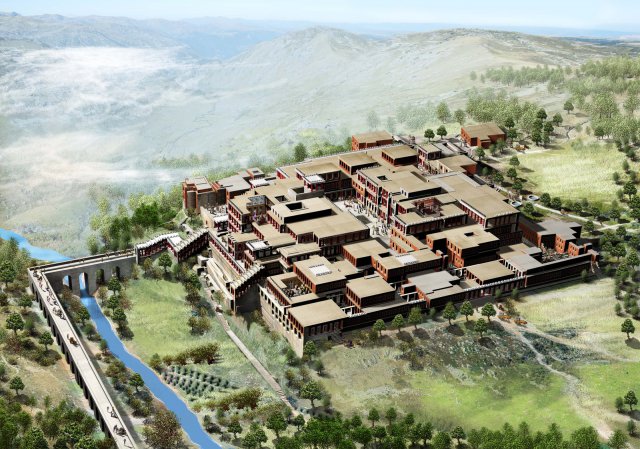
The Minoan palace is the greatest legacy of Knossos, one of the most famous cities of antiquity, whose history runs without a break from the Neolithic to the 5th century BC and, in diminished form, well beyond. It rises on the hill of Kefala (Κεφάλα), about five kilometres south-east of the centre of Heraklion, above the valley of the Kairatos stream – a position from which the sea was as easily reached as the fertile interior of the island. Tradition places here the throne of the wise King Minos. Wrapped in the mysterious legends of the Labyrinth and the Minotaur, of Daedalus and Icarus, the palace still stirs the imagination and draws travellers from all over the world who want to come close to the riddle of the earliest European civilisation. The very word labyrinth probably points to the place itself: many scholars derive it from labrys, the sacred double axe of the Minoans, so that “labyrinth” may originally have meant the “house of the double axe” – that is, the palace.
The oldest traces of settlement on the palace site date from the Neolithic (c. 7000–3000 BC); on present knowledge this makes Knossos one of the earliest settlements in Europe. Occupation continued through the Prepalatial period (3000–1900 BC), at the end of which the ground was levelled to make room for a great palace. This first palace was destroyed around 1700 BC, probably by an earthquake. On its ruins rose a second and more magnificent building, and it is essentially this one that the visitor sees. After a partial destruction around 1450 BC Mycenaeans established themselves at Knossos. Around 1355 BC a great fire destroyed the palace for good. The site was reoccupied in late Mycenaean times and remained inhabited into the Roman period, when, after the conquest of 67 BC, the town became a Roman colony under the name Colonia Iulia Nobilis Cnossus. The dates of the individual phases are approximations, accurate to within a few decades.
The rediscovery of the palace is a story in itself. The first spade was put in not by a foreign scholar but, in 1878, by a merchant of Heraklion with the fitting name of Minos Kalokairinos (1843–1907). Prompted by his reading of Homer, Strabo and Herodotus, he uncovered parts of the west wing – storerooms and a corner of what would prove to be the throne room complex – and came upon large storage jars (pithoi) and early written documents. After only three weeks, however, the Ottoman authorities had the dig stopped – not least from concern that the finds might draw Europe’s attention to the Cretans’ struggle for freedom. The American journalist W. J. Stillman took an interest, and so did Heinrich Schliemann, the discoverer of Troy, but Schliemann baulked at the price asked for the land. In the Heraklion massacre of 25 August 1898 Kalokairinos lost his son and his brother; his house was looted and burnt down, and with it part of his collection. A little later, on 23 March 1900, the Englishman Arthur Evans (1851–1941), Keeper of the Ashmolean Museum in Oxford, who had first come to Crete in 1894 on the trail of engraved sealstones, began systematic excavations on the hill, which he had by then acquired – at first with about 30 workmen, soon with around a hundred. His Scottish assistant Duncan Mackenzie kept the excavation daybook and worked by stratigraphic methods; the architect Theodore Fyfe drew the plans. The greater part of the palace was laid bare by 1905. In 1911 Evans was knighted for his services to archaeology; his four-volume work The Palace of Minos, published in six parts between 1921 and 1936, remains a foundation of Aegean archaeology.
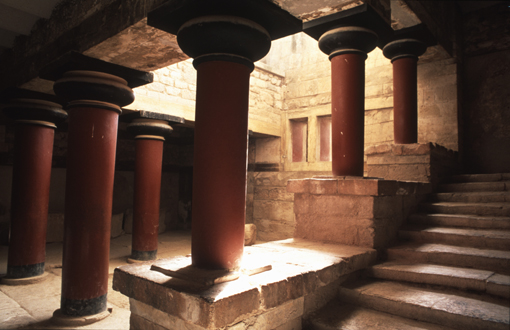
Evans had the palace restored on a large scale and in part rebuilt. The complex stood several storeys high and covered an area of about 20,000 square metres. The variety of building materials is striking: coloured plasters, facings of alabaster and gypsum, frescoes that adorned rooms and corridors. The high technical skill of the Minoans is shown by original architectural and structural solutions – light wells that brought daylight and fresh air down to the lower storeys; walls pierced by rows of doors whose leaves could be opened or closed according to the weather; timber beams that made the masonry elastic against earthquakes; the characteristic wooden columns tapering towards the base; and an ingenious network of water pipes and drains. For his reconstructions Evans at first used wood, later reinforced concrete, and he had the Swiss painters Émile Gilliéron, father and son, restore and repaint the frescoes. The results are disputed to this day: they are what makes the palace comprehensible to visitors, but in places they rest more on conjecture than on evidence, and they pose conservation problems of their own. The following video shows a vivid reconstruction of the palace.
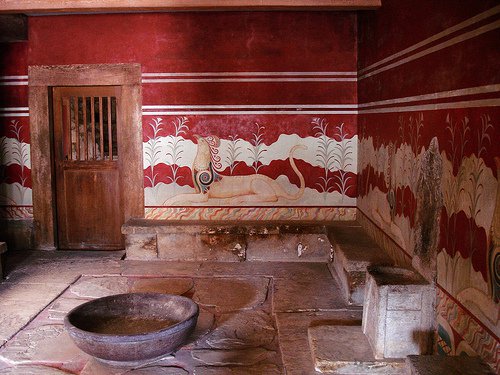
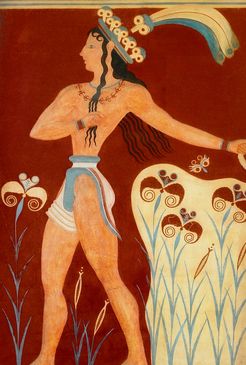
The palace is grouped around the great Central Court, the place of public gatherings. A second court, the West Court, served as the formal approach and as a setting for ceremonies. In the west wing lay the state rooms of administration and cult: the Tripartite Shrine, the Temple Repositories and the Pillar Crypts, with long rows of storerooms behind them. Most striking is the Throne Room, with its lustral basin and its throne of alabaster set against the wall, flanked by stone benches and painted griffins – it is held to be the oldest surviving throne room in Europe. In the south the most important features are the South Propylaea, the Corridor of the Procession and the South Entrance with the fresco of the “Prince of the Lilies”. The east wing contained the living quarters and large reception halls, among them the Hall of the Double Axes and the so-called Queen’s Megaron. They are reached by the majestic Grand Staircase, built down through several storeys into the slope.
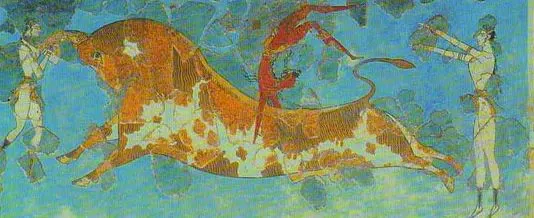
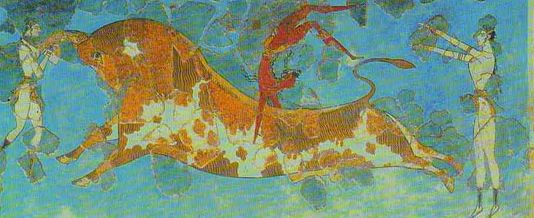
The North Entrance provided the link with the harbour of Knossos. It is lined by raised halls; the western one is decorated with a relief fresco showing a bull, which is seen in connection with the taurokathapsia, the ritual bull-leaping. A broad paved processional way, the Royal Road, led from the Little Palace and the town to the north-west corner of the palace, where an open, theatre-like area with stepped seating was laid out. Around the palace stretched the Minoan town, and on the surrounding hills lay the cemeteries. Important buildings of the same period include the South House, the House of the Chancel Screen, the Little Palace, the so-called Caravanserai, the Royal Villa and the Temple Tomb. Of Roman Knossos the Villa Dionysos, with its mosaic floors of the 2nd century AD, deserves particular mention.
The whole complex was served by a carefully planned system of water supply and drainage – clay pipes, channels and collecting basins that caught rainwater and carried waste away. Together with the light wells and the shrewd orientation of the rooms, it kept the building cool in summer and tolerably comfortable in winter. It bears witness to a level of engineering that was not matched in Europe for a very long time.
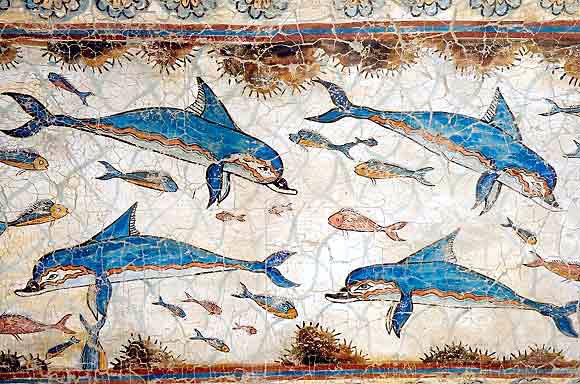
The walls of most rooms were painted with frescoes – the bull-leapers, the procession with its cup-bearer, the sacred grove. They are our most important source for the social order and cultural level of Minoan times, for the Minoan script proper, known as Linear A, remains undeciphered. The later Linear B, by contrast, has been read: the Englishman Michael Ventris recognised it in 1952 as an early form of Greek. But the clay tablets in this script from Knossos, of which Evans found some three thousand, are administrative lists from the Mycenaean phase of the palace – records of livestock, textiles, landholdings, personnel and offerings – and reveal little of what the Minoans believed and thought. The originals of the frescoes – the dolphins from the Queen’s Megaron, for instance – are now kept in the Heraklion Archaeological Museum; what one sees in the palace itself are copies, and many of the originals survive only as fragments set into modern restorations.
Archaeological investigation has shown that the town had no fortification walls. That speaks for a long period of peaceful development and economic prosperity. The state of Knossos possessed a strong merchant fleet and kept up close relations with the Greek mainland, with islands throughout the Mediterranean and with Egypt. According to ancient tradition Minos ruled the sea – Thucydides, who calls him the earliest man known to have built a navy, speaks of a mastery of the sea, the thalassocracy of Minos – and finds of Cretan pottery on far distant shores confirm at least the reach of this trade.
Egyptian influence is plainly felt in the wall painting and the reliefs. Scenes of lion hunting, such as are later known from Mycenae, cats stalking birds, or acrobatic leaps over a bull vividly recall related motifs in Egyptian reliefs and wall paintings. At the same time the Minoan painters developed a pictorial language entirely their own: full of movement and colour, rich in the observation of nature, with lilies, crocuses, sea creatures and birds.
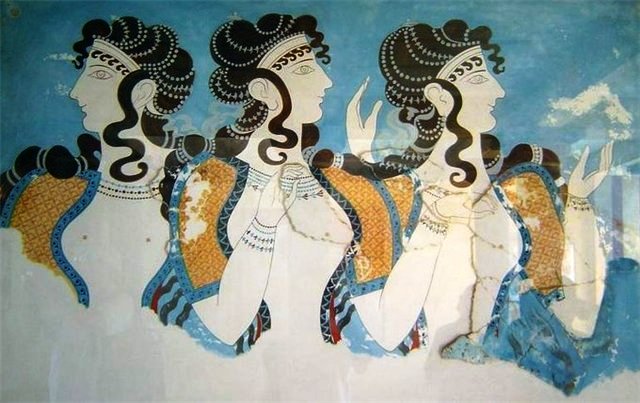
In the wall painting and small sculpture of Knossos, representations of women occur very frequently, and scholars have given them nicknames such as “La Parisienne” or the “Ladies in Blue”. The elegant coiffure, the made-up eyes and the fashionable dress of these figures put the excavators irresistibly in mind of the ladies of their own day. Whether the women represent goddesses, priestesses or high-born residents of the palace remains open – there is no agreed view of the religious ideas of the Minoans. Many scholars assume that a great female deity stood at the centre of the cult, as the famous snake goddesses from the Temple Repositories also suggest.
Myths and legends of the Palace of Knossos
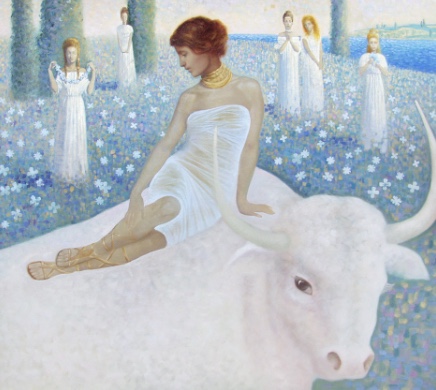
In the remote past, when the gods still walked among mortals and the sky with its clouds touched the earth, there lived a king’s daughter of great beauty named Europa. She was the daughter of the Phoenician king Agenor and the lovely Telephassa – so the Hellenistic poet Moschus has it, whereas Homer makes her the daughter of Phoenix – and the sister of Cadmus. So graceful was she that even the flowers leaned towards her, as if to touch her beauty.
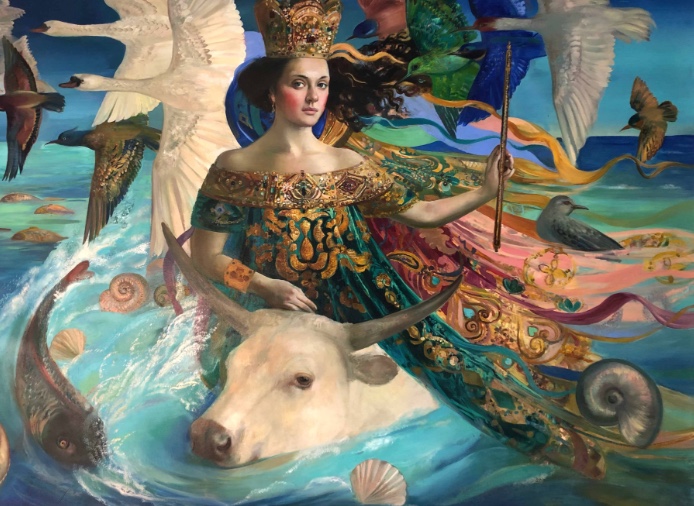
One day, as Europa was gathering flowers on the seashore with her companions, her eye fell on a white bull of unusual beauty. He was unlike all the others: his coat shone in the sun like snow on the mountain peaks, and his eyes were gentle and kind. But this bull was none other than Zeus, mightiest of the gods, who had fallen in love with Europa at first sight.
Zeus had taken the form of a bull in order to approach Europa and win her trust. Without any fear she went up to the animal and at last even seated herself on his back. At that moment the bull rose carefully, carried Europa off and swam with her through the waves out into the open sea. After the crossing Zeus brought her to Crete, where he resumed his true form and made himself known to her. Europa was shaken and at the same time enchanted. Zeus made her queen of the island and promised her everlasting love and protection; among his gifts, it was said, were the bronze giant Talos, a hound that never lost its quarry and a javelin that never missed. According to Cretan tradition the union took place beneath an evergreen plane tree at Gortyn, which has never since shed its leaves. Europa afterwards married Asterion, king of Crete, who brought up her children; the bull was set among the stars as the constellation Taurus, and she herself gave her name to a continent. From the union of Zeus and Europa came three sons. The first was Minos,
who became the great king of Crete;
the second Rhadamanthys, who was famed for his justice and after his death was appointed a judge in the underworld;
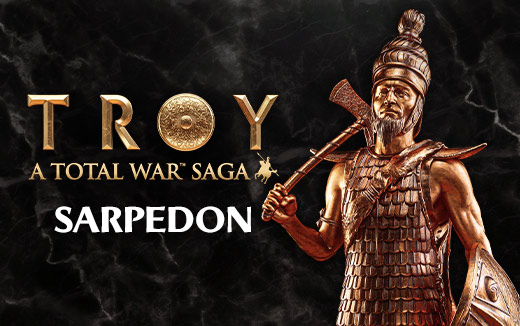
and the third Sarpedon, who according to legend later ruled over Lycia and in some traditions takes part in the Trojan War; in a few versions of the myth he too is numbered among the judges of the underworld. As a hero of Troy Sarpedon is a familiar figure to this day, not least through modern popular culture and computer games, in which he appears again and again. All three brothers were held to be blessed with wisdom and strength – the inheritance of their divine father.
Minos, son of Zeus and Europa, is, in mythological terms, the first European, so to speak. He was not merely a king but a symbol of rule sanctioned by the gods, a link between gods and men. It was after him that Arthur Evans named the entire culture he uncovered at Knossos: the term “Minoan” is a modern coinage, there is no evidence that Minos was a historical person, and what the Minoans called themselves we do not know.
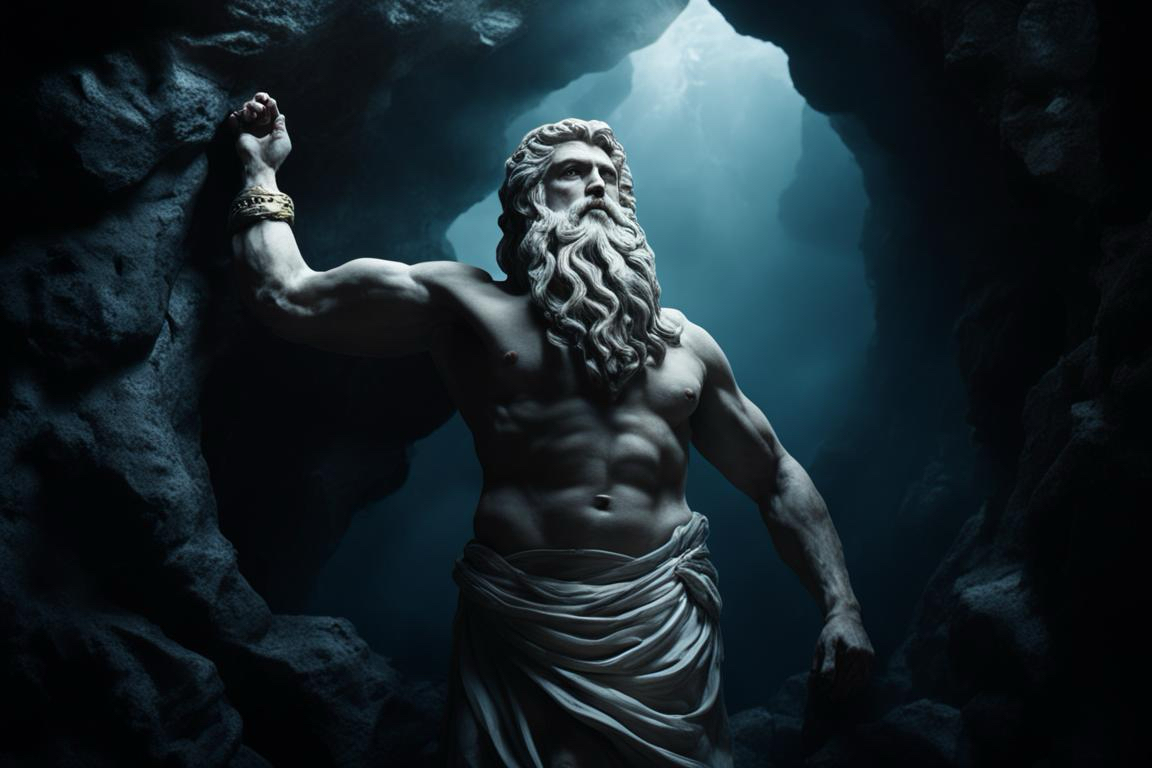
According to the myths Minos went down every nine years into a cave where Zeus handed him the laws – the Odyssey already speaks of Minos as the king who every ninth year conversed with great Zeus, and some traditions place this cave on Mount Ida or on Dikte. This direct dealing with the highest god not only confirmed his power over Crete but made his destiny unique and underlined his role as mediator between heaven and earth. The death of Minos, like his life, is wrapped in myth. In some versions he met his end in Sicily, where he had pursued Daedalus: at Kamikos the daughters of King Kokalos scalded him to death in his bath. In others he became a judge in the underworld together with his brother Rhadamanthys and with Aeacus, Minos having the casting vote. Whatever the circumstances of his end, Minos embodies an age in which myth and reality flowed into one another and the foundations were laid of a culture and of those values on which European civilisation was later built. Minos and his time stand for the golden age of Crete, an era of peace, prosperity and cultural flowering. They are also a reminder that power and greatness are often attended by tragedy and trial. The myth teaches us to value wisdom and justice, and to grasp that every decision has consequences and every deed its price.
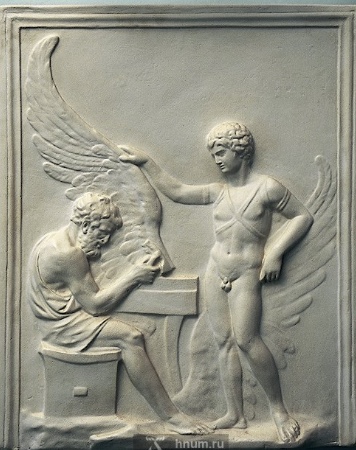
Daedalus, held to be the greatest builder and inventor of his age – his very name means “skilful craftsman” – won fame by creating, at the command of King Minos, the Labyrinth in Crete in which the Minotaur was to be kept captive. He had come to the island as a fugitive from Athens, where he had killed his gifted nephew out of jealousy; Homer also credits him with a dancing floor made at Knossos for Ariadne. But the greatness of Daedalus aroused the jealousy of the king, who would not tolerate so gifted a man leaving Crete to serve others. And so Daedalus and his young son Icarus were shut up in the very Labyrinth that Daedalus himself had built.
To escape, Daedalus made wings for himself and Icarus out of birds’ feathers, which he bound with thread and fixed with wax. He impressed on his son that he must fly neither too low, lest the spray of the sea weigh down the wings, nor too high, lest the sun melt the wax.
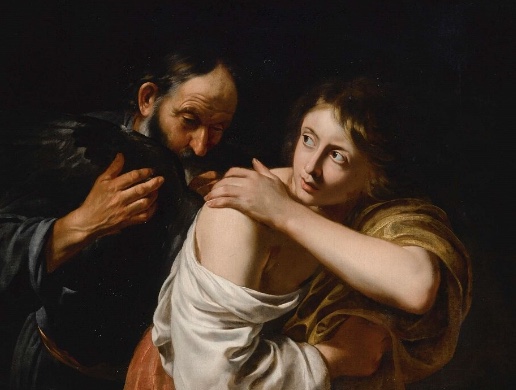
But in the exhilaration of flight Icarus forgot the warning and climbed higher and higher. The wax melted, the wings came apart, and Icarus plunged into the sea and drowned. The waters into which he fell have borne his name ever since, according to ancient tradition – the Icarian Sea around the island of Ikaria. Daedalus himself flew on and found refuge in Sicily at the court of King Kokalos. The myth has become an emblem of the limits of human striving and of the dangers of hubris.
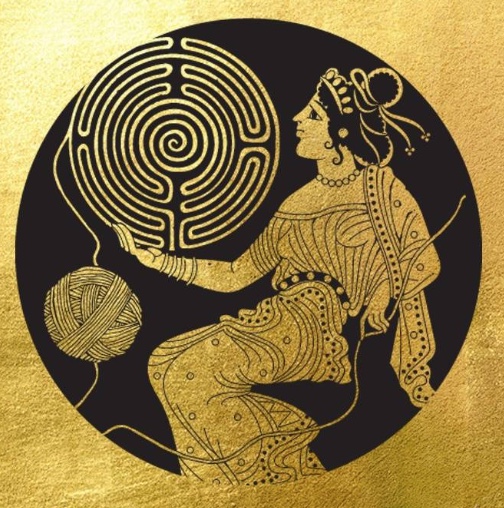
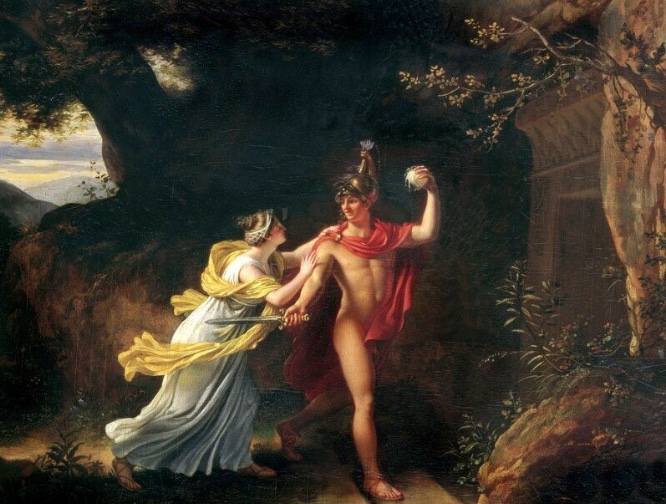
Ariadne, the Cretan princess, embodies in Greek mythology female strength and readiness for sacrifice; her name is thought to mean “most holy”. As the daughter of Minos and Pasiphaë she grew up in the shadow of the enigmatic Labyrinth, in whose depths the terrible Minotaur had his lair – fed, the story goes, on the seven youths and seven maidens whom Athens was forced to send as tribute after the death there of Minos’s son Androgeos. Her life changed at a stroke with the arrival of Theseus, the Athenian hero who meant to kill the monster. Ariadne fell in love with him at first sight and resolved to help her beloved.
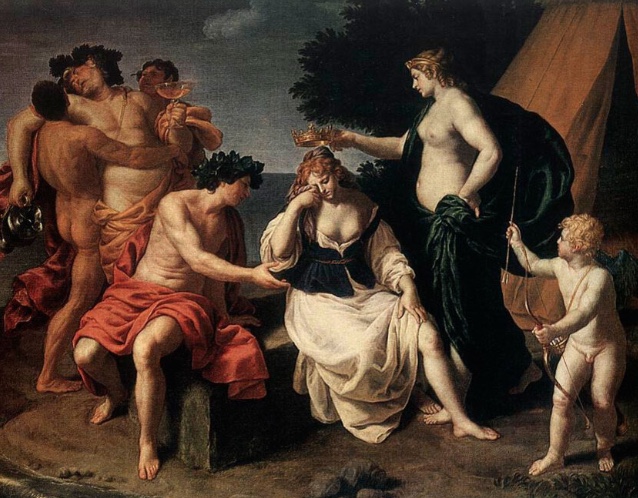
That she gave Theseus a ball of thread – and, in some tellings, a sword – was an act not only of love but of courage: she was risking her life, for her father’s punishment would have been certain. Thanks to the thread Theseus found his way out of the Labyrinth after the fight with the Minotaur, and he took Ariadne with him. Here the story might have ended happily – but it turned out otherwise. On the island of Naxos Theseus left her behind, wholly taken up with his own aims and unmindful of the promise he had given her; other versions have him abandon her at the command of Dionysus, and in Homer she is killed by Artemis. Alone and in deep grief, Ariadne there encountered Dionysus, god of wine and joy, who recognised in her not only a beautiful soul but an extraordinary strength. Dionysus fell in love with Ariadne and took her as his wife, and she herself rose to the rank of a goddess; their sons included Oinopion and Staphylos, whose names speak of wine and the grape. This union stands for Ariadne’s transformation from a victim of circumstance into a being with a divine destiny, and shows that even in the deepest despair fate can open a new path and the possibility of a fresh beginning.
The marriage to Dionysus not only restores justice to Ariadne’s life but grants her an eternal existence among the gods of Olympus, where she is honoured as a goddess of passion and transformation. Her bridal crown, so the legend goes, was thrown into the sky by Dionysus and set there as the constellation Corona Borealis, the Northern Crown.
The myth of the quarrel between Minos and Poseidon holds a special place among the Greek legends, because it shows so forcefully the many-layered relationship between mortals and gods. From the outset Minos wished to found his rule over Crete not only on earthly achievements but on divine assent. Poseidon, god of the sea and of earthquakes, heard his prayer and caused a magnificent white bull to rise from the waves. This animal was no ordinary creature: it was a sign of divine favour, and it was to be offered in sacrifice as a mark of acknowledgement and thanks.
But Minos, overwhelmed by the incomparable beauty and majesty of the bull, tried to outwit fate: he kept the bull for himself and sacrificed a lesser animal in its place. This act of greed and pride provoked the anger of Poseidon, who resolved to punish the Cretan king in a manner as unusual as it was cruel.
Poseidon laid a spell on Pasiphaë, the wife of Minos and a daughter of the sun god Helios, and filled her with a passionate, unconquerable love for the white bull; it was Daedalus who built the hollow wooden cow that allowed her to satisfy it. From this unnatural passion came the Minotaur, a being torn between human and animal nature – the living embodiment of Minos’s guilt and pride. The birth of the Minotaur, and the subsequent building of the Labyrinth by Daedalus in which the creature was to be shut away, make it plain that human action has inescapable consequences – above all when it springs from arrogance or ingratitude.
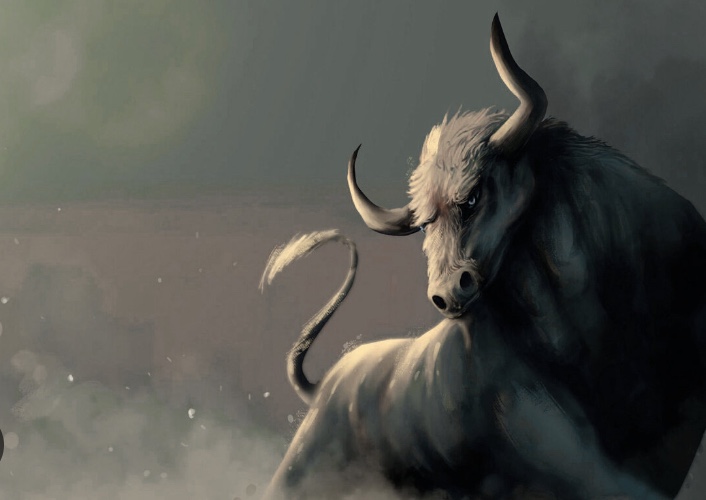
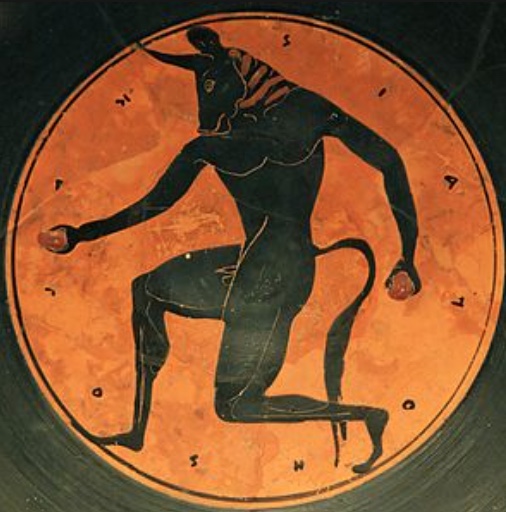
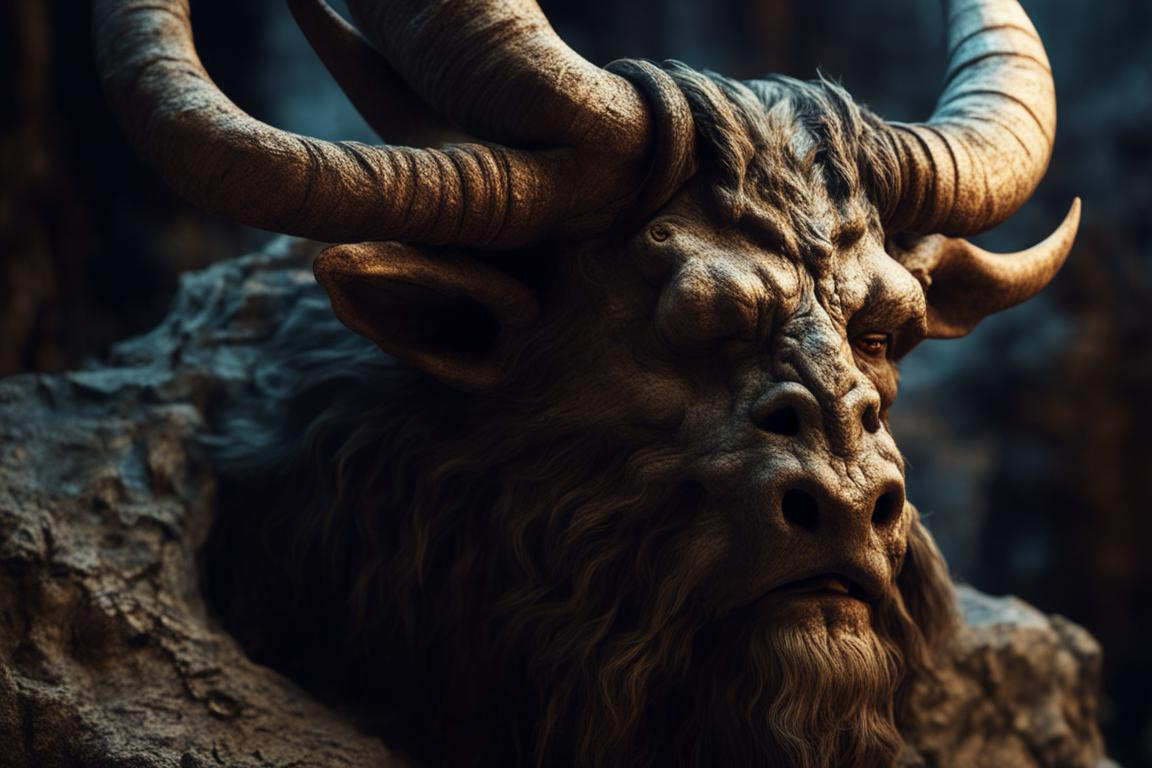
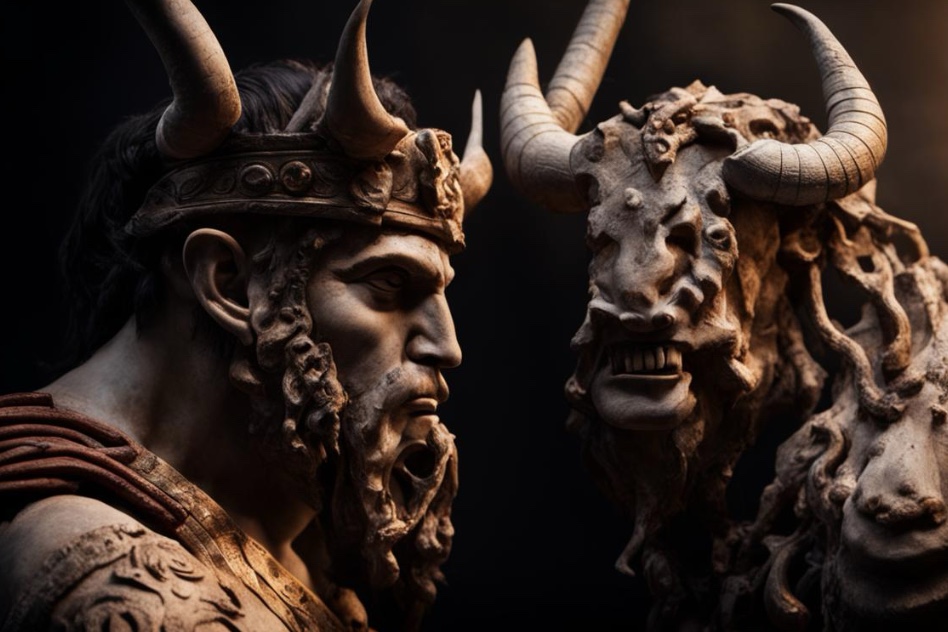
The Minotaur, a being with the body of a man and the head of a bull, stands at the centre of one of the most puzzling and gripping myths of Greek antiquity. His real name, tradition says, was Asterion, “the starry one” – the same name as the king who had brought up Minos; “Minotaur” means simply “bull of Minos”. Born of Pasiphaë, wife of the Cretan king Minos, and sired by the wondrous white bull sent by the sea god Poseidon, he became the living sign of divine wrath and of the consequences of human hubris.
Once the Minotaur had been born, Minos wished both to conceal the creature’s shameful parentage and to protect his people from its savagery. On the advice of the oracle at Delphi he ordered Daedalus, the greatest builder of the age, to construct the Labyrinth close to the palace at Knossos. That vast and tortuous building became more than the Minotaur’s prison: it came to stand for utter seclusion and loneliness, the condition in which the creature was condemned to pass its days. The Cretans themselves are said to have called it Asterion or Asterius; the name by which the world knows it simply joins Minos to tauros, the Greek for bull – the “Bull of Minos”. Its life in the Labyrinth remained wrapped in darkness and secrecy.
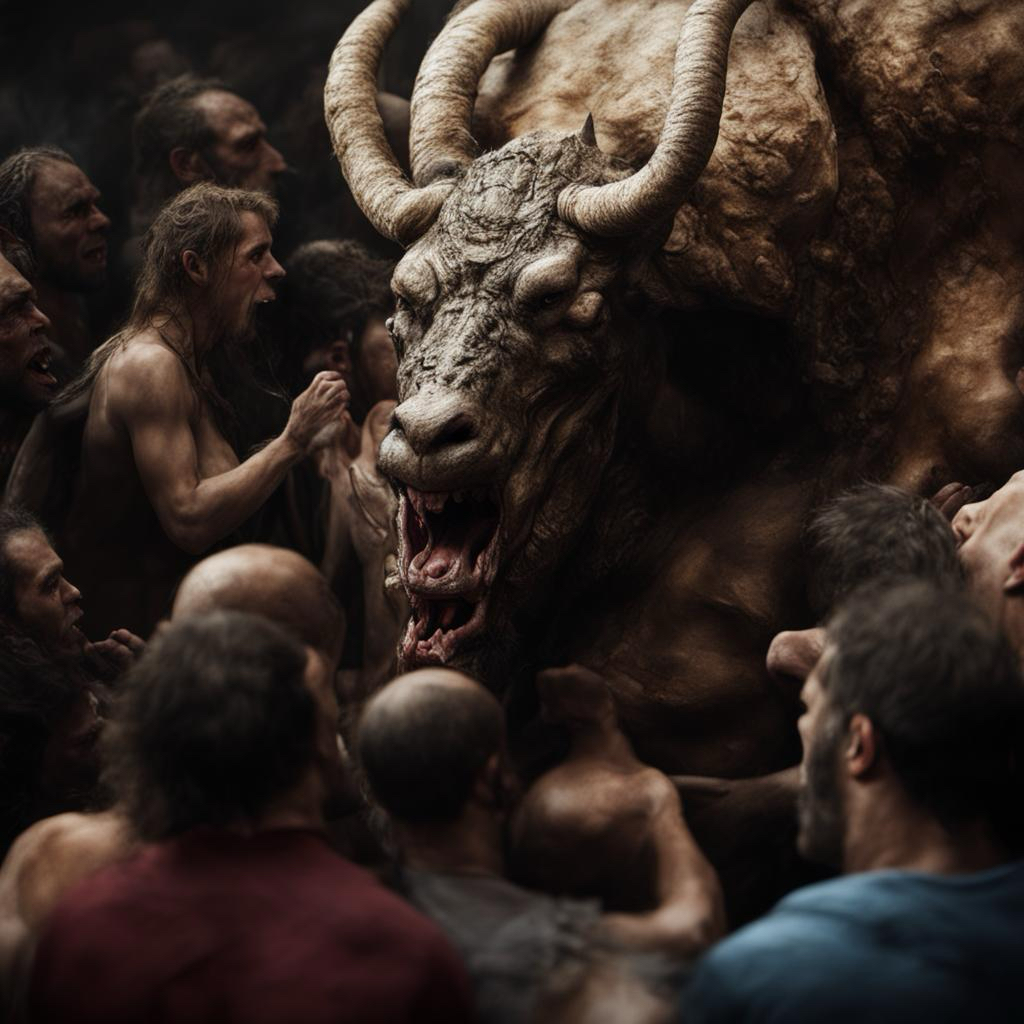
It fed on human victims. Every nine years – in the best-known version of the story, though others say every seven, or even every year – Athens had to send young men and young women to the island, seven of each and chosen by lot, as tribute for a war it had lost to Crete. The cause of that war, the legend says, was the death in Attica of Androgeos, the son of Minos: killed, according to one account, by Athenians jealous of his victories at the Panathenaic Games, and according to another by the bull of Marathon. Plutarch, Ovid and Apollodorus all tell the tale, each with his own variations. The Minotaur thus became a living reminder of the high price of arrogance and deceit. For all its fearsome reputation it remains a tragic figure, the victim of circumstances that lay far beyond its control.
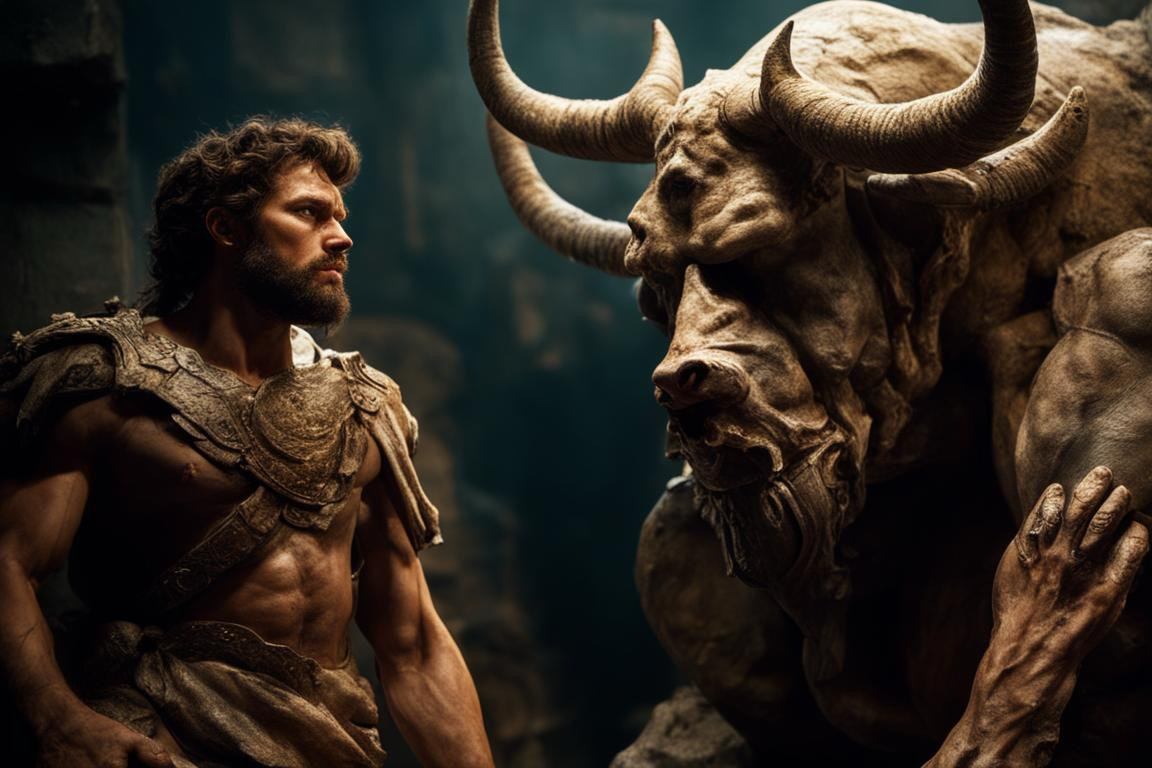
The story reaches its climax when Theseus enters the Labyrinth – the young Athenian prince who, as the third consignment of victims fell due, volunteered to go with them and put an end to the bloody tribute. Theseus kills the Minotaur; the ancient writers and vase painters cannot agree whether he did it with a sword, a club or his bare hands. The deed not only released Athens from its debt to Crete but also brought to a close the tragic life of a being as innocent as it was terrifying. The hero’s homecoming was not without its shadow, however. He had promised his father Aegeus that, if he succeeded, he would exchange the black sail of his ship for a white one; the legend says he forgot, and Aegeus, believing his son dead, threw himself into the sea – which has been called the Aegean ever since.
The myth of the Minotaur raises questions that reach into our own time. Faced with a creature that is half one thing and half another – classical art gives it the body of a man with the head and tail of a bull – some readers are even reminded of the arguments about genetic engineering that reached a wide public with Dolly, the cloned sheep. But the essential point lies elsewhere. Theseus did not merely kill the Minotaur: with the help of Ariadne, the daughter of Minos, who in most versions gave him a ball of thread to pay out behind him, he also found his way back out of the Labyrinth – hence the expression “Ariadne’s thread”. Had he failed, he would have had to remain inside and, in order to survive, turn man-eater himself. Here is the deeper meaning of the myth: whoever fights the Minotaur must not become the Minotaur. Theseus managed it – a lesson that holds good for modern medicine and science too.
The small town of Archanes
A picturesque little town that has kept its traditional architecture, with the Minoan excavation site of the same name on its doorstep.
Find on the map
Archanes combines two things in a small compass: lovingly tended lanes and mansions of Venetian, Ottoman and more recent date – and right alongside them, in the middle of the town and on the surrounding hills, the remains of a Minoan palatial town with its sanctuaries and tombs. It lies about 14 kilometres from Heraklion and only seven from Knossos, at the foot of the sacred Mount Juktas (Γιούχτας), an 811-metre ridge that rises above the town, and is today the administrative seat of the municipality of Archanes-Asterousia, created by the local government reform of 2011. Around 3,900 people live in the town itself. Ancient roads once linked the Minoan settlement here with Juktas, with Anemospilia and with Vathypetro.
Archanes is built on two different levels and brings together fine scenery and architectural wealth in a way that is all its own. The visit begins in Kato Archanes, Lower Archanes, spread out at around 360 metres above sea level: a comparatively small but attractive settlement that serves as a prelude to what awaits a little further on. From here an ancient footpath still climbs to the hill of Fourni and its celebrated necropolis, which occupies the high ground between the lower village and the upper town.
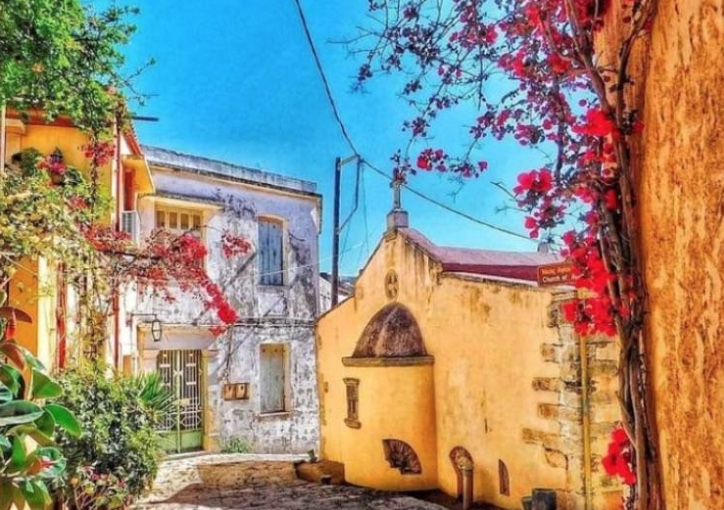
Drive on to Epano Archanes, Upper Archanes, and the distinctive architecture takes hold of you as soon as you arrive: narrow cobbled lanes that seem to lead back through the centuries, and old mansions restored with impeccable taste and great respect for their history. Wooden shop signs in the style of earlier days and old-fashioned lanterns give the town a character of its own, so that a walk through it feels like a journey into the past. The careful renewal of the townscape has earned Archanes recognition abroad as well: in 2000 the municipality received a European prize for integrated and sustainable rural development, followed in 2001 by an environmental award from the University of Crete.
Archanes is proud of its unmistakable character, in which Venetian, Cretan and neoclassical elements are harmoniously blended. The town has not merely preserved its heritage but carried it gently into the present, offering visitors and residents alike a place in which it is a pleasure to linger. Its name is said to go back to an ancient city called Acharna; from Ottoman times people recall the residence of Mustafa Naili Pasha, with its fountains and gardens. Archanes also played an important part in the modern history of Crete. During the rising of 1897 it was the principal revolutionary centre in the east of the island and the seat of the defence committee; in the Battle of Crete in May 1941 the Greek high command for the island was based here, together with a field hospital. Under the German occupation one of the first resistance and intelligence groups in Crete was formed in Archanes, and it was on the road between Archanes and Knossos that the German general Heinrich Kreipe was abducted in April 1944 by British officers and Cretan partisans. The ambush, led by Major Patrick Leigh Fermor and Captain William Stanley Moss with Cretan resistance fighters, took place on the night of 26–27 April at the junction near Skalani where the Archanes road meets the main road to Heraklion; Kreipe’s quarters were in the Villa Ariadne at Knossos. Moss then drove the general’s own car through Heraklion and past 22 checkpoints; nearly three weeks later the party was taken off by motor launch from a beach west of Rodakino and reached Egypt on 14 May.
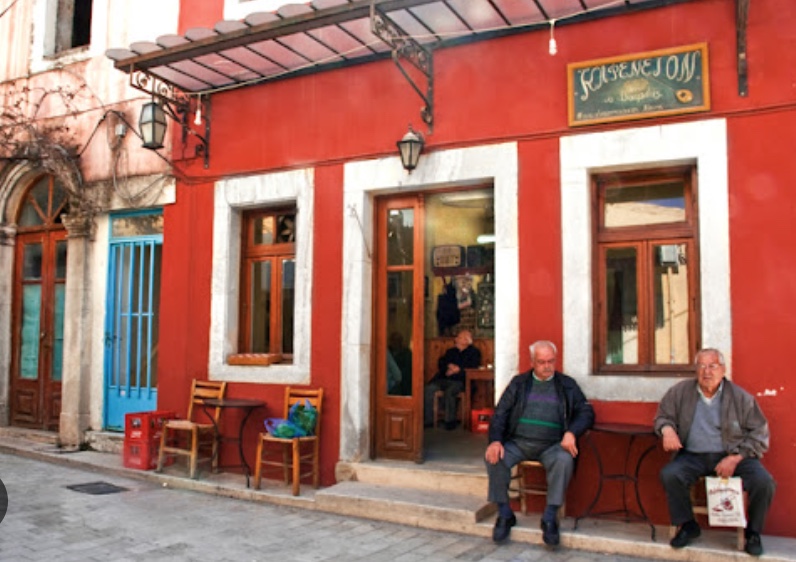
The main square of Epano Archanes is the lively heart of the town. Around it are ranged comfortable kafenia, small restaurants and the traditional taverns that Cretans call rakadika. In the shade of spreading trees you can try raki, the Cretan spirit distilled from grape pomace. With it come small dishes, mezedes, which often arrive on the table unasked. The square is a good place to break the journey and enjoy the local cooking. The town is also known for its wines, above all from the Rosaki grape, and for table grapes, sultanas and olive oil – grapes and olives between them account for almost all of the district’s agricultural produce, the growers’ cooperative dates back to 1931, and about a quarter of the wine goes abroad, to Germany, France and the Netherlands. How oil used to be pressed is shown by the restored olive mill of 1870. Very close to the square stands the three-aisled church of the Panagia (Εκκλησία της Παναγίας), of the 18th century, with a very fine bell tower and carved stone reliefs.
Also worth seeing is the church of the town’s patron, St Nicholas (Ναός του Πολιούχου Αγίου Νικολάου), which – according to the inscription over the doorway – was built in 1857. The town has in addition two Byzantine churches of the 14th century, one dedicated to the Holy Trinity (Agia Triada) and the other to St Paraskevi (Agia Paraskevi). It says much about the long history of the place that several churches in the district stand over the remains of Early Christian basilicas, which had themselves been raised on the sites of ancient sanctuaries.
The real attraction of Archanes, though, is its extraordinary archaeological record.
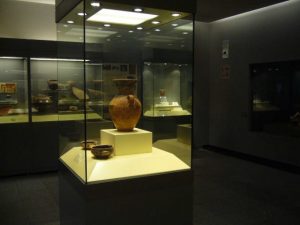
A visit to the Archaeological Museum of Archanes not only lets you look closely at the treasures from the excavations round about but also gives a better understanding of the scale and importance of Minoan civilisation. Carefully conserved and well displayed, the exhibits bring the past to life and allow a glimpse across the centuries, as if through the eyes of the ancient Cretans.
The museum was founded in 1993 on the initiative of the distinguished archaeologists Giannis Sakellarakis and Efi Sapouna-Sakellaraki, and stands as a testimony to their tireless work and their passion for the early history of Crete. The couple dug at Archanes for decades: Sakellarakis sank his first trial trenches in the quarter known as Tourkogeitonia in 1964, and from 1966 the excavations continued under the auspices of the Greek Archaeological Society. Their achievements have been highly honoured by the state as well, and underline how much they contributed to the study and preservation of the region’s cultural heritage.
It is thought that the palatial complex of Archanes, which arose around 1900 BC and was uncovered in the middle of the modern town, may have belonged to Rhadamanthys, the brother of Minos, and served as the religious centre of the realm of Knossos. Sir Arthur Evans had already suspected a palatial building here and supposed it to be a summer residence of the kings of Knossos; the trenches of 1964 produced the first firm evidence, and tablets in the Linear A script later came to light in a part of the site known as the Archive. The idea of a religious role is supported by the great peak sanctuary on nearby Mount Juktas, which bears witness to the importance of Archanes in Minoan cult. Efi Sapouna-Sakellaraki has gone so far as to call the palace of Archanes the only building that can be compared in importance with Knossos. It was evidently also a centre that directed the rich agricultural output of the fertile valley.
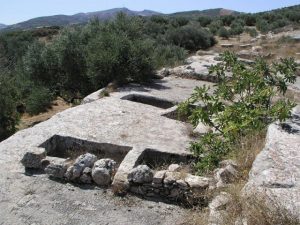
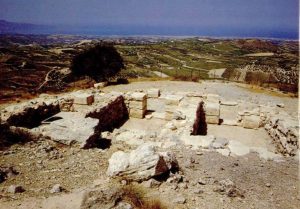
A site of particular importance is the hill of Fourni (Φουρνί), between Epano and Kato Archanes. The local farmers at first took a domed stone structure visible here for an old bread oven – fourni in Greek – and so the hill acquired its name. The excavations of the Sakellarakis couple, begun in 1965, revealed instead an extensive necropolis that remained in use for well over a thousand years – from about 2400 to 1000 BC. In all, 26 structures were uncovered over an area of some 6,600 square metres, most of them funerary, among them five beehive tombs (tholoi), together with buildings that had ritual and everyday functions and a quarry that served the necropolis alone. The largest and most intricate is Tholos B, a central domed chamber with twelve rooms; Tholos E is thought to be the earliest of the group; Tholos C was built above ground, with burials in sarcophagi; Tholos D, the southernmost, held the undisturbed burial of a woman; and in the northern part lies a Mycenaean grave enclosure containing seven rectangular tombs. The finds embrace the most varied forms of burial, including Minoan tholos tombs without parallel, hundreds of interments and exceedingly rich grave goods: some 250 cups, 136 sealstones, ivory seals and amulets and a diorite vase from Egypt, as well as loom weights and a wine press. In some tombs the skulls of sacrificed bulls were found – in one case the remains of a sacrificed horse as well – pointing to complex rituals devoted not only to the worship of the gods but also to the commemoration of the dead. Fourni is regarded as the most important cemetery in Crete and one of the most significant in the whole Aegean.
The most sensational finds came from a tholos tomb that probably belonged to a Minoan queen or princess. The quantity of gold jewellery set with precious stones, of seals, rings and other luxuries – gold signet rings, one of them engraved with a cult scene, necklaces, beads of glass paste, vessels of bronze and ivory – surpassed anything previously found in a Cretan grave. These pieces, many of which can now be seen in the Heraklion Archaeological Museum, testify to the high level reached by the economy, learning and art of the realm of Knossos some four thousand years ago.
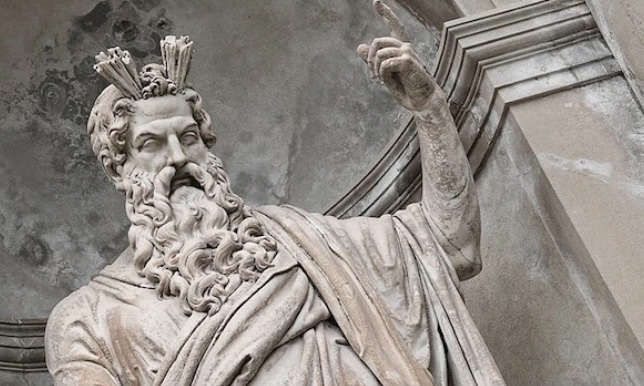
On Mount Juktas, which the Minoans revered as sacred and where, the legend says, Zeus himself lies buried – seen from the north, the ridge traces the profile of a bearded face lying on its back – Giannis and Efi Sakellarakis discovered in 1979, on the northern slope, the sanctuary of Anemospilia, “the caves of the wind”. The mountain also carries one of the most important peak sanctuaries of the Minoan world, perhaps the earliest of them all, first dug by Evans in 1909; Anemospilia lies at the northern end of the ridge, within sight of modern Heraklion. The two-storey building of the 17th century BC consisted of an antechamber with three rooms behind it. In the eastern room stood a stepped altar with vessels that had held offerings of milk, honey, grain and peas; in the central one a pair of clay feet marked the place of a life-sized wooden cult statue, consumed in the fire, with more than four hundred pots at the foot of the altar. In the western room came the traces of a human sacrifice: the skeleton of a young man of about eighteen lying on an altar-like platform, his legs drawn back as if bound, and beside him an impressive bronze blade 40 centimetres long, weighing more than 400 grams and engraved with a boar’s head. Three other people – presumably a priest, a priestess and an assistant – lost their lives when the building collapsed around 1700 BC in an earthquake and the fire that followed. The man, in his late thirties, 1.83 metres tall and powerfully built, wore a ring of silver and iron and an engraved seal; the woman, about twenty-eight, lay in a corner of the same room; the third body was found in the antechamber, its bones crushed as if by falling stone. The discovery suggests that, with catastrophe upon them, the Minoans in their desperation sought to appease their deity with this most extreme of offerings. The find is unique, for human sacrifice was not customary in Minoan society and this is the only known instance of such a rite; its interpretation is still disputed among specialists, some of whom hold that the blade is a spearhead that simply fell from a shelf. The site itself is fenced and closed to visitors, but the view of Juktas from the road is reward enough.
A few kilometres from Archanes – four, to be exact, to the south along an attractive country road – lies the abandoned village of Vathypetro (Βαθύπετρο), which preserves a further chapter of early Cretan civilisation. It lies in the locality of Piso Livadia on the south-eastern flank of Juktas, among vineyards that the excavator himself described as “fertile, well watered and full of flourishing vines”.
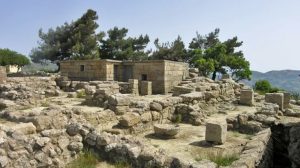
It was here, far from the bustle of the modern world, that the archaeologist Spyridon Marinatos made an important discovery in 1949: a Minoan villa of about 1600 BC. He dug the site in two campaigns, from 1949 to 1953 and again in 1955–56. It is a major piece of evidence for the sophistication of Minoan civilisation, which commanded knowledge and techniques that astonish scholars even today. The villa is a remarkable complex – in fact two buildings, east and west, separated by a corridor and aligned north to south – with a central and a west court, a small shrine, a storeroom holding sixteen large pithoi, workshops and a pillared hall. The western building borrows the vocabulary of the palaces: a formal west façade, porticoes and halls with light wells. What survives best is a wine press and an installation for extracting olive oil. The wine press, in the opinion of many the oldest known in Europe, is in the south wing and can still be seen; Marinatos supposed that a single workman trod the grapes while holding on to a rope hanging from the ceiling, as shown in Egyptian paintings. These installations, more than 3,600 years old, give an idea of the high standard of Minoan farming and of the skill with which people processed their harvests and produced their food. Loom weights, potters’ wheels and a large painted stirrup jar for transporting oil were found as well, along with a pottery kiln, carved stone lamps, brightly painted wall plaster, a bronze figurine, some gold leaf and three seals. Work on the building, begun around 1580 BC, had not yet been finished when an earthquake probably destroyed it around 1550 BC – displaced blocks and patched walls betray the interruption. The southern part was afterwards rebuilt as a farmhouse and working estate, and carried on until its final destruction around 1470 BC. The discovery of Vathypetro not only confirms that economic life in Minoan times was organised in complex ways but also helps to draw a fuller picture of the everyday existence of the ancient Cretans, their economic priorities and their cultural traditions: the wine press speaks of a developed wine culture, the oil press of the importance of the olive groves to the economy and culture of the Minoans.
The journey continues
Houdetsi and the chapel of the Archangel Michael
Between Archanes and Houdetsi, in the locality of Asomatos and about three kilometres from Houdetsi, stands the little church of the Archangel Michael (Ναός Μιχαήλ Αρχαγγέλου), whose splendid wall paintings of 1315 have survived. The single-aisled, barrel-vaulted chapel stands among greenery, surrounded by old oaks and plane trees. An inscription inside gives the year 1315/16 and names the donor, a certain Michael Patsidiotis, who probably came from the nearby village of Patsides and dedicated the church to the saint whose name he bore; beside the entrance he kneels, apparently with his wife, before the archangel. The chapel possesses the most extensive cycle of scenes of the Archangel Michael in any Cretan church, with episodes from his miracles, together with the Crucifixion, the Resurrection and the Lamentation over the dead Christ, and some rare Old Testament subjects: the fall of Jericho, the destruction of Sodom and Jacob wrestling with the angel. The west wall is taken up by an imposing Last Judgement, in which the Sea, too, appears in personified form.
Find on the map
Our route continues south along a fine hill road that links Archanes with Houdetsi. Houdetsi (Χουδέτσι), some 20 kilometres south of Heraklion, is a village of traditional architecture on the edge of the Spiliotissa gorge, whose rock walls and luxuriant vegetation shape the landscape. Today it is best known as a village of music. Ross Daly, a musician of Irish descent born in 1952 at King’s Lynn in Norfolk and one of the great masters of the Cretan lyra, set up his Labyrinth Musical Workshop here; founded in 1982, it draws musicians from all over the world and has since 2002 offered seminars and master classes in the modal musical traditions of the Mediterranean, the Near East and Central Asia. The workshop also keeps the collection of more than 250 instruments that Daly gathered on his travels, and he himself plays a lyra of his own design, devised in 1990, with three playing strings and 22 sympathetic ones. After the earthquake of 2021 the workshop moved to a new building within the village. In summer Houdetsi also celebrates the old custom of the Klidonas.
Panagia Spiliotissa
From Houdetsi the route turns east towards Peza. On the way we visit the monastery
of the Panagia Spiliotissa,
which lies in a delightful grove with numerous springs, about 22 kilometres south of Heraklion, tucked into the green gorge to which it has given its name, on a hillside between the villages of Houdetsi and Agios Vasilios. A paved road leads to it, but it can also be reached on foot from Houdetsi by a path of some 500 metres through thick vegetation, passing two old watermills and small Byzantine churches on the way.
Find on the map
The monastery was originally a house for men and is today one of the smallest convents still inhabited in Crete; nuns have lived here for about four decades. It is a metochion – a dependency – of St Catherine’s Monastery on Mount Sinai, while in ecclesiastical terms it falls within the Archdiocese of Crete. The patronal feast is kept on 15 August, the Dormition of the Mother of God.
The foundation of the church goes back to a legend: an icon of the Mother of God is said to have been found in the cave, and on that spot the present cave church later arose – a place where devotions may well have been held even in pre-Christian times. One tradition has the monastery founded as early as the 11th century; the more widely held view is that it came into being at the beginning of the 14th, a date supported by that of the church of the Holy Cross (Timios Stavros) on the uppermost terrace and by the ruins of an unidentified church on the south-west side. In the late Venetian period the monastery belonged to the distinguished Venetian family of Falier. At the end of the 16th century it was headed by the scholar Ioannis Morezinos, the first director of the Sinaite School of St Catherine in Chandax, the present Heraklion. The transfer to the Sinai monastery probably took place during the Ottoman siege of Chandax (1648–1669) or shortly afterwards – the year 1649 is usually given – a subordination intended to protect the property in uncertain times, and one that has lasted to this day. Under the Ottomans the monastery is said to have served for a time as a bishop’s seat as well; in 1866 it was thoroughly renovated. In the surroundings the little church of Agios Ioannis is worth seeking out for its frescoes of 1291, whose donor inscription, remarkably, names the Byzantine emperor rather than the Venetian overlords.
The monastic complex of the Panagia Spiliotissa is laid out on three levels and enclosed by a high wall that gives it the look of a small fortress. On the eastern side of the middle level stands the main church, the katholikon, and to the west of it the monastic buildings, which have grown up over the centuries. The upper level is occupied by the church of the Holy Cross and a scatter of ruined structures, while the cave church lies at the northern end.
Particular attention is due to the two-aisled cave church, dedicated to the Dormition of the Mother of God and to the Seven Sleepers of Ephesus, and connected with a later chapel of St Catherine – the dedication that recalls the mother house on Sinai. It has a carved iconostasis with notable post-Byzantine icons and preserves the only surviving fresco of the 15th century, which depicts the monastery’s patroness.
The Monastery of St George Epanosifis
The Monastery of St George Epanosifis (Μονή Αγίου Γεωργίου Επανωσήφη), one of the best known in Crete and, in the number of its monks, the largest community of men on the island, dates from the end of the Venetian period – the years around 1590–1600 are generally given for its building. It lies near the village of Metaxochori in the hill country some 30 kilometres south of Heraklion, and is reached by a paved road.
Find on the map
It was founded around 1600 by the monk Paisios. He was on his way from the monastery of St Antony at Apezana to the monastery of Angarathos, and spent the night on the land of the Venetian Langouvardos near the village of Kako Chorio, today’s Metaxochori. St George appeared to him in a dream, and Paisios thereupon built the monastery of Epanosifis on the spot; the landowner’s family is said to have paid for the work. In time the community grew, supported by the inhabitants of the surrounding villages and by monks from neighbouring houses.
The name Epanosifis goes back to the landowner Langouvardos. He had two shepherds, both called Sifis, and told them apart as “upper Sifis” (Epano-Sifis) and “lower Sifis” (Kato-Sifis). During the Ottoman conquest, in the long war of 1645 to 1669, the monastery began to flourish and acquired extensive estates. In the 18th century it reached its heyday and became one of the great places of pilgrimage in Crete, an important halt for travellers and pilgrims. In the course of time it gathered a number of dependencies, among them the now ruined monastery of Aistratikos and the small house of Xera Xyla near Neapoli. The monastery played a key part in the social and spiritual life of the island: it helped those in need and promoted education, paying for schools in the region, for orphanages and for hospitals.
Under Ottoman rule, and especially during the revolution of 1821, the monastery became a centre of national resistance; many monks took an active part in the struggle for independence, several lost their lives, and church treasures were sold to buy arms. The rising of 1866 was another significant period: the monks made a considerable contribution to the national movement and joined the insurgents under Michail Korakas, while the older brethren found temporary refuge in the monastery of Apezana. In the Second World War monks fought in the Battle of Crete in 1941; the monastery gave shelter and medical help to the partisans, served as a field hospital and housed more than a hundred families, though it was plundered by the Germans. Today it remains a place of pilgrimage and of religious education – a higher ecclesiastical school is attached to it – and keeps its historical and cultural importance. The monastery has a church museum and a library with old icons, manuscripts and other precious witnesses to its rich spiritual heritage: gospel books, carved crosses, a silver chalice of 1842 and the relics of twenty-one saints. The katholikon has a finely carved iconostasis and an icon of St George venerated as miracle-working; a second icon of the saint was brought here from the dependency of Xera Xyla. There are two feasts in the year: 23 April, the commemoration of the martyrdom of St George, and 3 November, the day of the translation of his relics – when the faithful flock here from the whole district.
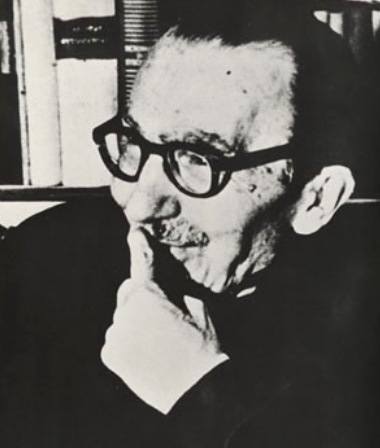
Nikos Kazantzakis
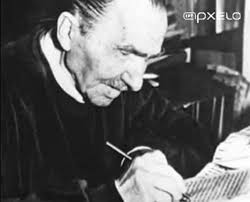
The village of Myrtia, some 20 kilometres south of Heraklion and about eleven from Knossos, is especially dear to every Greek, for here stands the ancestral house of the family of Nikos Kazantzakis, the world-famous Greek writer and thinker of the 20th century, who has also been called the Greek Nietzsche. The museum was opened on 27 June 1983 by Melina Mercouri, then Minister of Culture. It was founded by the stage and costume designer Giorgos Anemogiannis, who was related to Kazantzakis and revered him deeply; he made over his family’s house, on the plot where the homes of his relatives had also stood, and brought the collections together. He had been assembling the archive since 1976, and the writer’s widow, Eleni Samiou-Kazantzaki, added greatly to it with gifts from her own papers. Today the holdings amount to more than 50,000 items, arranged in ten collections – personal belongings, photographs, Greek and foreign-language editions of the works, letters, documents, and sound and film material – of which some 650 are on show. The permanent exhibition is arranged in five thematic rooms: biography, the epic Odyssey, influences and friendships, early works and theatre, and novels and travel books. In 2005 Anemogiannis also bequeathed to the museum his own archive of stage designs and costume sketches; in 2009 the building was comprehensively renovated and the display rethought. The museum is run by a foundation without regular state funding and is financed chiefly by admission charges and donations.
Find on the map
Life and work
The works of Nikos Kazantzakis have been translated into some forty languages. In 1956 he received the International Peace Prize, and he was put forward for the Nobel Prize in Literature nine times; in 1957 he lost it to Albert Camus by a single vote, and Camus himself said that Kazantzakis had deserved it a hundred times more. Best known are his novels “Christ Recrucified” (1948; Bohuslav Martinů based an opera on it under the title “The Greek Passion”), “Zorba the Greek” (1946), “The Last Temptation” (1955; placed by the Catholic Church on the Index of Prohibited Books) and his novel of St Francis of Assisi (1956). He also wrote several plays, philosophical studies composed under the influence of Nietzsche – on whom he had written his thesis as a law student in Athens between 1902 and 1906, before going on to Paris and the lectures of Henri Bergson – and the verse epic “Odyssey”, a sequel to Homer in 33,333 lines and 24 books on which he worked from 1924 until its publication in 1938; and he translated Dante’s “Divine Comedy” (1932) and Goethe’s “Faust” (1936) into modern Greek. Kazantzakis was a seeker who was fired by the most diverse ideas, from Buddhism to Communism. Russia, too, he knew at first hand: he stayed repeatedly in the Soviet Union in the 1920s, for about two years in all by his own account. He travelled a great deal, as journalist and writer, across Europe and as far as China and Japan, and his travel books are written with the same mastery as his novels.
World fame came to Kazantzakis above all through the film versions of his novels: Jules Dassin’s “He Who Must Die” (after “Christ Recrucified”, 1957, with Melina Mercouri), Michael Cacoyannis’s “Zorba the Greek” (1964, music by Mikis Theodorakis, with Anthony Quinn, Irene Papas and others) and Martin Scorsese’s “The Last Temptation of Christ” (1988, screenplay by Paul Schrader, with Willem Dafoe, Harvey Keitel, Barbara Hershey and others). Kazantzakis died in Germany, at Freiburg im Breisgau, on 26 October 1957, aged seventy-four, of the complications of an influenza he had caught on a last journey to China. His remains were brought home; since the Church refused him burial in a cemetery, he rests on the Martinengo Bastion of the Venetian walls of Heraklion, the Kastro. On his grave stands the inscription he composed himself: “I hope for nothing. I fear nothing. I am free.” From the bastion the view ranges far across the city to Mount Juktas – a fitting end to a route that begins at Knossos.
Notes on the route
The route runs from Knossos by way of Archanes, Houdetsi and the monasteries of the district to the Nikos Kazantzakis Museum in Myrtia. It brings together Minoan archaeology, Orthodox culture and the literary memory of Crete. A full day should be allowed for the whole circuit; the distances are short – Archanes is seven kilometres from Knossos, Houdetsi and Myrtia each about twenty from Heraklion, Epanosifis some thirty – but the roads wind through the hills and the sites take time. Anyone who wants to see Knossos, the museum at Archanes and the Kazantzakis Museum properly would do well to set off early and to check opening times beforehand.
Knossos and Archanes
Knossos was the palatial centre of Minoan Crete, Archanes an important settlement in its hinterland. The road between the two runs through vineyards and olive groves and joins the archaeological landscape to the rural life of the present – in hardly any other part of Crete is it so plain that wine-growing here has an unbroken tradition of more than three and a half thousand years, from the Minoan press at Vathypetro to the cooperative founded at Archanes in 1931.
Panagia Spiliotissa
The name Spiliotissa means “she of the cave” and refers to the church installed in a natural cavern in the rock. In Orthodox tradition such places are regarded as sanctuaries in which the natural space itself becomes part of the church.
The Monastery of St George
The Monastery of St George Epanosifis arose at the end of the Venetian period and later became one of the largest monasteries in Crete. The exact year of its foundation is not known; it was around 1600.
The Nikos Kazantzakis Museum
The museum is in Myrtia, the former Varvari, the home village of the writer’s family. On display are personal belongings, manuscripts, letters, first editions of his books and material on stage productions of his works. Founded in 1983, the museum has become a centre for the study of the life and work of Kazantzakis, and also offers educational and research programmes.
Nikos Kazantzakis at a glance
Nikos Kazantzakis (1883–1957) was a writer, philosopher and traveller, the author of the novels “Zorba the Greek”, “The Last Temptation” and “Captain Michalis” (1950; known in translation as “Freedom or Death”). He was twice married, to Galateia Alexiou from 1911 to 1926 and to Eleni Samiou from 1945 until his death. His attachment to Crete shows not only in his biography but also in the themes that run through all his work: freedom, resistance, faith and the inner choice of the individual.