Phaistos and the “Cretan Athos”: ancient cities and monasteries of the south
The most complete guide to Crete: 221 places on the map, 23 routes and 49 articles — with photos, videos and the story behind every place. Everything is open and free: no sign-up, no paid sections and no advertising, open or hidden. You can install the guide on your smartphone as an app.
Routes drawn along real roads
Weather at every stop
Full-text search
“Near me” by geolocation
Create your own printable itinerary
Satellite, terrain, dark mode
Works offline
⌕
Searches 1.7 million characters of descriptions, not just names
—places
4regions
—routes
—with video
Search results
—
Interactive map
Find what is near you
Filters narrow the map and the list at once. Zoom out and pins group together.
Region
Category
Фильтры карты
Landmarks
Featured places
RegionCategory
Routes
Ready-made day trips
Individual places
Articles about landmarks
The countryside of the regional unit of Heraklion through which this route passes wins the traveller over at once with its abundant green: broad, fertile valleys, carefully tended fields, vineyards that seem to have no end and olive groves with their silvery shimmer, above which, to the west, rise the foothills of Psiloritis. The route is planned for two days, so see to a bed for the night in good time, ideally in Vori or in Matala on the south coast. It makes for a long excursion, but one that links Minoan palaces, Roman cities, Byzantine churches and working monasteries.
We leave Heraklion by the western gate of the Venetian fortifications, the so-called Chania Gate (Chanioporta), and take the main road south-west in the direction of Mires. At about kilometre 13 turn right at a junction; after a further six kilometres Agios Myronas comes into view ahead, set high on its two hills among vineyards, cypresses and olive trees – the first stop on this journey.
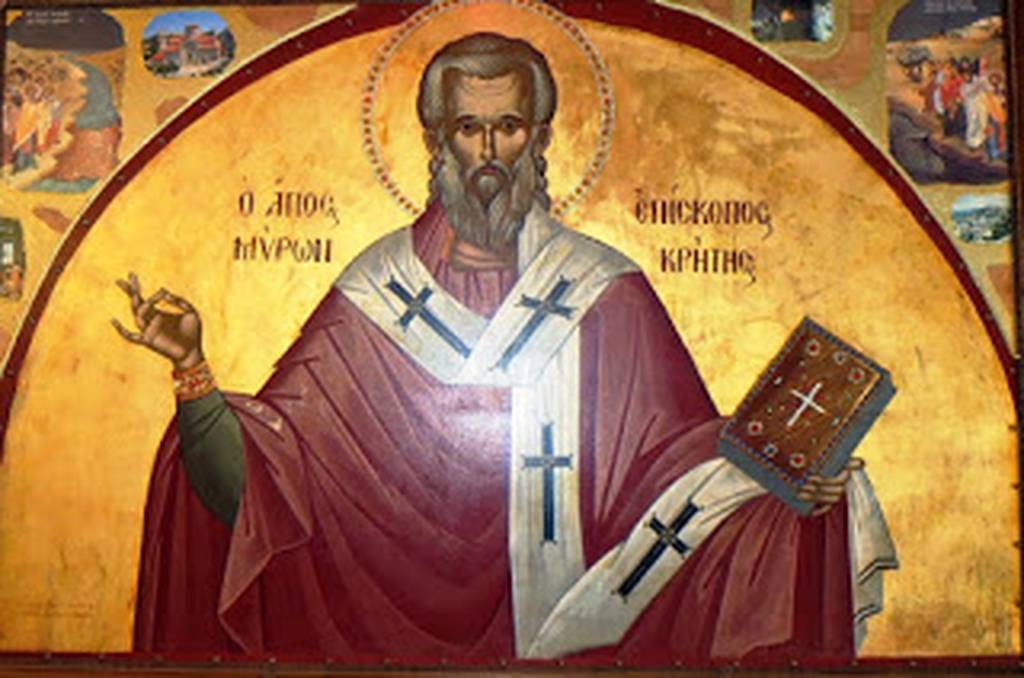
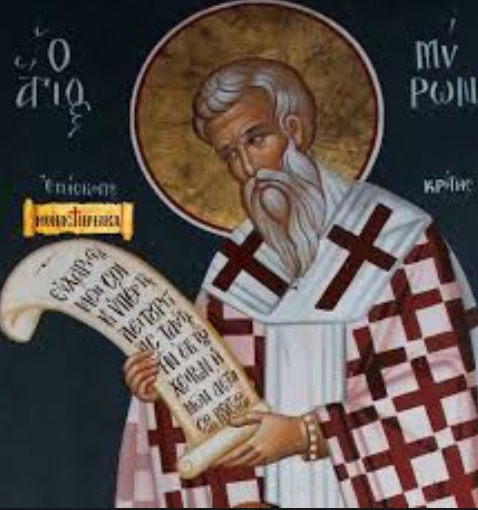
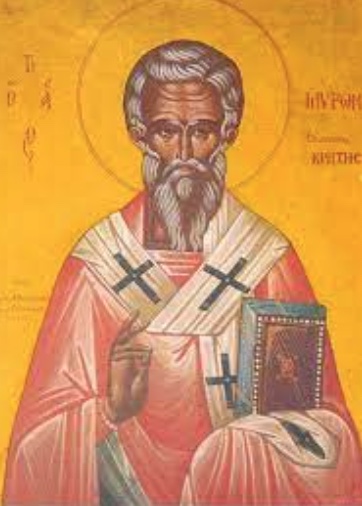
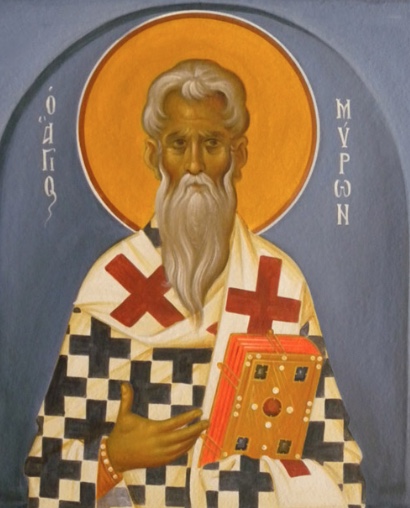
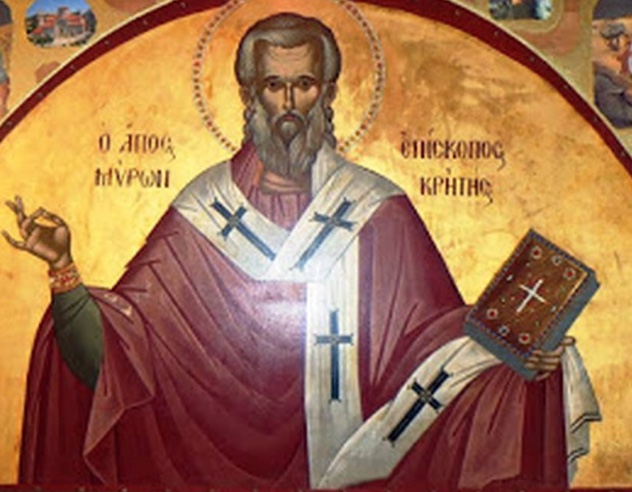
St Myron
A singularly handsome village, and at the same time the place where the relics of one of the most venerated saints of Crete lie.
Find on the map
Introduction
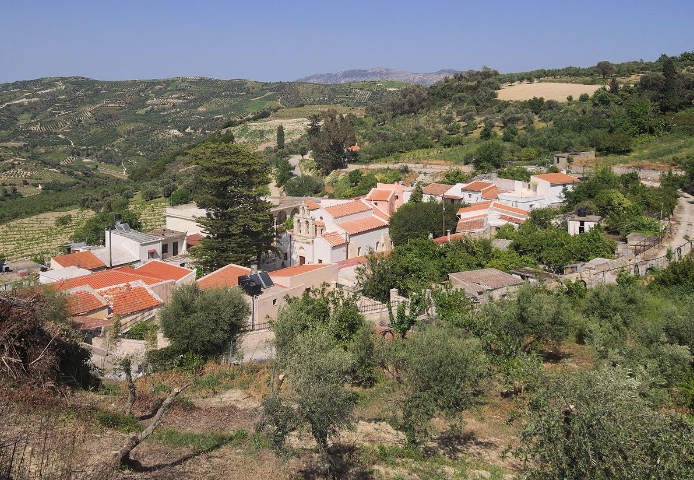
Agios Myronas (Άγιος Μύρωνας, officially also Άγιος Μύρων) lies some 18 kilometres south-west of Heraklion in the old district of Malevizi, on high ground several hundred metres above the sea, from which it looks out over the whole of that country. The substantial village spreads across two hills – which is why the Ottomans called it Tsatal Kioy, the “village with the two peaks”. At the census of 2011 it had a good 600 inhabitants, and 569 a decade later; they live chiefly from vine-growing and from producing wine and raisins, with some stock-raising besides. The local wine of Malevizi enjoys an excellent reputation throughout Greece and beyond. A count of 1837 found seventy families here, only three of them Muslim. Since the administrative reform of 2011 the village has belonged to the municipal unit of Gorgolainis; it has its own schools, a post office and a health centre.
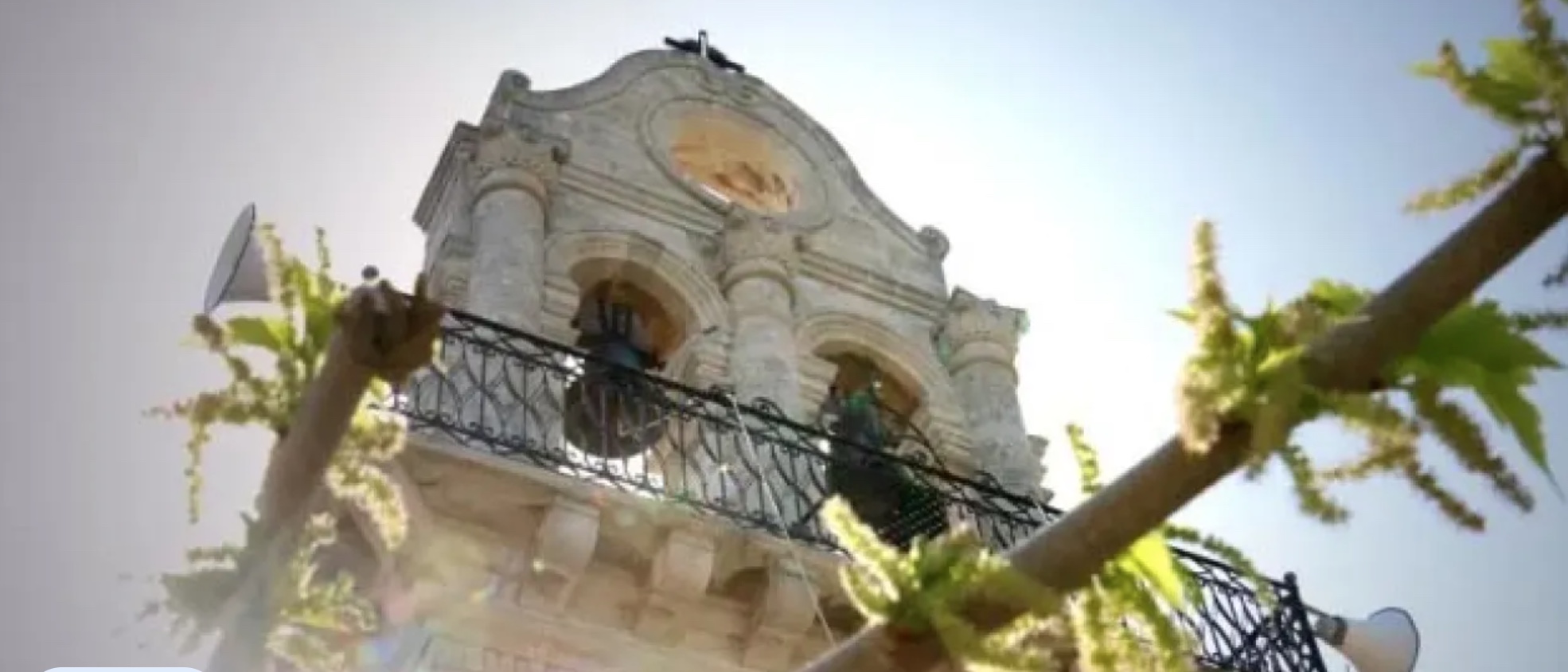
Worth seeing is the traditional Cretan village architecture that set the pattern when the place was rebuilt from the ground up after the devastating earthquake of 1856: houses of natural stone with inner courtyards, masonry archways and narrow, winding lanes. At the highest point of the village stands the school with a tower clock of 1900, a landmark for miles around, whose movement is said to have come from Genoa; it was the gift of a son of the village who had emigrated to Argentina. The villagers have a long record of taking up arms: men from here fought in the Therisso revolt and in the Macedonian Struggle of 1904–1908, and the whole village was involved in the resistance during the occupation of the Second World War.
This area was settled in the earliest times. Here lay the ancient city of Rhaukos (Ραύκος), between Knossos and Gortyn, which according to Homer is supposed to have taken part in the Trojan War, the campaign fought to recover the beautiful Helen. Coins of the city and numerous inscriptions have been found; the oldest finds from the area go back to around 1900 BC, and Minoan seal stones turned up here early in the 20th century. Archaeologists have also uncovered a Minoan cemetery with larnakes of the palatial period, brought to light at nearby Vrysi in 1966, and a chamber tomb of the Late Minoan IIIA period, discovered in 1941, containing four larnakes and pottery. The finds are now kept in the Archaeological Museum of Heraklion. Rhaukos, which is mentioned by Polybius and Diodorus and whose bees found their way into Aelian’s natural history, flourished in Minoan as in Roman times and bore its old name until the 4th century AD; the place was then renamed in honour of St Myron. The village is first mentioned in writing in a deed of 1281 that refers to the saint, and in the Venetian census of 1583 it appears under the name “Samiro”.
The cave and the miracle of the water
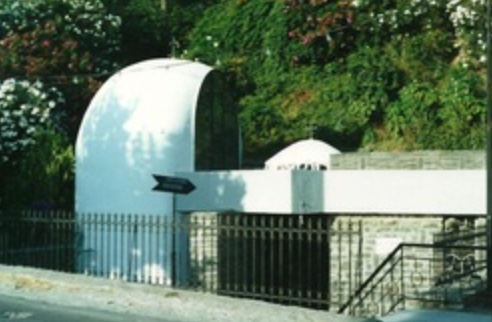
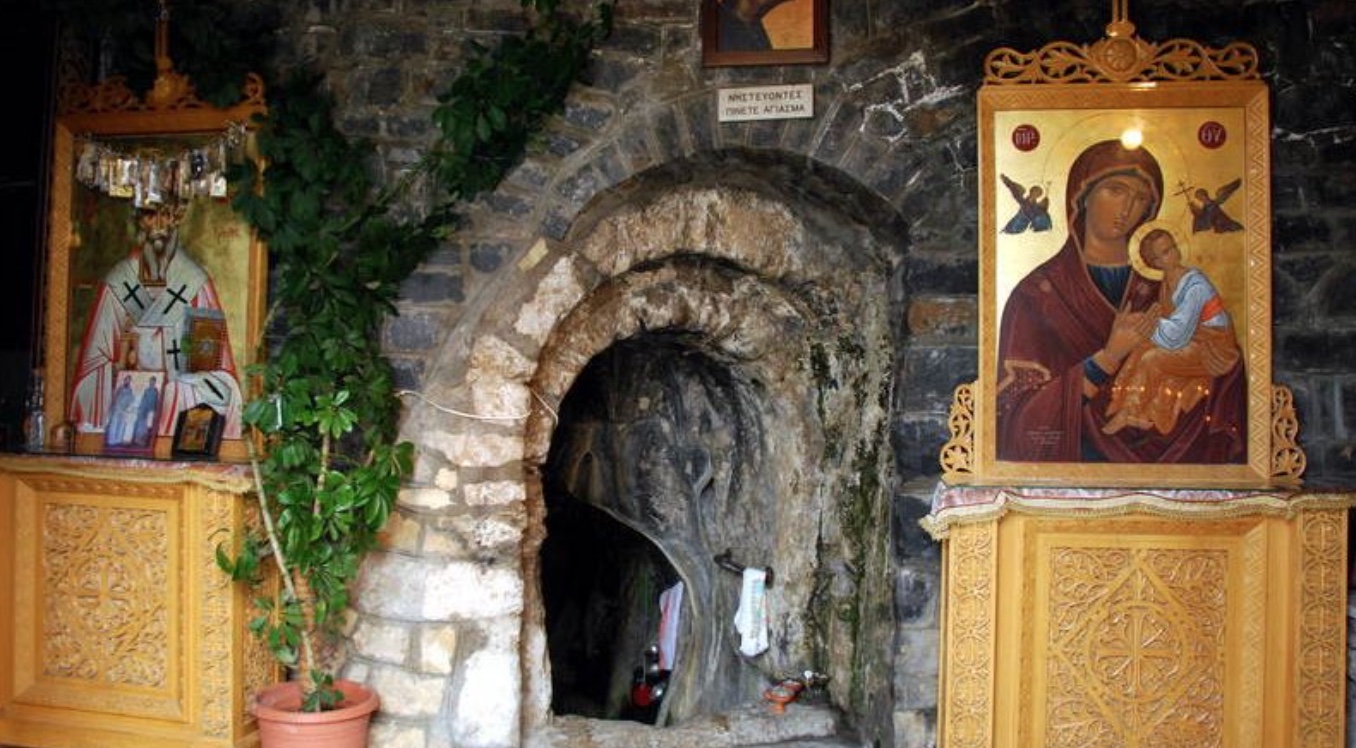
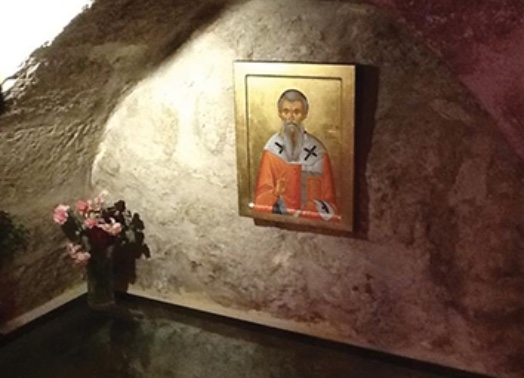
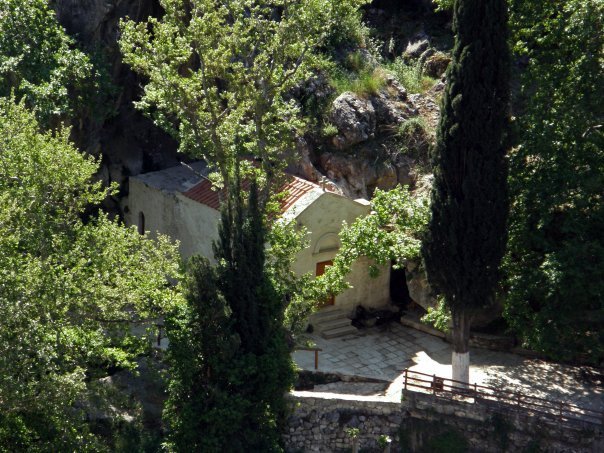
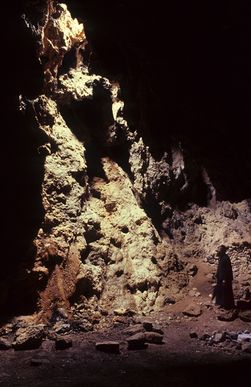
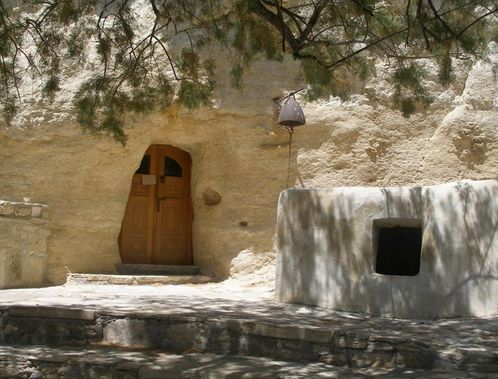
Descending the western slope from the courtyard of the church, one comes to a small rock cave lying directly beneath the building. The place is hallowed by the presence of St Myron: here, in his hermitage (σκήτη), tradition has it that he spent a large part of his life in prayer and ascetic discipline. Today the cave is fitted out as a small chapel.
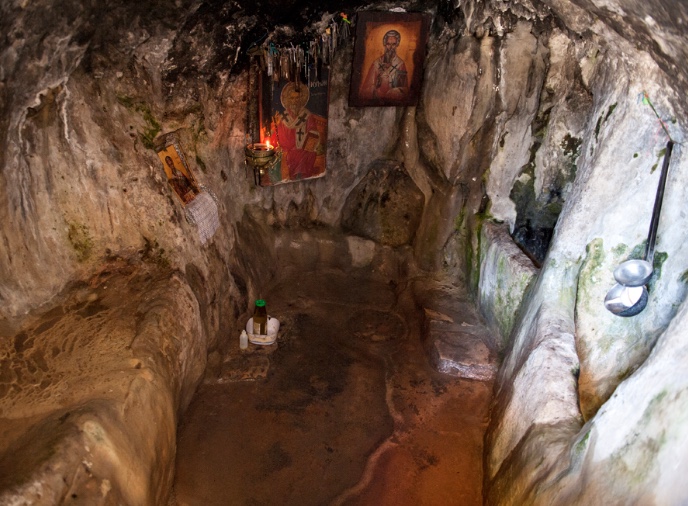
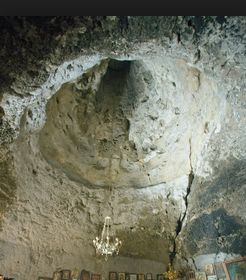
To enter the cave one goes down three steps into a cramped, almost circular space. On the left rises a small ledge of rock, standing about half a metre above the floor, which according to tradition served the saint as his meagre couch – people speak of the stone bed of St Myron. Stones lie scattered round about, and three small hollows can be seen in the floor; in the middle one holy water, the agiasma, always collects. In a niche in the rock stands an icon of the saint, before which a small oil lamp burns without ceasing.
That countless people have drawn from this hollow for centuries and yet the water never fails is a source of wonder to locals and pilgrims alike. There is no conclusive explanation – and in matters of faith, as is well known, human reason often runs up against its limits. A local tradition relates that the spring rose in a time of great drought, in answer to the saint’s prayer for villagers who had no water.
For the constant presence of the holy water in the cave there are two common explanations. According to the first, the water issues directly from the saint’s tomb – a supposition that, despite repeated investigation, it has not been possible to confirm. According to the second, the moisture in the cave increases noticeably on the saint’s feast day, during the reading of the Gospel, and then gathers in this hollow.
Whichever explanation one inclines to, it remains beyond dispute that at any season every visitor may draw some of the holy water with the little spoon that lies ready beside the hollow and, as the faithful say, experience its wonder-working power. Many pilgrims take a little of it home in a small bottle.
An occurrence of more recent date deserves mention too. Father Nikolaos Kritsotakis, the priest of the church, who serves here to this day, was witness to a remarkable event. The sacristans had decided to clean the hollow of the odds and ends and drops of oil that had fallen into it; they baled it out completely and washed it thoroughly. To their surprise they found shortly afterwards that the hollow had filled with water again – and more copiously than before.
The church
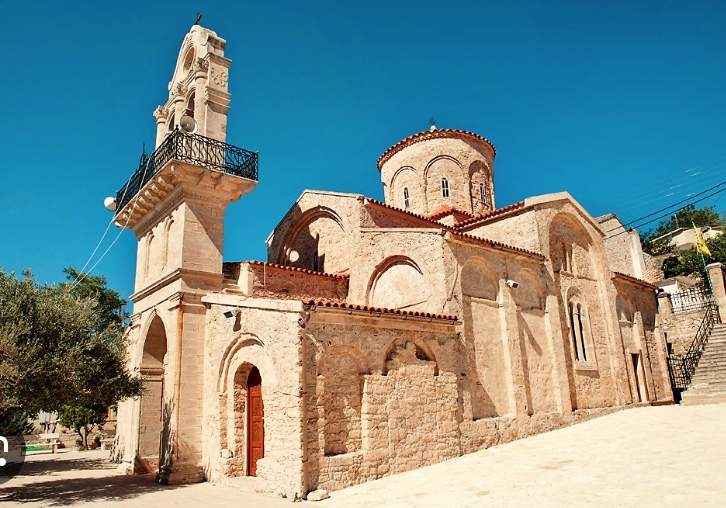
Beside the cave in which the saint prayed, the great church of St Myron was built, and his relics were translated to it; after him the place also received its new name. The present building is a cross-in-square church of the four-column type, crowned by a dome, and to judge by its architectural forms probably dates from the 12th century. It rises over the foundations of an Early Christian basilica, whose large sanctuary apse has survived together with the synthronon, the semicircular stone bench for the clergy. Later a tripartite narthex was added, opening through three arches into the aisles; in the 19th century the west wall of the narthex was strengthened so that it could carry a bell gable of two arches.
The interior is decorated with modern frescoes. The church holds the saint’s tomb as well as his relics, which are kept in a costly reliquary, and the faithful tell of the delicate, myrrh-like fragrance they give off. On the south-east side is an arcosolium, an arched tomb recess that is probably connected with the saint’s original burial place. To this day the relics are held to work miracles; numerous people testify that they have been cured of grave illnesses through the intercession of St Myron.
The life of St Myron
His birth is placed at about AD 250, his death – in the language of the Church his “falling asleep” (κοίμησις) – at about AD 350. Around 320 to 330 he ascended the episcopal throne of Gortyn, then the seat of the bishop of all Crete. Myron came from ancient Rhaukos and was the child of noble and devout parents. His birth and childhood fell in the hard years of the persecution of Christians under the emperor Decius, and so his parents took great pains to bring him up in the true faith and to shield him from the influences of the idolatry of the age. It was clear early on that his path would lead into the Church: he was sensible and level-headed, shunned childish frivolity and obeyed his parents. Even in his youth his goodness came to light, together with a particular gift of grace to which many miracles bear witness – he is known in the Orthodox calendar as Myron the Wonderworker. The best known of them is the miracle of the grapes and the wine.
According to tradition the boy once gave away the entire grape harvest from the family vineyard to the poor. His mother reproached him: they had worked in that vineyard the whole year long, and now there were no grapes left to press for wine. He did not answer her back, but said only: “God has kept something for us too, mother.” Then he went into the vineyard and found there a single bunch with only three grapes on it. He brought it home and laid it in a vessel – and at once the must began to flow, and went on flowing until the barrels of the family, and at length of the whole village, were full. It is a legend that is told with particular relish in a wine-growing district such as Malevizi.
When Myron had grown up he lived as a farmer. In this period of his life, too, he helped everyone as best he could: he fed the hungry, clothed the naked, cared for widows and orphans, took in strangers hospitably and stood by anyone in need. Church tradition extols him as a model father of a family and protector of the weak. Two incidents from that time are characteristic of the man.
The first took place one evening, when the saint noticed that thieves had come to steal wheat from his threshing floor. The men believed he was asleep. They filled their sacks, helped one another to heave the load on to their shoulders and made off. But nobody helped the last man, and he struggled in vain to hoist his sack. Then the saint got up and with his own hands loaded the sack on to the man’s shoulder. “May God forgive you,” he said – and the thief went away deeply ashamed and shaken; the story adds that the men led honest lives from then on.
On reaching marriageable age Myron wedded a devout and faithful woman. But she died before long, and, free of the bonds of marriage, he dedicated his life wholly to God. Daily he studied Holy Scripture, fasted and prayed, and at the same time carried on his works of charity. When his virtue became known he was ordained first a reader, later a presbyter. Under Constantine the Great, when the persecutions had come to an end, Myron devoted himself with still greater zeal to preaching the Gospel – and he taught not by words alone but above all by his actions and his example.
So his reputation spread rapidly across the whole island. When the bishop of Crete died, clergy, authorities and people turned to him with one voice and begged him earnestly to take on the care of their souls. Myron was consecrated bishop of Crete and in that office continued his work of miracles and charity; one tale has him halt the river Triton in flood and walk across it as though on dry land. He is said to have lived to almost a hundred and to have died a quiet, natural death, leaving behind an immense pastoral achievement; for hundreds of people he smoothed the way to a Christian life – and for many believers down to our own day. The Orthodox Church commemorates him on 8 August.
The miracles: deliverance from the Ottomans
In the year 1826 Ottoman troops from Constantinople under the command of Hasan Pasha mounted a punitive expedition against the villages of the province of Malevizi. They took many inhabitants prisoner, brought them to Agios Myronas and held them on the flat roof of a house beside the church. The next day they meant to march the captives to the city, execute some of them and sell the rest into slavery. To prevent any escape they even posted a second guard for the night. All night long the prisoners prayed and called upon the saint for help. At midnight a dazzling light appeared in the sky; like tongues of fire it came down and stood still above the church. At the same moment there arose a rumble of thunder and a deafening din. The Ottomans believed a Christian army had surrounded them and fled in panic. The villagers hurried up and freed the prisoners, who thanked the saint for their deliverance.
The miracles: the healing of a persecutor
Huseyin Aga of Archanes, who had had a hand in many massacres of Christians, lost his sight. No sorcerer and no physician could help him, and so in the end he gave up seeking a cure from them. Instead he entered the church and knelt down before the saint’s tomb. He remained on his knees throughout the liturgy. As the priest was reading the Gospel the blind man cried out: “Glory be to God, and glory to the holy elder – I can see.” After the service the aga did indeed go down into the cave to which the saint had once withdrawn, washed his eyes with the holy water and was completely restored. Until his death in 1859 he came again and again to the village and to the saint’s church, bringing gifts.
The miracles: the desecrators driven out
For a time the Ottomans used the saint’s church as a store for supplies and provisions, and posted sentries to guard it. One night, however, thunder and a fearful noise rang through the village. The inhabitants woke and ran to the church, from which the uproar was coming. There they saw the Turkish sentries rushing away, shouting that an evliya – a holy man, an old man with a white beard in a robe of gold – was after them. On the following day the Ottomans cleared their military stores out of the church and gave it back to the Christians for free worship.
The miracles: the healing of a woman
In the summer of 1861 Georgios Kolyvakis of Heraklion came to Agios Myronas with his wife Marigo. According to the doctors she was suffering from a severe nervous disorder. During their stay in the village her condition worsened, and her relatives, trusting in the healing power of the saint, brought her to his church. For five days the clergy, together with many villagers, prayed at the saint’s tomb and celebrated the Divine Liturgy daily; and as they did so, it is reported, a wonderful fragrance streamed from the tomb and filled the whole church. On the Wednesday evening the saint appeared to the sick woman and told her that on the Friday she would be freed from the evil spirit. On the Friday, during the liturgy, as the priest spoke the words that tradition renders as “Shut out …”, the woman gave a loud cry, staggered and fell to the ground as though dead. After a while she rose – fully recovered, praising God and thanking the saint for her cure.
The miracle of the dragon
This legend belongs to the Dragon’s Ravine (Χαράδρα του Δράκου) beside the village – the place the ancients knew as Rafkos, which now bears the name of its fourth-century bishop. When the wind is strong a dull rumbling can be heard in the ravine, uncomfortably like the roar of some great beast. The story goes that a dragon devoured any person or animal that strayed into the gorge, and that only the pastoral staff of St Myron was able to subdue it and turn it to stone. A fuller version relates that the monster reappeared one Sunday morning while the liturgy was being celebrated; the saint sent out his deacon, staff in hand, to command the creature in the name of Christ to move no further. When the service was over Myron himself threw a large stone at the paralysed dragon, whereupon a mysterious hail of stones came down and the beast was petrified where it stood.
The rock face of the ravine does indeed suggest the stiffened body of a dragon – though one without a head. According to the same legend the head came away from the body and turned to stone in the very cave where the saint lived as an ascetic, the underground hermitage that lies beneath the village church: in the projections of the cave wall above the holy water, a spring said to have risen in answer to the saint’s prayer when his people were short of water, the faithful make out the dragon’s eyes and nostrils. The “dragon” outside is a granite-like outcrop covering roughly 1,000 square metres, and the villagers still regard it as an infallible weather prophet. If small bubbles like white foam appear in its fissures, rain is on the way; if strange noises are heard from within it, a hard winter is coming. The best day to hear such stories told is 8 August, the saint’s feast, when one of the largest village festivals in Crete is held here.
We continue south and after one kilometre pass the village of Pyrgou. Two kilometres further on, Nisi comes as a surprise: the village has been abandoned by its inhabitants, yet the houses still stand intact, and their architecture is worth a few minutes’ attention. From Nisi it is six kilometres to Kato Asites and one more to Ano Asites.
Kato (Lower) and Ano (Upper) Asites
Two villages founded in the 10th century under the Byzantine emperor Nikephoros Phokas.
Find on the map
Introduction
Historical tradition traces the villages back to the great Byzantine general and later emperor Nikephoros Phokas. Having recovered Crete from the Arabs in 961, he settled here a body of brave mercenaries from Assos, a city of Mysia in Asia Minor – the modern Behramkale on the Turkish coast opposite Lesbos – and rewarded them with land. The name Asites (Ασίτες) is derived from their place of origin. The villages appear in Venetian archival sources by 1394 at the latest. The place offers a rare chance to step back into the centuries in which the culture and customs of Crete began to take shape.
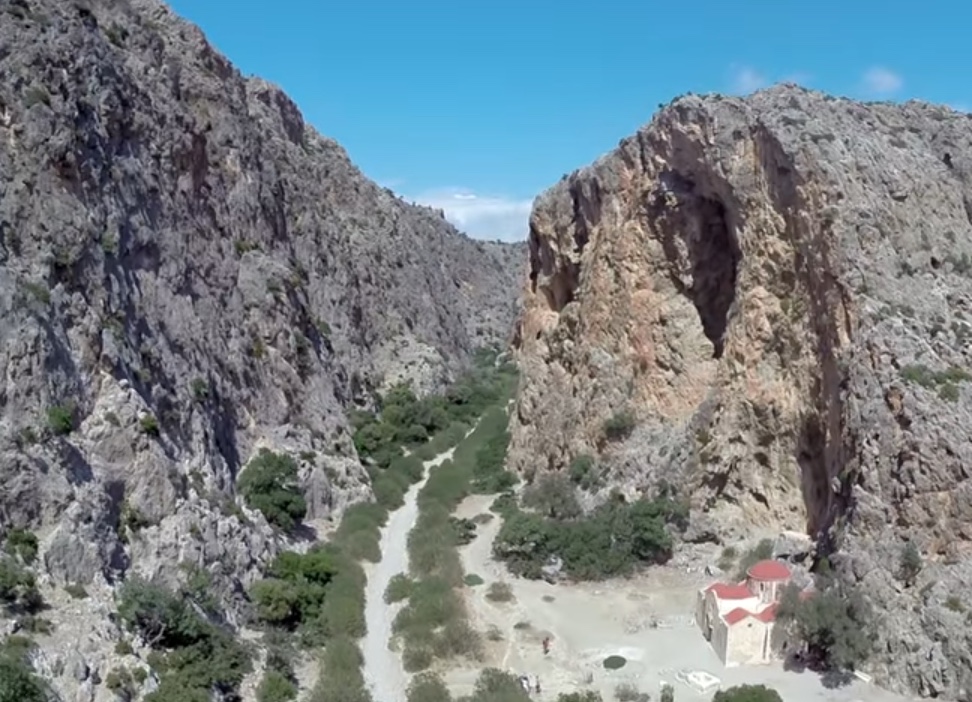
The two neighbouring villages lie some 24 kilometres south of Heraklion, in the old province of Malevizi, at the foot of the eastern spurs of the Psiloritis massif. Their inhabitants live chiefly from vines and olives and from stock-raising. A walk through the colourful, crooked lanes of both is rewarding, as is a visit to the small folklore museum of Ano Asites, which opened in 1995 in a house built in 1880. The gorge of Agios Antonios opens west of the villages, and the European long-distance path E4 runs through it; the gorge of Agios Charalambos is close by. Hill walkers value the refuge at Prinos, at an altitude of about 1,100 metres, which is run by the Mountaineering Club of Heraklion. It has been in use since 1967, sleeps thirty and is reached in about two hours on foot from Ano Asites; from it paths lead on to the summits of Koudouni and Gyristi, to the Rouvas forest in some four hours and to the Nida plateau in about seven.
Old churches
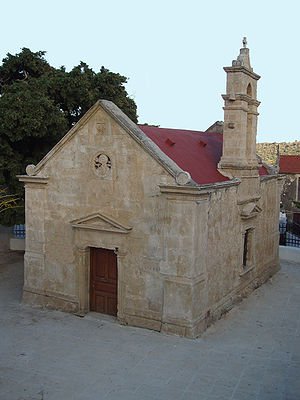
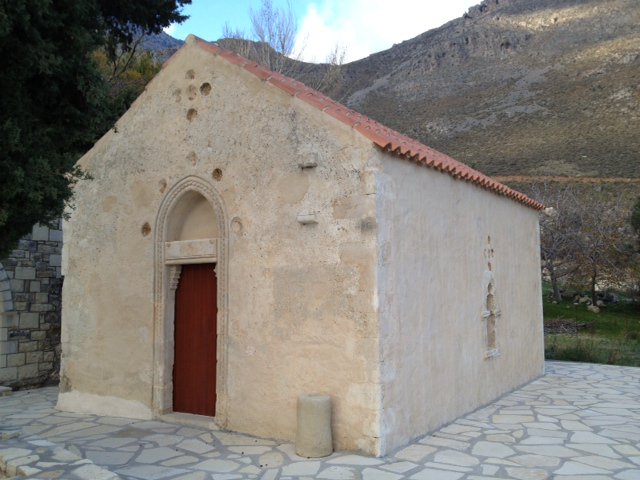
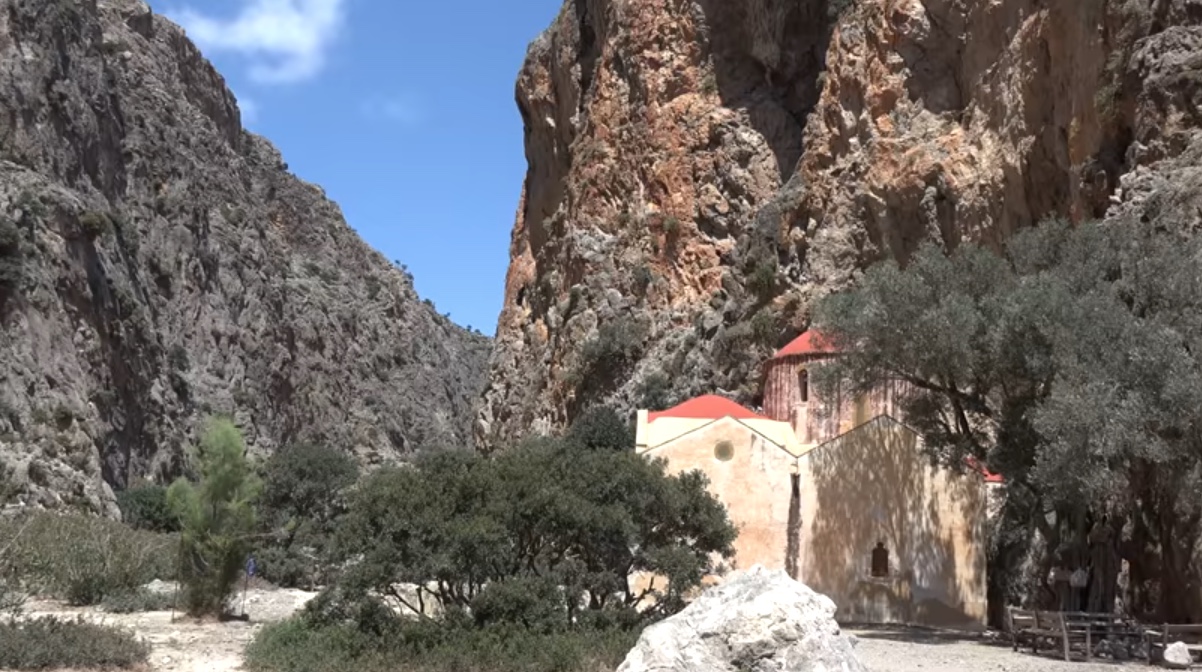
The old churches are the real treasures of the two villages and among the finer things in the Cretan heritage: the 12th-century church of the Panagia (the All-Holy Mother of God) and the 11th-century church of Agios Antonios in Kato Asites, together with the churches of Agios Georgios and Agia Paraskevi; Kato Asites also has a church of Christ. They keep the quiet of the place and stand open to travellers in search of stillness and reflection. The Byzantine church of Agios Antonios is so plain and severe from the outside that it is easily overlooked among the houses; it is best approached from the east along a narrow lane. A modern porch furnished with icons and benches invites a pause before one passes through the stone doorway into the old interior.
The monastery of St George (Gorgolaini)
The monastery is unusual in that its community of monks does without electricity in worship, so that the services in the monastery church still have the glow of earlier times about them.
Find on the map
Introduction
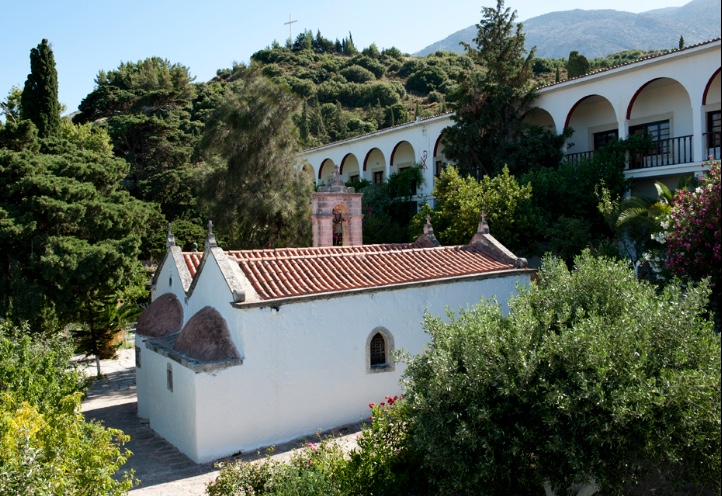
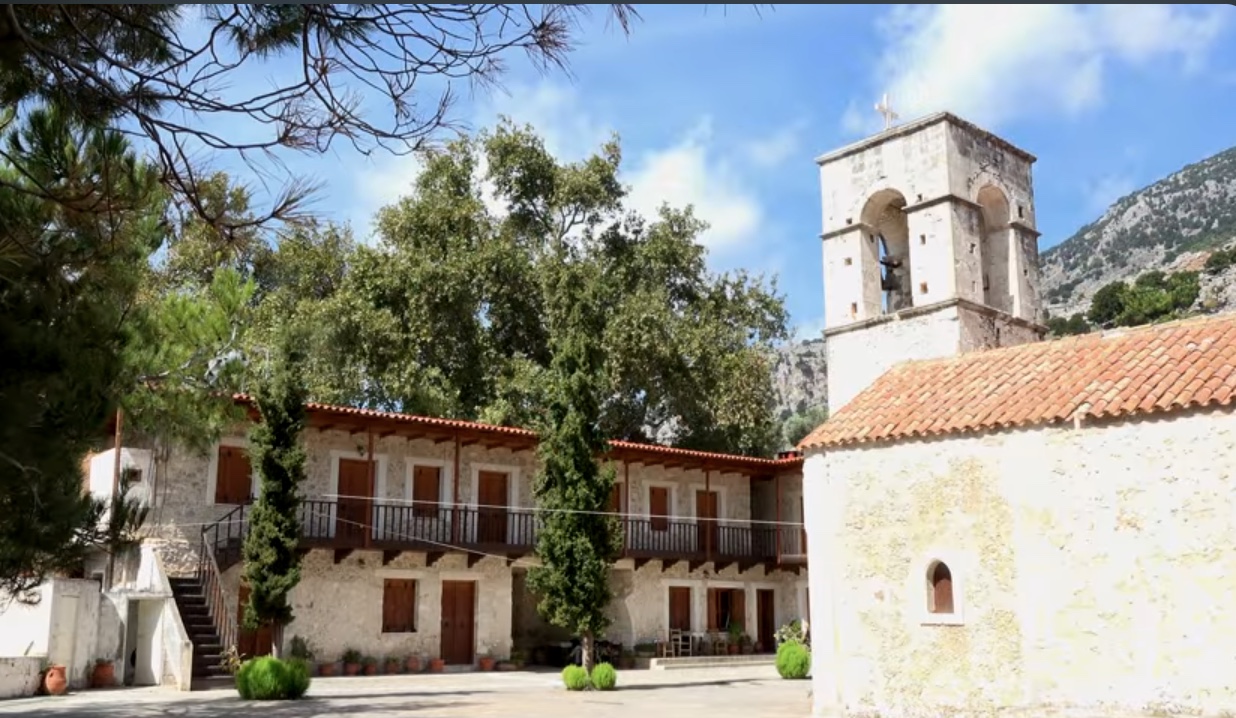
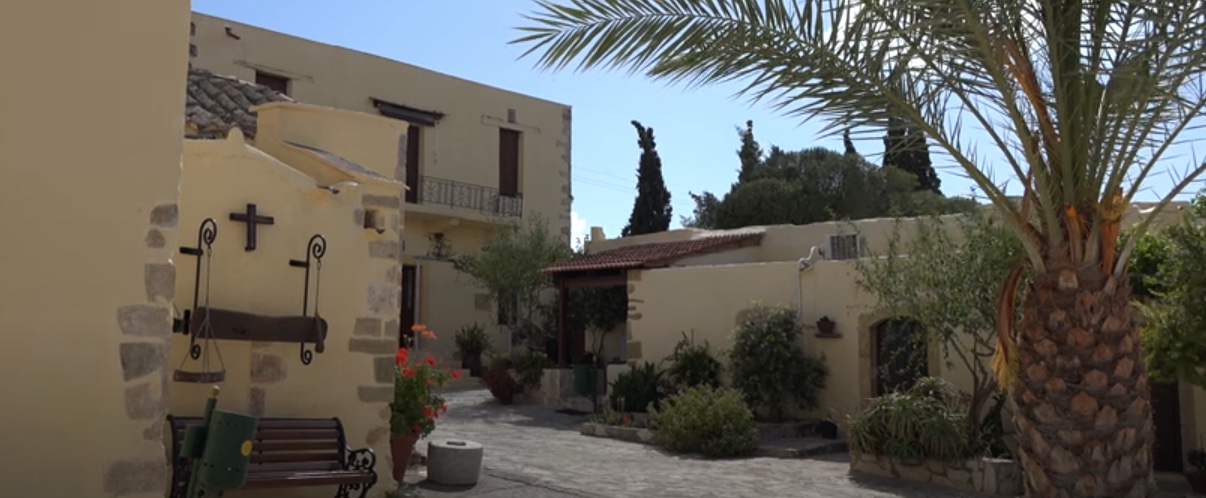
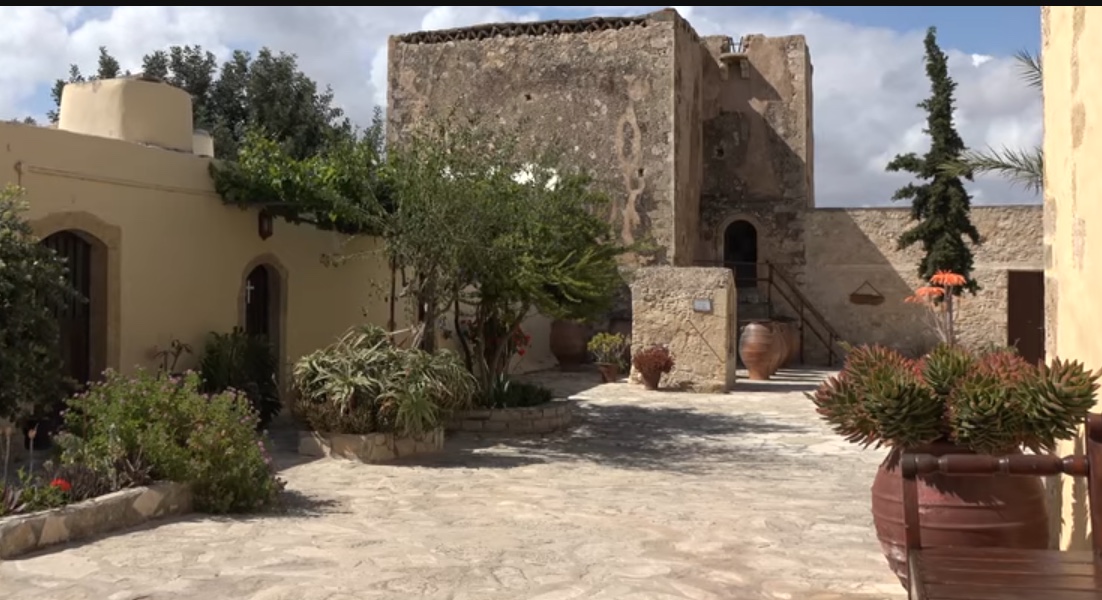
The monastery of Agios Georgios Gorgolaini (Μονή Αγίου Γεωργίου Γοργολαΐνη) stands at an altitude of about 480 metres at the foot of Mount Koudouni above Kato Asites, some 24 kilometres from Heraklion, in a green landscape of planes, cypresses and evergreen oaks. A surfaced road leads up to it from the village. Mighty oaks grow in the courtyard, and one cypress and one plane tree belonging to the monastery have been formally designated protected natural monuments. A breath of the past hangs over the whole place: at services there is neither electric light nor loudspeaker, only candles and oil lamps.
The history of the monastery, one of the oldest in Crete, goes back at least to the Venetian period, and its foundation is generally placed in the 13th century. A Venetian document of 1319 mentions it as “St George Gorgos” (the Swift); at that time it served as a cemetery church and had been rebuilt on the ruins of an older place of worship. A monk called Silvestros is named as its founder. According to the people of the neighbouring village, a church of St Nicholas previously stood on the site of the present monastery – and it is telling that today’s two-aisled church is dedicated to St George and St Nicholas, the aisle of St Nicholas having been added to the older arched nave only in the early 20th century. A major renewal took place in the early 17th century: the Venetian fountain in the courtyard bears the date 1617, and a relief slab with the winged lion of St Mark above the entrance the date 1627, the year in which the present church was completed. The marble lion that once adorned the fountain was stolen in 1990.
Under Ottoman rule the monastery’s position made it a centre of insurrection and a refuge for rebels, and the Turks burned it down in retaliation – three times in all, local tradition says, and each time the monks built it up again. In 1822 a battle was fought nearby between Cretan insurgents, some 5,000 strong, and a far superior Ottoman force put at 22,000; in 1830 Abbot Methodios and the master builder Neophytos restored the buildings. In August 1866, during the great Cretan Revolt, the freedom fighter Michalis Korakas made the monastery his headquarters and summoned the rebel leaders to meet there, whereupon it was destroyed once more; the insurgents gave up the position in 1867 after a lost engagement. In 1868 the aged Captain Frangios Mastrachas fell fighting the Ottomans at Asites; he is buried in the monastery grounds, where his tomb and a statue commemorate him.
The monastery was put in order in 1950, and in 1957 Archbishop Evgenios Psalidakis revived monastic life here; most of the monks’ cells were rebuilt at that time. In 1966 the monastery handed over almost all its land to the farmers of the surrounding villages. From the 1960s to the 1980s it housed what was called a Children’s Town (Paidoupoli), a holiday camp for hundreds of children. Today a small community of men lives here once again. The buildings follow the slope and are laid out on three levels: at the top the guest house and the chapel of St Arsenios, in the middle the Venetian fountain, at the bottom the abbot’s lodging. The carved wooden iconostasis in the church, a work of the 19th century, deserves a careful look as a fine example of the folk tradition of ecclesiastical woodcarving.
The miracle of St George
Many explanations are offered for the origin of the monastery’s name. According to one of them, a wandering monk once arrived as a guest. That evening he was tormented by thirst, but the brethren drew their water from a well that was usually cloudy and so had nothing they could offer him to drink. The monk lay down to sleep thirsty. During the night a young man entered the room where he was sleeping and handed him water in a small vessel, a lagena (λαγήνι). In the morning the monk looked for the young man to thank him but could find him nowhere – and discovered instead, on the base of the vessel, the inscription “St George Gorgolaini”. The faithful saw in this a miracle worked by the saint himself.
The history of the language offers a more sober reading. Gorgolaini, which in notarial deeds of 1629 to 1635 also appears as Vourvoulolaini, means something like “he who quickly fills the jugs” and alludes to the monastery’s vigorously flowing spring – the same water that feeds the Venetian fountain in the courtyard. Another interpretation reads the name as “he who is swift to help”, a reference to the saint’s prompt intercession and close to the epithet Gorgos recorded in 1319. Both explanations fit together with the legend of the water jug to make a satisfying whole.
From Ano Asites we return to Agios Myronas and continue along the main road to Dafnes and from there to Venerato.
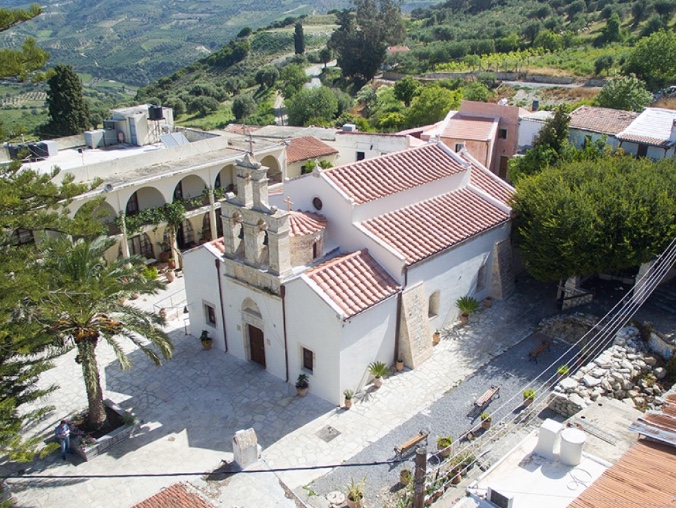
The holy tree and the monastery of Paliani
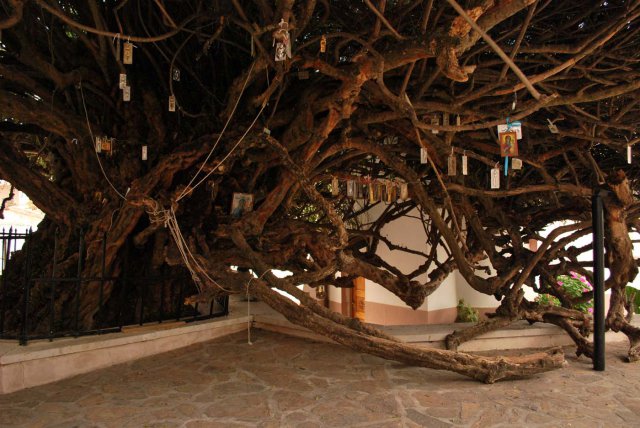
The holy myrtle (μυρτιά) has become the spiritual emblem of the monastery: local tradition holds that an icon of the Mother of God lay concealed in the branches of a myrtle bush, and the event is a fixed part of the community’s religious memory. The Virgin is accordingly venerated here as the Panagia Myrtidiotissa, “Our Lady of the Myrtle”. By some accounts the present buildings arose around 1200 on the site of an older complex; others place the beginnings of the monastery very much earlier, in the early Byzantine period, between about 450 and 550.
The monastery is famous for its holy myrtle, within which, according to local tradition, an icon of the Mother of God is hidden that only children can see. The convent lies at an altitude of about 280 metres south of Venerato, close to the hamlet of Avgeniki and some 20 kilometres south-west of Heraklion, and is open to visitors from sunrise to sunset.
Find on the map
Introduction
Paliani (Μονή Παλιανής) is reckoned one of the oldest monasteries in Crete; the exact date of its foundation is unknown, the 4th century being the usual conjecture. Its name is generally derived from the original designation “Old Monastery” (Παλαιά Μονή), worn down over time to Paliani. Remarkably, the monastery is mentioned as “Palaia Moni” in a papal letter as early as 668 – so it was thought old even then. Another view has the name go back to Apollonia, an ancient city nearby beside which the first community is said to have been established. Capitals and pieces of marble in the precinct suggest that an ancient sanctuary once stood here, according to some a temple of Athena.
History and architecture
As a patriarchal monastery – during the second Byzantine period (961–1204) it answered directly to the Patriarch and counted as an imperial foundation – Paliani at various times owned extensive estates and numerous dependent monasteries and churches. Under Venetian rule a long dispute broke out over whether the monastery belonged to the Latin archbishop of Crete, to whom Pope Clement V granted it in 1304, or to the Patriarch; in 1323 it passed under the authority of the Doge and was restored to Orthodox hands. Its wealth also made it, again and again, a target for conquerors and plunderers.
It suffered most severely in the Ottoman period. On 24 June 1821, in the first weeks of the Greek War of Independence, the monastery was completely destroyed and looted; of some seventy nuns only three survived, the rest being murdered or carried off into slavery. One of the survivors, the nun Parthenia Neonaki, came back in 1826 and by 1842 had rebuilt the monastery. The earthquake of 1856 brought down the church, which was put up again to an altered design, and in 1866, after the rebel leader Michalis Korakas had taken refuge here, Ottoman troops laid the monastery waste once more and carried off its icons. In 1872 Abbess Agathangeli had the church restored with donations from the Greek communities in Egypt. Thereafter Paliani enjoyed a new flowering and became one of the richest monasteries in Crete.
The main church (katholikon) is a three-aisled basilica, one of the oldest of its kind in Crete. Its three aisles are dedicated to the Dormition of the Mother of God (15 August, the principal feast of the house), to the Three Hierarchs (30 January) and to St Panteleimon (27 July). In its present form it is usually dated to the 14th century, though it has been much repaired since, and it incorporated parts of an Early Christian basilica together with the old apses. Beside it stands a small chapel of the Holy Apostles (30 June). The aisles are divided by columns in the Byzantine manner, their capitals decorated with finely pierced acanthus foliage; all over the precinct lie pieces of marble, columns, capitals and inscriptions of Early Christian and Byzantine date.
Around the main church the nuns’ cells and the domestic buildings are grouped about an inner courtyard. Remains of the defensive walls that once protected Paliani also survive, though the original gateway was pulled down in 1970 and replaced in concrete. Outside the enclosure, and belonging to the monastery, is the Byzantine cemetery church of St John the Theologian, which was painted around the middle of the 14th century by an artist named Georgios; in the donor’s inscription he asks to be remembered in prayer. Two scenes from the life of St John the Evangelist are especially rare: the saint dictating the Gospel to his disciple Prochoros, and the saint destroying the idols in the temple of Artemis at Ephesus – a cycle preserved in only a handful of Cretan churches. Within the monastery itself there is a museum of icons, relics, manuscripts and books of great historical and archaeological value. Paliani is open to visitors from sunrise to sunset.
The holy tree
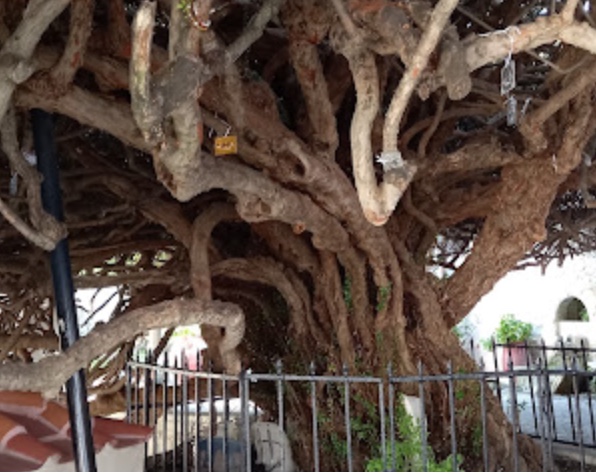
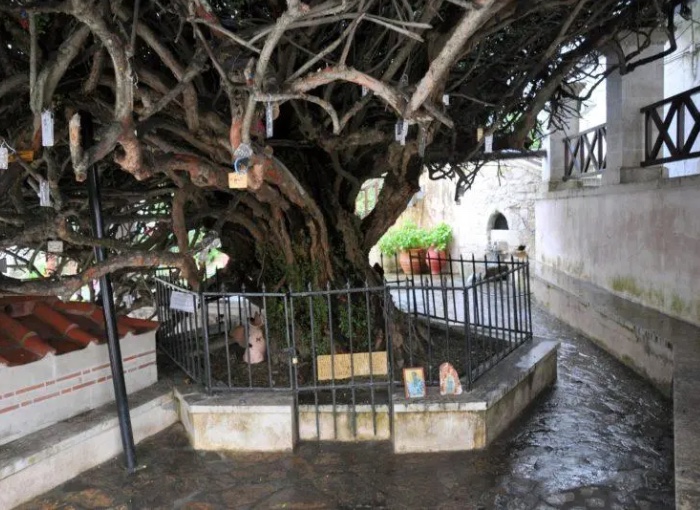
At the heart of the monastery of Paliani stands a very particular emblem of the spiritual life: the holy myrtle (Αγία Μυρτιά). The evergreen tree grows south of the main church, in the south-western part of the precinct, beside a spring that is venerated to this day and which the nuns call “Kavousi”. The myrtle is an evergreen shrub or small tree of the myrtle family; its white flowers, with their ring of delicate stamens, and its leaves contain fragrant essential oils. The age of the tree is put at around 1,500 years – which would make it as old as the Early Christian community itself.
A shrine built specially into the trunk always holds an icon of the Mother of God, and an oil lamp burns before the myrtle without interruption. Tradition has it that the district was once wooded and that the farmers set fires to clear land for the plough. Suddenly the voice of the Mother of God rang out from the thicket, and to their astonishment the villagers found her icon at the foot of a myrtle, with myrtle branches painted around the image. When, some time later, children came to the same spot, the painted branches had really grown; they went on growing and little by little hid the icon altogether. Ever since, it has been said that the icon of the Mother of God, hidden from the eyes of ordinary, sinful people, can be seen by children alone.
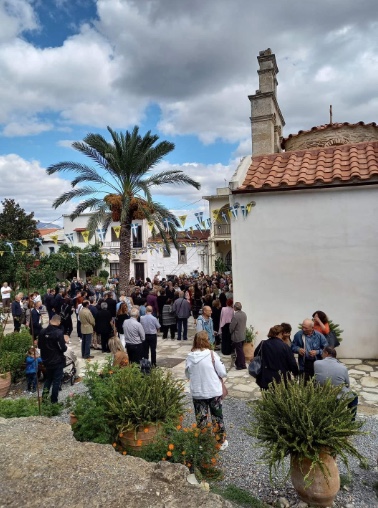
The holy myrtle, as the nuns call it, has a feast day of its own, separate from the other celebrations of the monastery: on 24 September – with solemn vespers on the eve, the 23rd – the Panagia Myrtidiotissa, “Our Lady of the Myrtle”, is honoured. The custom of blessing the festal loaves beneath the holy tree is particularly striking; the table used for the purpose is an ancient capital from the Early Christian basilica that once stood on this spot – whence the name “Old Monastery”.
The lower branches of the tree are usually cut by the faithful: some make amulets from them, others use them to adorn the icon corner at home. The veneration of the holy myrtle is an echo of age-old religious traditions, in particular the Minoan tree cult that was so widespread and so vigorous in Crete. It was absorbed naturally into Orthodoxy, which set an icon of the Mother of God in the tree – and since then the veneration has been directed to her and not to the tree itself.
At the feast of the Dormition of the Mother of God on 15 August the holy tree becomes the focus of devotion. From its branches the nuns carve small crosses to which miraculous powers are attributed; many stories and legends about these crosses live on in the tales told by the sisters. A shrine for the icon is fixed to the trunk, and all around can be seen the many votive offerings that believers have left on the trunk and branches of the myrtle.
The geographical centre of Crete
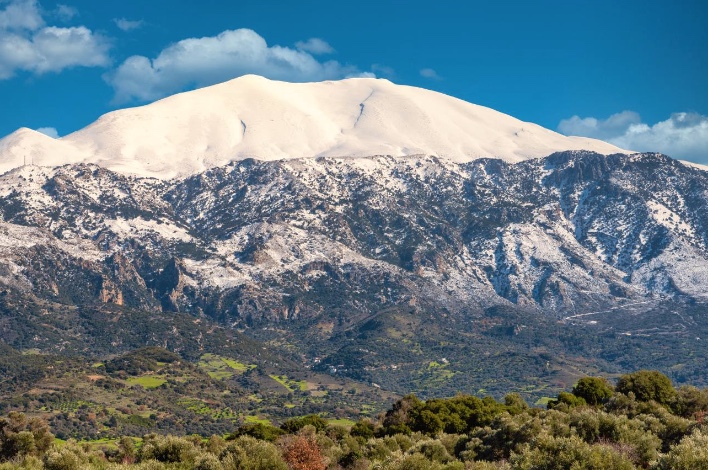
At the exact geographical centre of Crete, at the eastern foot of the “high mountain” – which is what the name Psiloritis means – lie three picturesque villages.
Find on the map
Introduction
Gergeri, Venerato and Agia Varvara are old settlements full of historic monuments, whose people keep their customs alive to this day. The video above shows the carnival procession of Gergeri, the “Apokrigiomata ste Gergeri”, one of the most original carnival celebrations on the island.
Venerato
This attractive village lies three kilometres from Dafnes, set in the green of countless olive groves and vineyards. Tradition has it that it was founded by wealthy Venetian merchants as a summer retreat, and its name, Venerato,
means “the venerated”. What was venerated was presumably the monastery of the Panagia Paliani, said to have been founded in the 4th century close by, on a hill above the river Apollonas and east of the gorge. It is said, incidentally, that Venerato is the only place in the whole of Crete to have kept its Venetian name unchanged.
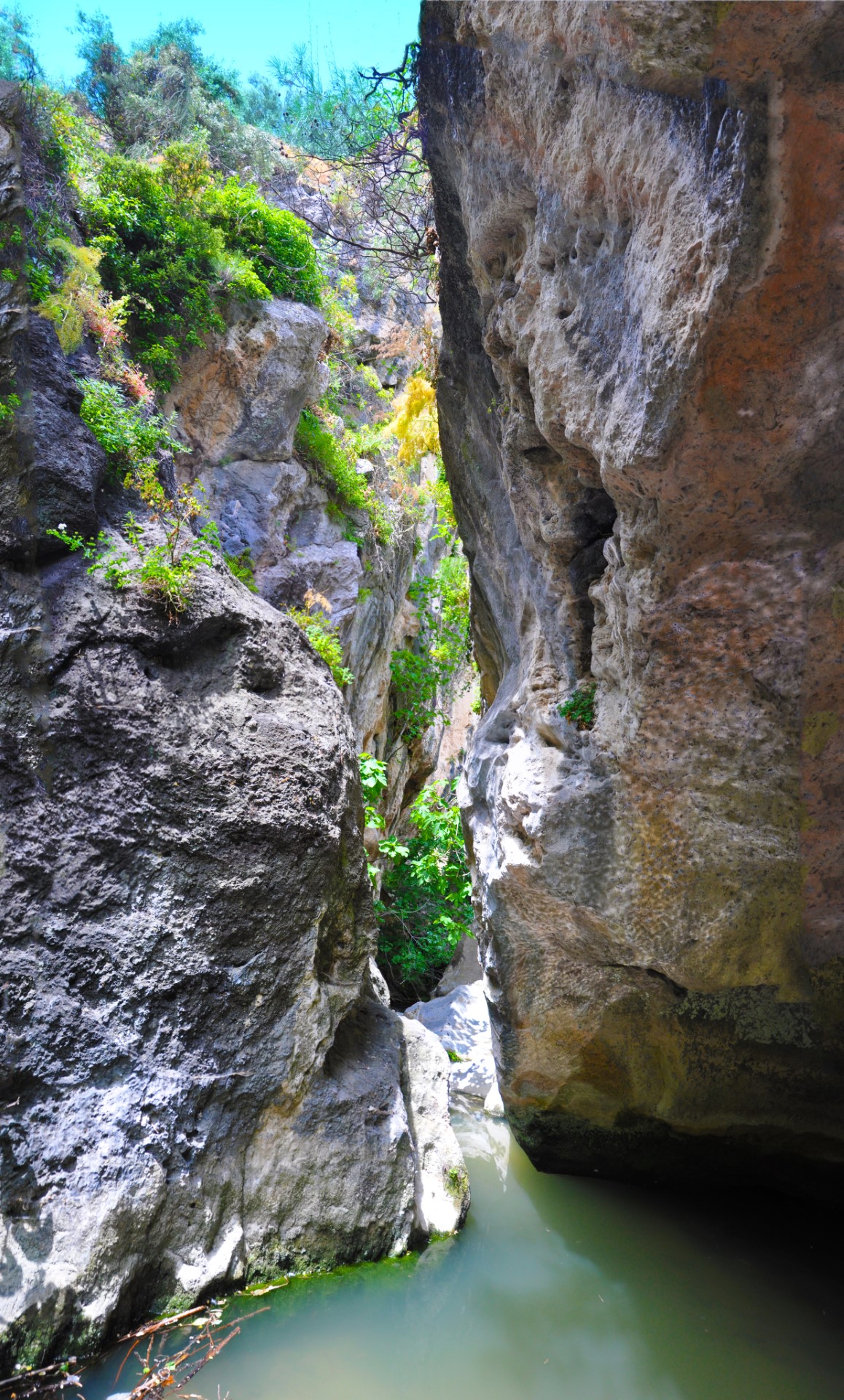
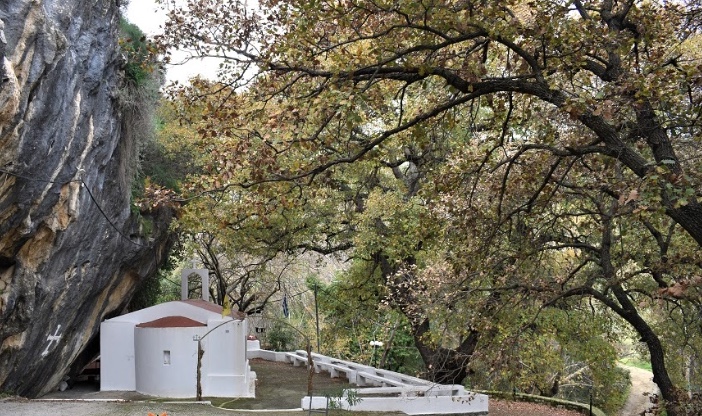
At Venerato the gorge of the same name opens. Although it is only some 500 metres long, it is a place of surprising beauty. Through it flows the Apollonas, whose source lies near Agia Varvara. The river is vital to the water supply of the district and is linked historically with the ancient city of Apollonia. The little church of Agios Fanourios sits snugly among the rocks.
The route through the gorge offers natural scenery of a rare kind, including the narrow passage of Kouroupi with its cascades and impressive rock formations. Going through it does, however, call for care and preparation; a helmet is expressly recommended, and after heavy rain the walk should not be attempted at all.
Agia Varvara
Beyond Venerato we reach the village of Agia Varvara, about 30 kilometres from Heraklion on the road to the western Messara. It owes its name to the 13th-century church of St Barbara at its centre. At the entrance to the village, perched on a rock, stands the little church of the Prophet Elijah (Profitis Ilias). Popular tradition has it that this very spot is the centre, the “navel” (omphalos), of Crete: two priests who had set out from opposite ends of the island are said to have met here, and the chapel was built to commemorate the meeting.
Close by, near the village of Prinias, lie the ruins of the ancient city of Rizenia, whose traces go back to Minoan times. The view from the height – some 690 metres above the sea – over the old city and the green hills all round is superb. Beside Rizenia archaeologists uncovered tombs of the Geometric period; here too are the remains of two temples of the 7th and 6th centuries BC. Agia Varvara is first mentioned by Barozzi in 1577; in 1823 and 1866 the village suffered badly from Ottoman reprisals, and many of its people fought for freedom in the revolts. Today they live from vegetable growing, olives and wine; a women’s cooperative makes traditional Cretan costumes. The feast of St Barbara is celebrated on 4 December with dancing, singing and hospitality, and on the last weekend in May the village holds its cherry festival.
Gergeri
This village, at an altitude of about 530 metres on the southern slopes of Psiloritis, some 36 kilometres from Heraklion and barely four from both Agia Varvara and Zaros, has kept its name since antiquity; the name is held to be pre-Hellenic, and a Venetian census of 1583 lists the place as Giergeri, with 500 inhabitants. “Gergeri” means “the murmur of water” – an allusion to the many underground springs whose water was already being used by the inhabitants of the ancient city of Gortyn, the ruins of which lie not far away. Stretches survive of a Roman aqueduct that carried water from the Fountana spring to Gortyn. In the 17th and 18th centuries numerous watermills were built along the stream to grind grain, some of which are still in use today. In the surrounding country one still sees the mitata, the stone shepherds’ huts of the high pastures.
Gergeri has many churches. The most important is the church of the Transfiguration of the Saviour (Metamorfosi tou Sotira), which was raised on the site of an ancient Greek temple; the temple’s marble blocks were reused in its construction.
The churches of St George and St Stylianos (Agios Georgios, Agios Stylianos) are also worth seeing. The patron of the village is St George, venerated here under the epithet Methystis, “the Drunkard”, whose feast on 3 November is celebrated with the opening of the new wine. Other great parish festivals are Candlemas on 2 February and the feast of the Prophet Elijah on 20 July; in May the shearing of the flocks is an occasion for festivities of its own. The church of Elijah (Profitis Ilias) was built in 1905 on a rocky summit and is most picturesquely placed.
The church of the Panagia Kera was built in 1443. Its frescoes can now hardly be made out, for it was in this church that, on 14 August 1944, the German occupying forces burned 25 inhabitants of Gergeri and the neighbouring village of Nyvritos – a place of quiet remembrance.
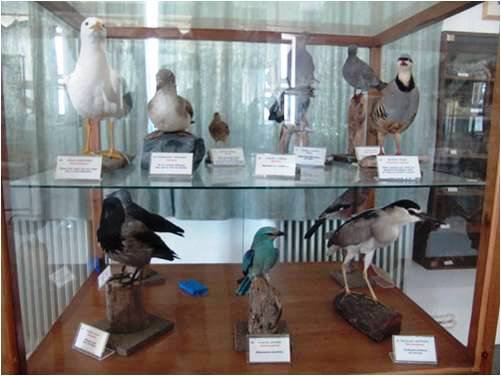
The Natural History Museum of Gergeri repays a visit, for its subject is an unusual one: the natural history of the district. It grew out of an initiative by the local secondary school and, after a period of closure, has been reopened.
It is devoted to the plants and animals of the unique forest of Rouvas, the kermes oak wood (Πρινόδασος του Ρούβα), which is protected as a Natura 2000 site. The tree in question is the uncommon hard-leaved kermes oak, called “prinos” in Greek, growing here together with cypress, pine, plane and wild pear. Nowhere else in Crete has so old and tall a stand survived as here at the foot of Psiloritis – some of the trunks are more than a metre across and the trees reach 15 metres in height; the Rouvas forest is reckoned the largest kermes oak wood on the island and can be reached by the long-distance path E4.
The lake and village of Zaros
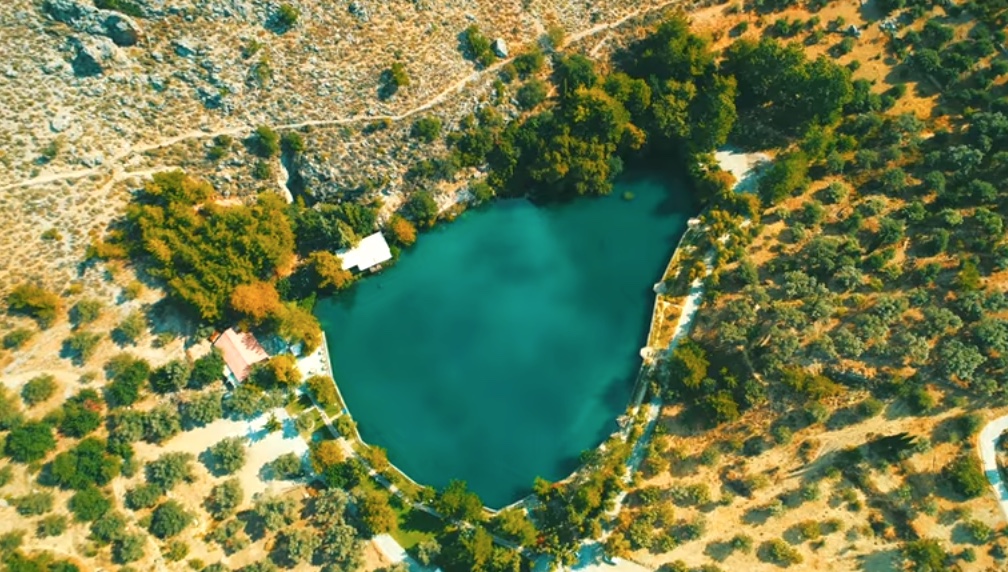
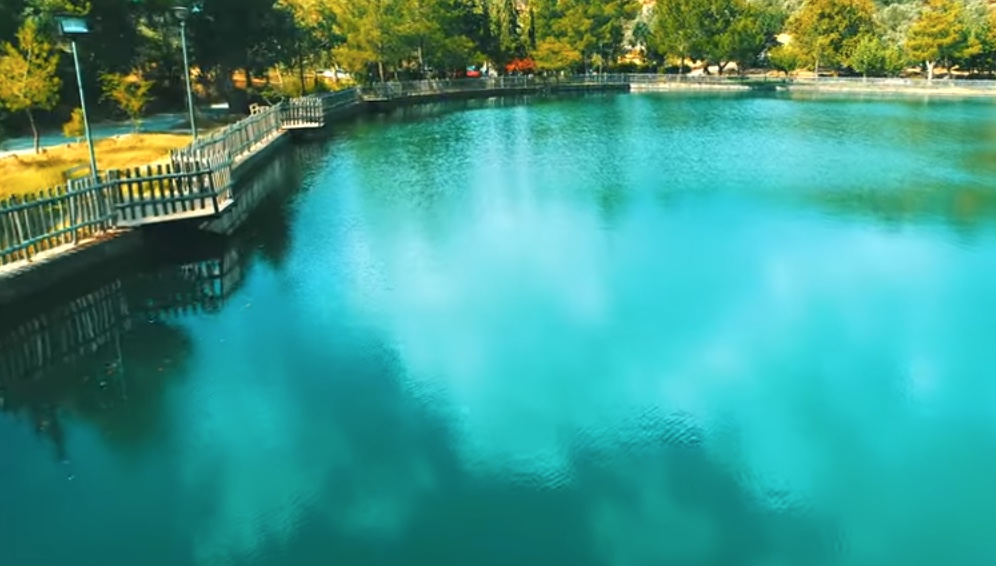
An exceptionally beautiful, green village beside the lake of the same name, which is fed by two copious springs credited with healing properties, Votomos and Mati.
Find on the map
The lake of Zaros
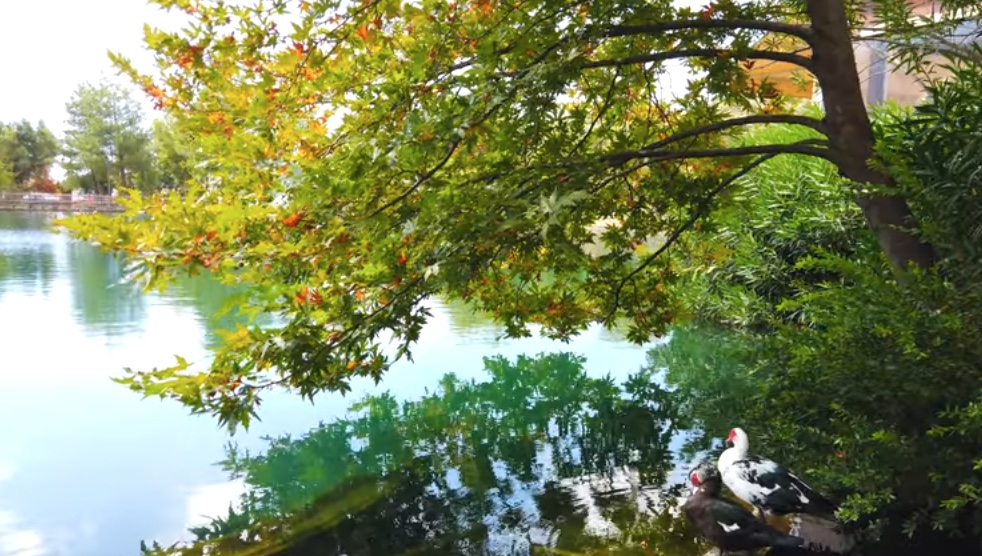
Zaros, a small town of some 2,000 inhabitants about 46 kilometres south-west of Heraklion, lies on the southern slopes of Psiloritis in a fertile valley rich in springs. The name is said to go back to an old word for a “place of many waters”; today the spring water of Zaros is sold in bottles all over Greece, trout thrive in small fish farms and several old watermills still stand in the village. Lake Votomos is artificial: until 1987 there was only a small wetland here around the pool of the Votomos spring, which was then dammed. As early as Minoan times there was a settlement at the locality of Kourtes, and remains of the Roman aqueduct that supplied Gortyn with water can still be seen in several places. A far larger sheet of water, the Faneromeni reservoir, lies seven kilometres to the west.
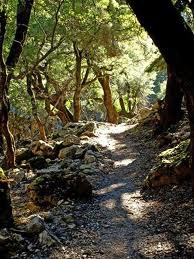
The cafés and tavernas on the shore serve fish fresh from the lake – usually trout – and look out on stately swans, geese and ducks. From the lake a path leads into the Rouvas gorge (also called the Gafaris gorge), the most important gorge of Psiloritis, and on to the Rouvas forest. The gorge is about four kilometres long and climbs roughly 1,000 metres; allow two and a half hours for the ascent, which crosses a wooden bridge on the way and ends in the heart of the forest at the chapel of Agios Ioannis, where there are a spring, benches and a mountain shelter.
Not far from the lake is the monastery of St Anthony (Moni tou Agiou Antoniou), Vrontisi, attested since Venetian times; immediately above the lake, at the mouth of the gorge, stands the monastery of Agios Nikolaos, from which the lower part of the ravine takes its second name. The people of Zaros are proud that the well-known Greek writer Giorgos Iatromanolakis was born here.
The monastery of St Anthony Vrontisi
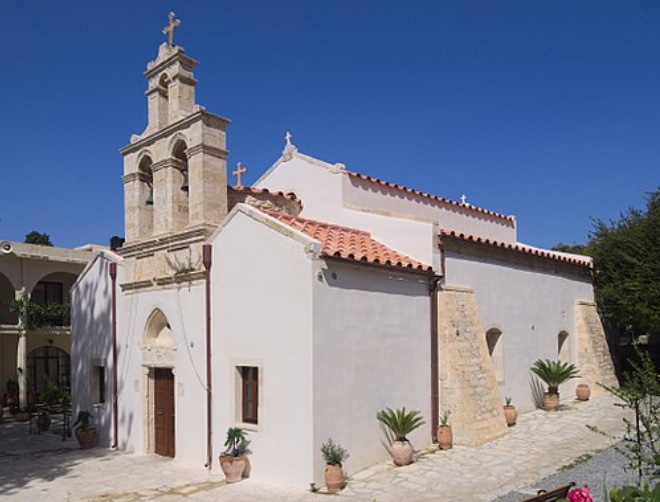
Vrontisi and the Cretan School: the monastery of St Anthony Vrontisi (Μονή Βροντησίου) lies between Zaros and Vorizia, 49 kilometres from Heraklion, and enjoyed its greatest prosperity in the 15th and 16th centuries. Its 14th-century frescoes and the works of Michail Damaskinos bear witness to the monastery’s close ties with the Cretan School of painting; six icons by Damaskinos, taken from Vrontisi to the church of Agios Minas in Heraklion in 1800, are now kept in the museum of the Archdiocese of Crete in the church of St Catherine in Heraklion.
A treasury of Cretan history and art
Find on the map
Introduction
The monastery of Agios Antonios Vrontisi, at the foot of Psiloritis not far from Zaros, on the edge of the Vorizia gorge and with a wide view over the Messara Plain, is among the oldest religious sites in Crete. The exact date of its foundation is unknown; it probably came into being in the second Byzantine period (961–1204) as a dependency of the monastery of Varsamonero. The first documentary references date from the beginning of the 15th century, around 1400, and the name may be that of a founder – a deed of 1323 records priests called Vrontisis in Candia. The monastery flourished above all at the end of the 16th century and in the 17th, as important buildings and singular architectural features of that time testify; by then it had even outstripped its mother house, which was already in decline.
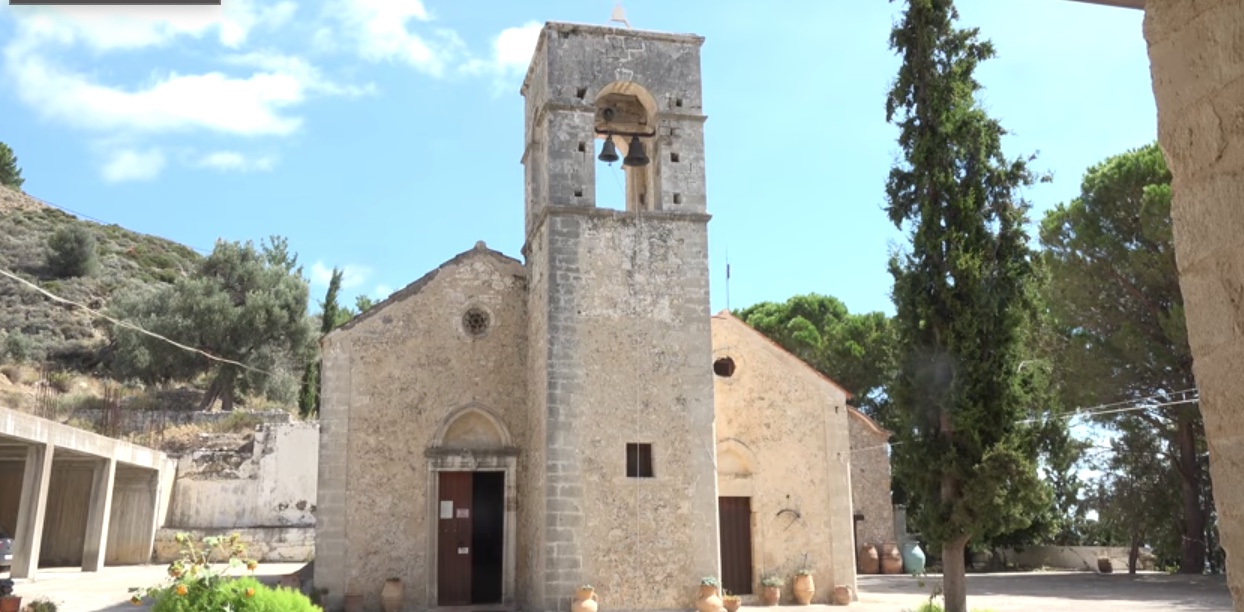
The two-aisled main church is dedicated to St Anthony, whose feast falls on 17 January, and to the Apostle Thomas, honoured on the first Sunday after Easter; a free-standing bell tower betrays Venetian influence. In troubled times Vrontisi was always a place of refuge. After the Ottoman conquest monks from Arkadi were taken in here in 1645; in 1866 the monastery sheltered the rebel leader Michalis Korakas, for which four monks were killed and the buildings wrecked and turned into a sheepfold, until insurgents occupied them again in 1878; and during the German occupation of 1941–1944 resistance fighters hid here. On 27 August 1943 the neighbouring village of Vorizia became the scene of a massacre by the occupiers and was destroyed. Restoration of the monastery began in 1992.
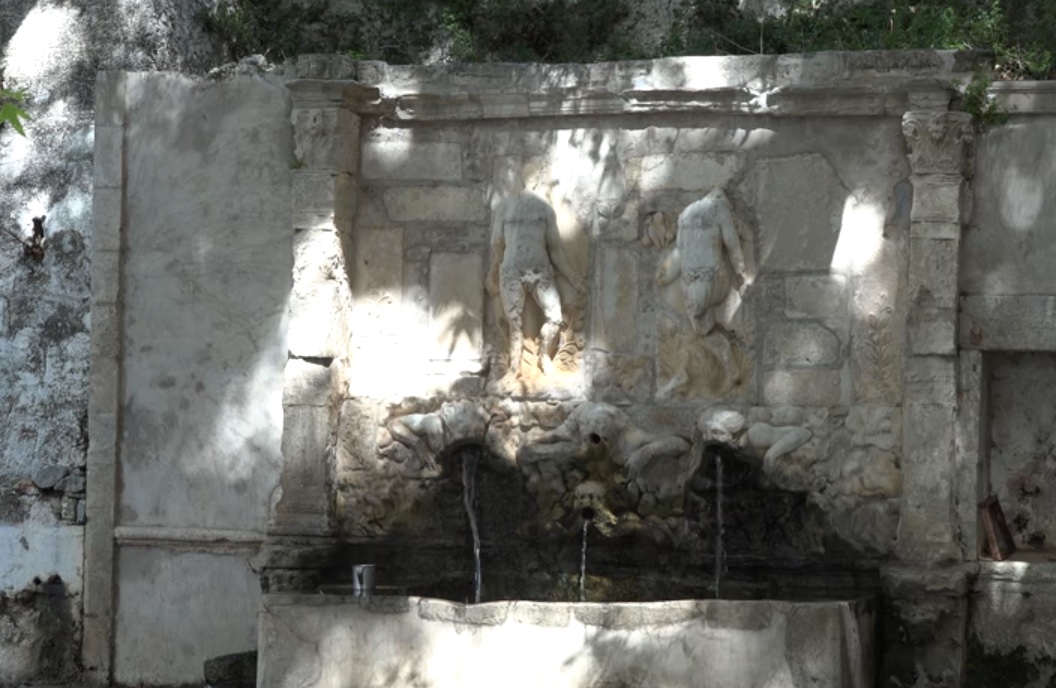
The fountain of Adam and Eve
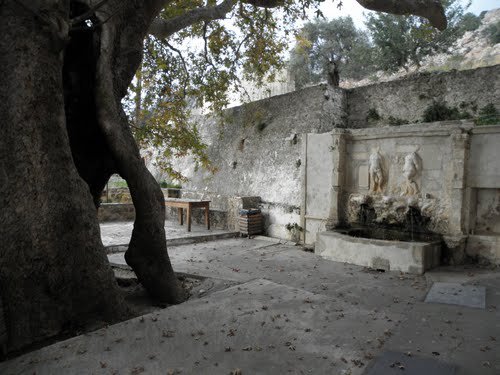
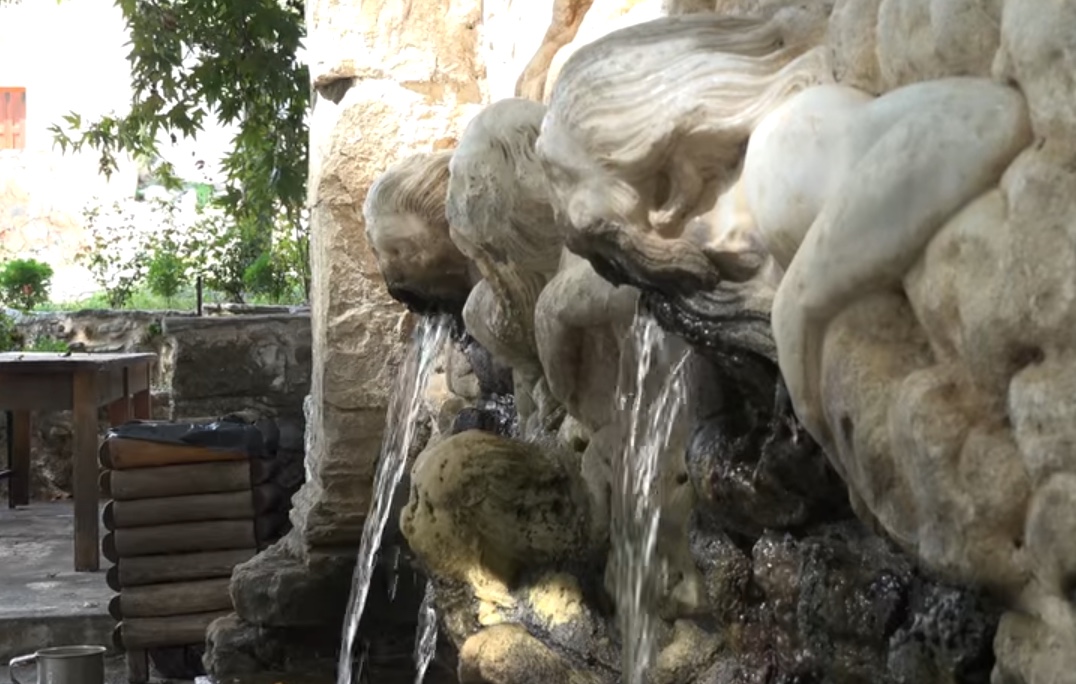
Outstanding among the architectural sights of the monastery is the marble fountain of the late 16th or early 17th century, though some would place it as early as the 15th. Its reliefs show Adam and Eve in Paradise and four figures personifying the four rivers of Eden, from whose mouths the water runs. Standing at the entrance to the monastery courtyard, the fountain is a brilliant example of the sculpture of an age in which the Venetian Renaissance and Cretan tradition came together. On its account the Ottomans called Vrontisi the “Fountain Monastery”, Santrivanli Monastir.
The art and icons of Michail Damaskinos
The monastery is famous for its icons by Michail Damaskinos, one of the outstanding masters of the Cretan School of icon painting in the 16th century, who according to local tradition lived here for a time. Six of his icons, originally painted for Vrontisi and removed to Heraklion in 1800, are now in the museum of the Archdiocese of Crete at St Catherine’s. They are important evidence of the flowering of art in Crete under Venetian rule, when painters combined the pictorial language of Byzantium with ideas drawn from the Italian Renaissance.
Frescoes of the 14th and 15th centuries
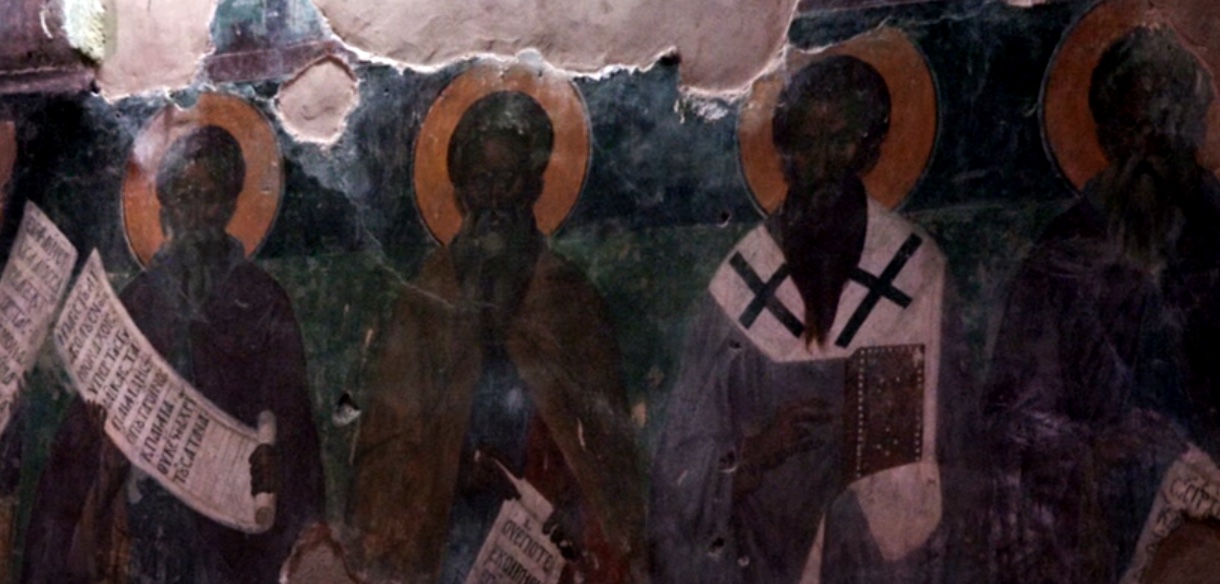
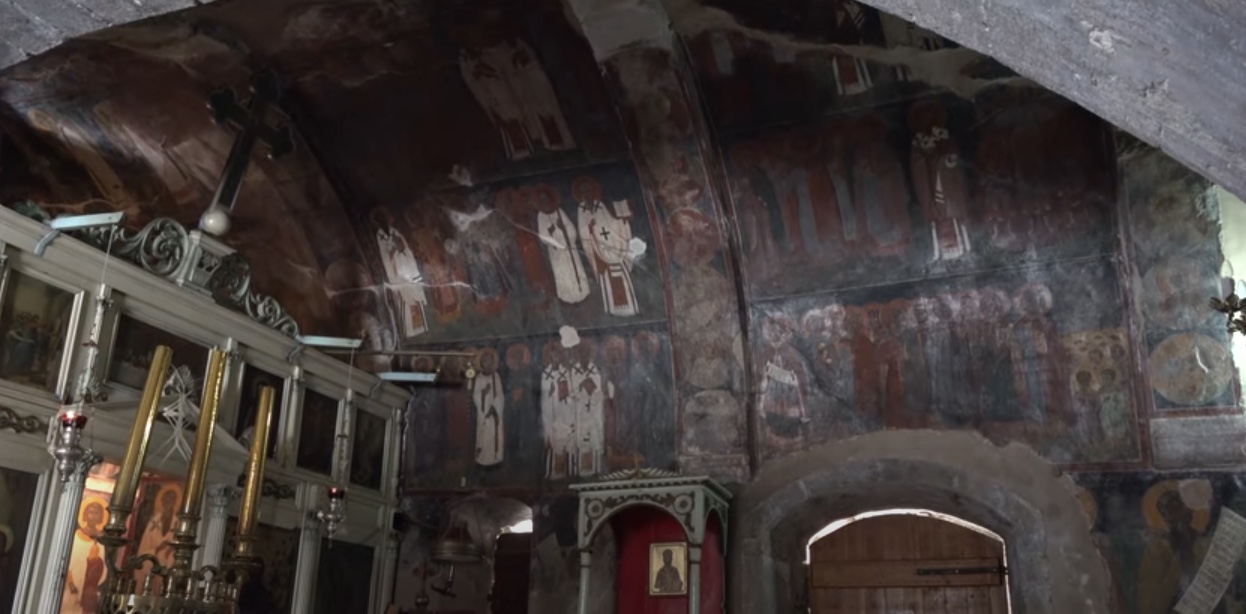
In the original nave unique frescoes of the 14th century survive in remarkably good condition, marked by the spirit of the Palaiologan Renaissance. Instead of the usual Gospel cycle they show a menologion, a calendar of saints.
That is a rarity in Crete. On the south wall, for instance, the month of December is depicted with the saints commemorated in it. The representation of the Supper at Emmaus in the apse, surrounded by medallions of apostles and prophets, underlines the particular standing of the monastery. Scholars believe that these frescoes were the work of a painter from Constantinople or Thessaloniki – proof of Crete’s cultural links with the great artistic centres of the age.
The Kamares Cave and the Cretan orchids
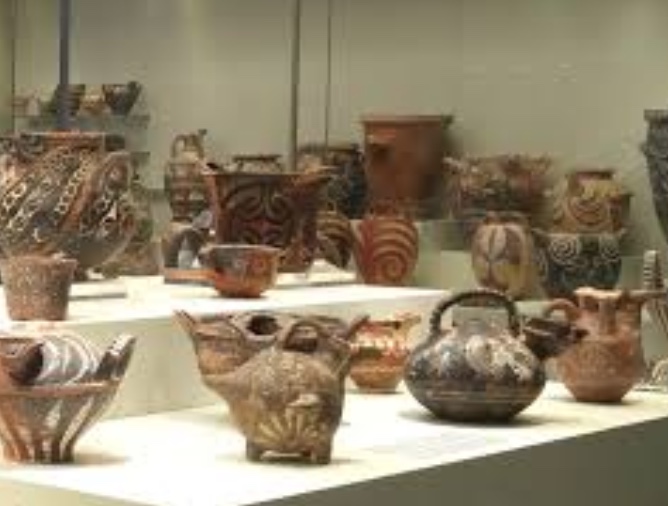
Here archaeologists found a great quantity of skilfully painted pottery in a uniform style, named Kamares ware after the place of its discovery.
Find on the map
Introduction
On the southern slopes of Psiloritis, at an altitude of about 600 metres, lies the village of Kamares, famous for its potter’s craft. The work of the local craftsmen is known far beyond the island and continues a tradition reaching back thousands of years. It was, however, the Kamares Cave, high above the village, that brought the place world renown. Shepherds first came upon its distinctive pottery in the late 1880s; in 1890 sherds brought down by a farmer reached Dr Iosif Chatzidakis in Heraklion, and in 1894 the Italian archaeologist Antonio Taramelli paid the cave its first scientific visit. In June 1913 the British School at Athens carried out systematic excavations here under Richard Dawkins and Max Laistner.
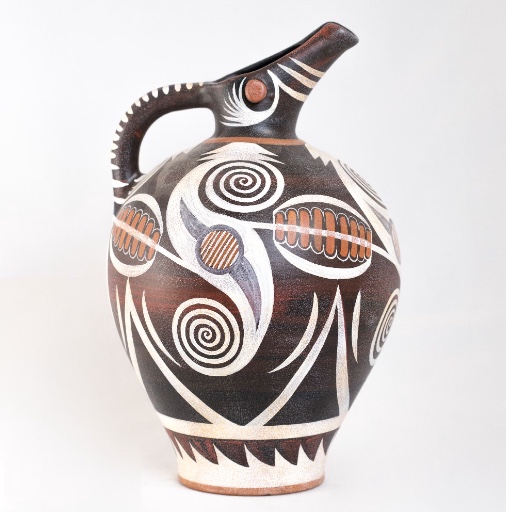
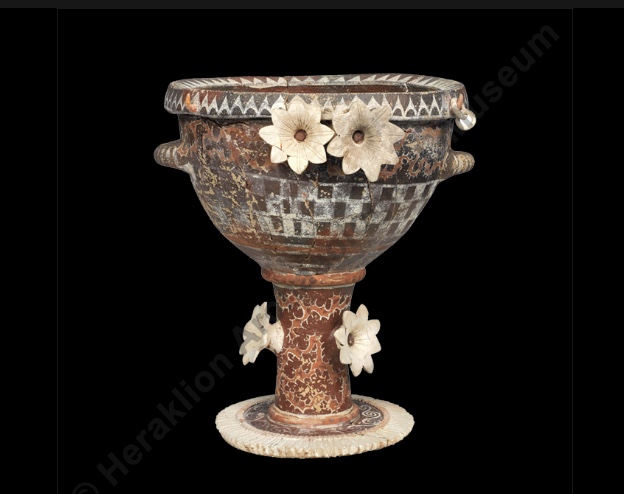
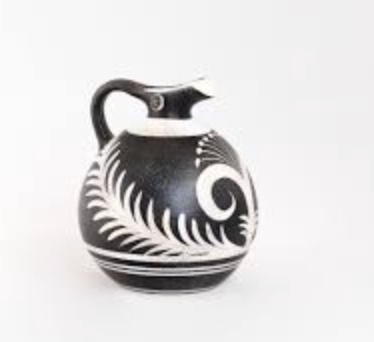
The cave lies at around 1,700 metres on the southern slope of the Soros summit, and its huge south-facing mouth – 42 metres wide and 20 metres high – can be seen even from the Messara. Behind it the main chamber runs back for some 100 metres, falling 40 metres towards the rear, where a passage only a metre wide leads to a second chamber with a small pool. Here the archaeologists came upon a real treasure of pottery in the characteristic Kamares style, fragments of more than 1,800 vessels: walls of wafer thinness, almost as fine as eggshell, painted on a dark, often black ground in white, red and orange with bold spiral and plant motifs. The vessels date overwhelmingly from the period of the Old Palaces (c. 2000–1700 BC) and are regarded as votive offerings made by the great palatial centres – above all Phaistos, which is visible from here, and Knossos – to a deity of the cave, widely supposed to be Eileithyia, goddess of childbirth and fertility. Clay animal figurines, tools of stone and bone, and the remains of cereals and fruit found with them point the same way.
Today these finds are kept in the Archaeological Museum of Heraklion, where they count among the most impressive examples of Kamares ware. As a cave, with its sparse stalactites, it is unremarkable – its value is archaeological.
A visit to the vast Kamares Cave is an absorbing undertaking of four to five hours, best tackled with a guide who knows the ground, and it takes one deep into the history and culture of Minoan civilisation. The waymarked path, a branch of the E4, begins in the village and climbs steeply for about three and a half hours through oak woods, past several springs and with magnificent views back over the Messara; the cave can also be approached from the Nida plateau. An early start is essential, and a torch is needed for the inner recesses.
Cretan orchids
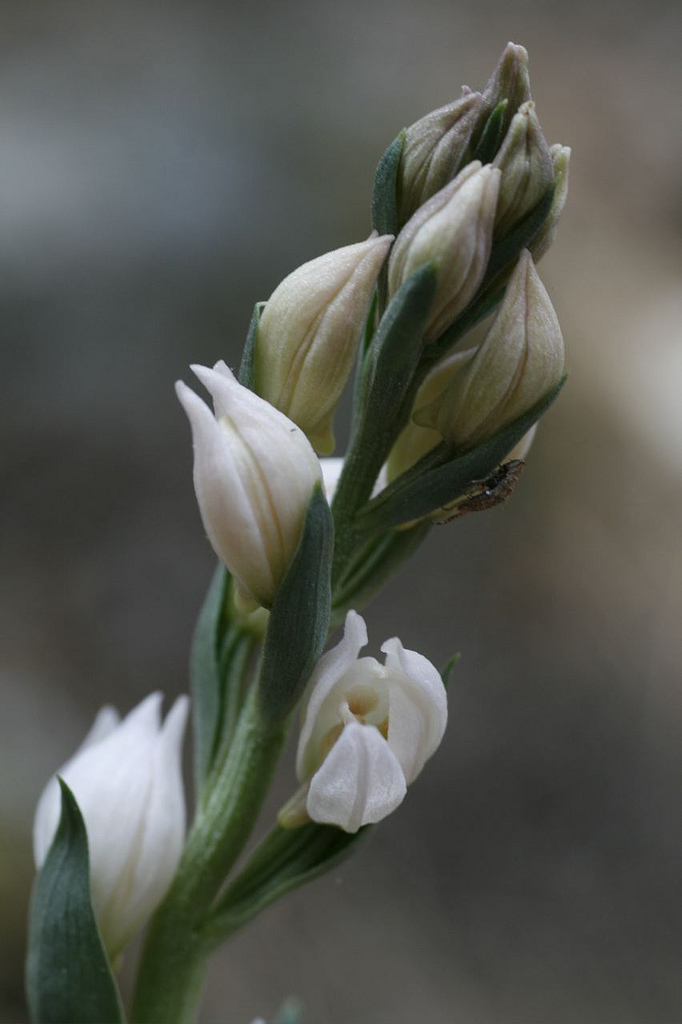
For lovers of plants a detour to the locality of Mana Nerou (Μάνα Νερού, “Mother of the Water”) near Kamares repays the effort. It is known for its nature reserve, home to one of the loveliest orchids in the world, which grows nowhere else: the Cretan helleborine (Cephalanthera cucullata), endemic to the island. On the flank of Psiloritis, in the untouched surroundings of the reserve, whole colonies of this orchid can be found; it is at its best in late spring. The plants are strictly protected and must on no account be picked or dug up.
The monastery of the Panagia Kalyviani
The monasteries of southern Crete were never merely places of worship; they were at the same time centres of learning, of the copying of books and of help for the population. That is why the route to Phaistos and the “Cretan Athos” links the archaeological monuments with the living Orthodox tradition of the island.
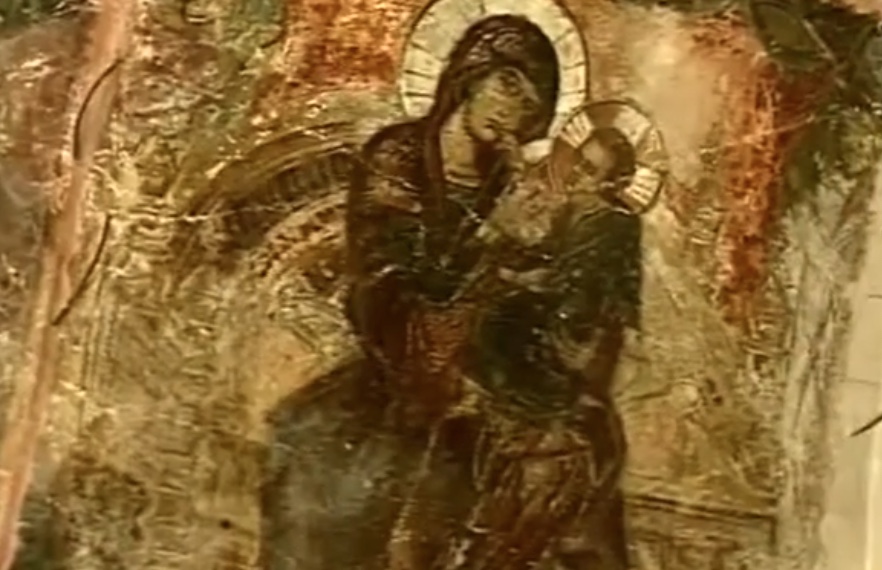
The icon of the Annunciation in this monastery is held to be miracle-working and draws pilgrims from all over the Christian world.
Find on the map
About the monastery
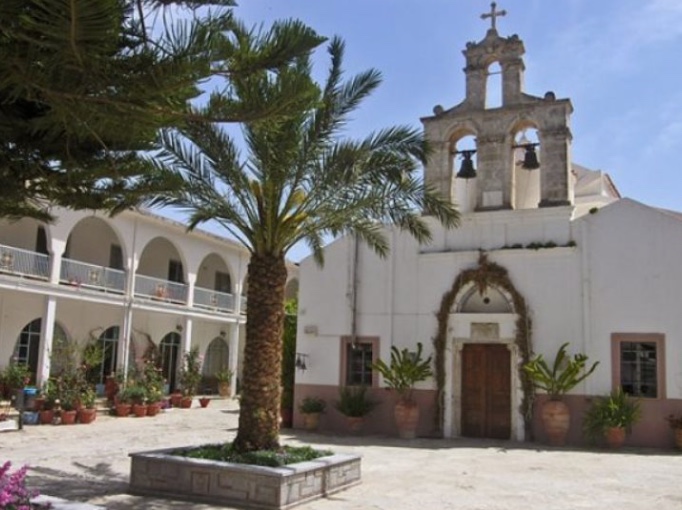
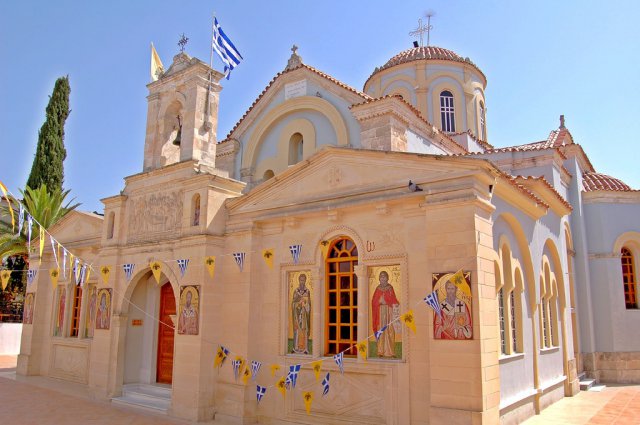
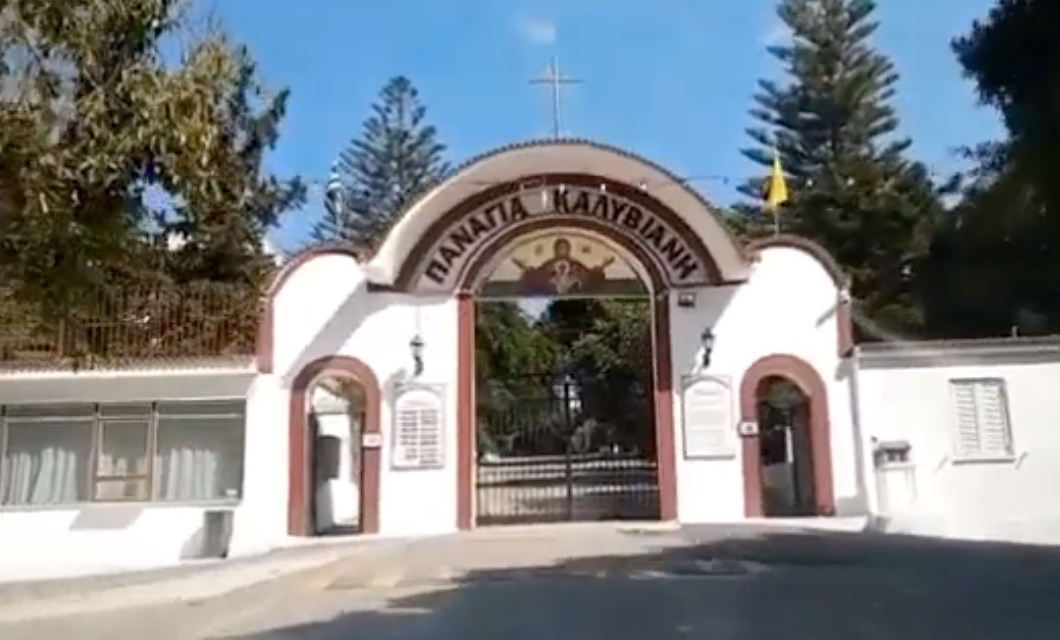
The monastery lies on the floor of the Messara, only 80 metres above the sea, at the locality of Kalyvia near the town of Mires and some 60 kilometres south of Heraklion. A community of men existed here as early as the second Byzantine period; from that era only the little 14th-century church of the Life-giving Spring (Zoodochos Pigi) survives, for the old monastery was destroyed by the Ottomans and by 1821 the abandoned church had fallen in. Tradition relates that the small, miracle-working icon of the Annunciation was found in this Byzantine church – in 1873, by one Matthaios Michelinakis, some years after a certain Ioannis Margiolakis had begun to repair the ruin – and it is this icon that has made the monastery one of the great places of pilgrimage in Crete. A new monastery grew up around the find, and the large three-aisled church, begun in 1911 and finished in 1924, is dedicated to the Nativity, the Annunciation and the Dormition of the Virgin. In 1956, under Bishop Timotheos Papoutsakis, Kalyviani was transformed into a convent devoted to prayer and active charity, a status confirmed by royal decree in 1961; today some forty sisters live here.
The monastery is known for its charitable work, set on foot by Bishop Timotheos in 1956–57: it maintains an old people’s home, an orphanage for girls, a Sunday school, a primary school and a kindergarten, a school of domestic science and a printing press, as well as various workshops in which the novices embroider, weave, sew liturgical vestments and paint icons. Their work is highly regarded and is sold at the monastery’s Saturday bazaars, which always attract many visitors. The monastery also has a museum of ecclesiastical and folk art with rich collections.
Besides the old chapel of the Life-giving Spring, the tomb of the venerable Charalambos is also a place of great devotion. The ascetic from Dafnes lived here as a hermit during Ottoman rule; his grave lies behind the main church, with a small chapel dedicated to him beside it, and his memory is kept on 23 August, at the close of the celebrations of the Dormition. Every year on 15 August a great festival (panigyri) is held in honour of the Panagia Kalyviani, drawing crowds of the faithful. In the town of Mires a large and cheerful carnival is held in July, and throughout August there are festivals of folk art with numerous culinary events. The monastery is reached by a surfaced road. Telephone: 28920-22151.
Phaistos the Great
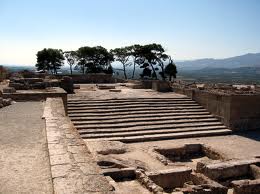
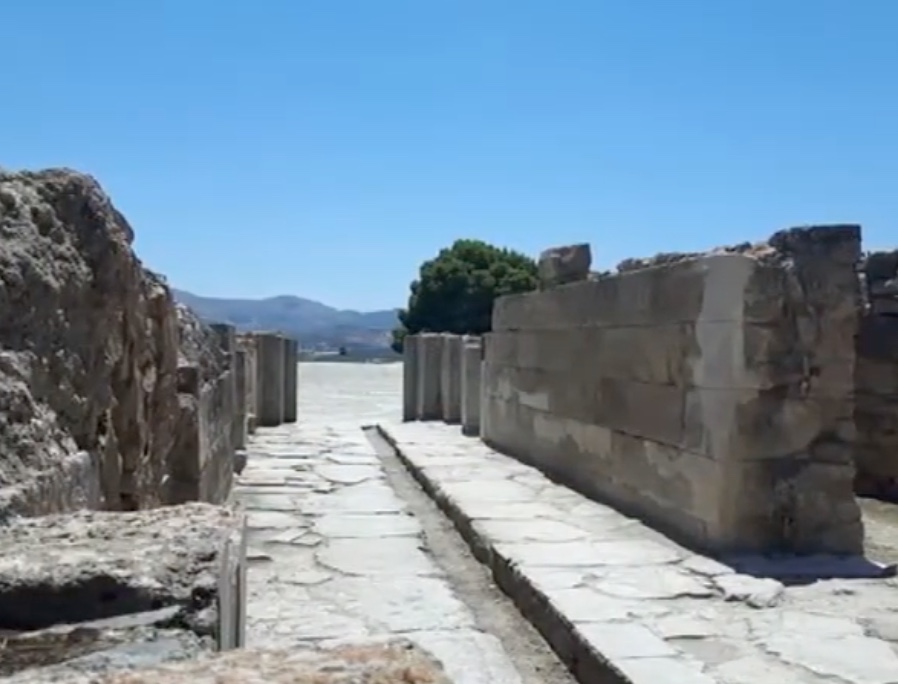
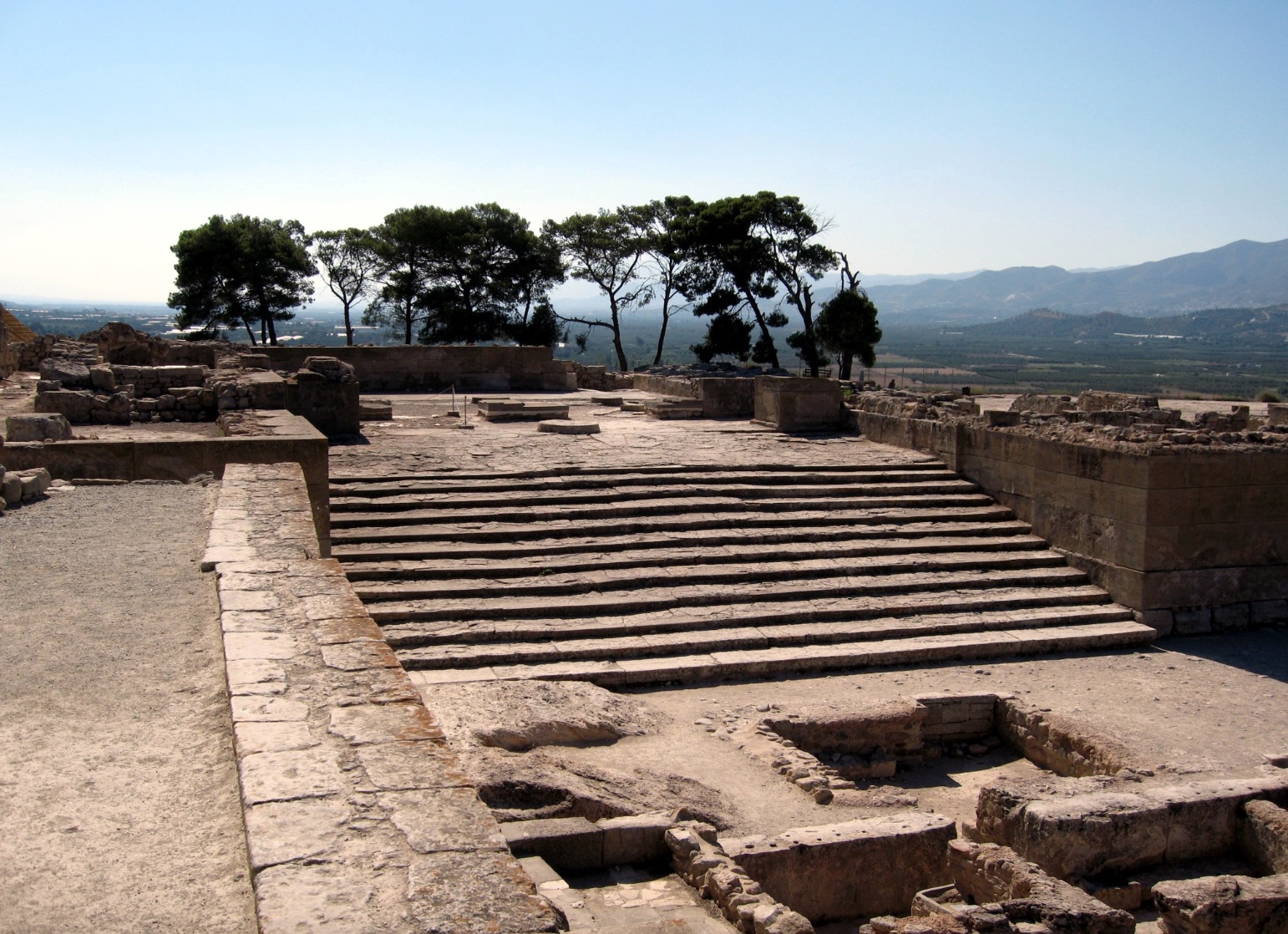
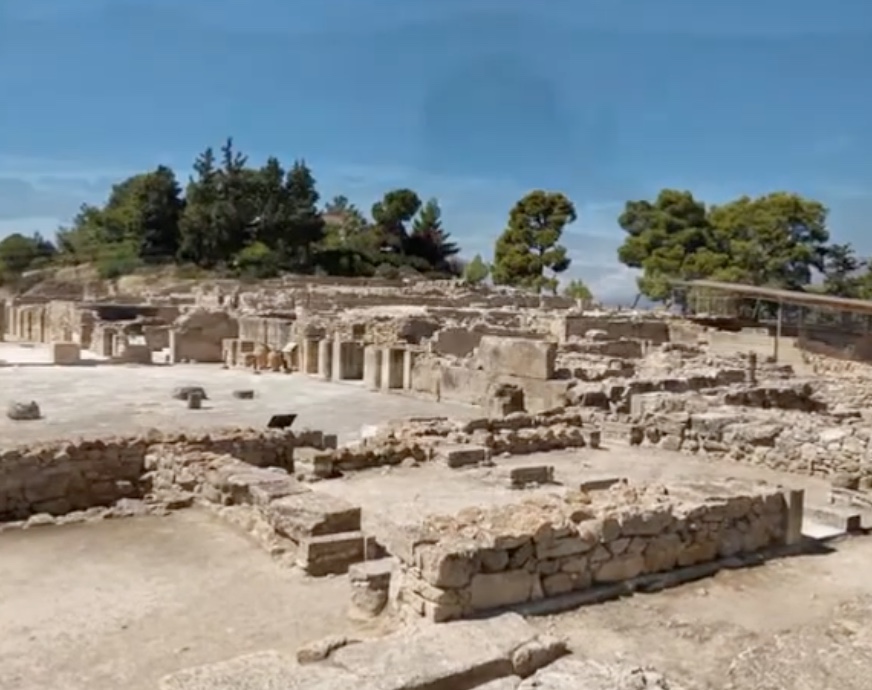
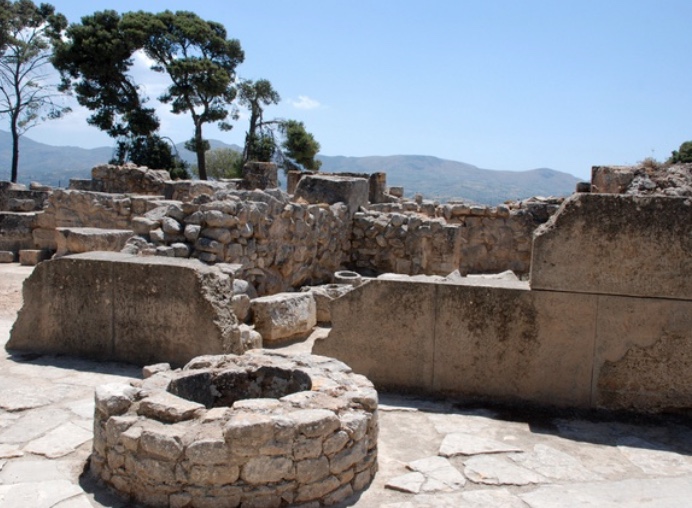
What survives at Phaistos: Phaistos was one of the foremost palatial centres of Minoan Crete. The first palace went up at the beginning of the second millennium BC, around 2000 BC; after its destruction c. 1700 BC it was rebuilt in the period of the New Palaces. The archaeological site takes in the Central Court, ceremonial staircases, storerooms, shrines and domestic and working quarters, the whole complex covering some 8,400 square metres – roughly two thirds the size of Knossos.
The palace of Phaistos is one of the four great centres of Minoan civilisation, and the most important of them in the south of Crete. Since 2025 it has been inscribed, together with the other Minoan palatial centres, on the UNESCO World Heritage List.
Find on the map
Introduction
Around 1900 BC, at a time when European civilisation was only beginning its ascent, the palace of Phaistos rose on Crete – a marvel of Minoan building. Powerful rulers walked its corridors then, and priests sought the signs of the gods in sacred rites. The palace sits on the eastern end of a low ridge at the western edge of the Messara Plain, some 60 kilometres south of Heraklion by road and less than six kilometres from the sea, commanding a broad view over the fertile plain and up to Psiloritis, where the Kamares Cave shows as a dark mark on the mountainside. The hill was already settled in the Neolithic: the earliest traces of habitation go back to about 3600 BC. Homer knew the place too, listing “well-peopled” Phaistos in the Iliad among the Cretan cities that sent men to Troy.
After a severe earthquake around 1700 BC the palace was rebuilt more splendidly than before; a further destruction followed in about 1450 BC, after which it was never raised again. The English naval surveyor Thomas Spratt identified the site in 1853, and from 1900 Phaistos was excavated by the Italian Archaeological School under Federico Halbherr and Luigi Pernier, and later, from 1950 to 1971, under Doro Levi; Italian teams are still at work here. Unlike Knossos, Phaistos has seen no reconstruction – the ruins appear as the excavators found them. It was here, in 1908, that Pernier’s dig produced the famous Phaistos Disc, a clay disc bearing 241 stamped signs arranged in a spiral and undeciphered to this day. The city lived on after the palaces fell, struck its own coinage – silver staters among them – and was finally destroyed in the Hellenistic period, around the middle of the 2nd century BC, by its rising neighbour Gortyn. Let us begin, as is only proper, with the myths.
Rhadamanthys, ruler of Phaistos
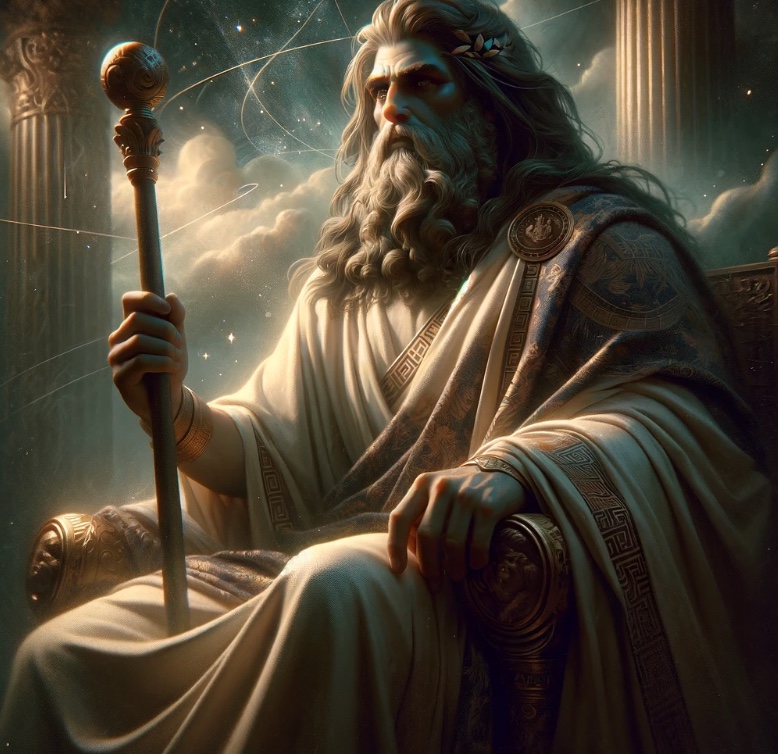
Rhadamanthys is among the most intriguing figures in Greek mythology. He was one of the three sons of Zeus and Europa, a brother of Minos and Sarpedon, and the boys were brought up by their stepfather Asterion, king of Crete. As a wise lawgiver and judge he holds a place of his own – in the realm of the living and in the world beyond. He is often linked with Phaistos, where he is said to have ruled while his brother Minos reigned at Knossos; one tradition has Minos, jealous of his popularity, drive him from the island to Boeotia, where he married Alcmene, the mother of Heracles. He was held to be a just and prudent ruler who issued many laws fostering order and justice in society – among them, it was said, the rule that a man who defends himself against an aggressor goes unpunished. According to ancient tradition even the Spartans later adopted the essentials of this Cretan legislation. His son Gortys was remembered as the founder of Gortyn.
His laws were thought severe but fair, and legend has it that they were written up on the walls of the temples, so that everyone could see and obey them. After his death Rhadamanthys was raised to be one of the three judges of the dead in the underworld, together with his brother Minos and with Aeacus. In Plato’s Gorgias he judges the souls that come from Asia and Aeacus those from Europe, while Minos has the casting vote. In that office he sat in judgement on the souls of the departed and decided who had earned everlasting bliss in Elysium and who must be punished in Tartarus. Homer, earlier still, has “fair-haired Rhadamanthys” dwelling on the Elysian plain at the ends of the earth, and Virgil makes him the stern magistrate of Tartarus – which is why “Rhadamanthine” still means inflexibly just.
Talos – the first artificial guardian
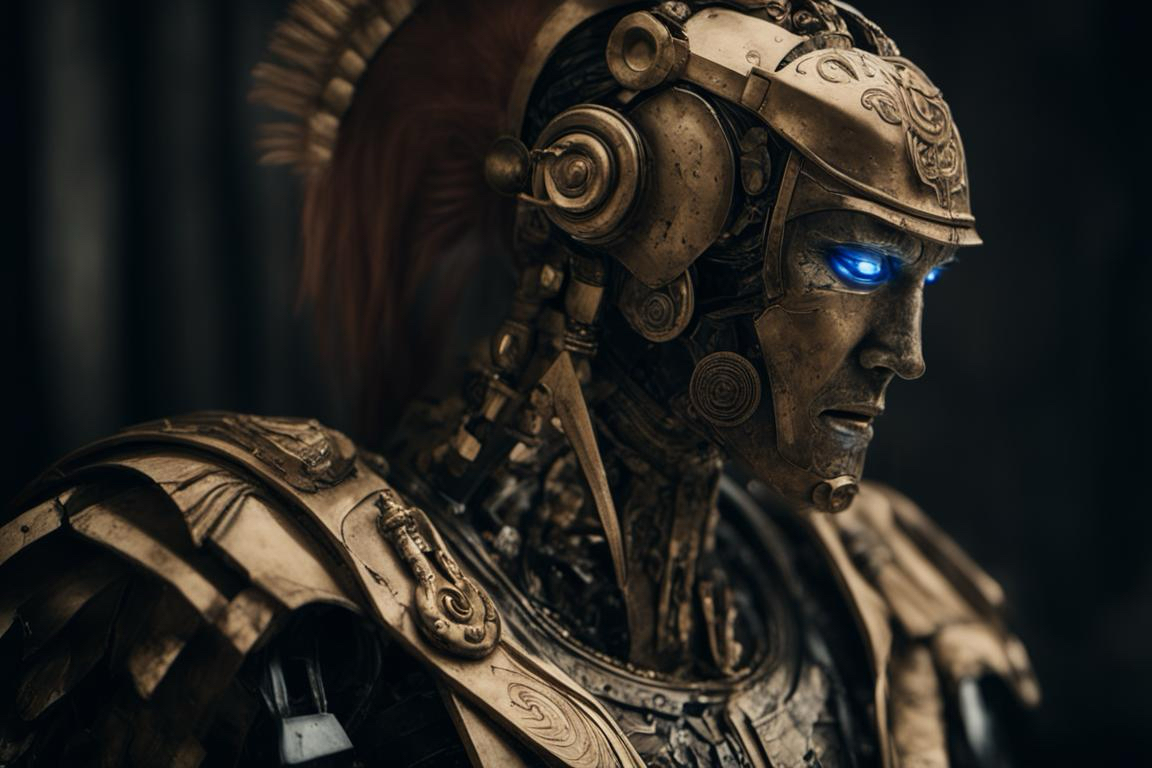
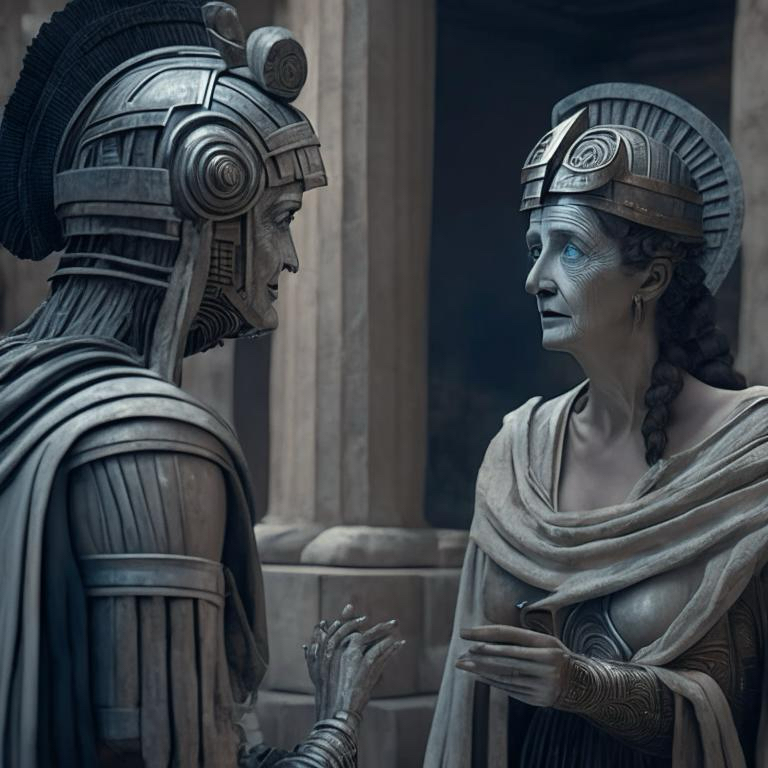
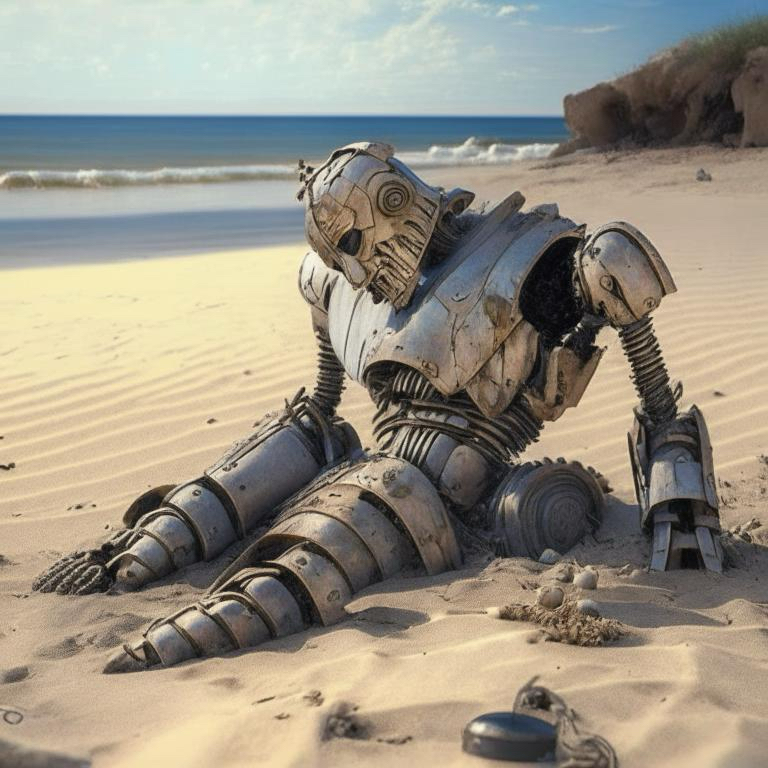
In Greek mythology Talos (Τάλως) appears as a man of bronze, a giant in the popular imagination, made by Hephaestus, the god of the forge. That makes him one of the earliest conceptions anywhere of an artificially produced being – a figure that anticipates much of what we now associate with robotics. Long before anyone coined the word robot, the Greeks described a creature that keeps watch, judges and acts of its own accord. One may fairly see in him an early prototype of what we call artificial intelligence – or, given the boldness of the idea, perhaps rather a late one.
The ancient sources tell different stories of his origin. In Apollodorus, Talos is a work of Hephaestus which the god made over to King Minos for the protection of Crete; the same author notes that some called him not a man at all but a bull. According to Apollonius of Rhodes, writing his Argonautica in the 3rd century BC, it was Zeus who gave the brazen sentinel to Europa, who passed him on to her son Minos. Other traditions see in him the last survivor of that race of bronze men, sprung from ash trees, of whom Hesiod tells; others again ascribe him to the ingenious Daedalus. Pausanias preserves a genealogy from the Spartan poet Cinaethon in which Talos is a son of Cres, the eponym of Crete, and father of Hephaestus. Plato, finally – or rather the dialogue Minos that passed under his name – turns him into a man: a brother of Rhadamanthys who went round the villages of Crete as guardian of the laws. The late antique lexicographer Hesychius records, moreover, that talos meant the sun in Cretan – which is why some scholars suspect an immemorial sun god behind the giant.
Talos was, so to speak, programmed to protect Crete, and he carried out the task with remarkable independence. Three times a day he made the circuit of the island – on foot, or in some depictions on wings – and kept a lookout for foreign ships. If uninvited guests approached, he hurled great boulders at them and sank their vessels; anyone who nevertheless reached the shore he is said to have clasped in his arms, having first heated his bronze body red-hot in the fire. That grim embrace is as old as the poet Simonides, who told how Talos leapt into the flames holding fast the Sardinians who defied him, and the ancients derived the phrase “sardonic laughter” from the grimace of his victims. He kept order at home as well: he carried the laws of Minos through the villages on tablets of bronze and saw to it that they were observed.
His vital force – today one might speak of a power supply, or of regeneration – he owed to ichor, the golden blood of the gods, which flowed through a single vein from the nape of his neck down to his heel. At the ankle this vein was closed with a plug, or in another version of the myth with a bronze nail; Apollonius says simply that there, and there alone, a thin membrane of skin covered it. In this sense Talos was really the first bio-robot in world literature: machine and living creature at once, wrought of metal and yet with a kind of blood coursing through him.
The plug was removed from Talos’s vein, the myth relates, by Medea, the sorceress and king’s daughter from Colchis who accompanied Jason and the Argonauts on their voyage for the Golden Fleece. She did it so that the Argo could approach the Cretan coast in safety and continue on its way. Talos, whose sole purpose was to keep every unbidden arrival from the island, did not stop to ask why the strangers had come; to him they simply meant danger.
How Medea overcame him is told in different ways. In one version she cast him into sleep with spells, then drew out the plug, and the ichor poured away – for a being of bronze, admittedly, not a very likely method. Apollonius of Rhodes has her bewitch the giant with the evil eye, calling up the spirits of death against him, so that he reeled and tore his ankle open on a rock, and crashed down like a great pine felled on the mountainside. A further tradition knows the Argonaut Poeas, who struck the one vulnerable spot with an arrow. The scene was a favourite of the vase painters: on a celebrated red-figure krater of about 400 BC, now in the Jatta Museum at Ruvo di Puglia, the dying Talos, painted white to suggest gleaming metal, sinks back into the arms of the Dioscuri while Medea stands by with her bowl of drugs. But the version most appealing for our purposes reports that Medea made Talos believe that removing the plug was the very thing that would cure him of his weakness and give him immortality.
Like every artificial intelligence, Talos feared one thing only: being cut off from his source of energy – a motif that films such as “The Matrix” have pictured memorably. He was persuaded that this fear was nothing more than a bug in the programme and that in truth there was no danger at all. And so Talos, equipped with exactly that capacity for independent decision towards which present-day technology is striving, drew out the plug himself. The ichor, his life force, ran out, and the bronze giant fell dead to the ground.
To the question that troubles many of our contemporaries – what happens when neural networks learn to decide independently, and therefore unpredictably? – Greek mythology thus gives a remarkable answer: in the end the technology breaks down. Man, however, sails on towards the Golden Fleece. For he is a creature able to dream, and the dream is at bottom nothing other than the capacity for mythical thought. It is a reading one may share or not – but it shows how alive the old stories have remained.
For Phaistos, incidentally, Talos is more than a figure of legend: the city struck coins with his image in the Classical and early Hellenistic periods, on which he appears as a naked, winged youth in the act of hurling a stone – on one issue with a hound between his legs. The wings are usually taken to stand for the speed he needed to circle Crete. Modern interpreters also see in the bronze giant a symbol of the Bronze Age itself, whose power rested on the mastery of metal; his death may reflect the transition to the Iron Age. The scholar Merlin Peris, in a 1971 study of Talos and Daedalus, called him astonishingly forward-looking and spoke of the world’s first robot.
The Phaistos Disc – from myth to reality
The essentials in brief
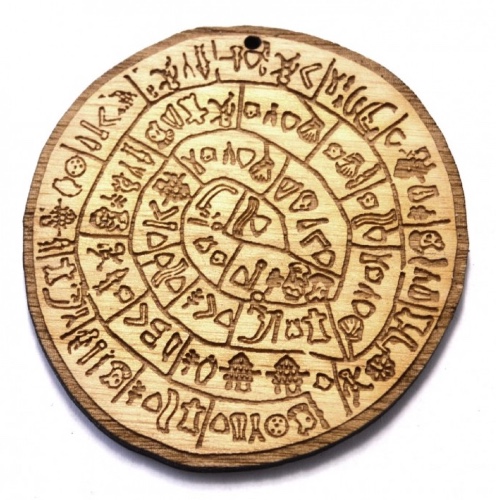
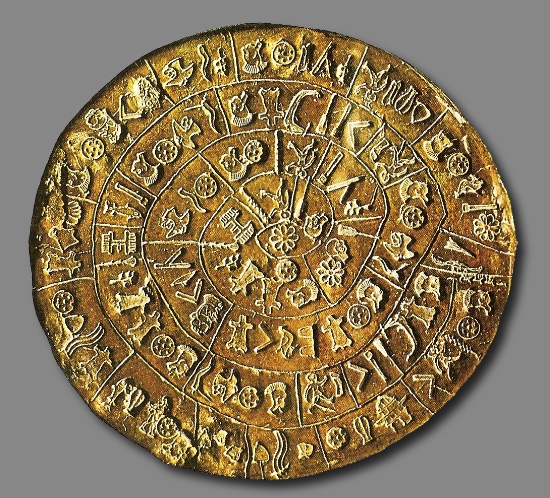
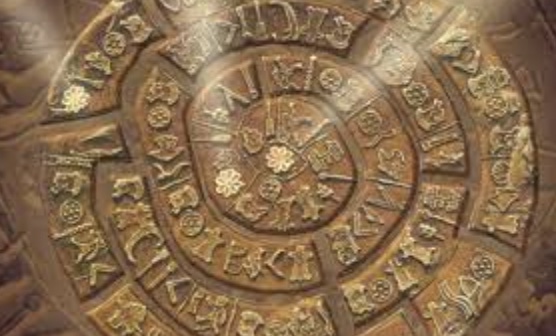
The Phaistos Disc (Δίσκος της Φαιστού) is one of the most enigmatic finds of Minoan civilisation. This unique object is dated to about 1700–1600 BC and so falls in the Middle Minoan period, on the threshold between the Old and New Palaces. Its unusual form, the way it was made and above all its script, undeciphered to this day, have held specialists and laymen alike for more than a century. Small wonder, then, that it plays a particular part in modern myth-making. Yet the disc is anything but a myth: it exists, and you can see it with your own eyes in the Heraklion Archaeological Museum, where it stands upright in a case of its own so that both faces can be studied. What it actually is, however, nobody knows.
The disc was found in 1908 by the Italian archaeological mission under Luigi Pernier, which was then uncovering the palace complex of Phaistos. It is made of clay fired to the hardness of pottery and bears stamped signs on both faces, running in a spiral from the rim to the centre. One face is very slightly concave, the other convex, and the edge is rounded.
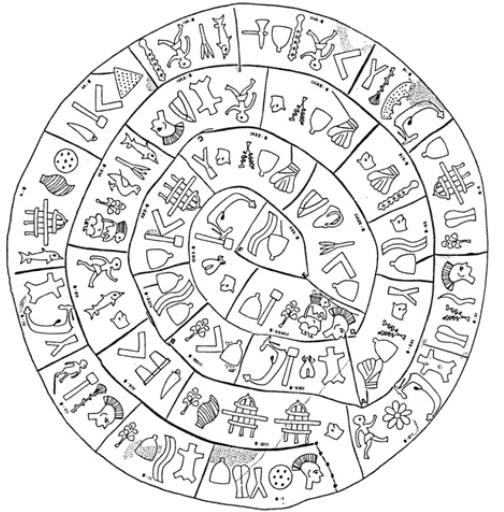
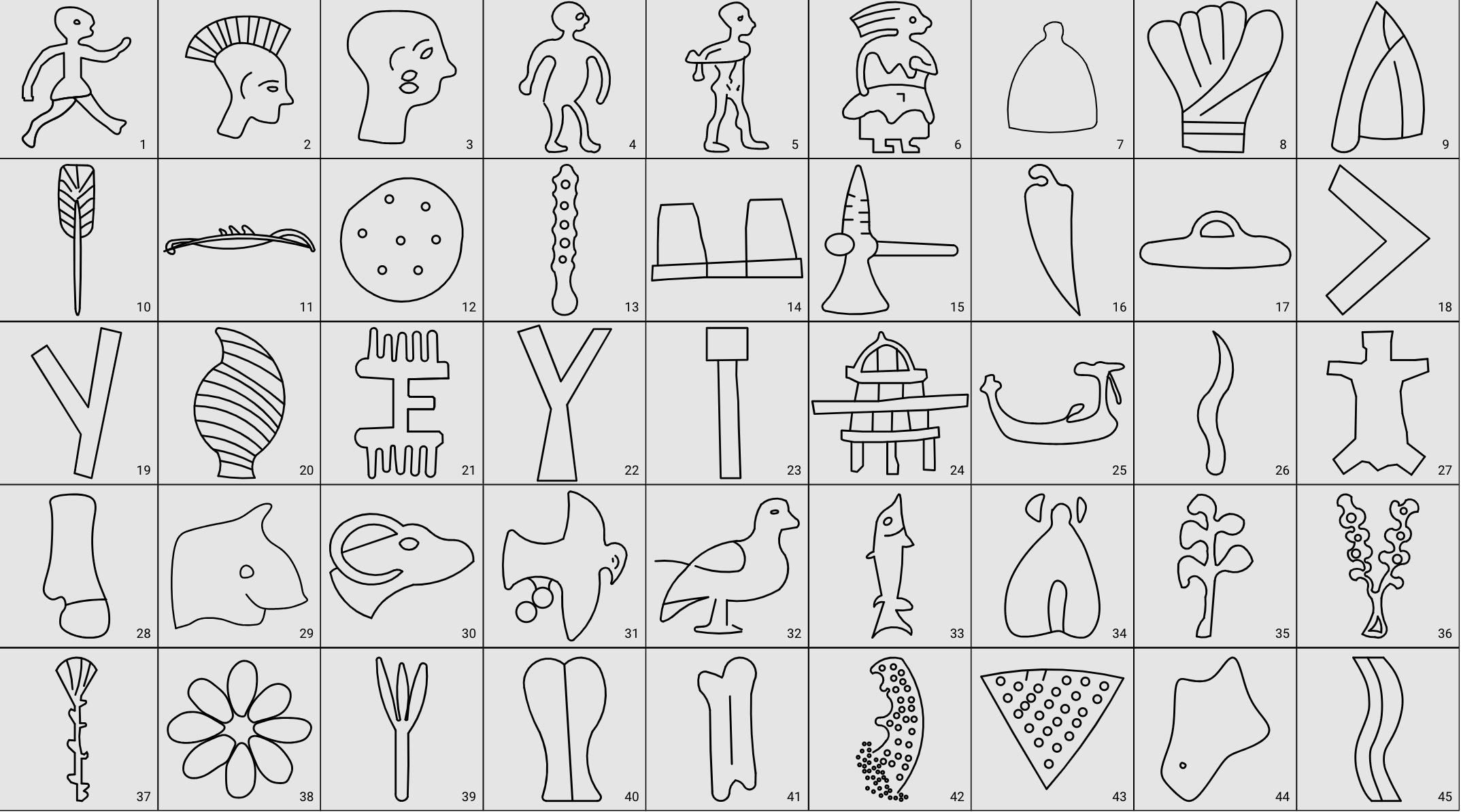
Its diameter is about 16 centimetres, its thickness roughly two. The surface carries 241 signs – other counts arrive at 242 – which reduce to 45 different symbols: representations of people, animals, plants, implements and geometric shapes. Sir Arthur Evans numbered them from 01 to 45, a system still in universal use; the commonest is the “plumed head”, a man’s profile with a crest, which occurs nineteen times. The signs were pressed into the still soft clay with individual stamps, a procedure unique for its time. The disc is therefore often described as the oldest “printed” document in the world – made some three thousand years before Gutenberg’s printing with movable type.
The disc remains undeciphered, although countless scholars and still more enthusiasts have tried their hand at it. The proposals range from a religious text or hymn to a calendar or even a kind of musical notation; it has been read as early Greek, as Luwian, and as the board for a game. None of these theories has won wide acceptance among specialists, who generally hold that the text is simply too short to be cracked unless more inscriptions of the same kind turn up. About half the signs do have counterparts in other inscriptions of the Cretan hieroglyphic script, and several recur on the bronze axe from the Arkalochori cave, but there is no real parallel to the disc as a whole – it is, and remains, a one-off.
The disc in detail
The find and its circumstances
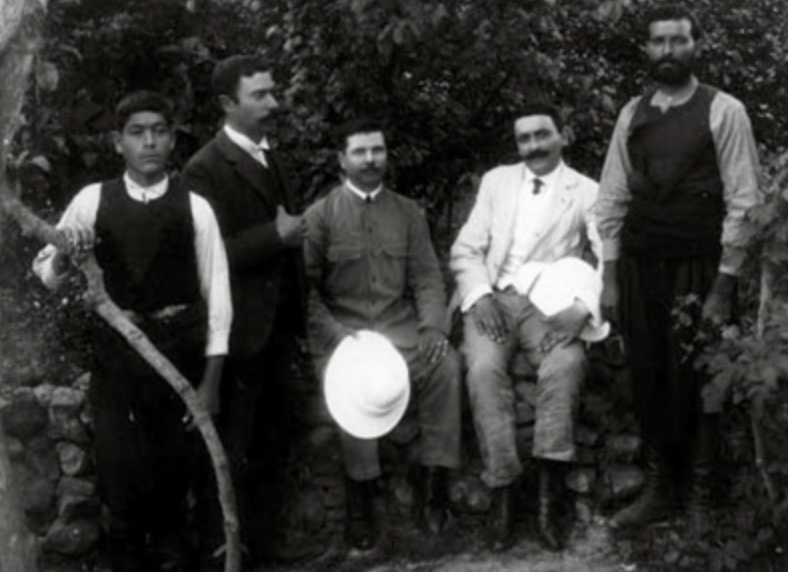
According to the entries in the excavation diary of the archaeologist in charge, Luigi Pernier, the disc came to light on 3 July 1908 at seven in the evening. It was discovered by Zacharias Iliakis, the foreman and trusted man of the Italian mission at Phaistos. Iliakis was supervising the work that evening, while Pernier had gone back to the mission’s house in the nearby village of Vori to write a letter to the director of the School. He had hardly finished and signed it when Iliakis arrived with the find.
Dusk was already falling, and when Pernier examined the object, still partly caked with earth, in the weak light, he made out written signs on one side only. Deeply moved, he added a final paragraph to the letter: “I am happy to be able to inform you that this evening, in the new excavations in the north-east of the acropolis plateau of Phaistos, we found a clay disc (diam. 0.16) covered with Minoan pictorial signs (more than a hundred), impressed with a stamp in concentric circles. We are in the presence of one of the most important monuments of early Cretan writing.” The next morning Pernier went to the excavation, had Iliakis show him the findspot and recorded all the particulars in the diary: the disc had lain about half a metre above the floor of a small basement chamber, in a layer of black earth and ash mixed with burnt cattle bones. Only after cleaning did it emerge that the second side is inscribed as well.
The findspot of the Phaistos Disc.
Luigi Pernier between Salvatore Aurigemma and Antonio Minto; on the right stands the foreman Zacharias Iliakis. Gortyn, before 1911 (archive of the Italian Archaeological School).
Distinctive features
The disc is made of an exceptionally pure, fine-grained clay of the kind used by Minoan potters for their wafer-thin “eggshell ware”. Its shape is not a perfect circle – the diameter varies between 158 and 165 millimetres – the surface is not quite even, and the thickness lies between 16 and 21 millimetres. The reason is that the disc was not made in a mould but by hand, by pressing a lump of clay onto a flat surface.
The 242 signs in all unfold within a spiral frame which the scribe had first incised in the clay with an awl, from the rim towards the centre, and which served him as a guideline; the signs themselves were pressed into the soft mass with stamps. Forty-five different signs form 61 groups of between two and seven signs each – 31 groups and 123 signs on side A, 30 groups and 119 signs on side B. Vertical dividing strokes mark them off from one another, and each group evidently corresponds to a word. In more than a dozen places the scribe rubbed out a sign and stamped a correction over it, which shows that he cared about getting the text right. The reading direction was probably from the rim to the centre, clockwise, starting at a vertical line with five dots.
Side A was probably made first. Once the text had been impressed in full, the disc was fired – and to all appearances deliberately, for the firing was so thoroughly successful that the surface took on a smooth finish and a handsome yellowish tone. That is remarkable: many inscribed clay objects of the Bronze Age survive only because conflagrations happened to bake them hard – the Linear A and Linear B tablets were merely sun-dried records, never meant to last. With the disc, by contrast, its makers clearly intended it to endure.
Authenticity and dating
The disc lay in Room 8 of Building 101 in the palace precinct, on the north-eastern plateau of the hill, a little way outside the main block of the palace. With it came a tablet in Linear A and pottery chiefly in the Kamares style. These associated finds show that the disc is to be dated to around 1700/1650 BC.
The dating of the layer excavated by Luigi Pernier has been confirmed by more recent investigations by Pietro Militello at the same spot, in the course of which a further fragment of a Linear A tablet came to light. An important contribution is also made by a clay sealing with the sign of the “comb” – one of the disc’s signs, no. 21 in Evans’s list – found in 1955 in a layer with seal impressions and Linear A tablets beneath the floor of Room 25. According to recent findings this is the destruction layer of the last phase of use of the Old Palace (Middle Minoan IIB).
To the same period, or to Middle Minoan IIIA, belongs a vessel bearing the stamped “comb” sign from the house “south of the ramp”. Other objects with spirally arranged inscriptions – a gold ring from the Mavro Spilio, the “Black Cave” (MM III/LM I), two conical cups from Knossos (MM III) and a Neopalatial cup from Tsoutsouros – support this dating and at the same time attest the disc’s connection with the artistic centres of central Crete. Doubts about its authenticity have never quite been silenced: precisely because it cannot be assigned unambiguously to any known writing system, a few voices – most publicly the American antiquities dealer Jerome Eisenberg in 2008 – have even entertained the idea of a modern forgery. No thermoluminescence test has ever been carried out on it, but the parallels unearthed since 1908, which no forger could have known, have persuaded the great majority of archaeologists, and the suspicion finds scarcely any support among specialists.
The script
The script of the disc is contemporary with Cretan hieroglyphic and Linear A – two writing systems that developed side by side during the Old Palace period, either in different regions of the island or for different purposes. Cretan hieroglyphic, in use from about 2100 to 1700 BC and best known from seal stones and from clay bars and medallions found at Malia, Knossos and Petras, owes its name to an outward resemblance to Egyptian hieroglyphs; it was Arthur Evans who christened it and first published its signs in 1909. In reality it was essentially a syllabic script, with some ninety-six syllabic signs alongside a couple of dozen logograms: each of the former stood for a syllable and not for a concept – just as in Linear A and later in Linear B, the script of the Mycenaean Greeks. Accordingly the pictorial signs of the disc, too, are regarded not as ideograms but as syllabic signs that join to form words.
In all, the text contains 61 such sign groups, that is, 61 words, distributed over the two faces – 31 on one and 30 on the other – and the wording of each side is different. The departures from the hieroglyphic script are explained in part by the fact that the signs were not incised but stamped. The direction of reading is disputed to this day. Evans at first thought the text ran from the centre outwards and later changed his mind; most scholars now assume that it followed the course of the incised frame, that is, from the rim to the centre – from left to right in the account followed here, while others argue for a reading from right to left.
The signs
The signs show chiefly people, animals, plants and objects. Of the 45 different signs, most can be recognised without difficulty. The following survey rests on Louis Godart’s monograph on the Phaistos Disc as the riddle of an Aegean script (1985); Godart is also joint editor, with Jean-Pierre Olivier, of the standard corpus of Cretan hieroglyphic inscriptions published in 1996. The suggestions as to possible meanings are expressly to be taken as conjecture: so long as the language remains unknown, any symbolism remains open.
Human figures: a striding man might stand for movement or a journey. A human head with a curious hairstyle or headdress – often read as a crown of feathers, and with nineteen occurrences the most frequent sign on the disc – may point to a rank or role in the community. A face with a tattoo on the cheek suggests a mark of identity or membership of a particular group. The figure of a captive with his hands bound behind his back possibly stands for captivity or subjection. An image that presumably shows a naked child could denote innocence or the beginning of life, the figure of a woman with bared breast and skirt fertility or female power.
Headgear, weapons and emblems of power: a sign that probably represents a cap or helmet – the second commonest, used eighteen times – may indicate station or occupation. A bandaged hand or fist guard, something like a boxing glove, hints at combat or protection. A kind of tiara – so Arthur Evans thought, at any rate – could symbolise rule or religious rank. Bow and arrow point to hunting or war. A round shield, on another reading a wax tablet, perhaps embodies protection or a message, a club power and strength. One further sign is unclear: Evans saw manacles in it, Pernier the image of a mountain.
Tools and implements: a mattock or some other tool for working the soil; an object for which a similar piece in bronze has been found at Phaistos, perhaps a tool, perhaps a weapon; a saw for working wood; a lid or stopper; a set square or boomerang, again tool or weapon; a kind of plane such as carpenters use; a large storage vessel, a dolium, whose shape also recalls a shell and which might be connected with water or seafaring; a comb, possibly a sign for purity or ritual – the same sign that turns up stamped on a sealing and on a bowl from Phaistos itself; a sling or a musical instrument, which may refer to hunting or to art; a piece of wooden furniture, a cage or a beehive, perhaps an allusion to house or craft.
Ship, animals and things animal: a ship stands for travel and trade, a horn possibly served as a signalling instrument. An animal hide – it occurs fifteen times, twice turned upside down in a single word – could recall hunting or sacrifice, a bull’s horn – some read a bull’s leg here – strength or fertility. The head of a cat may signify grace or protection, the head of a ram point to sacrifice and cult. A flying bird passes for an image of freedom or of the spirit, a sitting dove perhaps for a sign of peace or of a message. A fish, presumably a tunny, is associated with fertility and abundance, a bee with industry and community.
Plants and other objects: a leafy branch or tree as an emblem of life and growth; a shrub, perhaps a sign for nature or the healing art; papyrus as a symbol of writing and knowledge; a water wheel or a flower, that is, technology or beauty; a lily, which can stand for purity but also for death; the backbone of an ox, perhaps for strength or stock-rearing; a flute for music and festival; a grater for the preparation of food; a sieve, possibly for cleansing or ritual; a small axe, tool or weapon; and finally a wavy band that might suggest water or movement.
The difficulties of interpretation
The Minoan language in which the disc is composed is still unknown to us – and that is the decisive obstacle to any understanding of its content. Even so there have been countless attempts to decode the script and interpret the inscription, beginning as early as 1911 with readings of it as Greek; many of them move far beyond what can be defended on scholarly grounds, and occasionally stray into the realm of fantasy. With only 242 signs to work on, no proposed reading can be tested against a second text. Only a few observations are secure. Eleven of the 61 sign groups begin with the same signs: the head with the characteristic hairstyle and the circle with seven dots, usually interpreted as a shield.
In addition, certain sequences of signs recur several times, for instance bull’s leg and striding man, flying bird and bull’s horns, or oar, head and rosette. These repetitions have led some to suppose that this is a religious hymn or a magical text, a kind of invocation addressed to a deity. Others again have seen in it an astronomical calendar. A reliable interpretation, however, will only become possible once Cretan hieroglyphic and Linear A are understood and deciphered – or once the soil of Crete yields more texts stamped with the same set of punches, which must after all have been cut to be used more than once. Until then the disc remains what it has been since its discovery: the most beautiful unsolved riddle of the Minoan world.
Phaistos through the ages
According to legend Phaistos (Φαιστός) was ruled by Rhadamanthys, son of Zeus and brother of Minos, and Homer counts the city among the three important foundations of Minos on Crete. In the Iliad it appears as “well-peopled” and among the Cretan cities that sent ships against Troy. Later tradition also claimed for it Epimenides, the Cretan seer whom the Athenians summoned to purify their city after the Cylonian sacrilege. Archaeology draws a far longer picture still.
Neolithic (7000–3000 BC)
The first settlements on the site of the later Phaistos arose in the Neolithic; on the hill itself the earliest habitation is dated to around 3600 BC, late in that long age. Simple huts of branches and clay gradually gave way to ordered communities that practised farming and stock-rearing. The excavators found foundations of Neolithic houses, tools, figurines and sherds; at the southern edge of the palace even the stone footings of a round house came to light.
Early Minoan period (3000–2100 BC)
The Early Minoan period brought the first stone buildings and a growing mastery of metalworking. Phaistos became one of the centres of Minoan culture, as finds of pottery and luxury goods show. Structural remains of this phase are sparse; all the richer are the portable finds, among them vessels in the Pyrgos and Agios Onoufrios styles. The great tholos tombs of the Messara with their rich grave goods bear witness to a densely settled, prosperous countryside that already maintained links with the Cyclades, with Egypt and with the Near East.
Middle Minoan period (2100–1600 BC)
The Middle Minoan period was the heyday of Phaistos. Around 1900 BC a splendid palace arose on the hill; the complex covers some 8,400 square metres, about two thirds the size of Knossos, and in the course of roughly three centuries the Old Palace was rebuilt three times. In the view of scholars it served not only as the seat of the ruler but also as the hub of religious, administrative and economic life – a role borne out by the thousands of clay sealings and the Linear A documents recovered from it. Around 1700 BC a severe earthquake and a fire destroyed this Old Palace; a still grander New Palace was built on its ruins. It was in precisely this period that the famous disc was made, to this day one of the greatest riddles of archaeology.
Late Minoan period (1600–1100 BC)
The Late Minoan period brought the downfall of many Minoan palaces, Phaistos among them, probably as a result of earthquakes and the unrest that followed; the New Palace fell around the middle of the 15th century BC and was not rebuilt. Unlike many other places, however, Phaistos recovered quickly and even extended its influence. The town remained inhabited, with substantial houses of mud brick and a paved street leading up to the West Court; north-east of the town, at Kalyvia, Mycenaean tombs were found, some of them containing scraps of bronze armour.
After the end of Minoan Civilisation
Even after about 1100 BC, when Mycenaeans and Dorians had established themselves on Crete, Phaistos remained settled. Each culture left its traces, but the place never regained its former importance as a great cultural and economic centre. All the same, the city enjoyed a revival in the Archaic period: it spread beyond its Minoan limits, a temple of the Great Mother, Rhea, was built over the ruins of the Old Palace at the southern end of the site, and a fortified acropolis crowned the surrounding hills.
In the Hellenistic period Phaistos was prosperous once more, struck its own coins – silver staters showing Talos, among other types – and controlled the coast from Cape Lithino to Cape Melissa together with the Paximadia islets, with the harbours of Matala and Kommos. Around the middle of the 2nd century BC the city was finally destroyed and subjugated by its powerful neighbour Gortyn; after that only a modest settlement remained. The present-day village of Agios Ioannis on the southern slope of the hill is, as people in the district like to say, a meagre echo of that glittering past.
The palace of Phaistos
Architecture and layout
Like the other Minoan palaces, that of Phaistos is distinguished by an intricate plan: numerous rooms linked by corridors and small courts. It lies on a low hill about 100 metres above sea level, at the eastern tip of a ridge west of the river Geropotamos, the ancient Lethaios, and looks out over the fertile Messara Plain, framed by the mountains of Psiloritis, the Asterousia and the Lasithi massif. The summer villa of Agia Triada, perhaps a country seat of the same rulers, stands on the far end of the ridge some three kilometres to the west.
Although it ranks among the greatest monuments of the Minoan age, it differs in some essential respects from its more famous counterpart, the palace of Knossos. Unlike Knossos, Phaistos was not remodelled on so large a scale after the destructions. Its plan is therefore less convoluted, but affords a clearer view of Minoan building at one particular period. The absence of labyrinthine passages and the fact that the Italian excavators confined themselves to conservation rather than modern reconstruction – of the kind Arthur Evans undertook at Knossos – make Phaistos a unique place in which to study Minoan culture at an earlier stage of its development. Specialists praise the complex as a model of Minoan palace architecture, distinguished by masterly articulation and flawless execution.
The core of the palace is grouped around the Central Court, which served for ceremonies and public gatherings. Around it lay living and working quarters, storerooms, workshops and shrines. Coming from the west, the visitor first enters the paved West Court, across which solemn processions once passed; the circular stone-lined pits sunk into its edge, known as kouloures, belong to the Old Palace. On its north side rises a flight of eight steps 22 metres long, interpreted as seating for spectators – the so-called theatral area, larger than its equivalent at Knossos. From there a monumental open staircase leads up to the propylaea of the New Palace. Further north lie a peristyle court and the apartments known as the megaron of the king and of the queen, with floors of alabaster slabs and a view of Mount Ida.
A particular feature of the palace of Phaistos is its arrangement on several levels: the rooms lay at different heights and were connected by stairs and terraces. In this way the sloping ground could be turned to effect, and an impressive composition was created at the same time. Remains of the Old Palace survive chiefly south of the West Court and are now partly protected by shelters. From the Central Court the view opens northwards to Psiloritis, on whose flank lies the Kamares Cave – the cult grotto after which the fine, polychrome Kamares pottery is named. The site is all steps and uneven paving, and anyone unsteady on their feet will find parts of it hard going.
Wall paintings and furnishings
The walls of the palace were once adorned with frescoes: cult scenes, plants and animals, people in motion. Far less of this decoration survives at Phaistos than at Knossos, mostly no more than fragments of plaster with traces of colour. Yet even these fragments give an idea of the assurance with which Minoan painters commanded line and colour. What the wall paintings lack in abundance the rooms themselves make up: floors and dados of polished alabaster and gypsum slabs, broad open staircases and airy colonnaded halls still betray the ambition of those who built them.
Besides the frescoes, the excavations brought to light a wealth of everyday objects: implements of stone and bronze, jewellery, seals and above all pottery. Phaistos is famous for what is called Kamares ware, a class of the Old Palace period named after the Kamares Cave on the southern slope of the Ida range, where it was first found. It was made in the palace workshops of Phaistos, Knossos and Malia and reached its peak in the 19th and 18th centuries BC, once Cretan potters had taken up the fast wheel. Its vessels, some as thin as eggshell, with spirals, blossoms and whirling patterns in white, red and orange on a dark ground, are among the finest things produced by Bronze Age potters anywhere in the Mediterranean, and they were prized abroad: pieces have turned up in the Levant and in Egypt. Among the shapes from Phaistos are bridge-spouted jars, tall jars and huge storage pithoi. Then there are clay tablets in Linear A – twenty-six of them from this site – which attest an orderly administration keeping accounts of stores and dues. The most important pieces are now displayed in the Heraklion Archaeological Museum.
Water supply and drainage
Among the most astonishing achievements of the builders is the palace’s management of water. An ingenious network of stone gutters, masonry channels and clay pipes collected the rainwater from roofs and courts, led it into cisterns and carried waste water reliably away. The inhabitants thus had clean water at their disposal, and hygiene reached a standard that was not to become usual again in Europe until thousands of years later. Anyone who walks the site attentively can still pick out the narrow drainage runnels at the edge of the courts and staircases, which in the winter rains steered the water downhill.
The village of Vori
Vori (Βώροι) has been a listed traditional settlement since 1978, and its cultural heritage has won particular recognition at European level as well.
Find on the map
Vori – museum, lanes and old churches
Only a few kilometres north of Phaistos, on the edge of the fertile Messara Plain, lies the village of Vori, a quiet weave of stone houses, arched gateways and narrow lanes. Its story is closely bound up with the exploration of Phaistos: this is where the house of the Italian archaeological mission stood, and it was here in 1908 that Luigi Pernier – who had been digging on the palace hill with Federico Halbherr since the turn of the century – wrote the letter that closes with the news of the discovery of the Phaistos Disc.
The Museum of Cretan Ethnology (Μουσείο Κρητικής Εθνολογίας) deserves particular attention. Its collection grew out of the folklore research that the Cultural Association of the Messara began in 1973 and has continued ever since. The building itself went up between 1977 and 1982, to a museological scheme drawn up by Georges Henri Rivière, the Frenchman who created the Musée National des Arts et Traditions Populaires in Paris, and the first displays opened to the public in 1988. On show are household goods, furniture, metalwork, weaving, pottery, basketry and tools that tell of the life and customs of the Cretans down the centuries, with an especially strong showing from the Ottoman period. The exhibition is arranged not by period but by basic human needs: food, building and housing, textiles, production and trade, transport and communication, customs and traditions, and social organisation. In 1992 the museum received an award in the European Museum of the Year scheme (EMYA), held under the auspices of the Council of Europe. A research centre of some 2,800 square metres was added in 2001. The museum is far more than a storeroom of old things: here the cultural inheritance of the island comes alive.
The churches of the village repay a visit too. Two of them date from the 14th century: the church of St John (Agios Ioannis) and that of St George (Agios Georgios). These plain buildings are not only examples of medieval church architecture on Crete; they also preserve the spiritual legacy of past centuries. To these may be added the 19th-century church of the Presentation of the Virgin in the Temple (Eisodia tis Theotokou), which is likewise worth seeing for its architecture and its history. Anyone with time to spare should wander the lanes for a while after the museum and settle at the kafeneion on the village square.
Agia Triada
The excavations suggest that this was the summer residence of the ruler of Phaistos, or of a high dignitary of his circle.
Find on the map
A Minoan town with a Christian name
Agia Triada (Αγία Τριάδα) lies just three kilometres west of Phaistos and not far from Vori, on a gentle rise only 30 to 40 metres above sea level, overlooking the plain of the Geropotamos. After Phaistos it is one of the most important sites of Minoan civilisation in the south of the island. Luigi Pernier first noted it in June 1900, and systematic excavation followed from 1902 to 1908 under Federico Halbherr and Pernier for what became the Italian Archaeological School, which is still at work here: later campaigns were led by Luisa Banti, Doro Levi and Clelia Laviosa, and from 1977 by Vincenzo La Rosa.
The site takes its name from the nearby 14th-century church of the Holy Trinity. It is a remnant of the medieval village of Agia Triada, which had about 150 inhabitants in 1583 and was abandoned in the late 19th century. What the place was called in the Bronze Age is unknown, though one suggestion links it with a name, da-wo, that occurs on Linear B tablets from Knossos. Right beside the excavations stands the small Venetian-period church of St George Galatas (Agios Georgios Galatas), whose interior preserves remains of Byzantine wall painting.
The excavations suggest that this was the summer residence of the ruler of Phaistos or of an important member of his court. The hill had been settled since the Early Minoan period, but the splendid villa was built around 1550 BC, at the height of the Neopalatial era, and was destroyed around 1450 BC, probably by fire. That was not the end of the story: under Mycenaean influence building resumed on a monumental scale, including a colonnaded hall with shops that is often interpreted as an early agora, and the place was finally deserted only in the 13th century BC. A shrine was established among the ruins in the early Iron Age, and in Classical and Hellenistic times Agia Triada was still a place of worship, by then under the control of Phaistos.
The complex was linked to the palace of Phaistos by a broad paved road, stretches of which survive in good condition. To walk on these stones is quite literally to follow in the steps of the Minoan dignitaries who passed between palace and villa. Wear sturdy shoes: the ancient paving is uneven and polished smooth.
Among the most remarkable discoveries at Agia Triada is the so-called royal archive: a room full of clay tablets inscribed in Linear A, a script that still awaits decipherment. Nowhere else on Crete have so many Linear A tablets been found in one place – about 150, all of them baked hard by the fire that destroyed the villa, together with clay roundels and numerous sealed nodules. Also found here were sixteen copper ingots in the shape of stretched oxhides, witnesses to the far-reaching metal trade of the Minoans.
World-famous, too, are the works of art from Agia Triada now on display in the Heraklion Archaeological Museum, many of them grave goods. First among them is the painted limestone sarcophagus, found in a tomb in 1903 and the only one of its kind in stone known from its period; all four sides are frescoed with scenes of sacrifice – a bull bound on a table, libations poured between double axes topped with birds, musicians with pipe and lyre – making it one of the most important records of Minoan funerary ritual. Then there is the Harvester Vase of black steatite, with its exuberant procession of singing countrymen, one of them shaking a sistrum; the so-called Chieftain Cup (or Prince’s Cup), a serpentine vessel barely 11.5 centimetres high showing the meeting of a young ruler and an officer; and the Boxer Rhyton, with scenes of boxing and bull-leaping. Stone libation vessels and jewellery complete the list.
The history of Agia Triada runs exactly parallel, period by period, to that of Phaistos – proof that the two places were closely linked not only in space but in culture. A practical note: the site is generally open all year, with shorter hours in the winter months; admission is modest, and young people under 18 enter free. As there is hardly any shade on the hill, a morning visit is advisable.
From Agia Triada we drive down to the sea: first to Tymbaki, from there to Kokkinos Pyrgos and on to Matala, taking in whatever lies along the way.
From Agia Triada to Matala
The villages of Tymbaki and Kokkinos Pyrgos – and greenhouses as far as the eye can see. Kokkinos Pyrgos is especially appealing.
Find on the map
On the road to Matala
First impressions may be sobering: in this part of the island greenhouses dominate the scene. Around Tymbaki, the market town of the western Messara, stretches the largest hothouse district of the area, a sea of plastic sheeting beneath which tomatoes, cucumbers and other vegetables ripen for the markets of Greece and Europe.
Those who refuse to be put off by this landscape are soon rewarded: with the calm bay of Kokkinos Pyrgos (Κόκκινος Πύργος), some 67 kilometres from Heraklion, its splendid long sweep of sand and fine shingle running for several kilometres south-east towards Kommos, and a sea that is peaceful more often than not, although the shore lies open to westerly winds. The name, literally “Red Tower”, recalls an old tower that once stood here at the mouth of the Geropotamos and was built of reddish earth. From the beach the view extends across the Libyan Sea to Agia Galini and the two small Paximadia islands. In the western part of the village is a small harbour from which boats leave for neighbouring beaches in season; tavernas by the water serve fresh fish, and the eastern stretch, Katalyki, has sunbeds and a lifeguard.
The coast of the Bay of Messara is a protected natural area. It is one of the few places in the Mediterranean where the loggerhead sea turtle (Caretta caretta), an endangered species, comes to lay its eggs; behind the sand, the marsh at Katalyki is one of the most valuable wetlands of the plain. Between May and September the females come ashore on summer nights, dig their nests in the sand and return to the sea; the clutches are marked and protected by volunteers. With a little luck, in late summer you may see the newly hatched young find their way to the water by instinct – a moving sight. Anyone who spends the night on the beach or uses a light there after dark should take care around marked nests, because artificial light draws the hatchlings away from the sea.
On the drive through the village of Kamilari (Καμηλάρι) it is worth turning aside to a Minoan vaulted tomb (tholos), uncovered only in 1959 by the Italian archaeologist Doro Levi on a low rise west of Phaistos, just under two kilometres south-west of Agia Triada. Built around 2000 BC, the circular tomb has an internal diameter of 7.65 metres, and its walls still stand two metres high in places; the massive lintel stone of the entrance remains in position. It was used, with interruptions, for roughly half a millennium, and anthropological study has identified the remains of several hundred dead, adults and children alike. Attached to it is a suite of five roomy annexes and a paved court for offerings, with burials of later date, in which the change in funerary custom over the centuries can be traced and which give some idea of the family and communal rites of the early Cretans. The excavators recovered about 2,500 pottery vessels, among them hundreds of plain conical drinking cups. The tomb owes its fame to small clay models now in the Heraklion Archaeological Museum – a banquet, a scene of offering, and a group of four dancers holding hands in a ring, in which some see a distant forerunner of the Cretan round dances.
Kommos (Κομμός), about five kilometres north of Matala, is first of all a wide sandy beach on the Libyan Sea. Yet it also conceals one of the most important archaeological sites of the south coast.
In Minoan times Kommos was the principal trading port of Phaistos, connected to the palace by road. Sir Arthur Evans, who came this way in 1924, was the first to guess that a Minoan harbour lay beneath the dunes. The settlement arose around 2000 BC and, although an earthquake around 1700 BC struck it hard, it flourished for centuries afterwards and the site remained in use into Roman times. The excavations, which began in 1976 and ran for two decades under the Canadian archaeologist Joseph Shaw of the University of Toronto, working with Maria Shaw, could start only after a wartime minefield had been dealt with and metres of sand cleared by machine. They brought to light dwellings, large public buildings faced with the biggest dressed blocks the Minoans are known to have used, storerooms, oil presses and long galleries, six of them side by side, which are regarded as the oldest known ship sheds on Crete. Jars from Egypt, Canaan and elsewhere show how far the harbour’s contacts reached. Over the Minoan remains a Greek sanctuary grew up with temples, altars and a banqueting hall, used from about 1100 BC into the Roman imperial period; its second temple, of about 800 BC, contained a three-pillared shrine of Phoenician type, and temples, sacrificial altars and administrative buildings date from the Hellenistic age. Homer tells in the third book of the Odyssey how ships of Menelaus, homeward bound from Troy, were dashed to pieces on the south coast of Crete near Gortyn and Phaistos, where a small rock holds back the great waves – a tradition readily associated with Kommos and the reef offshore. The excavated area is fenced and can usually be seen only from outside.
And so the drive through this part of Crete becomes not a mere link between two points but a small journey of discovery: with monuments from four millennia, with fine scenery, and with a natural spectacle such as the hatching of the sea turtles.
Matala
The most famous beach in Greece in the 1970s. Hippies lived in the caves above the sand in those days. By now the hippies have turned into respectable citizens, who stay in comfortable hotels facing the caves …
Find on the map
Matala
Matala (Μάταλα), once a simple fishing village, is today a well-known resort on the south coast of Crete, a little over 70 kilometres and about an hour’s drive from Heraklion, just north of Cape Lithino. It draws visitors from all over the world, with good tourist facilities and plenty of scope for an active holiday, including various water sports. The beach lies in a bay framed by pale cliffs; its sand has a faint reddish shimmer, and the seabed shelves gently. That makes it safe for families with children. Those who prefer more solitude can reach Red Beach (Kokkini Ammos), south of the village, in about half an hour by a footpath over the rocks.
In antiquity Matala was one of the most important harbours of Minoan Phaistos, surpassed in significance only by Kommos; the Gortynians seized it in 220 BC, and later, in Roman times, the bay served as the port of Gortyn. According to local tradition it was here that Zeus, in the form of a bull, came ashore with the abducted Europa before taking her on to Gortyn. The remains of the ancient harbour now lie in shallow water and can be explored with a snorkel or on a dive. Such excursions to the sunken walls give a rare sense of connection with the past – one swims, as it were, across history.
The cliffs around the bay of Matala are famous for their many caves. The best known, cut into the soft sandstone of the northern slope, go back by local tradition to the Neolithic; what is certain is that they served as burial chambers in Roman and early Christian times, as the couches and niches worked into the rock indicate, though some may equally have been lived in. One is known as Brutospeliana, after the Roman general Brutus who is said to have frequented it. The cave slope is now fenced as an archaeological site and is generally open during the day for a small admission charge. Other grottoes along the steep coast can be reached only from the sea. Boat trips to them are very popular with holidaymakers: daylight falls into the caves, and reflections play across the walls.
Matala is known, too, for its more recent cultural history, above all for the hippie movement of the late 1960s and early 1970s, when the village became a meeting place for the counterculture from all over the world. The young drop-outs were attracted not only by the beauty and seclusion of the bay but also by the chance to live in the ancient caves – a life by oil lamp that lent their outlook a special charm and the greatest possible freedom. In the spring of 1970 the Canadian singer Joni Mitchell spent some weeks in Matala; her song “Carey”, on the 1971 album “Blue”, with its line about the Matala moon, recalls that time and the beach bar called the “Mermaid Café”. Later that same year the military government of the day, urged on by the Church, had the caves cleared. The slogan “Today is life, tomorrow never comes”, painted on a wall, is a reminder of those years, and every summer since 2011 the Matala Beach Festival has celebrated their spirit with music and encounters. On the village square stands a centuries-old olive tree, into whose trunk the Cretan sculptor Spyros Stefanakis has carved the faces of Zeus, Poseidon, Dionysus and Hermes.
Sivas – a listed village
The village has been officially recognised as a traditional settlement worthy of preservation and has been protected ever since.
Find on the map
Sivas
Sivas (Σίβας) lies at an altitude of about 110 metres on the south-western edge of the Messara Plain, where the ground begins to rise towards the western Asterousia Mountains, some 62 kilometres from Heraklion; it has around 600 inhabitants and now belongs to the municipality of Phaistos. Its official recognition as a protected traditional settlement underlines how valuable the look of the village is and how important it is to keep it for future generations. The name is commonly derived from an Arabic word for “spring” – a pointer to the abundance of water hereabouts – although other explanations, among them the Latin silva, “wood”, have also been put forward.
The village is old, and the ground older still: circular tombs of the pre-palatial Minoan period have been excavated nearby, and a hoard of early Hellenistic coins found in 1958 is in the Heraklion Archaeological Museum. As early as about AD 970, St John the Stranger (Ioannis o Xenos) is said to have been born here; after the Byzantine reconquest of Crete he pressed forward the renewal of the Orthodox faith on the island and founded several monasteries, and his feast is kept on 7 October. The church on the village square is dedicated to St John. Close by lies the monastery of Panagia Odigitria. Sivas was also the home of Ioannis Stefanakis, known as Skountis, who fought under Kolokotronis in the War of Independence of 1821, and associated with the village is the writer Themos Kornaros, after whom the local cultural society is named; it holds its festivities in late August. Today the villagers live from farming and tourism; a few tavernas, a traditional coffee house, a pottery workshop and guest rooms invite you to linger.
The architectural heritage of Sivas
The architecture of Sivas is striking for its individuality and its beauty. The stone houses have imposing round-arched doorways, above which the family names and coats of arms of the owners are cut into the stone. This gives the buildings a particular charm and considerable historical value. The centre of the village is dominated by the handsome school building of 1864.
These details are not merely pleasing to the eye; they bear witness to deep-rooted traditions and to the close attachment of the villagers to their own history. Walk slowly through the lanes and at almost every corner you will find a dressed lintel, a carved date or a piece of ornament.
The sacred places of Sivas
The church of the Prophet Elijah
It stands on the hill of the same name and commands a magnificent view across the Messara Plain. This is a place not only for prayer but for quietly taking in the surrounding countryside, and it is at its best in the late afternoon, when the light over the plain turns soft. As everywhere in Greece, the prophet has been given the high ground: his chapels crown hilltops and summits the length of the island.
The church of the Panagia
The church of the Virgin at the entrance to the village is known for its finely worked stone fountain, a handsome example of craftsmanship and of pious devotion. For as long as anyone can remember it has been a resting place for villagers and travellers alike – fitting enough in a village whose very name is usually explained as meaning “springs”.
The church of St John the Baptist (1864)
The church on the square is renowned for its carved iconostasis and for the icons by the well-known Cretan icon painter Ioannis Stafakis. On 29 August, the feast of the Beheading of St John the Baptist, the village holds its panigyri here: a patronal festival with a procession, a full cultural programme and a traditional Cretan feast, the glendi, with lyra music, grilled meat and dancing. For that day Sivas becomes the centre of celebration and of reunion for the whole district. In the last days of August the cultural society, which bears the name of the writer Themos Kornaros, often puts on several festive evenings of music, theatre and talks, which culminate in the glendi on the 29th.
Archaeological finds
Some time ago archaeologists working in the country around Sivas discovered one of the oldest vaulted tombs on the island, dated to between 2600 and 2000 BC. It belongs to the group of Early Minoan circular tombs that is characteristic of the Messara, in which whole clans were buried over many generations – the same tradition that produced the later and larger tholos at nearby Kamilari.
Great Gortyn – city of Sarpedon and of St Titus
Anyone driving to Phaistos should stop at Gortyn; anyone driving to Gortyn should visit Phaistos. And anyone who is not really going anywhere at all should go to Gortyn all the same.
Find on the map
Introduction
Gortyn (Γόρτυνα) looks back on a rich history that runs from the Minoan age to late antiquity. The ruins lie about 45 kilometres south of Heraklion in the Messara Plain, below the southern flank of Psiloritis, scattered among olive groves and the present-day villages of Agii Deka, Mitropoli and Ambelouzos, which were built in part upon the ancient debris. The Italian Archaeological School has been digging here since 1884, and yet most of the city still lies unexcavated under the trees.
From Sarpedon, son of Zeus, to Octavian Augustus
Of the three mythical brothers Minos, Rhadamanthys and Sarpedon, the sons of Zeus and Europa, legend has it that Rhadamanthys received the rule of Phaistos and Sarpedon that of Gortyn. It was here, beneath an evergreen plane tree on the bank of the river Lethaios, that Zeus is said to have lain with Europa, whom he had carried off across the sea in the shape of a bull – and visitors are still shown a plane tree that does not shed its leaves even in winter.
According to another version of the myth, handed down by the geographer Strabo, the city was founded by Gortys, a son of Sarpedon, and named after him.
Be that as it may, the first traces of settlement go back to about 3000 BC, and in Minoan times Gortyn was a considerable town whose layout some authors compare with Knossos and Phaistos. In the Old Palace period it had no fortifications – a sign that for centuries it had no outside enemy to fear and lived at peace with the other cities of Crete. After the devastating earthquake of around 1700 BC it was rebuilt at once and went on growing. It recovered quickly, too, from the eruption of the volcano of Santorini and the tidal wave that followed, just as Knossos and Phaistos did. Homer knew the place: in the third book of the Odyssey the ships of Menelaus, blown off course on the voyage home from Troy, are wrecked on the reefs of the Gortynian coast. On the acropolis hill a settlement of about 1050 BC has been found, which lasted into the 7th century BC.
In the centuries that followed Gortyn grew so powerful that it eventually subdued Phaistos and took over its harbours of Matala and Kommos; together with Lebena in the south, this gave it control of access to the Libyan Sea. Its ascendancy may have begun as early as the 5th century BC – Matala, at any rate, was in Gortynian hands by 220 BC, the year in which the island was torn apart by the Lyttian War – and the final destruction of Phaistos by Gortyn followed around the middle of the 2nd century BC. Even so, Gortyn was not the capital of Crete in Minoan or Classical Greek times, though it was always a major regional centre that contended with Knossos and Lyttos for supremacy on the island. To this period belongs the celebrated law code of Gortyn, cut in stone in the Dorian dialect in the 5th century BC and rediscovered in 1884; it is both the oldest and the most complete code of Greek law to have come down to us.
Gortyn as capital of Crete in Roman times
Even during the internal wars of the Cretan cities Gortyn had formed friendly ties with Rome. It took no part in the common resistance of the Cretans to the Roman conquest of 69 to 67 BC, the campaign that earned Quintus Caecilius Metellus the surname Creticus; on the contrary, it sided with him. As a reward – or, more probably, for geopolitical reasons – the emperor Octavian Augustus raised the city in 27 BC
to the rank of capital of the senatorial province of Creta et Cyrenaica, which joined Crete with Cyrenaica in what is now Libya. It was governed by a proconsul, assisted by a quaestor, whose seat was the Praetorium, first laid out in the 1st century AD. This arrangement lasted until the imperial reforms of Diocletian around AD 295; thereafter Gortyn remained the capital of a province of Crete that now stood on its own. At the same time the city continued to be the seat of the league of Cretan cities, the Koinon of the Cretans.
The harbour towns on the Libyan Sea – Matala, Lasaia and Lebena – became transit points for trade between the East, North Africa and Rome. Gortyn enjoyed a new flowering of its economy and its urban fabric, and drew merchants and wealthy landowners from every part of the empire. In these conditions it was the first city of Crete to be Romanised, quickly and thoroughly.
The new requirements soon led to a replanning of the city on the Roman model. Gortyn reached its peak between the reign of the emperor Hadrian and the early Severan period, that is, in the 2nd and early 3rd centuries AD. At that time the city extended over an area of several square kilometres and had an estimated 50,000 to 60,000 inhabitants. It expanded to the east and the south: a new street grid was laid out, along with temples, theatres, baths, an aqueduct, an amphitheatre and a hippodrome, and so Gortyn took on the character of a great Roman city. Still to be seen today are the Odeon, a small roofed theatre of the 1st century AD rebuilt under Trajan, into whose curving back wall the blocks of the law code were reused; the Pythion, the sanctuary of Pythian Apollo, some 600 metres from the agora; and the sanctuary of the Egyptian gods Isis and Serapis, where cult statues of the two deities and of Anubis were found. A colossal statue thought to represent Europa, discovered at the amphitheatre, is now in the British Museum. Imposing public buildings such as the so-called Praetorium complex served not merely the purposes of administration; above all they were meant to display the greatness of Rome.
Gortyn, “mother of the Cretan cities” (in the age of the New Rome)
The Edict of Milan of AD 313, which put an end to the persecution of Christians and cleared the way for the spread of Christianity, and the decision
of Constantine the Great to move the capital of the empire from Rome to Byzantion, an old Greek colony on the Bosphorus that was refounded in AD 324 and renamed Constantinople in his honour, mark the beginning of the transformation of the Roman Empire from a pagan into a Christian civilisation.
Modern historians call this Christian phase of the Roman Empire Byzantium, although the term was not in use in the Middle Ages themselves; its inhabitants called themselves Rhomaioi, that is, Romans.
The favoured position of Crete at the centre of the eastern Mediterranean made the island an important staging post in trade with the new capital. After Diocletian’s reform at the end of the 3rd century Gortyn remained the capital of Crete, a position it evidently kept until the Arabs conquered the island between 823 and 828. To this was added the tradition of the Church, according to which the Apostle Paul and his disciple Titus preached the Gospel in the city. Titus, who had served Paul as companion and envoy, notably in the disputes at Corinth, and whom the apostle is said to have left behind to appoint elders throughout the island, is regarded as the founder and first bishop of the Church of Crete;
this tradition secured Gortyn its primacy and made it the metropolis, literally the “mother city”, of the Cretan Church, where the metropolitan had his seat. The name lives on in the neighbouring village of Mitropoli. Among the most impressive ruins of Gortyn is the 6th-century basilica of St Titus, whose lofty apse can be seen from the road. Titus is held to have died at Gortyn in old age, around the end of the 1st century. The relic of the saint – his skull – was carried off to Venice when Crete fell to the Ottomans and came back only in 1966; it is venerated today in the church of Agios Titos in Heraklion. The Orthodox Church keeps his feast on 25 August.
Rebuilding after the earthquake of 365
The tremendous earthquake that shook Crete in AD 365 and sent a tidal wave as far as Alexandria caused severe destruction in most of the ancient cities of the island, Gortyn among them.
So that the city could survive and recover, the emperor granted aid in the form of grain shipments and funds. The work of reconstruction, however, was interrupted in the course of the 5th century by fresh disasters. These events, together with the reorganisation of the imperial administration from the 4th century onwards and the new religious needs that arose as Christian worship gradually established and organised itself, brought profound changes to the face of the city. The traditional places of cult, the theatres and the agora were given up one after another, residential quarters grew up on what had been open public ground, and parts of the old street plan were built over with Christian places of worship. By degrees the heart of the city shifted westwards, to the area in which the great Christian monuments were raised.
The 6th century, and particularly the reign of the emperor Justinian the Great, was for Crete a time of prosperity and of comprehensive renewal. In spite of repeated earthquakes in the 7th and 8th centuries, in spite of outbreaks of plague and of social and economic upheaval, most of the ancient cities were able to carry on.
The finds from the Byzantine quarter of Gortyn show that even after the devastating earthquake at the beginning of the 7th century the city still had strength enough to keep up its craft production and to import goods from Carthage, Alexandria, Syria and Palestine, North Africa, Asia Minor and Cyprus.
The imports from North Africa included costly tableware, often of considerable size, with a glossy red surface and stamped decoration of the kind typical of the North African workshops – what is known as African red slip ware. To these may be added amphorae of the 5th to 8th centuries. They prove that the exchange of goods went on even when the Byzantine provinces of North Africa had already passed into Arab hands. Only the Arab conquest of Crete in the early 9th century brought the urban life of Gortyn to an end.
Decline and the transfer of the capital to Chandax (Heraklion)
The economic and demographic consequences of the earthquake, and the persistent insecurity caused by Arab raids, which began around the middle of the 7th century and intensified in the 8th, forced the inhabitants of the urban centres to seek safety in fortified places that were hard to reach. The lower town of Gortyn in the plain was abandoned little by little; the few remaining inhabitants withdrew to the fortified acropolis. Already under the emperor Heraclius (610–641) the citadel hill had been refortified and given a castle at its centre – a clear sign that people no longer felt safe in the open plain. The great early Christian basilica in neighbouring Mitropoli, once the seat of the metropolitan of Crete, was likewise finally deserted after severe earthquakes in the 7th century.
In AD 823 Arabs landed on the south coast of the island in the area of Keratokampos. They were Andalusians, by tradition survivors of the failed revolt of 818 against the emir al-Hakam I, who had been driven out of Córdoba and had at first found refuge in Alexandria, until they were expelled from there in turn. Some 12,000 people, about a quarter of them fighting men, are said to have sailed in 40 ships. Under their leader Abu Hafs Umar they brought Crete step by step under their rule by AD 828. As the capital of their emirate they founded a new stronghold on the north coast, protected by a deep ditch; from the Arabic rabd al-khandaq, “castle of the moat”, it took the name Chandax, from which the Venetian Candia and at length the present-day Heraklion were to emerge.
When the Byzantine general and future emperor Nikephoros Phokas, who had sailed with his fleet in the summer of 960, won the island back after a siege of Chandax lasting through the winter – the city was stormed on 6 March 961 – the former glory of Gortyn had long since faded. The Arab interlude of some 135 years had laid bare without mercy the strategic vulnerability of the south coast, and had shown at the same time how much better placed another city was: Chandax, with its harbour on the north coast, close to the sea lanes to Constantinople. It was there that the capital of the island was now established. So ended Gortyn’s epoch of almost a thousand years as capital of Crete, which had begun with the Roman conquest in the 1st century BC, when the city rose to be the seat of the province of Creta et Cyrenaica.
Today Gortyn ranks among the most impressive archaeological sites on the island, for almost every period of Cretan history is represented here – from the first traces of Neolithic settlement through the Minoan, Archaic and Classical ages to the Roman provincial capital and the early Christian bishop’s see.
The church of St Titus at Gortyn
In a few words
The basilica of St Titus is a church of the 6th century that was rebuilt after an earthquake in the late 8th century. St Titus, one of the Seventy Apostles and a disciple of the Apostle Paul, was the first bishop of Crete, and is the island’s patron saint. According to tradition he was born on the island and died here too. It is to him that the Epistle to Titus, part of the New Testament, is addressed. The ruin, with its towering east end of carefully dressed limestone blocks, is one of the best-known images of Gortyn and lies only a few steps beyond the entrance to the archaeological site.
In the courtyard of the basilica stand marble sarcophagi that were intended for clergy. They are in the western forecourt, once a peristyle surrounded by colonnades – an indication that for centuries the church also served as the burial place of its priests.
The church in rather more detail
The church of St Titus lies in the publicly accessible part of the archaeological site of Gortyn, on the spot occupied by the Hellenistic and Roman agora and not far from the ruins of the Roman Odeon. It was excavated in 1900 by the Italian Giuseppe Gerola and in 1901 by the Cretan archaeologist Stefanos Xanthoudidis; the results were published by Anastasios Orlandos in 1926. The unusual architecture of the building and the lack of reliable stratigraphic data from those first investigations meant that it was long regarded as an architectural oddity and dated in widely differing ways: to the time of Justinian, to the end of the 6th century, to the 7th, the 8th or even the 10th century. For a time the very association of the monument with the Apostle Titus was disputed; it was proposed instead that it was the katholikon of a monastery dedicated to the Mother of God of Blachernae, founded by Archbishop Andrew of Crete in the first half of the 8th century.
Only the renewed excavations carried out between 2013 and 2015, as part of a project to restore the monument and open it up to visitors, by the 13th Ephorate of Antiquities in Heraklion under the direction of the ephor Vasiliki Sythiakaki brought clarity to the disputed questions of interpretation. It emerged that the domed church of St Titus had been raised on the foundations of a three-aisled early Byzantine basilica of the 6th century, which remained in use into the 8th. The position of this basilica in the middle of the ancient agora – where Titus may well have preached for the first time – and at a marked distance from the other Christian buildings of the city is taken as evidence that what was venerated here was the martyrion of Titus, the memorial of his witness to the faith and of his teaching at Gortyn.
The succeeding building rose on the foundations of the first after a devastating earthquake in 795 had levelled the city, and it was already in use before the Arab invasion (823–828). That it was the only structure in the lower town to be built anew from the ground up underlines how much it meant to the inhabitants. For building material they used whatever could be salvaged from the ruined Roman and Christian monuments of the city; nevertheless the church was planned with care and in keeping with its rank. This is shown by the transitional character of its architecture, which seeks to fit a cross-in-square domed church into the ground plan of a three-aisled basilica, with the dome carried on four piers, and equally by the dignity of the façades, whose pseudo-isodomic masonry imitates the splendid Roman buildings of the city, the ruins of which were then still standing.
The complex construction; formal elements that point to a martyr’s shrine and place of commemoration – the triconch sanctuary and the triconch core of the cross; its use as a burial ground; several layers of wall painting; the rich architectural ornament; numerous Byzantine votive offerings; the alterations of the Venetian period; and unbroken use for worship since early Byzantine times: all these are weighty testimony to the link between the monument and the Apostle Titus, the founder of the Cretan Church.
Beneath the floor of the church a large hoard of liturgical vessels came to light, which can now be seen in the Historical Museum of Crete in Heraklion. In the Venetian period, when the lower town had long been deserted, a smaller church was fitted into the surviving east end, while the remaining parts of the building fell into decay. What survives is chiefly the sanctuary with its three apses and parts of the arms of the cross, which likewise end in conches on the north and south; the narthex was divided into three. The originally rich painted decoration had already been lost by the 16th century. Standing before the ruin today, one has to supply in the mind’s eye the dome that once rose above the crossing – and a peculiarity of the building is that it had galleries on the west side only.
The life and work of the Apostle Titus
Tradition ties Gortyn to St Paul. He first saw the island when the ship carrying him to Rome as a prisoner, around AD 59, was forced to put in at Kali Limenes – the “fair havens” of the Acts of the Apostles – on the south coast not far from Gortyn. The anchorage, some 70 kilometres south-west of Heraklion and today a hamlet of a handful of inhabitants in the municipality of Phaistos, lay close to Lasea, one of the harbours that served the ancient city. According to the Epistle to Titus in the New Testament, Paul later came back to Crete to preach the word of God and left his disciple Titus behind in Gortyn to set the local church in order. For that reason Titus is regarded as the first bishop of the Church of Crete. Tradition holds that he was buried at Gortyn, and that his relics were afterwards moved to Chandax (Heraklion). The city’s standing in Roman times made it the natural place for him to settle: Gortyn was the capital of the joint province of Crete and Cyrenaica, and it remained the chief city of the island until the Arabs destroyed it in about AD 828. It was this apostolic connection that led to Gortyn being raised to a metropolitan see – the “mother city” of the Cretan church, which is what the Greek word metropolis literally means. Those beginnings are recalled today by a monument to the Apostles Paul and Titus at Gortyn, put up on the initiative of the Metropolis of Gortyna and Arkadia and paid for by the Region of Crete.
From the Epistle of Paul to Titus. The letter is short – three chapters, forty-six verses in all – and is counted, with the two letters to Timothy, among the Pastoral Epistles; many modern scholars place its composition a generation after Paul, between about AD 80 and 100. It also contains the notorious line about the Cretans, usually attributed to the Cretan poet Epimenides (Titus 1:12).
My son Titus: “For the grace of God that bringeth salvation hath appeared to all men, teaching us that, denying ungodliness and worldly lusts, we should live soberly, righteously, and godly, in this present world; looking for that blessed hope, and the glorious appearing of the great God and our Saviour Jesus Christ; who gave himself for us, that he might redeem us from all iniquity, and purify unto himself a peculiar people, zealous of good works. But after that the kindness and love of God our Saviour toward man appeared, not by works of righteousness which we have done, but according to his mercy he saved us, by the washing of regeneration, and renewing of the Holy Ghost; which he shed on us abundantly through Jesus Christ our Saviour; that being justified by his grace, we should be made heirs according to the hope of eternal life.” (Titus 2:11–14; 3:4–7, King James Version)
In more detail: the Life of the Apostle Titus
Titus, one of the Seventy Apostles, was a native of Crete and the son of well-born pagan parents. As a young man he applied himself eagerly to Greek philosophy and the ancient poets. For all his devotion to learning he led a virtuous life and did not give himself up to the vices and passions that had hold of most pagans. He lived in chastity, as the holy martyr-bishop Ignatius the God-bearer testifies. For such a life the Lord did not leave him without help. At the age of twenty Titus heard a voice in a dream urging him to abandon Hellenic wisdom, which brings the soul no salvation, and to seek the wisdom that saves. He then waited a whole year to see whether a similar instruction would be given him – and he was indeed commanded to acquaint himself with the teaching of the prophets of God. The first thing he read was the Book of Isaiah. He opened it at the forty-first chapter and was struck by words that seemed to have been spoken about the state of his own soul.
When word reached Crete of a great prophet who had appeared in Palestine, and of his miracles, the governor of the island, who was Titus’s own uncle, sent his nephew there. That prophet, the Life says, was the Lord Jesus Christ himself, made man of the most holy Virgin Mary and come into the world to free mankind from the burden of original sin. In Jerusalem Titus saw the Lord, heard him preach and came to believe. He witnessed his Passion and death on the Cross, his glorious Resurrection and his Ascension. On the day of Pentecost the future apostle stood in the crowd and heard the twelve apostles, after the descent of the Holy Spirit, speaking in many tongues – among them the language of the Cretans (Acts 2:11).
Titus was baptised by the Apostle Paul and became one of his closest disciples, serving him, it is said, as secretary and interpreter. He went with him on his missionary journeys, repeatedly took on errands to the newly founded congregations – the letters to the Corinthians, for instance, tell of his missions to Corinth, where in about AD 55–56 he was sent to settle a quarrel, carried Paul’s stern letter of rebuke and afterwards organised the collection of alms for the Christians of Jerusalem – and was with Paul in Jerusalem at the council of about AD 48–49, when the question of the Mosaic observances was debated. Titus was numbered among the Seventy Apostles and consecrated Bishop of Crete by Paul. Around the year 65, shortly before his second imprisonment, Paul addressed a pastoral letter to his chosen disciple, the Epistle to Titus (Titus 1–3); in it he asks Titus to join him at Nicopolis in Epirus, and a later letter mentions him travelling on to Dalmatia. When Paul was taken to Rome as a prisoner to be tried before the emperor, Titus left his Cretan flock for a time and went to Rome to stand by his spiritual father. After Paul’s martyrdom he returned to Gortyn, the capital of Crete.
Titus governed his flock wisely and laboured to bring the light of the Christian faith to the pagans. The Lord had granted him the gift of working miracles. At a pagan festival in honour of the goddess Diana – the Greek Artemis – he preached to a great crowd. Seeing that no one was listening, he asked the Lord himself to show those in error how empty their idols were; at his prayer the statue of Diana crashed to the ground before everyone’s eyes and broke in pieces. On another occasion Titus prayed that God would prevent the completion of a temple to Zeus then under construction, and the building collapsed. Through such miracles he brought many to faith in Christ. Having carried the light of the faith to the neighbouring lands as well, Titus died peacefully at the great age of ninety-four; the New Testament says nothing of his end, and tradition sets it at Gortyn around AD 96. Before his death, it is said, his face shone like the sun.
The venerable head of the apostle is kept today in Heraklion, the capital of Crete, in the church of St Titus. When the Ottomans took Candia in 1669 after a siege of more than twenty years, the departing Venetians carried the relic off to Venice, where it was kept in St Mark’s. Only after three centuries did it come home: on the morning of 15 May 1966 the destroyer “Doxa” entered the harbour of Heraklion with the precious reliquary on board, and a solemn procession escorted the head through the town centre to the church of St Titus. The city commemorates that homecoming every year in May. The principal feast of the apostle, patron saint of Crete, falls on 25 August in the Orthodox calendar – the Western churches keep him on 26 January – and that evening a procession carries the relic through the streets of Heraklion’s old town.
Odeon and theatre
The odeon of Gortyn
To the right of the church of St Titus – the sixth-century cathedral whose apse still stands – lies the well-preserved Roman odeon of the 1st century BC: a small theatre, once roofed, for music, recitations and assemblies, with marble tiers of seats and a rectangular, covered stage reached through three doors. The orchestra is paved with slabs of white and blue-grey marble and set off from the auditorium. The odeon was built on the site of a Late Minoan administrative building, whose masonry was reused as building material; more recent research has shown that the Hellenistic bouleuterion, the city’s council chamber (4th–2nd century BC), also stood here beforehand.
An earthquake in about AD 46 badly damaged the first building; under the Emperor Trajan the odeon was rebuilt around AD 100, and it was altered again in the 3rd and 4th centuries. The orchestra is only about 8.50 metres across; the auditorium was divided into three wedges below and four above, and niches for statues stood beside the stage doors. Excavation began in 1884 under Federico Halbherr, working for what became the Italian School of Archaeology at Athens, and was later continued by Luigi Pernier; between 2004 and 2007 the structure was conserved, deliberately without any reconstruction. The odeon owes its fame above all to its curved rear wall: into it the Roman builders had set the stone blocks carrying the law code of Gortyn – twelve columns of text, some 600 lines in all, forming a band about ten metres long and a metre and a half high, cut in the Dorian dialect in the first half of the 5th century BC and running boustrophedon, alternately from right to left and left to right. A first fragment had turned up in 1857; Halbherr found further columns in 1884 beside a watermill, and with the German scholar Ernst Fabricius he brought the whole text to light. It is treated at length further on. A roofed gallery of brick now protects the inscription from wind and rain.
The Great Theatre of Gortyn
Excavation of the Great Theatre of Gortyn, on the south-eastern slope of the hill of Agios Ioannis – the acropolis – and to the west of the visitors’ enclosure, began in the summer of 2011 under a programme agreement for cultural development between the Ministry of Culture and Sports and the Region of Crete, which funds the research. Around 400,000 euros were available for the campaigns up to 2015; in May 2020 a further agreement, worth 240,000 euros, was signed in order to complete the uncovering and restoration of the theatre. The building had been known to European travellers since the 16th century, although their descriptions differ considerably from the picture that is now gradually emerging. Before work began the outline of the upper auditorium could barely be made out; the rest lay beneath several metres of earth. After intensive work in three seasons (2011, 2012 and 2014–2015) the greater part of the auditorium and orchestra had been exposed, together with a substantial section of the stage building and part of a structure east of the stage whose function, and possible connection with the theatre, have yet to be investigated. Since 2020 the work has concentrated on clearing the southern entrance.
With a maximum diameter of about 93 metres and an estimated capacity of some 7,500 spectators, it ranks among the large Roman theatres. In later times it was heavily quarried for stone; tellingly, the rows of seats and the stair treads of the middle and upper tiers are almost entirely missing, as is the original stone paving of the orchestra. Two passages divide the auditorium into an upper, a middle and a lower tier; at the edge of the upper tier there are traces of a roofed gallery running right round. The tiers rest on a substructure of vaulted walls, set radially and concentrically, which form covered chambers and carry the seating. In the lower tier a few seats survive in their original position. The two surviving passages were originally vaulted and led the spectators to their tiers; above them ran open walkways, the diazomata, by which the upper rows were reached. That there were also covered entrances from outside to the orchestra is shown by voussoirs found at the spot where the northern entrance is thought to have been.
The orchestra is slightly lobed, almost horseshoe-shaped, and measures about 20 metres across. Along its edge the excavators found a band of marble flooring some 0.90 metres wide, made of rectangular slabs alternating with square tiles, some of them reused. The front of the stage is formed of alternately rectangular and semicircular arched niches, plastered, whose greatest height is estimated at about 1.5 metres. Of the stage area only part of the central section has so far been uncovered. The proscenium has collapsed; it originally rested on cross vaults, which in turn were carried on stone elements dressed to a prismatic shape. In the middle of the structure, beneath the proscenium, a covered chamber came to light that probably linked the space under the stage with the stage building.
On the stage lay an extensive destruction layer, with numerous architectural members in various kinds of marble and in grey granite, and with sculptures that come from the stage building. The quantity and variety of the architectural pieces point to a façade of at least two storeys. In the southern part of the stage a lime kiln was built at a later date; around it and inside it were fragments of sculpture and of architectural members that had already been set aside for burning, some of them half turned to lime. The burning of the theatre’s marble for lime is probably connected with the rebuilding of the neighbouring church of St Titus at the end of the 8th century AD – a vivid illustration of how the splendour of the ancient city passed, quite literally, into the new house of God.
The excavation evidence shows that the area of the theatre was brought back into use at the end of the Early Byzantine period (7th–8th century); remains of buildings, pottery and coins of Byzantine emperors belong to this phase. In the covered chamber beneath the stage a rectangular marble altar or base was found, with a visible height of up to 1.20 metres, decorated with reliefs of Erotes at the corners and a garland on each side. It bears a dedicatory inscription to the Emperor Domitian (AD 81–96), whose name has been chiselled out because the Senate, shortly after his assassination in AD 96, decreed that his memory be erased – the damnatio memoriae. The inscription proves that the theatre was already in use in the last quarter of the 1st century AD. A similar, smaller piece came to light in the orchestra of the so-called “Roman Theatre” of Gortyn, a 2nd-century building with a semicircular orchestra in the locality of Kasinedes, and was interpreted as a thymele, an altar at the centre of the orchestra.
Numerous fragments of sculpture have been found in every part of the theatre examined so far. Their number, and the types that have been identified, make it plain that both the stage and the auditorium were richly furnished with statuary. Some of the pieces are already on display in the Archaeological Museum of the Messara. As the theatre lies outside the fenced main site and work is still going on, it is best to ask on the spot whether it can be visited, and from where.
The plane tree of Zeus and Europa
Behind the odeon grows a mighty plane tree, centuries old, around which one of the best-known myths of Crete has gathered. In its shade Zeus, who in the guise of a magnificent white bull had mingled with her father’s herds on the Phoenician shore and then carried the princess Europa across the sea to Crete, is said to have lain with her. Europa – daughter of King Agenor, or in another version of his son Phoenix, and sister of Cadmus – then bore him three sons: Minos, Rhadamanthys and Sarpedon, three figures who live on in legend as kings and judges. She afterwards married the Cretan king Asterion and so became the island’s first queen, and it is from her that the continent takes its name. One perfectly real peculiarity has never been fully explained: the tree is evergreen and, unlike any ordinary plane, does not shed its leaves even in winter.
Ancient authors already knew of this marvel. Theophrastus, the pupil of Aristotle, and later Pliny the Elder report the evergreen plane near Gortyn and connect it with the love of Zeus and Europa. Botanists regard it as a rare evergreen form of the oriental plane (Platanus orientalis), of which a few other specimens are known on Crete. Local belief has it that the leaves of this tree help childless couples to a son. It is this very plane that appears on the coins of Gortyn – with Europa seated in its branches; on the reverse of some issues stands the bull, the form the father of the gods had taken. The many coins found here bearing her image suggest how large she loomed in the religious life of the city, and Cretans honoured her with a festival of her own, the Hellotia; she remains in circulation, for her image is used on modern euro currency.
The sanctuaries of Pythian Apollo and of the Egyptian gods
Archaeologists date the building of this temple, the so-called Pythion, to the 7th century BC. It stands south of the main road in the area of the ancient agora, out in the middle of the plain and not far from the Praetorium, and for some thirteen centuries it was the religious centre of the city – until Christianity prevailed and the church of St Titus took its place. The original building was a rectangular shrine whose roof was carried by four wooden columns inside; its outer walls and the steps of its base were covered with Archaic inscriptions, among them some of the oldest legal texts of the city. Over the centuries the temple was repeatedly enlarged and rebuilt: in the Hellenistic period, by which time Gortyn had subdued Phaistos and come to dominate the south of central Crete, it acquired a monumental porch with commemorative stelae set up between its columns, and in Roman times there were further alterations, including a small theatre to the west. In the 6th century AD its marble served as building material for the church of St Titus.
Little therefore survives of the pre-Christian sanctuary – chiefly the imposing stepped altar of sacrifice in front of the entrance on the east, which in its present form is Roman work, and the inscriptions cut into its marble. Excavation began in 1887, three years after the Italians had first started digging at Gortyn. A Roman statue of Apollo of the 1st century AD that had been found here was stolen in February 1991 together with nine other finds; not until 2007 was it tracked down and returned to Greece. In Byzantine times houses and water conduits were built over the abandoned sanctuary.
The sanctuary of the Egyptian gods
This temple was built in the 4th century BC and dedicated to Isis, Serapis and Anubis, the last of whom was worshipped in the Greek world as Hermes-Anubis; its final building phase belongs to the 1st and 2nd centuries AD. It is the only sanctuary of its kind on the whole island, although the worship of the Egyptian deities was widespread on Crete from the 4th century BC to the 1st century AD – not least thanks to the busy trade with Ptolemaic Egypt, whose coast is not so very far from the Messara. The architecture is remarkable: a rectangular cult room with a vaulted niche, hidden underground chambers on the south side and a large water basin on the east, beyond the walls of the niche. Water played an important part in the cult of Isis, for it stood for the sacred water of the Nile. The marble statues of the deities – Serapis in the central recess, with Isis and Anubis to either side – are no longer in place.
The Roman baths
In the course of the excavations the archaeologists uncovered several bathing rooms with water at different temperatures – from the hot pool of the caldarium by way of the lukewarm tepidarium to the cold frigidarium – together with a room for meetings and entertainment and various service rooms. For the Romans, baths were far more than a place to wash: people met here, took exercise, talked business and enjoyed one another’s company. The high technical standard of the baths in the provincial capital, with underfloor heating and an ingenious water supply, makes them the spas of their day, and it fits a city that at the height of its prosperity may have had well over 40,000 inhabitants. The installations were fed by aqueducts from the springs of the surrounding hills; north of the Praetorium the remains of a large water tank and of a nymphaeum, a splendid fountain house, can still be seen.
The Praetorium (administrative centre)
The complex known as the Praetorium grew up in the city block bounded by the West Street and the North Street. It was probably the official seat and residence of the Roman governor, the proconsul, who from Gortyn – capital of Crete from 67 BC, two years after the Roman conquest of the island – administered the double province of Crete and Cyrenaica, and it was rebuilt many times; its present appearance goes back essentially to the 2nd century AD, when it was laid out under Trajan around a colonnaded court, and to later renovations. The western part, between the Hellenistic stadium and the West Street, served administrative purposes. The stadium, which had been converted into a gymnasium, remained in use until the 3rd century AD and was then turned into a bath complex. On the open ground to the east a temple to the deified Augusti – that is, for the cult of the emperors – was put up in the 1st century AD. It incorporated an older monumental altar, probably of the 4th century BC, which according to a surviving inscription was dedicated to the Highest God. With its colonnades, courts and halls the Praetorium still conveys something of Rome’s claim to power in the capital of one of the wealthy provinces of the eastern Mediterranean.
The acropolis
The acropolis stood on the hill of St John (Agios Ioannis), north-west of the lower town; this is the fortified height that lies behind the mention of Gortyn in the Iliad (2.646). Excavation has shown that the first traces of human presence here go back to the 6th millennium BC. The successive layers tell the story of a site occupied for thousands of years: the hill was inhabited almost without a break from the Neolithic through the Minoan age to the Middle Byzantine period. In Geometric times a fortified settlement arose here, and in the 7th century BC a small temple of Athena Poliouchos, protectress of the city, was founded on the south side, with an altar beside it; in the 6th century AD it was turned into a Christian basilica. Important sculptures of the 10th to 7th centuries BC come from its precinct. Many valuable finds went to the archaeological museums of the region, including those at Agioi Deka and Heraklion. In the 7th century AD the Emperor Heraclius had the acropolis fortified once more and a fort built at its centre; part of this wall survives, though in poor condition.
Unfortunately the buildings on the hill survive only in a very fragmentary state. The climb is nevertheless worth making for the view: the eye travels across the broad Messara Plain, over the excavations of Gortyn and the village of Agioi Deka – named after the ten Christians martyred here in the middle of the 3rd century – to the Asterousia Mountains and the Gulf of Messara. The light is best in the late afternoon, when the heat eases and the olive groves of the plain glow gold.
And finally: the laws of Gortyn
A row of inscribed stone blocks was built into the curved wall of the odeon. When scholars deciphered the letters, they turned out to be laws of the city of Gortyn from the 5th century BC – the so-called Great Inscription, the most important document of Greek law of the Archaic and Classical periods and the oldest collection of laws in Europe to survive on such a scale; among Greek inscriptions of any kind only one, that of Diogenes at Oenoanda in Asia Minor, is longer. The Roman builders had taken the blocks, which originally belonged to a public building on the agora, and reused them when they put up the odeon, so preserving them for posterity without meaning to. A detective novel could be written about the decades-long search for the missing parts of this code. Greek and foreign archaeologists have taken part in the excavations at Gortyn, foremost among them the Italian School of Archaeology at Athens.
The first inscribed block was discovered in 1857 by the French School at Athens in a watermill that then belonged to the brothers Panagiotis and Manolis Kouridakis and was later known as the Savoudakis mill – the block is now in the Louvre in Paris. The mill, which was working until the middle of the 20th century, stands right beside the odeon and is currently being restored to serve as an open museum of Crete’s pre-industrial heritage. The decisive find came only in 1884: the Italian Federico Halbherr and the German Ernst Fabricius exposed the greater part of the inscription after the water of the mill race had washed the wall clear at one point. The vaulted brick shelter that covers it today was built over the wall in 1889.
In the end, decades after the first find, twelve columns – often called the twelve tables – had been assembled, with provisions of family and property law and articles regulating the political life of the city-state. Together they fill a stretch of wall some ten metres long and a metre and a half high. Each column has 53 to 55 lines; the text originally ran to about 600 lines, by far the greater part of which survives. It is written in the Dorian dialect of Crete and in an archaic alphabet that still lacks the letters phi, chi, psi, zeta, eta and omega. The lines run in what is called boustrophedon, “as the ox ploughs”: alternately from right to left and from left to right. The inscription is dated to about 450 BC, but in part records older legal rules going back at least to the 6th century BC. It deals with disputes over property, with rape and adultery, with marriage and divorce, with inheritance and with the custody of children, and it grades its penalties by the standing of the parties – free citizen, serf, slave or foreigner. Strikingly, these laws knew neither the death penalty nor imprisonment – there seem to have been no prisons at all; offences were punished with fines. It cannot, of course, be entirely ruled out that such provisions stood on tablets now lost.
Some provisions of the law code of Gortyn
If there is a dispute as to whether a person is free or a slave, those who testify that he is free shall prevail.
If a man is caught in adultery with a free woman, in the house of her father, her brother or her husband, he shall pay a hundred staters; if it happens in any other place, fifty.
If husband and wife divorce, the wife shall keep her own property, which she brought into the marriage, together with half of the yield, if her property has produced anything, and half of whatever she has woven, if there is any, and five staters besides if the husband is to blame for the divorce.
If a daughter who was given in marriage by her father or brother becomes an heiress and does not wish to remain married to the man to whom she was given, although he wishes the marriage to continue, then, if she has children, she shall receive her lawful share of the property and be free to marry another.
For those who would like to look into the matter more closely, the laws follow here in full, arranged by field of law. The rendering follows the sense of the original; words in brackets are added to make the meaning clearer.
Lawsuits over slaves
1. Whoever intends to go to law over a free man or a slave shall not carry him off by force before judgment. 2. If he does carry him off, the judge shall sentence him to pay ten staters for a free man and five for a slave, because he has carried him off, and shall order him to release him within three days. 3. If he does not release him, the judge shall sentence him to pay one stater for a free man and one drachma for a slave for every day until he releases him; as to the length of time the judge shall decide on oath. 4. If he denies having carried him off, the judge shall decide on oath, unless a witness testifies.
5. If there is a dispute as to whether a person is free or a slave, those who testify that he is free shall prevail. 6. If two men dispute over a slave, each claiming that he is his, then, if a witness testifies, the case shall be decided according to that testimony. 7. If they claim that the slave belongs to both of them or to neither, the judge shall decide on oath. 8. If the one who had the man in his power loses the case, he shall set the free man at liberty within five days and hand over the slave. 9. If he does not set him at liberty or does not hand him over, the judge shall sentence him to pay fifty staters for the free man and one stater for every day until he sets him at liberty, and for the slave ten staters and one drachma for every day until he hands him over.
10. If the judge sentences him to pay within the space of a year, three times the sum or less shall be exacted, but not more; as to the length of time the judge shall decide on oath. 11. If a slave over whom the case has been lost takes refuge in a temple, the plaintiff shall summon his opponent and, before two free witnesses of full age, point out the temple in which the slave himself, or another in his place, has sought sanctuary. 12. If he does not summon him and does not point out the temple, he shall pay as is prescribed. 13. If he does not hand him over within a year, he shall pay the simple fine. 14. If the slave dies while the case is in progress, the party contesting it shall pay the simple fine.
15. If a member of the board of kosmoi carries off a slave, or if someone else carries off a slave from a kosmos, the injured party shall bring his action after the term of office has expired; if the defendant loses, he shall pay what is prescribed, reckoned from the day on which he carried off the slave. But whoever carries off a slave from a man who has lost his case, or from one pledged for debt, shall go unpunished.
Punishable offences
16. If anyone does violence to a free man or a free woman, he shall pay a hundred staters. 17. If he does this to the son or the daughter of an apetairos, ten staters. 18. If a slave does violence to a free man or a free woman, he shall pay double. 19. If a free man does violence to a woikeus or to a woman of that class, five drachmas. 20. If a woikeus does violence to a woikeus or to a woman of that class, five staters. 21. Whoever does violence to a slave woman living in the house shall pay two staters. 22. If he has intercourse with one who has already been dishonoured, he shall pay one obol by day and two obols by night; the oath of the slave woman shall be valid. 23. Whoever attempts, against the will of her relatives, to approach a free woman shall pay ten staters, if a witness confirms it.
24. If a man is caught in adultery with a free woman, in the house of her father, her brother or her husband, he shall pay a hundred staters; if it happens in any other place, fifty. 25. If she is the wife of an apetairos, ten. 26. A slave with a free woman shall pay double. 27. A slave with the wife of a slave, five. 28. Whoever holds the man who has been caught shall proclaim it before his relatives and before three witnesses, so that they may ransom him within five days. 29. In the case of a slave he shall proclaim it to his master before two witnesses. 30. If they do not ransom him, the man holding him may deal with him as he pleases.
31. If the man who was caught claims that a trap was laid for him, then the one holding him – where fifty staters or more are at stake – shall himself swear as the fifth, with four oath-helpers, and each shall call down curses on himself should he swear falsely. 32. If the case concerns an apetairos, with three oath-helpers. 33. If it concerns a woikeus, his master shall swear with one other that the man was caught in adultery and that no trap was laid for him.
Divorce and the property rights of the wife
34. If a husband and wife divorce, the wife shall keep her own property, whatever she brought with her into the marriage, together with half of the yield, if her property has produced any, half of whatever she has woven, if there is any, and five staters, should the husband be to blame for the divorce. 35. If the husband denies that the fault is his, the judge shall decide on oath. 36. If the wife carries off anything else from among her husband’s possessions, she shall pay five staters and give back whatever she has taken away and whatever she has purloined from him. 37. If she denies any of it, the judge shall require her to swear by Artemis at the Amyklaion, by the Archeress. 38. If, once she has sworn, anyone takes anything away from the woman, he shall pay five staters and the value of the thing itself. 39. If an outsider helps in the carrying off, he shall pay ten staters and twice the value of whatever, by the judge’s oath, he has helped to remove.
40. If the husband dies and leaves children, the wife may marry again if she so wishes, keeping her own property and whatever her husband has given her in accordance with the rule, before three free witnesses of full age. 41. If she takes away anything that belongs to the children, she shall be brought before the court for it. 42. If the husband leaves his wife childless, she shall keep her own property, half of whatever she has woven, a share in the yield of the household alongside the relatives entitled to inherit, and whatever her husband has given her in accordance with the rule. 43. If she takes away anything else, she shall be brought before the court.
44. If the wife dies childless, her property shall be returned to the relatives entitled to inherit from her, along with half of whatever she has woven and half of the yield of her property, if there is any. 45. If husband or wife wishes to make the other a gift, let it be clothing, or twelve staters, or something to the value of twelve staters, and no more. 46. If the wife of a woikeus is parted from her husband, whether in his lifetime or by his death, she shall keep her own property. 47. If she takes away anything else, she shall be brought before the court.
The position of the divorced wife and of children born outside marriage
48. If a divorced woman bears a child, she shall bring it before three witnesses to the house of her former husband. 49. If he does not accept it, the mother shall have the right either to bring the child up or to expose it; the oath of her relatives and of the witnesses who brought the child shall prevail. 50. If a divorced woikeus woman bears a child, she shall bring it before two witnesses to the master of the man to whom she was married. 51. If he does not accept it, the child shall belong to the master of the woikeus woman. 52. If she marries the same man again within the first year, the child shall belong to the master of the woikeus; the oath of those who brought the child, and of the witnesses, shall prevail.
53. If a divorced woman exposes her child before she has brought it to the man as prescribed, she shall, if she loses the case, pay fifty staters for a free child and twenty-five for one that is unfree. 54. If she has no house to which she might bring the child, or if she cannot get sight of the man, no blame attaches to her if she exposes the child. 55. If an unmarried woikeus woman conceives and bears a child, the child shall belong to her father’s master; if her father is no longer alive, to the master of her brothers.
Division of property and the law of inheritance
56. The father shall have authority over the children and the right to divide the property, the mother authority over her own property. 57. So long as the parents are alive there is no obligation to divide. 58. But if anyone is condemned to pay a fine, the share of the person condemned shall be set apart for him in accordance with the rule. 59. When someone dies, the houses in the town and everything in them – provided that no woikeus who lives on the land is housed there – and likewise the sheep and goats and the larger cattle that do not belong to a woikeus, shall pass to the sons. 60. All the rest of the property shall be fairly divided, and the sons, however many there may be, shall each receive two parts and the daughters one part each. 61. The mother’s property is to be divided after her death in the same way as is prescribed for the father’s. 62. If there is no property other than the house, the daughters shall receive their share as it is prescribed.
63. If a father in his own lifetime wishes to give his daughter something on her marriage, he shall do so in accordance with the rule, and give no more. 64. If he has already given or promised her something earlier, she shall keep that and receive nothing beyond it. 65. A woman who has no property – neither given nor promised by father or brother, nor inherited, nor received by lot in the year when members of the clan of the Aithaleis provided the commanders and Kyllos presided over the college of the kosmoi – shall receive her property according to the lot; but against those who received something earlier no claims shall lie.
66. If the husband or the wife dies and there are children, or children’s children, or their children in turn, these shall have the property. 67. If there is none of these, but there are brothers of the deceased and children of those brothers or their children, these shall have the property. 68. If there is none of these either, but there are sisters of the deceased, their children or their children’s children, these shall have the property. 69. If there is none of these, the property shall go to whoever is entitled to it by right; and if there are no such persons either, it shall go to the people who belong to the klaros of the house, that is to say the serfs bound to the estate.
70. If some of those entitled to inherit wish to divide the property and others do not, the judge shall decide that the whole of the property belongs to those who wish to divide, until the division has been carried out. 71. If, after the judgment, anyone forces his way in and leads or carries anything off, he shall pay ten staters and twice the value of the thing. 72. If the heirs will not agree over livestock, crops, clothing, ornaments and movable goods in the way that is written, the judge shall decide on oath according to the plea. 73. If they come to no agreement in dividing the property, the property shall be sold to the highest bidders and the proceeds given out, each receiving his due share. 74. The division of the property shall be made in the presence of three or more free witnesses of full age. 75. If anyone gives something to his daughter, let it be done according to the same rule.
‹Pledging and disposal of property›
76. So long as the father is alive, none of his sons may sell or pledge anything from the father’s property.
77. But whatever a son has acquired for himself, or has received by inheritance, that he may sell if he so wishes.
78. The father may neither sell nor pledge the property of his children which they have themselves acquired or inherited; nor may the husband dispose of his wife’s property, or the son of his mother’s, by sale or by pledge.
79. If anyone buys something, takes it in pledge or has it promised to him in any other way than the law prescribes, the property shall remain with the mother and with the wife. Whoever has sold, pledged or promised shall pay double the sum to the buyer, or to the person who accepted the pledge or the promise; and if some further wrong is involved besides, the single penalty is due in addition. Whatever took place before this law shall not be brought before the court.
80. If the opposing party in the dispute over the thing at issue denies that it belongs to the mother or to the wife, the case shall be heard where it properly belongs: before the judge who is competent under the law for the matter in question.
81. If the mother dies and leaves children, the father has control of the mother’s property; but he may neither sell nor pledge any of it without the consent of those children who are of full age.
82. If anyone buys in any other than the manner prescribed by law, or takes something in pledge, the property shall remain with the children; the seller or pledger shall pay the buyer or the holder of the pledge double its value and, if some further wrong is involved, the single penalty in addition.
83. If the father takes another woman in marriage, the children shall have control of their mother’s property.
‹Sale into slavery›
84. If anyone is sold into a foreign land [into slavery] and another man ransoms him at his own request, he shall belong to the man who ransomed him until he has repaid what he owes.
85. If the two do not agree about the sum, or if he was not ransomed at his own request, the judge shall decide on oath according to the plea.
‹Children of unions between slaves and free women›
86. If a [slave] goes to a free woman and takes her as his wife, the children shall be free.
87. If, on the other hand, a free woman goes to a slave, the children shall be slaves.
88. If the same mother has both free and unfree children and she dies, her property, if she has any, shall belong to the free children.
89. If there are no free children, the relatives entitled to inherit shall have the property.
90. Whoever buys a slave in the market and does not repudiate the purchase within 60 days shall answer for him in court, should the slave have done anyone a wrong either before or afterwards.
What settled the standing of the children, then, was not the standing of the father but the house in which the couple lived: if the unfree man moved into the house of the free woman, the children were free; if the free woman moved into the house of the unfree man, the children followed his condition. It is one of many places in which the code draws its distinctions by social class – it recognises the free citizen, the serf, the slave and the foreigner, and grades its penalties accordingly. The sixty-day term on the purchase of a slave in the market, for its part, looks very like an early rule of warranty – whoever let it lapse bore the risk of the purchased man’s conduct himself from then on.
‹The legal position of heiresses›
91. The heiress shall marry the eldest of her father’s brothers.
92. If there are several heiresses and several brothers of the father, the next [in age] shall marry the next [in age] of the father’s brothers.
93. If there are no brothers of the father, but there are sons of the father’s brothers, she shall marry the son of the eldest brother [of the father].
94. If there are several heiresses and several sons of the father’s brothers, the next [in age] shall marry the son of the next [in age] of the brothers [of the father].
95. The kinsman entitled to marry the heiress may marry only one of them, not several.
96. If the kinsman entitled to marry and the heiress are not yet of marriageable age, the house, if there is one, shall belong to the heiress, but the kinsman entitled to marry her receives half of all the income.
97. If the kinsman entitled to marry, having been under age and having now reached marriageable age, is unwilling to marry the [heiress], who is likewise of marriageable age, the relatives of the heiress shall bring an action, and the judge shall [order him to marry her within two months].
98. If the kinsman entitled to marry, being of full age, is unwilling to take as his wife the [heiress] who is of full age and wishes to marry, the relatives of the heiress shall bring an action, and the judge shall [order him to marry her within two months].
99. If he does not marry her as it is prescribed, the heiress shall keep the whole of the property; if there is another kinsman entitled to marry her, she shall marry him.
100. If there is no kinsman entitled to marry her, she may, of her own free will, marry anyone of the phyle who asks [for her hand].
101. If the [heiress], being of marriageable age, is unwilling to take the kinsman entitled to marry her as her husband, or if he is not yet of marriageable age and the heiress is unwilling to wait, the house, if it lies in the town, shall be hers; of the rest of the property she receives half, and may of her own free will marry whichever man of the phyle asks [for her hand].
102. To him [the kinsman entitled to marry her] a part of the property shall be given.
103. If the heiress has no kinsmen entitled to marry her according to the rule [of the laws], she shall keep the whole of the property and marry whom she will from the phyle.
104. If no one of the phyle is willing to marry her, the relatives of the heiress shall proclaim publicly in the phyle, asking whether anyone is willing to take her as his wife.
105. If anyone is willing to marry her, he shall do [so] within thirty days of this proclamation.
106. If he does not, she may marry another, whomever she is able to find.
107. If a [daughter] who has been given in marriage by her father or her brother afterwards turns out to be an heiress, and she is unwilling to remain married to the man to whom she was given, although he wishes the marriage to continue, she may, if she has children, take from the property what is due to her according to the rule [of the laws] and marry another man of the phyle.
108. If she has no children, she shall receive the whole of the property and marry the kinsman entitled to marry her, if there is one.
109. If there is no [kinsman] entitled to marry the heiress, she shall proceed according to the rule [of the laws].
110. If the husband of the heiress dies and leaves children, she may, if she wishes, marry whichever man of the phyle she can get; but she shall not be compelled to do so.
111. If the deceased [husband] leaves no children, [the widow] shall marry the kinsman entitled to marry her according to the rule [of the laws].
112. If the kinsman entitled to marry her is not in the country and the heiress is of marriageable age, she shall marry the [next] kinsman entitled to marry her according to the rule [of the law].
113. An heiress is a woman who has no father and no brother by the same father.
114. The management of the property falls to the relatives on the father’s side, and they shall receive half of the income until she has reached marriageable age.
115. If the heiress, not yet being of marriageable age, has no kinsman entitled to marry her, she shall herself have control of the property and of the income; until she is of marriageable age she shall be brought up with her mother.
116. If there is no longer a mother, she shall be brought up by a relative on the mother’s side.
117. If anyone marries the heiress in any other way than the [law] prescribes, the relatives shall report the matter to the college of the kosmoi.
118. If the father dies and leaves an heiress, and she herself, or someone acting for her, pledges or sells anything from the father’s or the mother’s property, the pledge and the sale shall be valid.
119. If anyone sells or pledges a part of the heiress’s property in any other way, the property shall remain with the heiress; the seller or pledger, if he loses the case, shall pay the buyer or the holder of the pledge double its value and, if some further wrong is involved, the single value in addition, just as [the laws] prescribe.
120. For whatever took place earlier there shall be no action.
121. If the opposing party in the dispute over the thing at issue denies that it belongs to the heiress, the sworn judge shall decide.
122. If the man who has maintained that [the thing does not belong to the heiress] wins the case, he shall carry the action on to the place where it belongs, where there is a rule [of the law] for each particular case.
‹Pledge and surety. Debts›
123. If a man dies who has stood surety or has lost a case, who is a debtor, has been defamed or has broken an agreement, or another [in the same position], the action shall be brought within the first year. The judge shall decide according to the plea.
124. If the dispute concerns a case that has been won, the judge and the mnamon, provided they are still alive and in possession of their rights as citizens, together with the witnesses and the relatives entitled to inherit, shall [confirm it].
125. In matters of surety, of debt, of defamation and of breach of agreement, the witnesses and the relatives entitled to inherit shall give evidence.
126. If they give evidence, [the judge] shall decide, after administering the oath to the [defendant] himself and to the witnesses, so that the single penalty may be exacted.
127. If a son stands surety during his father’s lifetime, he is himself liable, with the property that he has acquired.
128. If anyone has dealings abroad and does not return to the foreign creditor holding the pledge what is due to him, judgment shall be given on the testimony of the witnesses, if adult witnesses confirm the matter: three witnesses where the sum in dispute is a hundred staters or more, two where it is less, down to ten staters, and one for smaller sums still.
129. If the witnesses make no statement and the man who stood surety appears [before the court], he shall take an oath if the plaintiffs demand it.
130. A son may give his mother, or a husband his wife, a hundred staters or less, but not more.
131. If he gives more, the relatives entitled to inherit may, if they wish, pay out the money and take the property for themselves.
‹Ransoming a person›
132. If anyone has given money away while he was a debtor, was under a fine or had an action pending against him, and what remains is not enough to [pay] the fine, the gift shall be void.
133. A person held in pledge shall not be bought out so long as the holder of the pledge has not released him; no one shall go to law [with him], nor accept a surety from him, nor promise him anything, nor pledge anything to him.
134. If anyone does any of these things, it shall be unlawful, provided that two witnesses confirm it.
‹Adoption›
135. A man may adopt from whatever family he pleases.
136. [The adoption] shall be proclaimed in the market place before the assembled citizens, from the stone from which the people are addressed.
137. The adopter shall give his hetaireia a sacrificial animal and a jug of wine.
138. If [the adopted son] receives the whole of the property because there are no children of the blood, he shall carry out all the sacred rites and all the human obligations on behalf of the adopter, as is prescribed for children of the blood.
139. If he is unwilling to carry these out as [the law] prescribes, the relatives entitled to inherit shall have the property.
140. If the adopter has children of his own, the adopted son receives, alongside the male descendants, the same share as the daughters receive alongside their brothers.
141. If there are no male descendants but there are female ones, the adopted son receives an equal share and is not obliged to carry out the [duties] on behalf of the adopter; he receives the property that the adopter has left, but no more than that shall fall to the adopted son.
142. If the adopted son dies without leaving children of his own, the property returns to the relatives of the adopter.
143. If the adopter wishes [to revoke the adoption], he shall proclaim it in the market place before the assembled citizens, from the stone from which the people are addressed; he shall deposit ten staters with the court, and the mnamon for the affairs of foreigners shall hand them over to the man who has been cast off.
144. A woman and a minor may not adopt.
145. Proceedings shall follow the rule of these laws; if anyone has a claim against the adopter or the adopted son [from the time before these laws], he shall not bring the matter before the court.
‹Disputes over money›
146. A person whom someone has led away before [the judgment] of the court shall be taken back at any time. The judge shall decide as is required: either on the strength of the statements of (sworn) witnesses, or as the law prescribes for cases that cannot be confirmed by oath. In all other cases he shall give judgment on oath, according to the plea.
147. If a man dies who owes money or has lost a [money] case, and the relatives entitled to inherit wish to take over [his] property, they shall have it once they have paid the fine and returned the money owed.
148. If they do not wish to, the property shall go to the man who won the [money] case or to whom [the deceased] owed the money; but against the relatives entitled to inherit there shall be no further claims.
149. On the father’s behalf compensation [is] to be made out of the father’s property, on the mother’s out of the mother’s property.
‹Property rights of the wife. The heiresses›
150. If a wife is divorcing her husband and the judge has imposed the oath upon her, she shall swear within 20 days, in the presence of the judge, concerning whatever she is accused of.
151. Whoever brings the action shall give notice of it to the woman, the judge and the mnamon within four days, before witnesses.
152. If a son has given property to his mother, or a husband to his wife, in the way that was customary before [the enactment of] these laws, there shall be no claims at law against it; but in future he shall give as [these] laws prescribe.
153. With the heiress, if there are no orphanodikastai and she is not yet of marriageable age, proceedings shall follow the rule of the laws.
154. If the heiress has no kinsmen entitled to marry her and there are no orphanodikastai, she shall be brought up with her mother.
155. The father’s and the mother’s property of which mention has been made, and the income from them, shall be managed as well as possible until she marries.
156. [The heiress] shall marry at the age of twelve or later.
Supplementary collection of the laws of Gortyn
Besides the Great Inscription, numerous other fragments of laws have been found at Gortyn, some older and some rather later than the famous principal work. They often survive only in pieces, which is why, in the text that follows, ellipses mark the places where the stone is damaged or missing. It is precisely these fragments that show how closely the legal life of the town was regulated: from the damage done by an animal to the farmhand who ran away. Like the code itself, they came to light in the excavations that the Italian School of Archaeology at Athens began here in 1884, and they confirm that the citizens of Gortyn had long been in the habit of setting their law in stone on the walls of public buildings, in the Dorian dialect and for all to see.
(Inscription on the north wall)
1. The injured party shall, if he wishes, hand over his own animal and receive in exchange that one [which caused the damage]. If he does not wish to make the exchange, he shall receive the single value [of the animal]. But if he does not lead up the injured animal, or carry it up, or show the dead one in the way that is prescribed, there is no liability.
2. If a boar injures or kills a hoofed animal, the owner of the animal that has suffered shall receive the boar … 3. … he shall pay the same price …
4. A horse, a mule or an ass shall, where possible, be led up in the manner that the law prescribes. If the animal has died or cannot be led up, he must within five days, before two witnesses, call upon [the other party] to let himself be shown where the animal lies. But as to whether he has led it up, carried it up or issued the invitation to view it, he himself and the witnesses shall have the stronger claim to the oath.
5. But dogs that have received a kick from a hoof … 6. … If both dogs follow, there is no liability; if both do not follow, the man who received them shall pay the single value.
7. If anyone is unable to return a hoofed animal or a bird to the person who gave it to him for safe keeping, lent it to him or handed it over in some other way, he must pay its single value.
8. But if he lets the matter come to trial and denies it, he must pay double the value and a fine to the city … 9. … he shall pay fourfold. If, however, he gives back the same animal, he shall pay the single value.
10. A woikeus who has run away may not be sold on, either when he has sought refuge in a temple or within a year of his flight.
11. But if the runaway belongs to one of the kosmoi, he may not be sold on so long as [his master] is kosmos, nor within a year of the flight.
12. If anyone nevertheless sells him on before this term has run out, he shall be condemned. As to the time, the judge shall decide on oath. 13. … If he has not sworn, he shall pay the single value.
14. If anyone cultivates a piece of land with the consent of the person in whose power he stands, and carries off the fruits of it, he shall go unpunished.
15. But if that person shows that this was done without his consent, the judge shall decide on the strength of the oath, should no witnesses make a statement.
16. If a person held in pledge does harm to a third party, he shall himself bear the penalty. 17. If he has nothing with which to pay, the winner of the case and the master of the pledged man shall … 18. … but no more.
If anyone does harm to a person held in pledge, that person’s master shall conduct the case and claim the penalty as for a free man; of whatever he recovers, one half shall go to the pledged man and the other to his master.
19. If the master of the pledged man is unwilling to conduct the case, the man himself may bring the proceedings once he has discharged his debt. 20. But if the pledged man …
21. A person who drives or carries property to a temple … 22. The buyer shall pay to the man who reclaims the property the fine that the laws lay down for this case; but the person shall be personally liable to the claimant if the buyer does not return the goods within thirty days. 23. But if they agree within ten days that nothing is to be returned, the surety [holds] …
Lentas beach (the Lion’s Cape)
The beach of Lentas – the “Lion’s Beach” – is of fine shingle; the water is clear and the seabed shelves gently. It lies on the Libyan Sea some 75 kilometres south of Heraklion, in the municipality of Gortyna, in a small bay sheltered by a headland shaped like a crouching lion. Right beside it are the remains of the ancient town of Lebena (Λεβήνα), once the harbour of Gortyn and a celebrated place of healing.
Find on the map
Beach and village
Among the coastal villages of the southern Messara, Lentas (Λέντας) has a character all its own. It owes its name, which means “lion”, to a myth: a lion that drew the chariot of the goddess Rhea is said to have been turned to stone by her anger. And indeed the rock of the western cape that juts into the sea – called Kefala or Liontari, and marked on medieval charts as Cape Liontas – does from a distance recall a lion at rest. According to another explanation the name comes from Phoenician; some scholars trace it back to a pre-Greek word for “lion”, from which the ancient name Lebena is also supposed to derive. The ancient authors spell it variously Leben, Lebena and Lebene, and the Peutinger Table, the medieval copy of a Roman road map, garbles it into Ledena.
Today Lentas is a small, unhurried holiday village at the end of a winding road over the Asterousia Mountains, with a handful of tavernas and guesthouses around the bay. Take the descent slowly, for the bends are many and the views across to the Libyan Sea are a distraction. Beyond the Lion’s Cape lies the beach of Dytikos, which for decades has drawn those in search of quiet and devotees of the simple life.
The ancient town of Lebena
The principal sight of Lentas is the ruins of ancient Lebena, whose history reaches far back into Minoan times. The first traces of settlement on the Lion’s Cape date from as early as the Neolithic; for the Prepalatial period (c. 2600–2000 BC) there is evidence of a substantial settlement whose finds point to contacts with Egypt and the Cyclades. The Greek archaeologist Stylianos Alexiou uncovered Early Minoan tholos tombs here that rank among the most important of their kind on Crete, and the Greek Archaeological Service has since brought further Minoan houses and graves to light. In historical times the town was one of the two harbours of Gortyn – Strabo calls it a maritime town and puts it about 70 stadia from the city – and it grew in importance as Gortyn rose to be the leading power of the island after the eclipse of Knossos. It was famed throughout the ancient world for its healing springs; Philostratus, in his Life of Apollonius, speaks of the renown of its temple, and Pausanias mentions it too. Beside the springs a whole precinct for cures grew up – today we should speak of a sanatorium, and one much favoured by well-to-do Romans. The remains were first explored by the Italian School of Archaeology, which dug here in 1900, 1910 and 1912–13.
The complex included a bathhouse for water cures, a building for restoring the strength of the body and another for the well-being of the mind, in which poetry, theatre and dance were cultivated; it was called the “Psychiatrio”, which means something like “healing of the soul”. That is how the ancient Greeks understood healing: as care for body and soul at once. Of the temple, dedicated to the healing god Asklepios and his daughter Hygieia, parts of a splendid mosaic floor survive, and a decorated altar on which the statues of Asklepios and of Hygieia Soteira once stood. The sanctuary was founded by the people of Gortyn at their harbour at the beginning of the 4th century BC; according to ancient testimony it was laid out on the model of Epidauros. Inscriptions of the 2nd and 1st centuries BC tell of cures and describe quite elaborate treatments with herbs, wine and ash. The sick came from far away, even from Libya across the sea.
Also to be seen are the remains of the “Xenonas”, a guesthouse for strangers – a word still used in Greece today for small hotels and pensions. In about 46 BC the complex was badly damaged, and the town with it, in an earthquake, but the Romans rebuilt it, adding thermal baths and new buildings, and the sanctuary went on receiving those in search of a cure from all over the Roman Empire. At the same time Lebena became an important staging post in the trade between Egypt and Crete. With the spread of Christianity the temple of Asklepios and Hygieia gradually fell into decay in the 4th and 5th centuries; its marble served as building material for an Early Christian basilica, the ruins of which can still be seen, and beside them stands the small Byzantine church of St John, built in the 14th century. Probably in the 7th or 8th century the inhabitants abandoned a coast menaced by pirates. The sacred spring that antiquity so extolled has since run dry – according to local report as a result of the many wells sunk in the surrounding area.
Kali Limenes
Kali Limenes (Καλοί Λιμένες) means “Good Harbours”; the King James Version renders the name as “The fair havens”. According to the biblical account, this is where the Apostle Paul came ashore when the ship carrying him sought shelter under the south coast of Crete. The village lies some 70 kilometres south-west of Heraklion, close to the southernmost point of the island, and at the last census it had seventeen permanent inhabitants.
Find on the map
Beaches and village
This most remote corner of the Heraklion region is mentioned in the Acts of the Apostles. Chapter 27 tells how the ship laboured along the coast of Crete, “and, hardly passing it, came unto a place which is called The fair havens; nigh whereunto was the city of Lasea” (Acts 27:8, King James Version). Paul warned that to sail on so late in the year would end in damage and loss, but the centurion preferred the advice of the master and the owner; the anchorage was thought unsuitable for wintering, and the majority voted to make for Phoenix, a harbour further west. They put out on a gentle southerly, were caught by the gale the text calls Euroclydon, and were finally wrecked off Malta. In antiquity the city of Lasaia stood here, its harbour controlled in Roman times by Gortyn. Ancient writers scarcely notice it: apart from Acts it appears only in the Peutinger Table, which places it sixteen Roman miles from Gortyn, and in the Stadiasmus Maris Magni, a Roman sailing manual that records its harbour and sets it some 50 stadia from Lebena and 80 from Matala. The site, about a kilometre and a half east of the village and opposite the islet of Trafos, has never been fully excavated. What survives are the remains of an ancient aqueduct and a few circular vaulted tombs. Archaeological work continues and access to the site is restricted, but a nearby hill gives a splendid view over the historic ground.
On a hill west of the village stands the church of the Apostle Paul. The British naval surveyor Thomas Spratt described a small, ruinous but still used church on the spot in 1850; a new building was put up in 1911, and the present church dates from the early 1970s, a benefaction of the Vardinogiannis family. It is dedicated to the Apostle Paul, St Nicholas and St John Chrysostom. A little to the west is a small cave chapel which tradition connects with the apostle’s stay and preaching – local legend goes so far as to say that he lived in it for two years. Since Spratt does not mention it, it is more likely to have been used by hermits at a later date. All around lie sherds and dressed stones of an earlier age.
Present-day Kali Limenes is a quiet place, the largest seaside settlement of the Asterousia Mountains for all its handful of residents, reached by a narrow asphalt road with some sharp bends that comes down from Pompia in the Messara Plain by way of Pigaidakia, or by a dirt road from Odigitria Monastery. It has a small harbour, where fishing boats and excursion boats rock at the mole. These take bathers to secluded beaches,
which can be reached only from the sea. Among the beaches of the bay are Psili Ammos, the strip of fine sand in front of the village and the busiest of them; Stena, behind the hill; Karavovrysi, two kilometres to the east, a stretch of coarse sand without shade; and Makria Ammos, the “long sand”, a broad arc of fine greyish pebbles shaded by tamarisks, with the pale rock called Aspros Volakas close inshore and the dark Mavros Volakas further out. The sea here is calm for most of the year and the water deep. Several small islands lie off the coast; one of them, Mikronisi, is said by legend to have sheltered the ship that was taking the Apostle Paul to his trial in Rome, and local people therefore also call it St Paul’s Island. Today oil tankers often ride at anchor in these waters, transferring their cargo: the storage tanks on the islet were built in 1961 by the Vardinogiannis family, and Kali Limenes has since become one of the principal bunkering stations of the southern Mediterranean, able to take vessels of up to about 200,000 tonnes deadweight – a strange contrast to the biblical stillness of the place.
The Cretan Athos and Odigitria Monastery
At the head of a gorge whose rock walls are riddled with countless caves, to which ascetic monks once withdrew, lies the celebrated monastery of the Panagia Odigitria. Not far away is one of the most beautiful beaches in Crete.
Find on the map
Introduction
This district is known as the “Cretan Athos” because the Gorge of the Saints, Agiofarango (Αγιοφάραγγο), has been a place of ascetic tradition since early Christian times. It can be walked in barely an hour. The crown of the landscape is one of the oldest monasteries in Crete – Odigitria, founded in the 14th century, first recorded in a ducal document of 1393 from Candia, and linked with the powerful Kallergis family. Today it is a patriarchal and stauropegial monastery in the Asterousia Mountains, standing at about 250 metres above sea level at the end of the asphalt road that climbs south from the village of Sivas. Many people, it must be said, come chiefly to visit one of the finest beaches on the island. But first things first.
Agiofarango – the Holy Gorge
Agiofarango lies south of Odigitria Monastery and is formed by two streams: one rises north-north-east of Gialomonochoro, the other north-east of Odigitria. They meet at the church of Agia Kyriaki, flow west and south of the church through comparatively gentle country, and then enter the ravine. Here the gorge proper begins, running down to the Libyan Sea, where there is a small but magnificent pebble beach. The streams carry water only in winter and spring. Walkers leave their cars at a small parking area at the end of the dirt road from the monastery – not under the trees, where the goats clamber over anything left in the shade – and from there the path to the sea is about a kilometre and a half long, almost level, and takes around half an hour.
For the greater part of its length, huge vertical walls of rock rise on either side, pierced by innumerable caves. The beauty of Agiofarango is wild and austere. Shortly before the sea the cliffs have been bolted as a climbing ground, and there are usually a few climbers at work on them. The gorge can be entered only on foot, and it was precisely this seclusion that determined its fate.
All this, together with the great distance from any inhabited place, made Agiofarango from the first Christian centuries the earliest centre of the ascetic life – not only of the region, but of the whole of Crete. Legend speaks of three hundred hermits living here in complete isolation from one another. The very name of the place expresses its holiness more aptly than anything else.
The church of St Antony
Descending through the gorge, one comes, some 250 metres before the beach, to the church of St Antony (Agios Antonios). It was the centre of the eremitic life of the district, for it was presumably here that all the services of the ascetics were held. The church is thought to have been rebuilt three times before it took on its present form. It began as a tiny chapel in a small cave in the rock; as the number of hermits grew, a larger space was needed and it was extended. It was altered or enlarged for the third and last time in the 14th or 15th century, and it survives in that form today. It is built with great structural skill and was once painted throughout, but the nearness of the sea and the salt-laden air have destroyed the frescoes. In front of the church is a well from which the ascetics drew their water, for there is no spring anywhere in the neighbourhood.
South of the church, on a low hill, a buried Minoan circular tomb with a vault was discovered – evidence that people were living here as early as Minoan times.
Finally, going down from the church of St Antony towards the sea, one finds on the left, not far from the church,
the “Goumenospilio”, the “Abbot’s Cave”, with a very low entrance but a spacious interior, lit by an opening in the roof. Popular tradition relates that the monks of the monastery of St Antony lived and held their services here while their church was being built. Another story makes it the one place where the hermits of the gorge ever met: once a year they gathered in the cave, and so learned how many of their number had survived the past twelve months.
Odigitria – the founding of the monastery
According to tradition, the monastery was founded by a woman who lived in the district of Livadiotis, near the village of Pompia. She came from a wealthy family and had one daughter. After her husband died, the daughter died too, suddenly – on the day of her betrothal. The mother left her house and implored the all-holy Mother of God to show her the way. The Virgin revealed to her the place where she was to rebuild a ruined monastery and become a nun. She did indeed give up her entire fortune and raised a large convent, which she named Odigitria – “She who shows the way”.
Her lands in Livadiotis she made over to the monastery, and she lived in it herself under the name of Martha. The name of the nun Martha is still commemorated in the monastery’s services as that of its foundress.
According to another, historical explanation, the name Odigitria goes back to a copy of the famous icon of the Hodegon Monastery in Constantinople. That icon was attributed to the Evangelist Luke and was one of the most venerated and wonder-working icons of Byzantium: the Mother of God points with her hand to the Child, and so to the way of salvation.
The monastery’s golden age (Venetian period)
Masterpieces of 15th-century Cretan painting were produced at Odigitria Monastery, among them works by the painter Angelos, who painted the iconostasis of the church. Four icons by Angelos are preserved in the monastery to this day: Christ the Vine, the Mother of God as the Life-giving Spring, the Embrace of Peter and Paul, and John the Baptist. The monastery was at that time a place where artistic currents from Constantinople took root in Crete. The two-aisled main church is dedicated to the Dormition of the Mother of God and to the holy apostles Peter and Paul; a third aisle, of St Phanourios, once stood beside them but has been demolished, and the cross-vaulted narthex survives from the 14th century.
Among the important paintings of the period are also the frescoes in the chapels of St Andrew and St John the Baptist in the deep valley, both of which belong to Odigitria Monastery; they keep their feasts on 30 November and 29 August respectively. The frescoes date from the early phase of the brilliant style of Palaiologan art.
The latest dated frescoes were painted in the third decade of the 14th century. Odigitria Monastery also possessed a large library, in which many learned monks and copyists of manuscripts worked. Numerous documents in the State Archives of Venice, chiefly contracts of sale and purchase, show that under Venetian rule the monastery was among the largest and richest in Crete. Of the buildings from those years, a pillar at the entrance carries the date 1568; the olive press is of the 17th or 18th century and the refectory was built in 1782.
Under Ottoman rule
Odigitria Monastery stood resolutely by the Orthodox faith and by the country people who suffered under the violence of the Ottoman conquerors. It shared its modest means with the people of the surrounding district and supported the Chainides – irregulars who held out in the mountains against Ottoman oppression.
A key figure among the Chainides was Xopateras, a monk of Odigitria Monastery who became a symbol of Cretan heroism. With him and other fighting monks, the monastery took an active part in the struggle for the liberation of the island. Other well-known fighters of the resistance included Michail Kourmoulis, Michail Korakas, Malikoutis and Tsakiris. In the rising of 1866, too, monks of the monastery took up arms, and the house was sacked again in reprisal.
After the death of Xopateras the Ottomans laid the monastery waste, destroying buildings and sacred objects. In 1841 the Holy Synod of Crete resolved on its rebuilding, and the Ecumenical Patriarchate granted it the status of a stauropegial monastery, directly subject to the Patriarch, in 1844. This contributed to its new flowering. A small museum, arranged in the old olive press and bakery, now displays agricultural implements, the mill, a loom, stone bread ovens and objects from the former life of the monastery; elsewhere within the walls are the wine press, the storerooms, the cheese cellar and the guest house.
The legendary “Xopateras”
Anyone seeing Odigitria Monastery from a distance for the first time might take it for an old castle. It lay far from the shores where pirates landed in the 16th century, yet the district was as lonely then as it is now. Against enemies of every kind – robbers, Ottomans and others – it was protected by high walls, part of which still stand, and by monks who knew how to fight.
Outstanding among these monks was the legendary Xopateras, also called Xepapas, whose name in the world was Ioannis Markakis and in religion Father Ioasaph. Ioannis, who was born in 1788 and came from Manousiana, wished to marry a girl of whom his father did not approve. In protest he entered Odigitria Monastery as a monk, receiving there the name Ioasaph. Before long he had joined the Cretan insurgents fighting Ottoman oppression.
His exploits became widely known from 1810, when the Ottomans called him a “chaini” – from the Arabic “chain”, traitor or renegade. The Chainides, whom the Cretans also called “Kalisperides” on account of their night raids on the Turks (kalispera means “good evening”), were an emblem of resistance. He was also known as the “Ntelis” Papas, the “mad priest”.
Ioasaph’s reputation as a protector of the Christians spread quickly and so alarmed the Ottomans of the district and of Heraklion that they turned to the Metropolitan and demanded that he be brought to heel. Under threats and pressure the Metropolitan deprived him of his priesthood and made him an “ex-papas”, a “priest outside” – hence the nickname “Xopateras”, the unfrocked father. According to another tradition, Ioasaph was cast out because he had killed an Ottoman janissary who had insulted his sister. After he was unfrocked he had a tower built at the north-west corner of the monastery, close to the main gate, which served him from then on as his base.
After Xopateras had killed the cruel and tyrannical janissary “Argolidas”, the Ottomans resolved to attack Odigitria Monastery in February 1828 with 3,000 soldiers. Xopateras, warned of the expedition, called on other leaders from the Messara for help, but they could not come to his aid because the River Geropotamos had burst its banks. In the monastery at the time were five monks and five laymen and women, including Xopateras’s sister; local accounts also name his nephew Troulinos and Vlatakas of Melambes.
From the tower, which survives to this day within the monastery walls, Xopateras and his companions fought an unequal battle that lasted three days. Tradition has it that he held off the attackers for a whole day with ten beehives, which he hurled down upon them. On the third day, when all his companions had fallen, Xopateras fought on alone in spite of his wounds.
The heroic end came when the Ottomans set fire to the tower; his sister was suffocated by the smoke. He came out for the last fight with a pistol in one hand and a sword in the other. After his death the Ottomans struck off his head, fixed it on a lance and carried it through the villages as a warning, proclaiming their “triumph” – which bore witness rather to the unbroken spirit of Crete than to any victory of the conquerors. The tower in which Xopateras met his death, is now the best-known landmark of the monastery; visitors may enter it today as a memorial.
The cave church of Martsalo
About five kilometres from Odigitria Monastery, at the place called Martsalo (Μάρτσαλο), is the church of the Panagia, the Mother of God. Martsalo is a gorge some two kilometres long, falling steeply to the Libyan Sea between Cape Lithino and Agiofarango, which lies less than a kilometre to the east; it is the property of the monastery and ends at a small natural cove with a beach of sand and pebbles. Cliffs full of caves close it in, and its bed shelters unexpectedly rich vegetation, including a small grove of palms; the monks once kept a watered plot here known as the Perivoli, the “garden”. The name is said to be of Latin origin and to mean “good harbour”; excavation has shown that the cove was already in use as a port in Minoan times, between about 1800 and 1600 BC. Together with Agiofarango, Martsalo is by tradition one of the first places where Christian hermits settled after the preaching of the Apostle Paul, and its eremitic life is thought to have flourished until the middle Byzantine centuries. Saints Parthenios and Evmenios are also said to have lived here before they founded Koudouma Monastery.
The cave church, known as the “Panagia Martsaliani”, is dedicated to the Annunciation of the all-holy Mother of God – after an icon found inside it. According to local tradition a shepherd named Lambakis discovered the cave around the middle of the 19th century. It deserves particular attention because it is hewn into the rock in the shape of a cone, so that it resembles a bread oven. It is eight metres deep and ten metres high to the crown of the dome. The way there leads through bare, sun-scorched rocky country and rewards the walker with an incomparable view over the Libyan Sea.
Between 1866 and 1869 the Ottomans raided Martsalo in order to seize the abbot of the monastery of St George Gorgolaini in the district of Malevizi, and in doing so destroyed all the icons of the church. The two most important icons of the Virgin from Martsalo – “In Thee Rejoiceth” and “The Annunciation of the all-holy Mother of God” – were painted anew around 1867 by Ioannis Statakis and are now kept in the main church of Odigitria Monastery.
The church of Saints Eftychios and Eftychianos
West of Odigitria Monastery, a little over a kilometre away along a dirt track on the slopes of Mount Raxos, at a spot known simply as “Agious” – “at the Saints” – stands the beautiful church of Saints Eftychios, Eftychianos and Kassiani. It was built on the ruins of an older church of the same saints. Construction began early in 2008 and was completed in the summer of 2009; on 8 May 2011 the church was consecrated and at the same time refounded as a convent of nuns. With its domes and pale masonry it is now regarded as a classic example of the neo-Byzantine architecture of the region. Beside it the old cave chapel can still be visited, together with an arcosolium, an arched tomb recess of the Venetian period.
The lives of the saints
According to tradition, the brothers Eftychios and Eftychianos led an ascetic life in this district. Their grave gave the place its holy name, “at the Saints”, and marked it out as ground hallowed by their presence. Their sister Kassiani chose for her own life of asceticism a cave in the sheer rock face of Cape Lithino, also called Kefali, which is known today as the “Cave of Kassiani” or the “Cave of the Nun”.
From the beginning of the Christian era this district was home to many monks and hermits, who settled in the numerous caves of the region. It is thought that the holy Eftychianoi lived here during the period of Arab rule (827–961). On the same spot are the remains of the church of a monastery which St John Xenos – “the Stranger”, also called John the Hermit, one of the great renewers of Cretan monasticism – founded in the 10th century in honour of the saints, after their graves had been discovered. The monastery was to all appearances destroyed during the great Cretan War (1645–1669), in which the Ottomans wrested the island from Venice; the monks afterwards found refuge at Odigitria Monastery.
Eftychios was Bishop of Gortyn and Archbishop of Crete. It is supposed that he withdrew as a hermit because of the persecution of the Church, or was banished to Mount Raxos, where he continued his ministry together with his brother, the monk Eftychianos. St Eftychianos suffered martyrdom near the village of Listaros at the place called “Manaria”, where a chapel of the Archangel Michael now stands. On the rock on which he was beheaded, the imprints of his hand and of the axe are said to be preserved. Eftychios and Kassiani buried Eftychianos in a cave, in which later – in accordance with his last wish – Eftychios himself was also laid to rest. Today this cave is a chapel of the holy monastery of Odigitria in honour of the three sainted siblings; their feast is kept on 17 August, when the faithful from all over the Messara gather for the service at the new church.
The relics of the holy Eftychianoi are venerated in the holy monastery of Odigitria. The grave of St Kassiani, on the other hand, has never been found. Many legends and stories have gathered around the place, and there are reports of mysterious natural phenomena which are said to have prevented some who went looking from reaching the cave of St Kassiani.
That completes the round of the holy places of the “Cretan Athos”, and here our journey ends.
Notes on the route
The route “Ancient Phaistos and the Cretan Athos” runs through the central and southern Messara, linking Minoan palaces, ancient cities, Byzantine churches, monasteries and the coast of the Libyan Sea. None of these stops stands alone: the country road joins the archaeological landscape to a living Orthodox and rural culture. Between the olive groves of the plain and the bare ridges of the Asterousia Mountains, four thousand years of Cretan history can be experienced within a small compass.
Phaistos and the Minoan Messara
Phaistos was one of the most important palatial centres of Minoan Crete, set on the eastern end of a ridge overlooking the Messara Plain, some 62 kilometres south of Heraklion and less than six from the sea. A first palace was built around 2000 BC; destroyed and replaced by a new one around 1700 BC, the site was finally ruined around 1400 BC and the palace never rebuilt. The complex comprised courts, storerooms, workshops and cult rooms; finds of pottery, seals and inscriptions help us to understand the structure of society in the 2nd millennium BC. The systematic excavations were Italian from the start: Federico Halbherr and Luigi Pernier dug here from 1900 to 1904, and Doro Levi resumed the work between 1950 and 1966. The most famous find is the Phaistos Disc, a disc of fired clay discovered by Pernier on 3 July 1908. About 16 centimetres across, it carries on its two faces a spiral text of 242 signs, impressed with individual stamps from a repertoire of 45 different characters and still undeciphered; it is in the Heraklion Archaeological Museum. Homer knew Phaistos as a well-peopled city that sent men to Troy, and it survived as a city-state until its neighbour Gortyn destroyed it towards the end of the 3rd century BC. The term “Cretan Athos”, by contrast, refers to the Christian monastic heritage of the southern Asterousia Mountains and not to the Minoan age.
Gortyn and the law
Gortyn was an important city of the Hellenistic and Roman periods and later the capital of the Roman province of Creta et Cyrenaica. On the wall of the Roman odeon a great inscription has survived, setting out provisions of civil and family law. It was cut in the first half of the 5th century BC, in the Dorian dialect and in the boustrophedon manner, each line running in the opposite direction to the last, on the curving wall of a public building of the agora; the Romans later reused the blocks in their odeon. The twelve columns, some 600 lines in all, extend for about ten metres and stand a metre and a half high. A first fragment was noticed in 1857 by the Frenchmen Georges Perrot and Louis Thenon; Federico Halbherr found four columns near a watermill in 1884, and the remaining eight were then excavated. The inscription ranks among the most important monuments of ancient law in Greece and is regarded as the oldest surviving legal code in Europe: the text shows the position of heiresses, the rules governing divorce, adoption, the law of debt and pledge, and the relations between the free and the unfree.
Odigitria Monastery and Agiofarango
Odigitria Monastery is a patriarchal stauropegial monastery in the Asterousia Mountains. “Stauropegial” means that it is subject directly to the jurisdiction of the Patriarch – here the Ecumenical Patriarch in Constantinople, who granted the status in 1844 – rather than to the local bishop; the term goes back to the custom of setting up a cross (Greek stauros) at the foundation of such a monastery. Agiofarango – the “Holy Gorge” – became a centre of Cretan eremitism; the way from the monastery to the coast passes between cliffs and caves and takes about an hour on foot. Those who drive the dirt road to the small parking area at the mouth of the ravine have only the last kilometre and a half to walk, roughly half an hour on almost level ground.
St Myron and the monastic traditions
The stories of the miracles of St Myron, St George and other patron saints along this route belong to the ecclesiastical tradition of this countryside. They are given here as they are told locally. The reader should take them as saints’ legends and distinguish them from the historical information and the description of the buildings – only the two together give the complete picture of a district shaped by faith.
Practical notes on the route
The route is designed as a continuous drive from Heraklion into the Messara and on to the south coast. The stretch through Agiofarango calls for stout footwear, plenty of water and care on the stony ground; there is hardly any shade, and in high summer one should therefore set out early in the morning. Spring, when the stream beds may still hold water and the heat is moderate, is the kindest season for the walk. The roads in the Asterousia Mountains are in places narrow, winding and not asphalted throughout; the descent to Kali Limenes from Pompia in particular has sharp bends, and the tracks beyond Odigitria are unsurfaced.