We leave Heraklion heading south-east, at first on the old road that links the island’s capital with the Lasithi plateau, through flat, fertile and luxuriantly green country. The two high points of the journey are the Minoan palace of Malia and the monastery of the Panagia Kera (Μονή Παναγίας Κεράς Καρδιώτισσας), where the Virgin is venerated as Kardiotissa, “Our Lady of the Heart”. Between them lie beaches, a green gorge, sacred caves and the traces of one of the oldest civilisations in Europe – enough for one long and varied day or, better still, for several unhurried outings.
Karteros – beach and gorge
Those who like to be active have every kind of water sport to hand on the shore; those who would rather walk can follow the gorge inland. Karteros (Καρτερός) lies only a few kilometres east of the city, just beyond the airport – and yet, once inside the valley, one feels a long way from the noise of the capital.
Find on the map
Introduction
The gorge is as well suited to cycling as to walking. The whole route takes about three and a half hours and presents no real difficulty; it is graded among the easiest gorge walks on the island. The path is well laid out: bridges cross the stream, wooden railings line the trail and signposts keep the visitor reliably on course. All this makes it ideal for families with children. It is at its best in spring, when the river is running and the slopes are in flower, and again in autumn; in high summer it is wiser to set out early in the morning.
At the end of the walk one steps out of the valley on to Karteros beach. The sea shelves gently, the beach is well supplied with sunbeds and umbrellas, and a string of pleasant cafés and tavernas at the water’s edge offers rest and refreshment after the long tramp – or indeed without it. The broad sands run a long way east to Amnisos; lying open to the summer north wind, they are popular with windsurfers and kitesurfers. But back to the gorge, which deserves a fuller description.
Walking the gorge
The Karteros gorge, also called the Astrakiano gorge (Αστρακιανό φαράγγι) after the village of Astraki, is one of the largest in the region; the walking route is about 12.5 kilometres long in all. It starts at the hamlet of Kato Astraki (Κάτω Αστράκοι), crosses the hinterland and leads down to Karteros, the coastal settlement with the fine beach just described. Through the green valley, from end to end, flows the river of the same name, the Karteros, known in antiquity as the Amnisos; the poet Callimachus called its nymphs the Amnisiades. After about six kilometres the Kounavi gorge (Κουναβιανό φαράγγι), which begins near Peza, comes in from the south, close to the village of Skalani; both belong to the web of valleys, more than 21 kilometres long taken together, that runs from the massif of Mount Juktas to the north coast. There is access at both ends: at the top near Kato Astraki, and at the bottom at the picnic ground of Mesa Karteros.
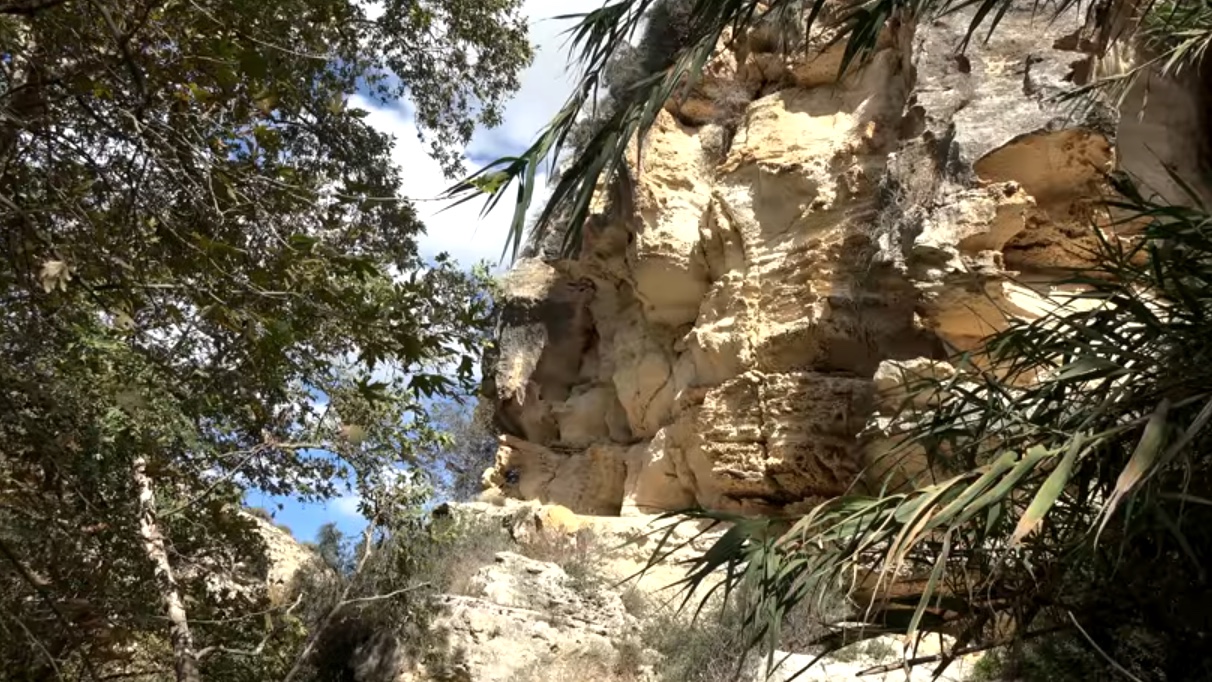
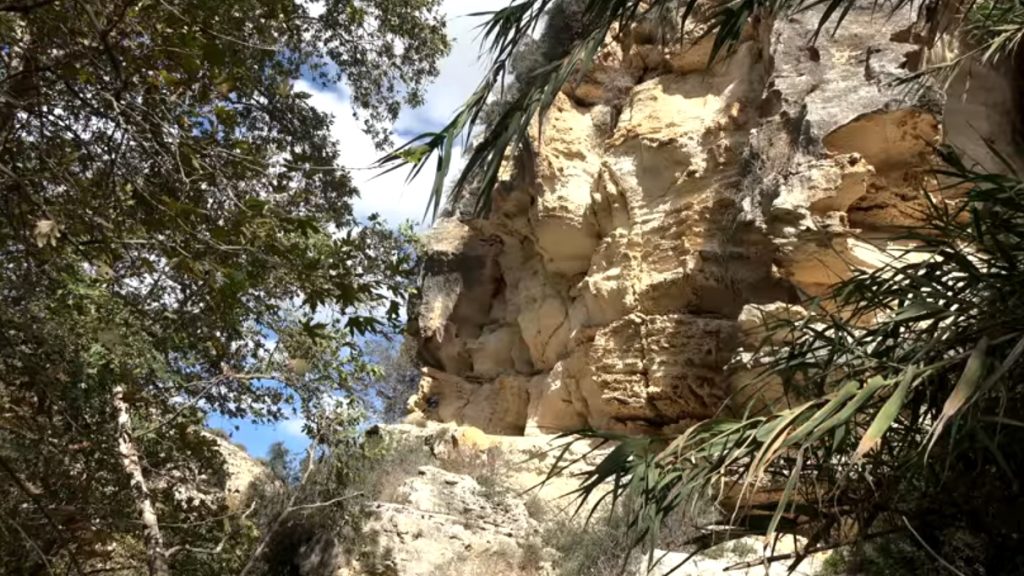
Hardly any other path in the district brings together so many natural, geomorphological and cultural points of interest; the valley is full of history and tradition, of ancient and merely old buildings. One walks along green paths past numerous springs, beneath planes, oaks and cypresses, with willows and osiers crowding the banks, among kermes oak (prinos), mastic bushes and an abundance of endemic wild flowers and herbs. Along the way the river forms small pools and basins in which water often stands well into the summer. The wildlife is notable too: more than 44 species of bird have been counted, together with seven species of mammal.
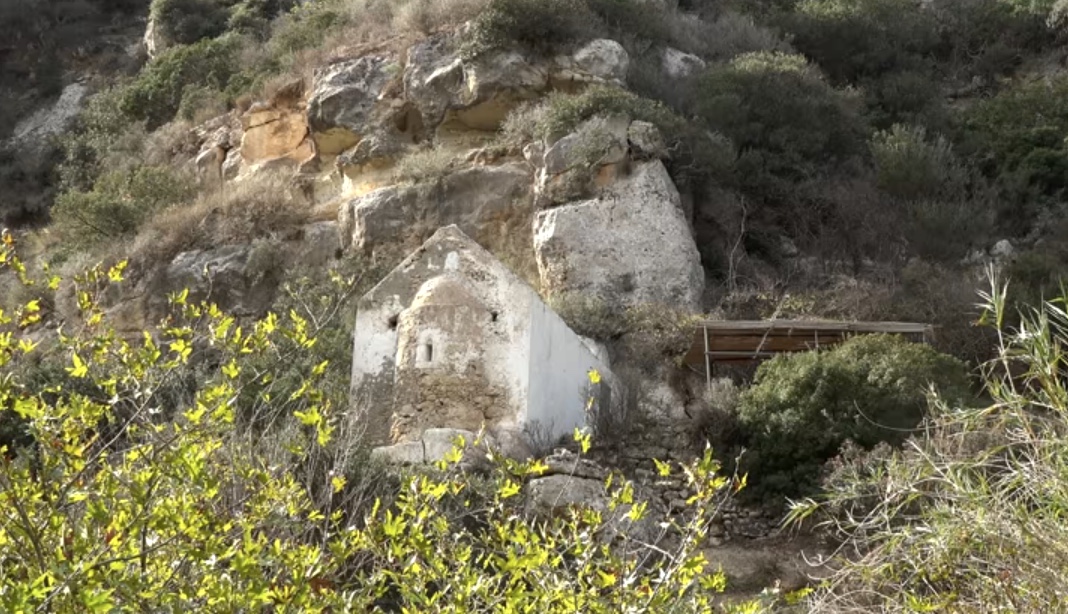
On the way one comes upon chapels among the rocks, old watermills and small waterfalls – evidence that the valley was once busily used. The mills were driven by the river, and the farmers of the surrounding villages ground their corn in them; ten were still at work before the Second World War, and the ruins of several stand beside the path, as does the old arched bridge known as the Astrakiani Kamara near Kato Astraki. The middle section is especially impressive, with its luxuriant vegetation and curiously shaped rocks. Here lies the Neraidospilio (Νεραϊδόσπηλιο), the “Fairy Cave”, inside which a spring rises and feeds a clear pool. Legend has it that the Nereids, the water fairies of Cretan folklore, chose this very cave for their dwelling, and more than once they are said to have appeared to the people of the village. The entrance is closed by a gate, so the cave is seen from outside, reached by a short side path.
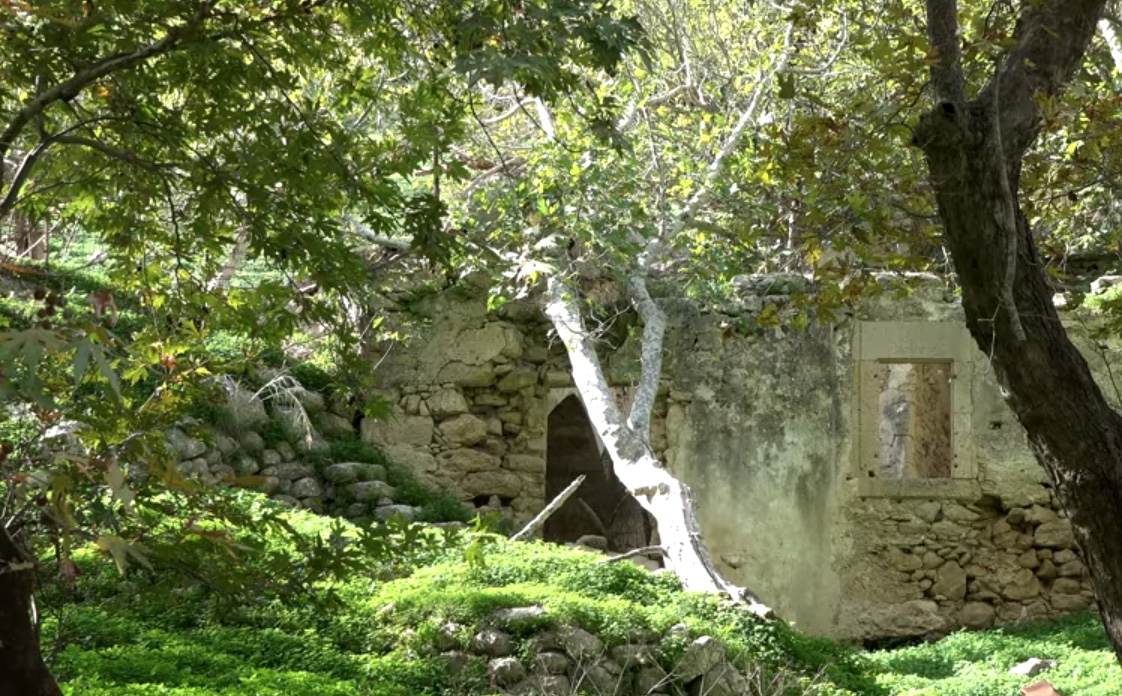
Close to the Neraidospilio, beside the path, are the ruins of a church dedicated to St George, a three-aisled Byzantine basilica. A hundred metres further on stands the church of the Panagia, with the Byzantine double-headed eagle above its doorway; an abandoned chapel of St Nicholas also stands by the trail, and a second chapel of the same saint waits at the lower end. The path goes on to the deserted settlement of Kato Astraki, two kilometres from Astraki, whose inhabitants left it at the beginning of the 1930s. In the gorges of this area archaeologists have identified several sites, among them ancient Eltyna, the Minoan settlement of Myrtia and the Minoan cemetery of Astraki.
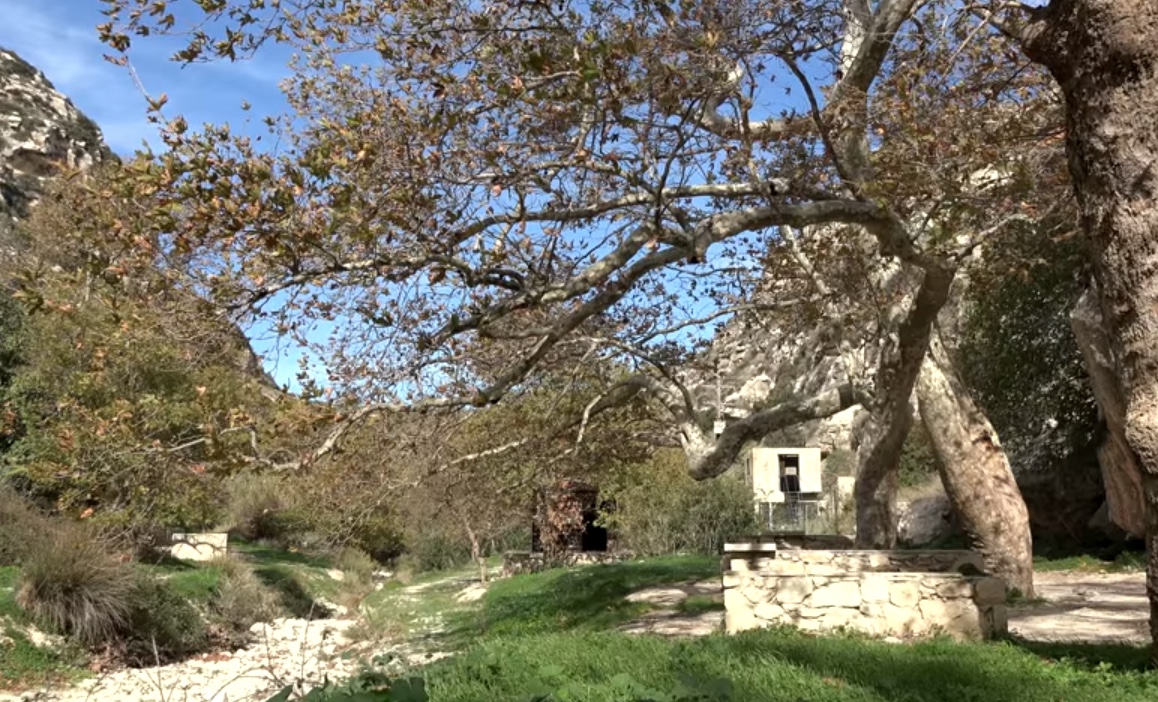
At the mouth of the gorge, at the place called Mesa Karteros, there are an information point, a car park and a picnic area for visitors, beside the little chapel of St Nicholas. Anyone who does not wish to walk the gorge from end to end can stroll some way up the valley from here and return by the same path.
Amnisos
By way of explanation, a word first about the cave of Eileithyia. The Greek name Eileithyia (Εἰλείθυια) denotes the goddess of childbirth and of women in labour. The cave near Amnisos was a place of worship from the Neolithic onwards and became a Minoan sanctuary in the third millennium BC; the excavations of 1929–1938 show that it was frequented at least into the Geometric period and far beyond. Its pottery runs from the Neolithic to the Roman age, most of it Minoan.
On the hill of Amnisos, according to local tradition, a momentous event of ancient mythology took place: here the umbilical cord fell from the newborn Zeus.
Find on the map
Introduction
The people of the district marked the event fittingly, naming the plain behind the hill of Amnisos the Omphalion pedion (Ὀμφάλιον πεδίον) – the “Plain of the Navel”. The Hellenistic poet Callimachus already tells, in his Hymn to Zeus, how the cord fell from the divine child as the nymphs were carrying him to Knossos, and that the plain took its name from this; exactly where it lay, however, is a matter of dispute among scholars.
The area is of note besides for the ancient town of Amnisos and for the island of Dia, lying not far offshore: according to the myth it was here that Theseus abandoned Ariadne after his fight with the Minotaur.
And finally, of course, there is the most famous sight of the place – the cave of Eileithyia.
Ancient Amnisos and Ariadne’s island
Amnisos belonged to the domain of Knossos, which explains its strategic and economic importance; the shipyards attested here bear witness to it. The merchant fleet of Knossos, reputed one of the most powerful in the Mediterranean, had its principal base in the harbour of Amnisos. Homer mentions the port in his epics, the Iliad and the Odyssey: from here Idomeneus is said to have sailed with a great fleet for the Trojan War to bring back the fair Helen, and Odysseus too is said to have put in during his long wanderings. In Book 19 of the Odyssey – in the tale the disguised Odysseus spins for Penelope – Amnisos is the place where the cave of Eileithyia is, and its harbour is a difficult one to make. The name is in fact older than Homer: it appears as a-mi-ni-so on Linear B tablets from the palace archive at Knossos, which record among other things offerings of honey to Eileithyia. The word has a place in the history of scholarship as well, for it was one of the place names that helped Michael Ventris to decipher the script.
The centre of the ancient settlement was the hill of Paliochora, also called Mesovouni, on the north-eastern edge of the plain at the mouth of the Karteros, seven kilometres east of Heraklion. Today a well-equipped bathing beach stretches at its foot, with umbrellas, showers and small snack bars, so that archaeology and swimming combine here without effort.
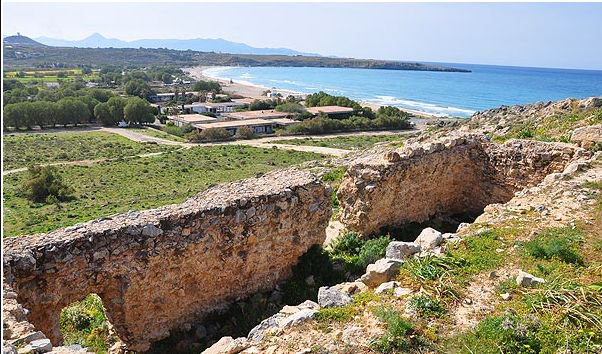
The excavations that began on the hill in 1929 brought important finds to light. In 1932 the archaeologist Spyridon Marinatos uncovered the celebrated Minoan “House of the Lilies”, a two-storeyed building of about twelve rooms with a paved court, a hall divided by pier-and-door partitions, a kitchen, a bathroom and a shrine, dating from the end of the Middle Minoan period. The walls of the interior were decorated with frescoes of white and red lilies, shown growing in containers alongside mint, iris and papyrus; the panels, some 1.8 metres high, are now in the Archaeological Museum of Heraklion. Also found were an Archaic sanctuary with a sacrificial altar to Zeus, of the 6th century BC, enlarged in Hellenistic times as the sanctuary of Zeus Thenatas with a great circular altar – from it come two life-size limestone eagles, the sacred birds of the father of the gods – and, close to the shore, the remains of the harbour of Amnisos, which were submerged after the eruption of the volcano of Santorini.
It was at Amnisos that Marinatos observed volcanic pumice in the Minoan levels. This led him to his later famous thesis that the eruption of Thera and the tidal wave that followed dealt Minoan civilisation a heavy blow; the House of the Lilies itself was destroyed, by fire, around 1500 BC. He followed the trail for decades – until his excavation of Akrotiri on Santorini, from 1967.
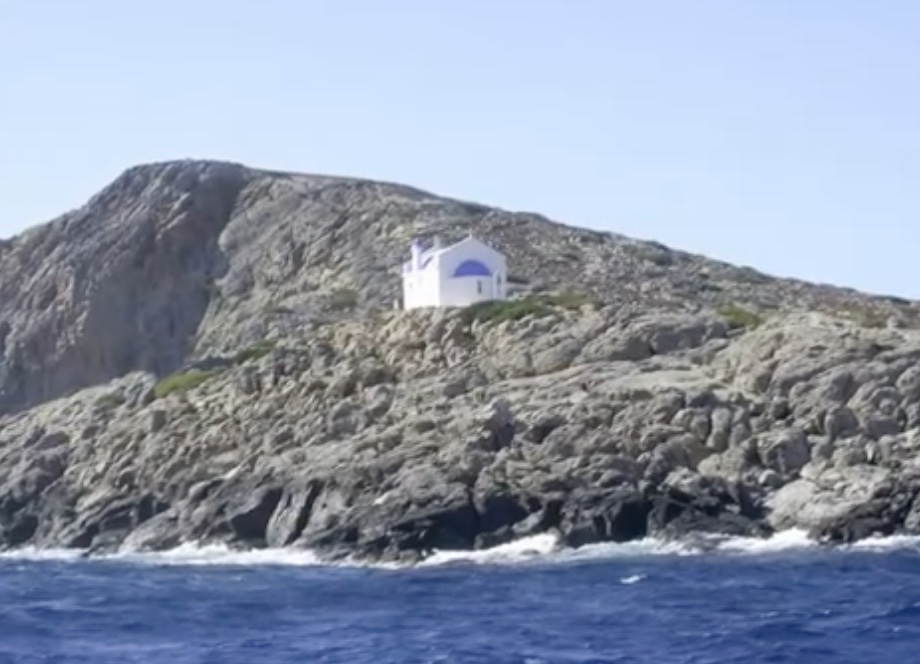
The island of Dia (Δία, popularly Ντία), about 13 kilometres north of Heraklion, is linked with the myth of Theseus, who left Ariadne here after the fight with the Minotaur (in another version he deserted her on Naxos). A second legend explains its outline, which from the city looks like a basking reptile: a giant lizard set on destroying Crete was turned to stone by a thunderbolt of Zeus. In the mid-1970s Jacques-Yves Cousteau discovered off its shores the remains of a further Minoan harbour, with living quarters and stretches of town wall, together with traces of shipwrecks from Minoan to modern times. These finds show how greatly the area flourished before the catastrophe of the Santorini eruption. Today the uninhabited, barren island, five kilometres long, three wide and rising to 220 metres, is a protected area within the Natura 2000 network, home to Cretan wild goats (kri-kri) and to several hundred breeding pairs of Eleonora’s falcon; in summer excursion boats cross from the harbour of Heraklion, generally to the bay of Agios Georgios, one of four coves on the south coast, with its small chapel and a taverna.
The cave of Eileithyia (Spilaio Eileithyias)
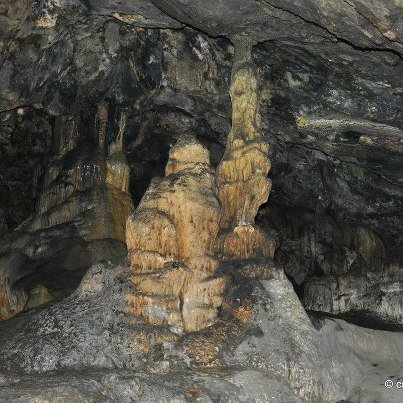
The “Cave of the Nymphs”, as it is also called – popularly, like the one in the gorge, Neraidospilio – lies about a kilometre south-east of Amnisos on the eastern slope of the Karteros valley, some seven kilometres east of Heraklion; a gnarled fig tree used to mark its entrance. It is about 60 metres long, 9 to 12 metres wide and only 3 to 4.5 metres high. Stalactites and stalagmites give it an unmistakable natural character. In the middle of the cave stands a rectangular altar, which underlines its cult significance. Most singular of all are two cylindrical stalagmite columns whose outlines suggest a woman and a child – the taller, in the centre, has the look of a standing female figure; they lend the place an air of mystery and were evidently worshipped in antiquity as embodiments of the deity herself. A stone wall enclosed this sacred area, and small water basins in the rock probably served ritual purposes.
The cave is regarded as one of the oldest places of unbroken worship in Crete. Archaeological investigation confirms that the goddess Eileithyia was venerated here, whom Homer names as a daughter of Zeus and Hera. As protector and comforter of women in childbirth she received honours in Minoan, Geometric and Roman times, down to the 5th century AD; women brought her milk, honey, oil and woollen cloth. Among the offerings are vases in human form of the 7th century BC and a remarkable number of Egyptian and Egyptian-style objects, including figures that recall Isis suckling Horus. According to the myth the goddess was born in this very cave.
The finds attest use from as early as the Early Neolithic – testimony to a history of thousands of years as a centre of cult. The first investigations were made in the 19th century by Joseph Hatzidakis; the cave was then systematically explored by Spyridon Marinatos between 1929 and 1938. Remains of buildings near by are interpreted as lodgings for priests or guardians. The entrance is closed by an iron gate; the interior can be visited only with a permit from the competent authorities, but the forecourt may be approached at any time. A torch is useful for peering in through the bars.
The route from Amnisos to Malia


On the way to Malia
Between Amnisos and Malia there are several places to stop, as inclination dictates. Many readers will be staying in the area in any case, for the coast between Heraklion and Malia is among the most thoroughly developed for tourism in Crete. The pleasantest way to travel is along the old coast road, which runs parallel to the north-coast highway (VOAK) and passes through all the larger resorts.
Kokkini Chani
The resort of Kokkini Chani – the name means “red inn” – is known for its golden sandy beaches, friendly tavernas and plentiful entertainment. Every guest finds something to suit: bathing in clear water, a taste of traditional Cretan cooking, or a varied choice of things to do in the evening. But it is not the beach alone that draws travellers here.
The Megaron of Nirou (Μέγαρο Νίρου) deserves particular attention. It was discovered in 1918 by the eminent Cretan archaeologist Stefanos Xanthoudidis, a pioneer in the study of Minoan monuments; after trial trenches in the summer of 1918 he uncovered the whole building, measuring about 34 by 30 metres, in the summer of 1919. The megaron is a two-storeyed structure from the transition between the Middle and Late Minoan periods; it is usually dated to about 1550 BC, or more precisely to the phases MM III to LM IA (roughly 1700–1480 BC). The total area is around 1,000 square metres; the ground floor alone has some 40 rooms, with two spacious courts, a shrine, a staircase to the upper floor, chambers lined with benches and storerooms for farm produce. It stands only about 50 metres from the shore, some 12 kilometres east of Heraklion.
The courts of this handsome building are paved with large stone slabs, often described as marble. At the entrance were found horns of consecration (κέρατα καθοσιώσεως), which underline the religious purpose of the house. Carefully considered arrangements – for the supply of water, for lighting, for drainage and for keeping the precinct clean – speak of the high technical standard of Minoan civilisation some 3,550 years ago. The builders used large dressed blocks of ashlar with a framework of timber beams, which gave the walls elasticity against earthquakes, and finished the surfaces in plaster.
In the north hall splendid wall paintings were preserved, evidence of the cultural level of the society that produced them; one fragment shows a “sacred knot”. Among the finds are numerous ritual vessels, stone lamps, clay tripods interpreted as altars, and four large bronze double axes – the double axe being the very emblem of Minoan civilisation – besides many other objects. In some of the votive cups there was pumice from the eruption of Thera. What the building was for remains disputed: it has been explained as the residence of a high priest, as a workshop and store for cult equipment, as a semi-public religious building, or as the administrative centre of the coastal settlement, closely tied to Knossos. A fire in Late Minoan times, in the 15th century BC, put an end to its use; it was never lived in again.
Since 1960 the site of the Megaron Nirou – often called the “Palace of Nirou” – has been under state protection; even so, access for visitors is unrestricted. The ruins are compact, and they offer a rare opportunity to get to know the legacy of the Minoan age at close quarters and without the crowds.
The Labyrinth of the Minotaur – the Cave of Skotino
The detour to Skotino (Σκοτεινό) is worth making if you would like to see one more cave that people have been visiting since the earliest times. It lies high on a hillside about 1.5 kilometres north-west of the village, a few kilometres inland from the coast at Gouves, and it is uncommonly beautiful: stalactites and stalagmites have grown together into fantastic shapes. Steps lead down into an enormous karst shaft and out into a hall whose roof rises to 37 metres and which, on account of its size, is known as the “Great Temple”. The hall is roughly 126 metres long and some 36 metres across; add all the passages together and the total comes to a little under half a kilometre, which makes this one of the largest caves on Crete. Four further chambers lie on different, descending levels deep inside the mountain, and most visitors have no idea that the most impressive part begins only beyond the great hall.
The cave served as a sanctuary of ancient deities; which ones exactly has never been settled. It seems to have begun as the shrine of a female fertility goddess, and many scholars think of Artemis or her Cretan counterpart Britomartis, whose cult the Romans in turn continued under the name of Diana. Arthur Evans was the first to examine the cave in the early 20th century; soundings by Evans and John Pendlebury in 1933 and a fuller excavation by Kostis Davaras in 1962 produced finds running from the Late Neolithic (5th millennium BC) through the Minoan and Protogeometric periods to Roman times, among them a considerable number of bronze and pottery votive offerings. Basins hollowed into the stalagmites to hold water were evidently used for ritual purification. The French scholar Paul Faure went so far as to identify the twisting cave with the legendary Labyrinth itself – an attractive but unproven theory, and the source of its nickname.
At the entrance you will see the ruins of a Christian church of the 16th century; they show that this mysterious place has linked people with higher powers over a great many centuries. On the level ground above the cave stands the chapel of St Paraskevi, after whom the cave is also named – locals know it simply as the Cave of Agia Paraskevi. On her feast day, 26 July, the faithful of the surrounding villages gather here for a large patronal festival (panigyri). Stout shoes and a torch are advisable for the visit: the floor is damp and slippery in places, the light fades quickly once you leave the great hall, and the cave is home to bats, which should not be disturbed.
We return to the main road, continue eastwards along the coast, and after about ten kilometres reach Limenas Chersonisou, the “Port of Hersonissos”, some 25 kilometres east of Heraklion.
Hersonissos
Hersonissos is one of the largest holiday centres in the whole of Crete, extremely well organised, with fine sandy beaches where everything is laid on for every kind of water sport. Hotels of all categories, and in great numbers, cater for every purse; the airport of Heraklion is only about 25 kilometres away, which goes some way to explaining the resort’s success. Countless bars, restaurants, tavernas and cafés stay open for their guests into the small hours. The nightlife is at its liveliest in the pedestrianised Agias Paraskevis Street. Anyone who would rather have peace after dark is more likely to find it on the harbour promenade, where the fishing boats are moored.
By day a visit to the large water park, covering some 40,000 square metres, is as much part of the programme as the endless sandy beaches that run on towards Malia. For those whose curiosity survives the amusements there is more to discover: Sarakino, a splendid Roman fountain on the seafront road, pyramidal in form and faced with mosaics of fishing scenes; the church of St George on a small cape west of the town; and the imposing basilica of St Nicholas in the eastern part. On the rocky hill behind the harbour lie the ruins of another Early Christian basilica, with mosaic floors. Individual stretches of the Roman water supply survive as well, an aqueduct of the 1st to 2nd century AD. Of the ancient port, which belonged to Lyttos, there also remain traces of the theatre and a handsome marble fountain with mosaic pictures.
The history of the place goes back a long way. Pottery and traces of settlement prove that people were living here as early as Minoan times. In the Hellenistic period Chersonesos (Χερσόνησος or Χερρόνησος) was the harbour of the Dorian city of Lyttos in the interior, yet kept a certain independence and struck its own coins showing the prow of a ship. The hill of Kastri is thought to have been a sacred acropolis with a sanctuary of Artemis Britomartis – a temple of the goddess stood on the coast about a kilometre east of the town; a wall on the hill dates from the Hellenistic period, and a cemetery of some 30 rock-cut tombs yielded vessels, gold and silver coins and rich jewellery. The city reached its height in Roman and Early Byzantine times, with a theatre, public baths and an aqueduct said to have been about 14 kilometres long; an underground cistern measures 58 by 22 metres and is 5.5 metres deep. In the Christian centuries it was the seat of a bishop, subordinate to the metropolitan of Gortyn, and its bishops are recorded from 431 to 787. The Roman theatre was still visible in the late 19th century but was destroyed in 1897.
From the busy town it is a short drive up to the foot of Mount Charakas and the three traditional villages of Ano Hersonissos, Piskopiano and Koutouloufari.
Ano Hersonissos – Piskopiano – Koutouloufari
These three pretty villages lie very close to the noisy coastal town and yet could hardly be more different from it. They may fairly be described as an “open-air museum”. The houses are without exception built of stone and roofed with tiles, and the paved courtyards are full of flowers and keep the atmosphere of a traditional Cretan village. Old women sit knitting at their doors and offer the passing walker a sprig of basil and a glass of fresh water. Everywhere there is an air of rural calm.
The narrow lanes, patiently laid as stone paths, invite aimless strolling; in the evening the small tavernas fill with guests enjoying the view down to the lights of the coast. In Piskopiano an agricultural museum displays tools and objects from the farming life of earlier times. Ano Hersonissos is also called Megali Chersonisos, “Great Hersonissos”; around its village square with the kafenia, everyday Cretan life can still be watched going on much as it always has. Together with the neighbouring settlements of Anisaras, Panagia and Sarantari, the villages now form a small and popular holiday district high above the sea.
Stalida
This well-known resort is still very young: it grew up in the 1980s on the bay of Stalida (Σταλίδα, also Stalis), whose sandy beaches, invariably clear and calm water and gently shelving seabed draw holidaymakers from all over the world. Stalida, too, is well provided for and has nightlife as busy as that of Hersonissos and Malia, if a little quieter. It is mainly young people who come here to relax. Behind the resort the slopes climb to the mountain village of Mochos, to whose territory the coastal settlement belongs, and along the beach you can walk all the way to neighbouring Malia.
We continue eastwards and come to Malia.
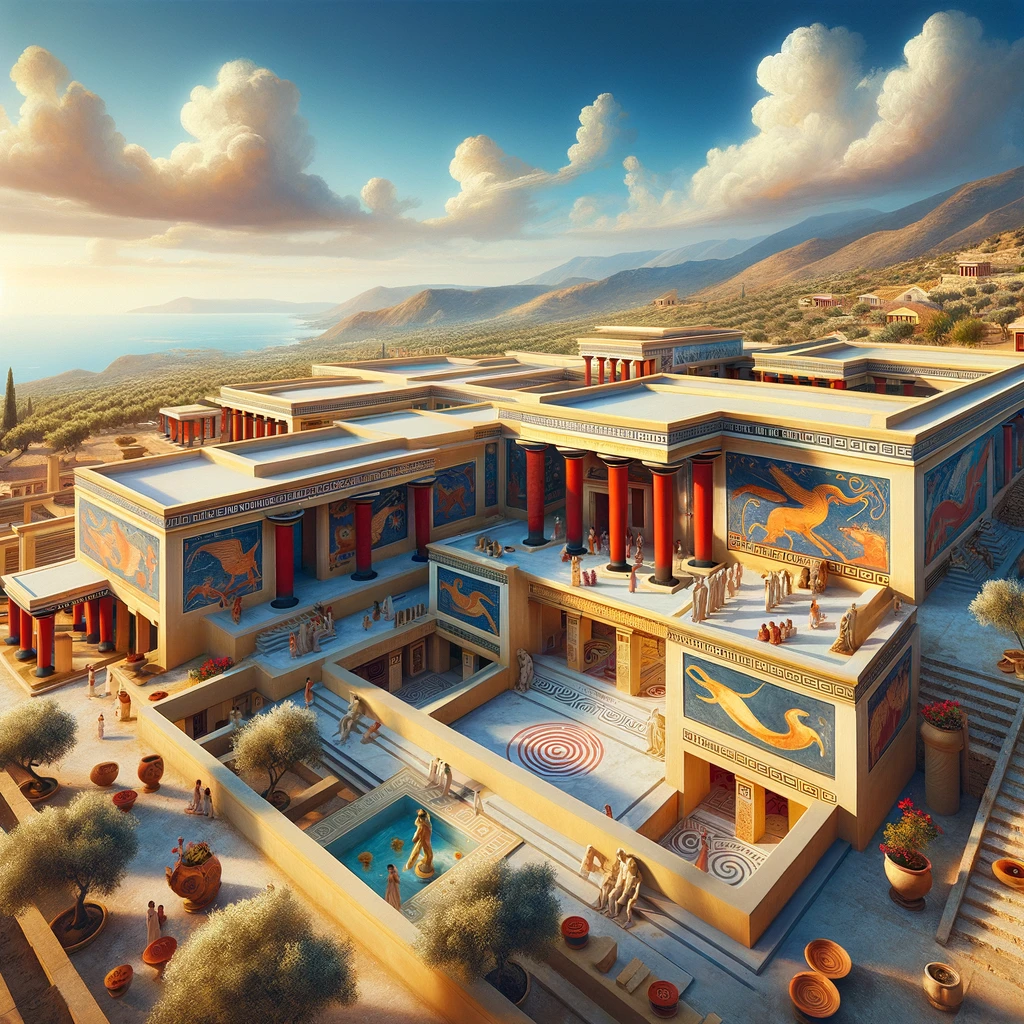
Malia
Present-day Malia is a seaside resort on the north coast of Crete, about 34 kilometres east of Heraklion, in the immediate neighbourhood of the Minoan palace with its exceptionally rich history.
Find on the map
Introduction
Malia is among the leading holiday centres of Crete. Known for its attractive sandy beaches – the shoreline here runs for some six kilometres – and for its well-developed facilities, it draws visitors from all over the world with a wide choice of entertainment and cultural sights. Chief among the latter are the excavations of the Minoan city over which, according to legend, King Sarpedon ruled, and some remarkable churches, first of all the Panagia Galatiani, in whose construction, local tradition says, milk was used instead of water. Malia is also famous for the finds from the burial precinct of Chrysolakkos, the “Gold Pit”, which owes its name to the wealth of gold objects recovered there. In this way the place combines a beach holiday with a good deal of history.
The Panagia Galatiani (Παναγία Γαλατιανή) was built in the 14th century as a single-aisled church and enlarged in the late Venetian period, by the addition of a north and a south aisle, into a three-aisled basilica. In the original nave there survive 14th-century frescoes of high quality with scenes from the lives of Christ and the Virgin Mary; it is characteristic that each scene shows only the essential figures – the Crucifixion, for example, has Christ, Mary and St John the Evangelist alone. The church also keeps a notable collection of icons of the 15th to 19th centuries, among them works of the Cretan School; it belongs to the Metropolis of Petra and Cherronisos.
Modern Malia
Malia is one of the largest holiday centres on Crete. It stretches along a magnificent sandy beach, has tourist facilities of a high standard and, in summer above all, attracts thousands of visitors from around the world – a striking contrast with a resident population of about 5,500. Only Limenas Chersonisou can rival it for sheer “tourist density”, and the two now belong to the same municipality of Hersonissos. The main street, which bears the name of Venizelos, links the beach resort with the old village of the same name, which lies a little higher up and is surrounded by green olive groves.
It is precisely this old Malia that repays a walk away from the bustle of the beach: among low stone houses, churches and small squares with tavernas, something of the life of a Cretan country town can still be felt, and in the evening people sit under vine pergolas while down on the coast the nightlife is getting under way. In the background rise the mountains of the Selena massif, which close off the fertile coastal plain to the south.
Ancient Malia
Malia, on the north coast of Crete, is one of the most important archaeological sites bearing witness to the greatness of Minoan civilisation. This ancient city, wreathed in myth and legend, was with Knossos and Phaistos one of the three chief centres of the Minoan world. The site was occupied from the middle of the 3rd millennium BC, and Malia flourished between 1900 and 1450 BC, when its principal monument was built and prospered: the palace, famous for its well-considered architecture and advanced technology. The first palace was built c. 1900 BC and destroyed c. 1700 BC; its successor, raised on the same spot c. 1650 BC in dressed sandstone and mud brick, stood until the final destruction c. 1450 BC. At some 7,500 square metres – roughly 80 metres by 100 – it is the third-largest palace on Crete. It stands only about 20 metres above sea level and little more than a kilometre from the shore, from which it is separated by marshy ground that seems to have been marsh in Minoan times too. What the ancient city was called has not come down to us; some scholars think of Milatos. Since 2025 the palace has been a UNESCO World Heritage Site, together with Knossos, Phaistos, Zakros and other Minoan centres.
According to legend the kingdom of Malia, like other Minoan city-states, was governed by mythical rulers, direct descendants of Zeus and Europa. Sarpedon, the brother of Minos and Rhadamanthys, reigned over Malia and brought it prosperity and wealth; Herodotus tells how the brothers later fought for the Cretan throne and how Sarpedon, defeated and driven out by Minos, crossed the sea and became king of the Lycians. The archaeological excavations began in 1915 with soundings by Joseph Hatzidakis and have been carried on since the 1920s by the French School at Athens – at first under Fernand Chapouthier, who dug here until 1936, and from 1964 under Olivier Pelon. They brought to light not only splendid palace buildings but also a complex urban fabric of houses, ceremonial buildings and cemeteries, pointing to a highly developed social and economic system. Of particular importance is Quartier Mu, a complex of some 3,000 square metres about 200 metres north-west of the palace, regarded as the most important ensemble of the Old Palace period on Crete; its houses doubled as workshops, two hoards of craftsmen’s tools – drills, saws, axes and adzes – were found in them, and it has yielded inscriptions in the still undeciphered Cretan Hieroglyphic script.
Among the most impressive features of Malia is its labyrinthine palace, comparable to that of Knossos. With its interlocking parts on several storeys – the Central Court of about 48 by 23 metres with an altar at its centre, two smaller courts to the north and north-west, ceremonial halls, storerooms and living quarters – it shows an astonishing degree of architectural and engineering skill on the part of the Minoans. Its special features include the Loggia, a raised hall open to the court, a pillar crypt with a cult function, broad flights of steps that served at the same time as seating for spectators, eight circular grain silos in the south-west corner and the famous kernos, a round offering stone with small hollows around its rim. The storerooms held earthenware jars as much as two metres high. A water supply and drains, together with carefully planned lighting and ventilation, testify to the high technical achievements of this ancient culture.
North of the palace, near the shore, the burial precinct of Chrysolakkos was discovered, a building of dressed stone measuring about 30 by 39 metres and divided into many small rooms, which dates from the Old Palace period (c. 1900–1700 BC). There archaeologists found numerous burials with rich grave goods, including exquisite gold jewellery. Especially remarkable is the jewellery in the form of bees, above all the world-famous gold pendant with two bees holding a honeycomb. Found by the French excavators in 1930 and first published by Pierre Demargne, it is only 4.6 centimetres high and 4.4 wide: the two insects are set head to head as mirror images, with small discs hanging from their wings and tails. It is now on display in the Heraklion Archaeological Museum and is probably the best-known single piece of Minoan jewellery, a measure of the high art of the Minoan goldsmiths. As early as the 19th century the British admiral Spratt reported “gold leaves” that peasants were finding here. These finds confirm that Malia was an important religious and cultural centre in which craft and art flourished.
Sadly the greatness of Malia, like that of many other Minoan cities, was brought to an abrupt end around the middle of the 15th century BC. For a long time this was put down to the eruption of the volcano of Santorini and the tsunami that followed, causing destruction across the island; today scholars generally date the eruption somewhat earlier – geological traces at Malia itself point to only a modest wave – and reckon with several causes working together. Despite some attempts at rebuilding – in the 14th and 13th centuries BC parts of the site were lived in again, notably in Quartier Nu, a house of three wings around a court, until about 1250 BC – the city never regained its former importance. From later times there are remains of Roman buildings on the coast and an Early Christian basilica of the 6th century.
The site is open to visitors. It is best to come early in the morning, before the heat settles over the stones, for there is little shade in the courts; the most important finds are to be seen in the Heraklion Archaeological Museum and in the museum of Agios Nikolaos.
The “Milk Church” of Panagia Galatiani
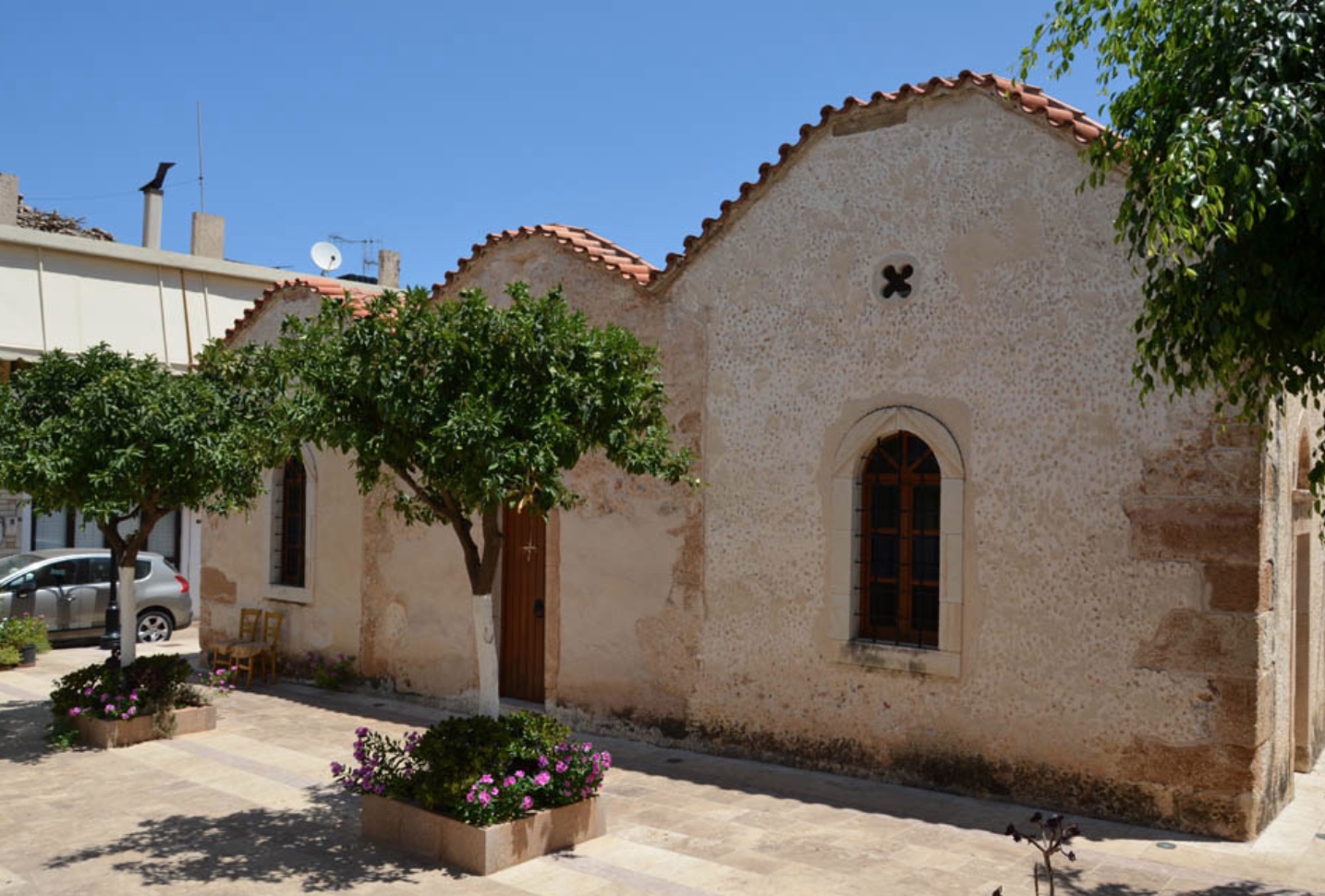
Among the sights of Malia one church stands out in particular: the church of the Mother of God, dedicated to the feast of the Assumption – in Orthodox tradition the Dormition of the Virgin – which local people know only as Panagia Galatiani (Παναγία Γαλατιανή). The epithet goes back to an endearing legend: when the church was being built, the mortar is said to have been mixed not with water but with milk, carried here by shepherds and stock-breeders from the whole district. The Greek word gala means “milk”, and so the name still recalls this gift of the shepherd families. Similar tales of churches said to have been built with milk are known from other parts of Greece as well.
The church stands in the old centre of Malia, away from the lively hotel strip on the coast, and belongs to the Metropolis of Petra and Cherronisos. Originally it was a plain single-aisled building; only in the late Venetian period were a north and a south aisle added, so that today it appears as a three-aisled church. Inside, wall paintings of high quality from the 14th century have survived. They relate scenes from the lives of Christ and the Mother of God and confine themselves to essentials: the Crucifixion, for instance, shows only Christ, Mary and St John the Evangelist. All the more striking is the Last Judgement, which occupies the entire west wall and parts of the north and south walls and is unusually large in proportion to the rest of the painted programme; in it the twelve Apostles hold open books in their hands. The collection of icons is also noteworthy, with works from the 15th to the 19th century, among them two of the Cretan School: a Beheading of St John the Baptist and a Deesis, the intercession of the Virgin and the Baptist before Christ enthroned. The church is, moreover, a station on a pilgrims’ route that leads from Avdou across the Lasithi Plateau to Malia.
Other churches in the town are worth a visit too: the church of St John the Baptist, the church of the Archangels, the church of St Demetrios and above all the church of St George at the locality of Loutra, whose frescoes have come through the centuries astonishingly well. It has a legend of its own: St George is said to have protected wayfarers from the nymphs who haunted this district. In Cretan folk belief these beings are called Neraides; they were imagined as beautiful but dangerous female figures who live by springs and in caves, dance at night and can rob of their wits anyone who encounters them. According to local tradition they still show themselves from time to time.
From Malia we drive back to Stalida and turn south at the junction. The road climbs into the foothills of the Dikti Mountains and after about 12 kilometres reaches the mountain village of Mochos; from there it goes on to the famous monastery of Panagia Kardiotissa, which is also called Kera Monastery after the neighbouring village.
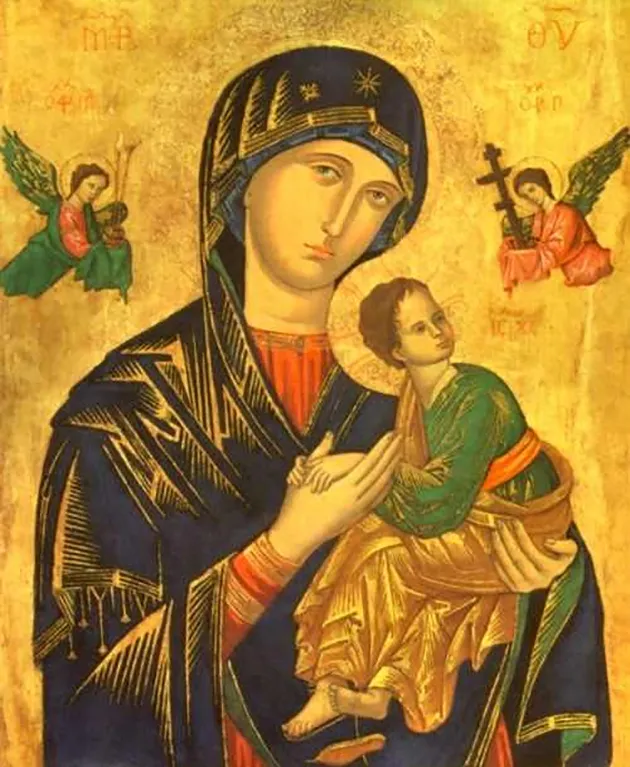
The Mother of God of the Heart (Kardiotissa)
A word on the meaning of the name: the epithet Kardiotissa (Καρδιώτισσα), derived from the Greek kardia, “heart”, goes back to an ancient miracle-working image of the Mother of God that was venerated in the monastery at Kera. In church terms the monastery is dedicated to the Nativity of the All-Holy Mother of God, and its whole life revolves around her wonder-working icon. The house has the rank of a patriarchal and stauropegial monastery, a status it has held since 1720: it is subject not to the local bishop but directly to the Ecumenical Patriarchate of Constantinople.
The icon was made long before the schism of 1054 and so, in a quiet way, preserves the unity of the churches in the veneration of one and the same image: in the East it is called the Mother of God of the Heart, in the West Our Mother of Perpetual Help.
Find on the map
Introduction
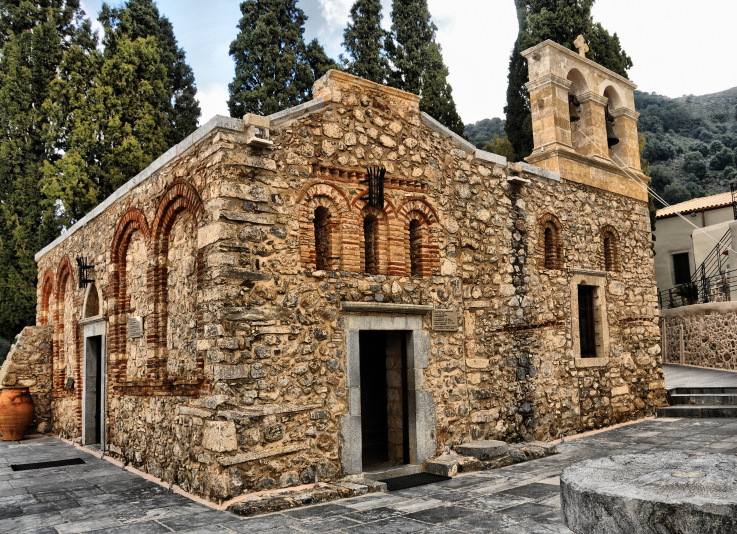
A few kilometres before the climb to the Lasithi Plateau, on the wooded northern slopes of Dikti and beside the road itself, the holy monastery of Panagia Kardiotissa lies in lush green country at a height of 630 metres, by the village of Kera and some 50 kilometres south-east of Heraklion. It is among the oldest monasteries on Crete and is dedicated to the Nativity of the Mother of God, whose feast is kept on 8 September – on that day pilgrims come up from all over the island. When the monastery was founded is not precisely known. It is first mentioned in a document of 1333, at that time as a fief of the Latin Patriarchate; in all probability, however, it already existed before the Venetian conquest of Crete, that is, in the second Byzantine period between the expulsion of the Saracens by Nikephoros Phokas in 961 and the takeover of the island by Venice around 1210. It may have begun as a metochi, a dependency, of Agarathos Monastery. The two villages of Kato Kera and Ano Kera owe their name to the monastery: in Cretan usage Kera is the “Lady” – meaning the Mother of God.
The monastery church, built of rubble masonry, was originally a single-aisled building. In four building phases it grew into its present form, with two narthexes and a small side chapel; its outer walls are enlivened by blind brick arcades and patterns worked in tile. One room, tradition has it, served under Ottoman rule as a “secret school” in which children learned in private to read and write. Inside, frescoes of the 14th century survive, among them seven scenes from the life of the Mother of God. The central and southern parts, painted c. 1320, show cycles from the Gospels and the Last Judgement; the fragments in the northern part date from the 15th century and include a St George on horseback. The paintings are marked by age, but it is precisely their faded colours that give the dim interior its particular dignity.
Its sheltered, fortress-like position between the plain of Heraklion and the Lasithi Plateau made the monastery a centre of resistance in the eastern districts during the risings against foreign rule; for this it had repeatedly to endure reprisals from Venetians and Ottomans alike. The Turks destroyed it in 1822 and, after it had been restored, again in 1842, and during the great revolt of 1866–67, when Cretan insurgents used it as a base, it came under attack once more. As late as the Second World War it served fighters of the Greek resistance as a stronghold. Today Kera is a convent. The nuns keep the place, with its flower-filled courtyards, in the best of order; a small museum shows portable icons, church treasures and rare manuscripts.
This monastery is inseparably bound up with one of the most beautiful icons in Christendom – the miracle-working image of the Mother of God Kardiotissa.
The icon was painted – or, as they say in the Eastern Church, “written” – according to tradition by St Lazaros, a monk and icon painter who lived at the time of the Iconoclast controversy in the 9th century. Others argue for a later origin and connect the image with the Cretan painter Andreas Ritzos (1421–1492); the question remains undecided to this day.
The icon shows the Mother of God holding the infant Jesus on her left arm, close to her heart – hence the name Kardiotissa, “Mother of God of the Heart”. This is a young and beautiful Mary in a dark robe, with a star on her forehead. Her gaze is full of sorrow, for she knows her own fate and that of her son. The child turns his head towards an archangel who holds out the cross to him, and in his fright seeks shelter in his mother’s arms; in doing so one of his sandals has come loose and hangs by a single strap. On either side appear the archangels with the instruments of the Passion: Michael with lance, sponge and vessel of vinegar, Gabriel with cross and nails; abbreviated Greek inscriptions on the gold ground name each of the figures. The picture is small – a panel of about 43 by 53 centimetres. And so it anticipates in a single scene the whole suffering of Christ – and at the same time the tenderness of a mother who cannot protect her child and holds him fast all the same.
The icon reached Crete in the troubled times of the Iconoclast controversy, when the iconoclasts, the opponents of the veneration of images, were destroying icons everywhere. It was brought to the island – presumably from Constantinople – and hidden in the remote mountain monastery; pious tradition even relates that the icon flew to Crete of its own accord. The Byzantine emperor Theophilos (813–842), a determined enemy of images and the last emperor to uphold iconoclasm, who in 832 forbade the veneration of icons by edict, heard of the miracles that issued from the picture and gave orders that it be tracked down and brought to Constantinople, where he intended to destroy it with his own hands.
Twice, however, the miracle-working image escaped its pursuers and each time returned to its church. On the third occasion it was fastened with a heavy chain to a marble column so that it could not “flee” again – and the icon returned to the monastery, column and all. Column and chain are shown in the monastery to this day, the chain inside the church, to the left of the iconostasis; the icon itself, however, is no longer there. In its place a copy of the 18th century is venerated – made in 1735 by an unknown painter – which is likewise held to be miracle-working and full of grace. In 1982 this copy was itself carried off by thieves, but it was recovered once they had been caught. And as for the original …
The story of the icon – as told by Michalis Vrettakis
The earliest written evidence for the monastery dates from 1333; the Florentine priest and traveller Cristoforo Buondelmonti, who visited Crete, mentioned the icon in 1415 and the miracles attributed to it. Later the image found its way to Rome and became known there as Our Mother of Perpetual Help; at Kera a younger copy standing in the same tradition is venerated today. The Cretan writer Michalis Vrettakis traced this long journey in an article for the newspaper Patris; the account that follows keeps in essentials to his brilliant narrative.
Vrettakis sums up the story thus: “The incredible history and journey of the Cretan icon of the Mother of God Kardiotissa from the monastery of Kera near Heraklion links a repentant thief, two Catholic orders, the troops of Napoleon, three popes, an apparition to an innocent girl and the indelible memory of a monk. For sixty years it was forgotten, for fifty papal scudi it was redeemed, four different names it has borne – and today it is to be found in thousands of churches on all five continents. Millions of Christians in more than 82 countries venerate it more fervently than any other Christian icon. Its name lives on in schools, colleges, universities, hospitals, clinics and even sports clubs; it is the patron of states, dioceses and cities and the heavenly patroness of countless churches.
This icon has crossed the borders of states and joined together different cultures, languages and rites of worship throughout the world. The faithful see in it the perpetual helper of the poor, the sick and the weak; it is venerated as an emblem of love and of hope.”
But let us begin the story at the beginning …
The theft of the icon
According to tradition a wine merchant stole the Cretan icon in the year 1498 and took it to Italy – ostensibly to bring it to safety from the Turks, who were then conquering the lands of the eastern Mediterranean one by one. The excuse was not altogether groundless: Constantinople had fallen in 1453, and the Venetian possessions in the Aegean were coming under ever greater Ottoman pressure. Crete itself was at that time still under the rule of Venice, which was to last until 1669.
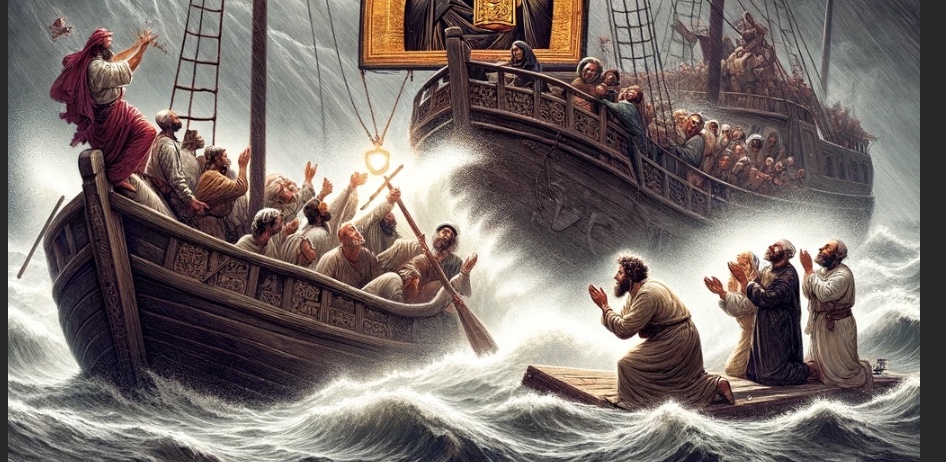
During the crossing a violent storm suddenly broke and threatened to sink the ship. Among the terrified, weeping passengers the merchant brought out the icon; all began to venerate it and to implore the Mother of God to save them – and the sea did indeed grow calm. This time the Mother of God had evidently decided to leave Crete for a while; that while was to become more than five hundred years. A return, at least in likeness, there was nevertheless to be. In the monastery, meanwhile, another image of the Mother of God remained, which is likewise held to work miracles. Let us return, then, to the story of the original.
The icon in Rome
In Rome the merchant fell gravely ill. Faced with death, he recognised the sin of his theft, repented and confided the story of the holy icon to a friend; he asked him to place the picture in a church where it could be publicly venerated. The friend gave his promise, but his wife would not part with so precious an object, and so, in spite of the word that had been given, the icon stayed in the family’s house.
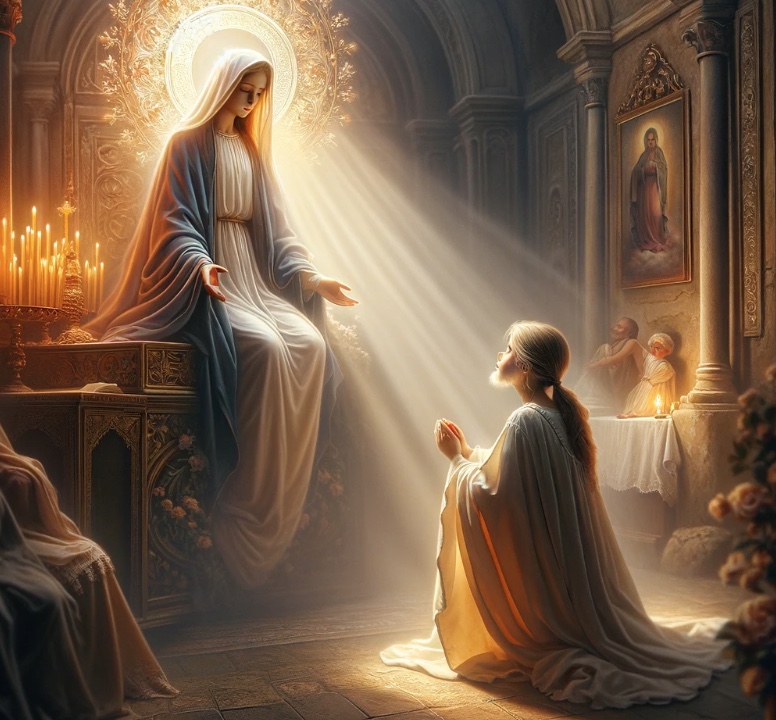
Then the All-Holy Virgin Mary appeared in a dream to the little daughter of the house – about six years old – and charged her to convey the will of heaven to her mother and grandfather: her icon was to be taken to the church of St Matthew, which stood on the Esquiline, one of the seven hills of Rome. According to tradition the apparition on this occasion called herself the “Mother of Perpetual Help”.
The translation to the church
Following the will of the Most Pure, the girl’s mother turned to the order of the Augustinians. The friars received the icon and on 27 March 1499 carried it in solemn procession to the church of San Matteo on the Via Merulana, where it was given the name “Madonna of San Matteo”. During the translation a child is said to have been healed – the first of the many miracles ascribed to the image in Rome.
Our Mother of Perpetual Help
How are the Kardiotissa and Our Mother of Perpetual Help connected? In English the Roman icon, in Italian the Madonna del Perpetuo Soccorso, is known as “Our Mother of Perpetual Help” or “Our Lady of Perpetual Help”. The history of its veneration is bound up with the miracle-working image of the Kardiotissa from the monastery of Kera. Even so, these are different designations within one iconographic and historical tradition – not simply two names for one and the same work of art existing today.
The icon was set up behind the high altar of San Matteo, and for some three hundred years it was honoured every year on 27 March in memory of its miraculous translation. Beside it hung a parchment with the story of its wanderings; a copy of this is kept in the Vatican. The more the veneration of the Byzantine icon from Crete grew among the faithful, the more often it was invoked under a new name: Madonna of Help – the emblem of a hope that never runs dry and of support for all who turn to her.
The iconographic type of the “Madonna of Help”, attested in Italy since 1306, showed the Mother of God as the rescuer of a child. In popular feeling, therefore, the Byzantine model, with the boy Jesus fleeing in fright into his mother’s arms, fitted quite naturally into this tradition.
In 1572 Gregory XIII was elected pope – on 13 May, after a conclave of less than a day; born Ugo Boncompagni, he is the pope whose name lives on to this day in the Gregorian calendar, which he introduced in 1582. Among his projects was the completion of the decoration of St Peter’s in the Vatican, and in particular of the Gregorian Chapel on its south side, which he had built. The pope, himself devoted to this type of image, chose for the chapel a 12th-century icon known as the Madonna del Soccorso, the Madonna of Help, and had it placed there.
To avoid confusion with the Madonna of Help at San Matteo, he gave the latter a new name in 1579: Madonna of Perpetual Help. At the same time the Augustinian friars placed above the entrance of San Matteo the Latin inscription “Deiparae Virgini Mariae succursus perpetui” – “To the Mother of God, the Virgin Mary of perpetual help”. Since then the icon has been called Madonna del Perpetuo Soccorso, in English Our Lady of Perpetual Help.
From the time of Gregory XIII the icon had, as it were, a new vocation: it became the emblem of perpetual help and perpetual protection for all the faithful. This brought it worldwide renown and affection; countless churches – and countless people – have chosen it as their patron.
The following photograph was taken in present-day Italy.
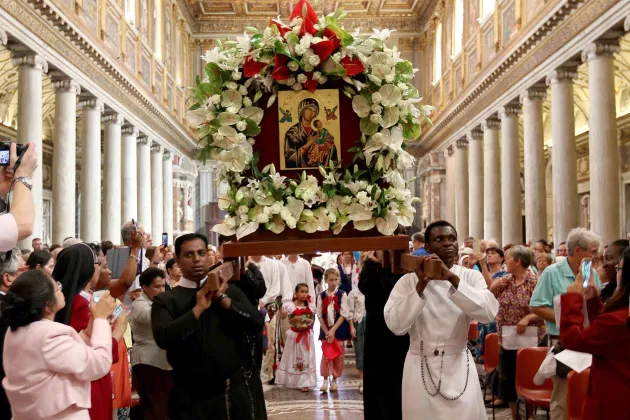
Napoleon and sixty years of oblivion
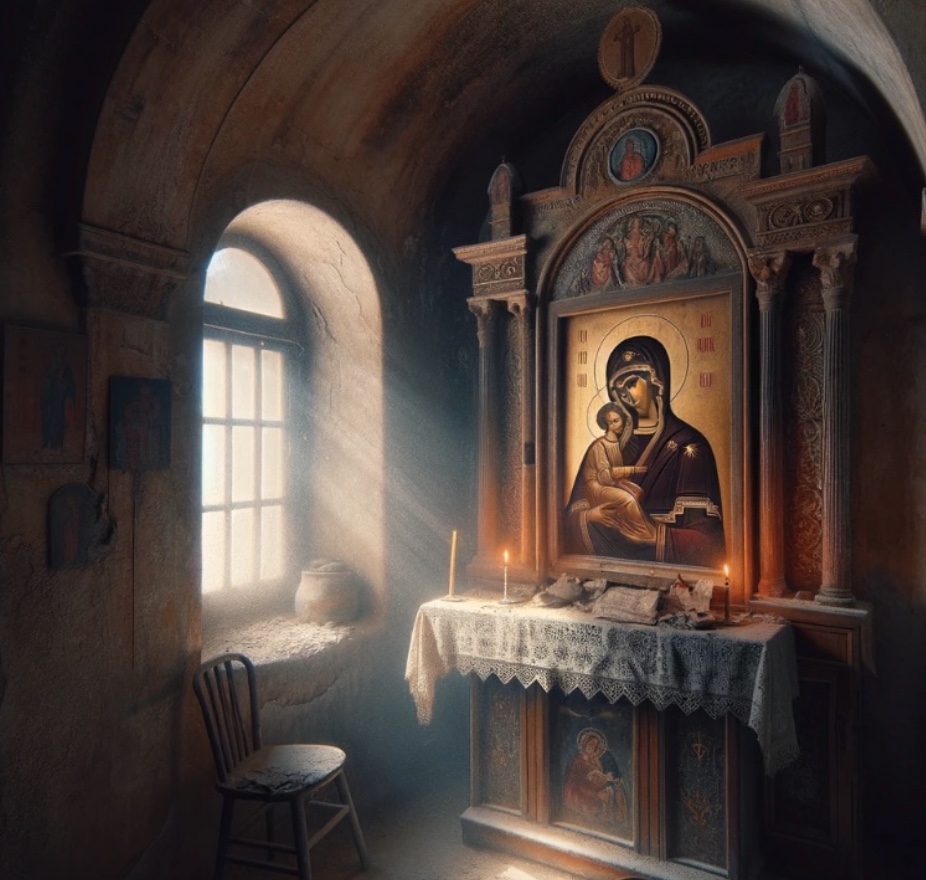
In the course of Napoleon’s campaign in the Italian peninsula, French troops occupied Rome at the end of the 1790s – they entered the city in 1798; Pope Pius VI was forced into exile and died there. For the building of fortifications it was decided to pull down numerous buildings, monasteries and churches in the city – San Matteo among them.
The Augustinian friars of San Matteo were scattered. Those who stayed in Rome – after an interval at the monastery of Sant’Eusebio, to which the icon is said to have been taken in 1799 – eventually found refuge in the small house attached to the church of Santa Maria in Posterula, not far from the Tiber. The brothers had taken with them the icon of Perpetual Help, which they had managed to save at the last moment.
Since another miracle-working image was already venerated in that church, however, the icon was lodged in a small private chapel on the upper floor. There it remained for more than sixty years – without prayers, without lamps or votive offerings, wholly abandoned to oblivion.
At a time when the political storms and wars of the first decades of the 19th century – the Napoleonic Wars, risings and revolutions – were shaking Italy and the whole of Europe, the image passed out of almost everyone’s mind. Only one man remembered: the young Augustinian friar Agostino Orsetti, who had formerly lived at San Matteo and after its destruction had moved to the new church.
Decades later, around 1851, Orsetti told his young friend Michael Marchi, who served as an altar boy in the church, that on the upper floor, in the chapel of the monastery, there was a miracle-working image, the “Madonna del Perpetuo Soccorso” – Our Mother of Perpetual Help – rescued from the demolished church of San Matteo, and he lamented that it no longer received any veneration. Orsetti died in 1853; Marchi entered the Congregation of the Most Holy Redeemer in 1857, whose members are known as Redemptorists, and was later to serve as one of its missionaries.
The Redemptorist order
The Catholic Congregation of the Most Holy Redeemer had been founded on 9 November 1732 by Alfonso Maria de Liguori (1696–1787) at Scala, a small hill town above Amalfi in what was then the Kingdom of Naples; papal approval followed under Benedict XIV in 1748. The order set out to preach the teaching of Christ in poor and neglected communities – through popular missions and sermons, and by founding communities, chapels, parishes, houses of prayer, churches and monasteries. With the backing of the Catholic Church it spread beyond Italy into Europe and North America: to Poland (1786), Germany (1793), Switzerland (1818), Portugal (1826), Austria (1827), Belgium (1831), the United States (1832), the Netherlands (1836) and further countries besides. In the German-speaking lands its chief figure was Clement Maria Hofbauer (1751–1820), who carried the congregation into central and eastern Europe, was canonised in 1909 and is now the patron saint of Vienna. The founder himself had been canonised in 1839 and ranks as a Doctor of the Church.
In January 1855 the Redemptorists bought a property on the Via Merulana in Rome, the Villa Caserta, intending to move their general house to the Eternal City and to build there a new church and monastery in honour of their founder, Alphonsus Liguori. The church went up between 1855 and 1859 to designs by the Scottish architect George Wigley, and is one of the very few Gothic Revival buildings in Rome; the order’s headquarters remain at Via Merulana 31 to this day. With the purchase, the fathers began to take an interest in the history of the quarter in which their new centre lay.
In the sermons of the Jesuit Francesco Blosi they came across a remark that the church of San Matteo had once stood in this neighbourhood, and that it had also been known as the church of the Virgin of Perpetual Help. Descriptions of Roman antiquities likewise spoke of a church in the monastery garden that housed an old image of the Virgin, deeply venerated and famous for its miracles – the icon had been installed in San Matteo on 27 March 1499. At this point Father Michael Marchi remembered what his friend, the Augustinian Agostino Orsetti, had told him, and announced that he knew where the icon was.
Armed with this knowledge, the Superior General of the order, Father Nicholas Mauron, approached Pope Pius IX and asked that the icon be entrusted to the Redemptorists, so that it might be set up once more in the place where it had been venerated for three hundred years. The Pope granted the request and, in a letter of 11 December 1865, committed the icon to the care of the order – with the charge “Fatela conoscere a tutto il mondo”: “Make her known throughout the world.”
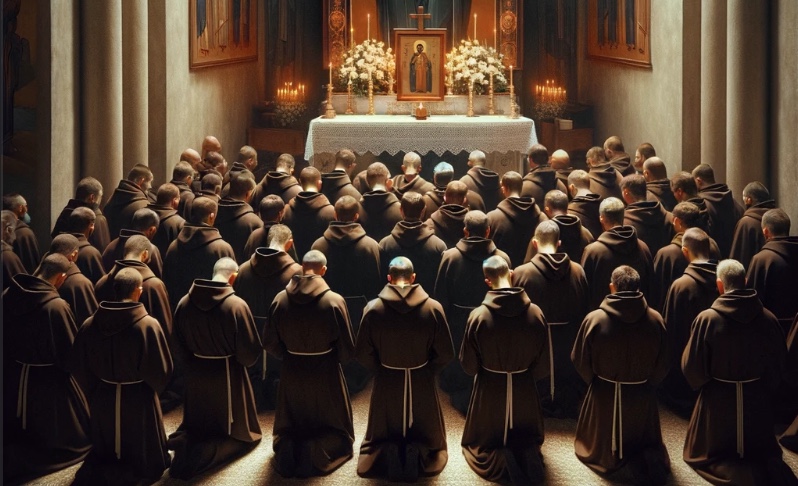
On 1 January 1866 the order received the icon. The church in Posterula, where it had hung since the French occupation of Rome in 1798, was given another image of the Virgin in exchange, together with 50 scudi, the currency of the Papal States at the time. Before the panel was shown in public it was restored by the Polish painter Leopold Nowotny.
Veneration across the world
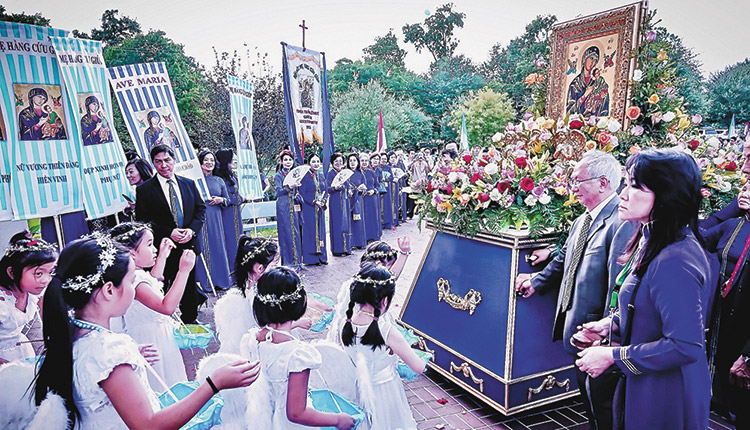
On 26 April 1866 the icon was carried in a splendid procession to the church of Sant’Alfonso, accompanied by thousands of the faithful who had answered a solemn invitation (invito sacro) from the Cardinal Vicar of Rome, Costantino Patrizi. On 5 May Pope Pius IX came in person to venerate it, and on 23 June of the following year the image was solemnly crowned. Ever since, it has been in the church of Sant’Alfonso all’Esquilino, where it can be seen above the high altar: a small panel of walnut, about 43 by 53 centimetres, painted on a gold ground.
The Pope was presented with the first faithful copy of the Cretan icon, which he set up in his bedroom. Since then Our Mother of Perpetual Help has been the patroness of the Redemptorists; her feast was fixed in 1876 on 27 June.
From now on a deliberate effort was made to draw the attention of the faithful to the icon and to spread its veneration not only in Rome and Italy but far beyond. It was certainly needed: after sixty years in obscurity the icon had been all but forgotten and was unknown to most believers.
To begin with, the miraculous image was set up in Sant’Alfonso on a small throne, ceremonially veiled. The “unveiling ceremony” took place on appointed days of the week, the month and the year; this lent the picture a particular value and, in an atmosphere of expectation and solemnity, drew ever more worshippers. Before long it was regarded as a privilege to be present at the services held in honour of the icon.
To make the image known, every means the age afforded was pressed into service: newspapers, photographs, medals, postcards and faithful copies – even embroidery on the vestments of monks and priests – made the faithful familiar with an old icon that had, in effect, been “found again”.
In Sant’Alfonso people now prayed to Our Mother of Perpetual Help and laid their petitions before her, on the other Marian feasts as well and throughout the month of May, which in the Catholic Church is dedicated to the Mother of God. Preachers told of her miracles.
The printing of devotional pictures of Perpetual Help, in every format and technique, grew rapidly. Ten years after the icon’s return to public view, 176,000 pictures had already been printed in Rome; more than 420,000 small images on thin paper were handed out, chiefly to the sick. There were chromolithographs and woodcuts too, gilded editions and coloured ones.
For the year 1902 it was estimated that publishers in Italy, France, Austria and Germany had printed more than 4.5 million pictures, with a further 200,000 in Rome alone in that same year. The number of small images and medals issued in the principal countries of Europe exceeded 55 million.
At the same time the Swiss painter Jakob Wüger (1829–1892) was commissioned to produce faithful copies of the icon in his studio in Rome. The first 400 went to the countries with the largest communities of the order, above all to the German-speaking lands. By 1966 a further 128 churches of the order had been dedicated to Our Mother of Perpetual Help around the world, most of them in Brazil and the United States, with 13 in each of the two countries.
Among the earliest and best-known churches, which quickly became local centres of the devotion, were those in Perth (1869), Boston (1871), Paris (1874), Granada (1879), New York (1887), Montevideo (1889), Leoben (1846), Vienna (1889), Madrid (1892), Valparaíso (1903) and in the Rhône valley in the Swiss Alps (1932). The first copy to leave Italy had gone as early as 1867 to the convent chapel at Argentan in Normandy.
It was just as important to set down in writing the history of the icon, its miracles and its fame, so as to foster its veneration. Between 1866 and 1916 the first books, studies and monographs appeared, and were translated into several languages. The first book from the pen of a member of an order was Ernesto Bresciani’s “Cenni storici sull’antica e prodigiosa Immagine della Madonna del Perpetuo Soccorso”, Rome 1866. By 1926 some 2.7 million copies of books and pamphlets about Our Mother of Perpetual Help had been printed.
In 1876, moreover, the Pope founded the “Confraternity of St Alphonsus and of the Most Blessed Virgin of Perpetual Help”. Its members – among them the Pope himself, in whose bedroom one of the first copies hung – had the particular task of spreading the veneration of the icon among the faithful. By 1925 the confraternity numbered 1,250 branches worldwide, with millions of members. On its model, spiritual associations in honour of the miraculous image sprang up in various countries; the most important was founded in Chile in 1878 for the whole of South America.
The miracles attributed to Our Mother of Perpetual Help also awakened in the faithful a wish to come to know the icon and to own a likeness of it. Pilgrims from abroad sought to obtain pictures for themselves, for relatives and the sick, for churches and monasteries.
The founding of the Italian nation state in 1861 and the shrinking of the Papal States that followed, the laws of 1866 suppressing all Catholic orders on the Italian peninsula except those within the papal dominions, the law of 1867 on the sale of church property – in truth an expropriation – and the anathema pronounced by Pope Pius IX on the royal house and on Italy’s politicians provoked fierce criticism of the Catholic Church and its head at the time. Pius IX has gone down in history for, among other things, the dogma of papal infallibility proclaimed in 1870.
According to Vincenzo La Mendola of the Redemptorist Historical Institute, the new veneration of the Mother of God as “Perpetual Help” answered ideally to the needs of a Christian community that, well into the early 20th century, was living through profound and violent upheavals.
A major contribution to the spread of the devotion was made by the novena that was introduced into services at St Louis in the United States in 1927. It became known as the “Perpetual Novena” and was widely taken up because, going beyond the customary nine days of prayer, it provided for prayers of its own every Wednesday.
By 1930 the “Perpetual Novena” was being said in 30 churches in St Louis and Detroit; over the next 25 years it spread to almost 2,000 churches in the United States and Canada, and by the outbreak of the Second World War it had already become a mass movement.
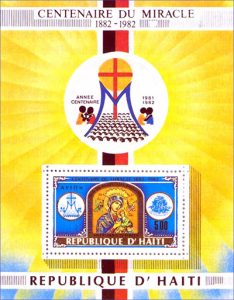
In Haiti a smallpox epidemic died out with surprising speed in 1882; the people of Port-au-Prince gave thanks for it to Our Mother of Perpetual Help, and the icon was declared the official patroness of the country – a patronage formally requested in 1942 and confirmed under Pope Pius XII. In 1982, on the hundredth anniversary of the end of the epidemic, commemorative postage stamps and other prints were issued bearing the image of the Cretan icon.
In many regions of Spain and Latin America it has been the custom since 1950 to pass the icon from family to family; it stays in each house for 24 hours (Visita Domiciliaria).
In the Philippines, a country of more than 90 million Christians, Our Mother of Perpetual Help is venerated more fervently than anywhere else – in the country itself and among Filipinos abroad alike. The Redemptorists brought a copy of the icon to the islands in 1906. The focus of the devotion is the church of Baclaran on Roxas Boulevard in Parañaque, Greater Manila: the National Shrine of Our Mother of Perpetual Help, where the first Wednesday novena was held on 23 June 1948 with seventy people present.
By special permission of the Pope, and because of the enormous crowds, this national shrine stays open round the clock every Wednesday for the Perpetual Novena; the present church, designed by the architect César Concio and consecrated in 1958, seats 2,000 and can hold some 11,000 with those standing, and Manila people call Wednesday “Baclaran Day” on account of the traffic. There one meets the icon in public places too, in shops and businesses and, it goes without saying, in private homes.
A university in the Philippines bears the name of Our Lady of Perpetual Help, as do hospitals, colleges and clinics, and they carry her image in their coats of arms.
In the monastery of the Mother of God of the Heart on Crete, by contrast, only a modest plaque records that the original icon is in the church of Sant’Alfonso in Rome.
In the 520 years or so since the theft, the icon has never returned to its homeland, nor have any ties been formed with its place of origin. A faithful copy did, however, find its way in 2011 into an Orthodox church in Austria.
For the Redemptorists made over the Catholic church of St Alphonsus at Leoben in Styria to the Orthodox Metropolis of Austria, together with the copy of the icon, which the Orthodox call the Mother of God of the Heart, Kardiotissa.
At the official handover of the church on 9 November 2014, the Ecumenical Patriarch Bartholomew declared, among other things, that the gesture deserved to be honoured as the fruit of an atmosphere of trust and cooperation between the Orthodox and the Roman Catholic Churches.
One might add that the icon, created before the division of the Churches, preserves their invisible unity in the veneration of one and the same image – the Greek word eikon means nothing other than “image”. Its lettering is Greek throughout: the abbreviations for “Mother of God” and “Jesus Christ”, and the initials of the archangels Michael and Gabriel, who carry the instruments of the Passion towards a frightened Child with one sandal slipping from his foot. In the East she is called the Mother of God of the Heart, in the West Our Mother of Perpetual Help. But the image is one.
On the way back a detour is worth making: about two kilometres from the village of Potamies lies a 14th-century monastery with magnificent wall paintings, dedicated to the Panagia Gouverniotissa.
The monastery of Panagia Gouverniotissa
Glorious Byzantine frescoes in a monastery with a thousand years of history – now open to visitors as a museum.
Find on the map
Introduction
The monastery stands on a small hill on the north-western side of the village of Potamies, about five kilometres inland from Hersonissos and a good 30 kilometres east of Heraklion, and is reached by a surfaced road; the view extends across the valley of Langada to the Aposelemis reservoir. The slopes around are green and scented with sage and oregano, and in the grounds grows an olive tree reckoned to be more than five hundred years old. Anyone entering the church is plunged at once into an atmosphere of mystery and, for a moment, loses all sense of the everyday. Through the eight narrow window slits of the dome a soft, mild light falls, as though from a window in heaven …
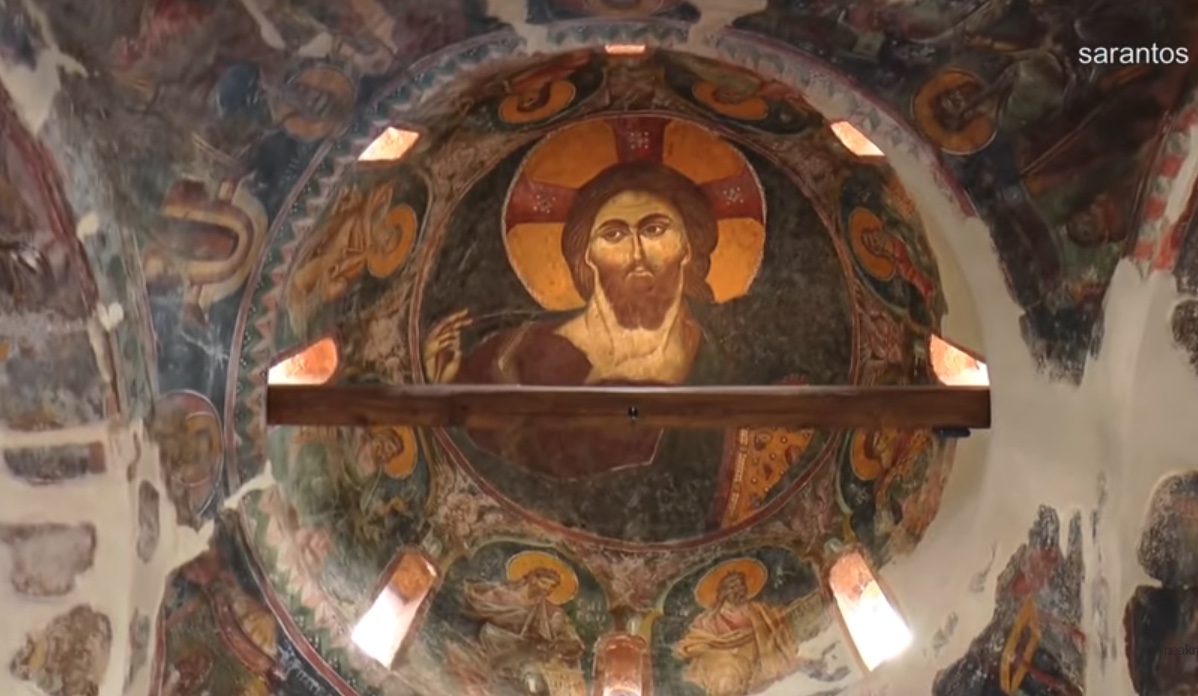
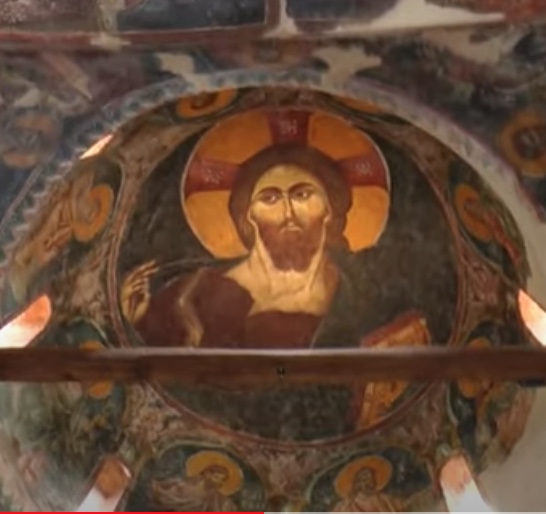
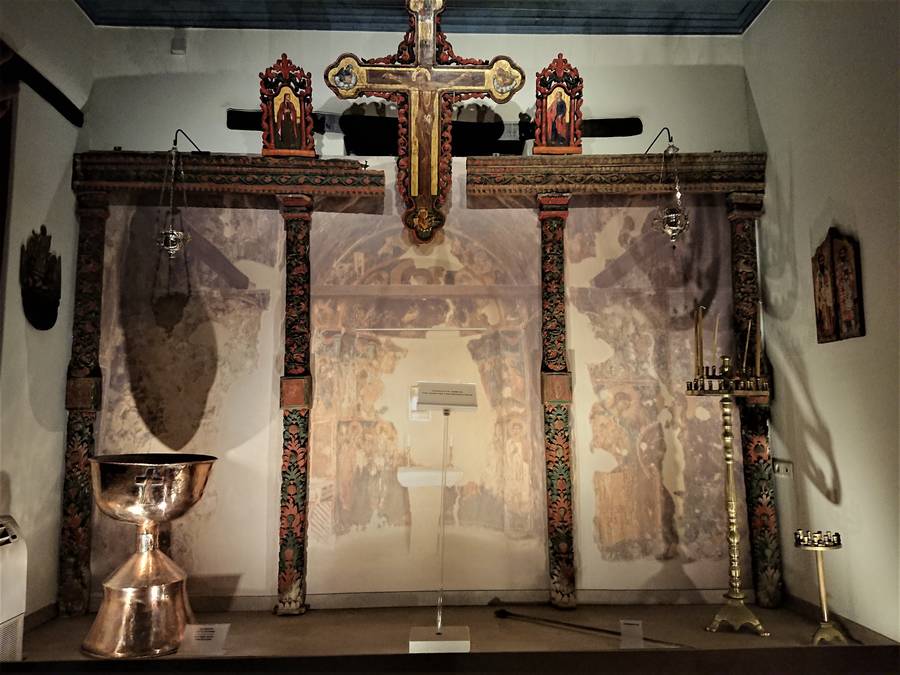
The first thing to catch the eye is the majestic image of the Pantocrator: the main dome is filled by the figure of the Ruler of All, shown half-length and on a superhuman scale. In the sanctuary, the heart of the church, the Last Supper is depicted; on the west side a particularly lively St Barbara stands out, beside prophets, the Crucifixion and scenes from the lives of Christ and the Virgin – the cycle of the twelve great feasts, the Passion and the miracles – some of them iconographically unusual, indeed rare, and showing Western motifs alongside those of Constantinople. The church itself is a domed cruciform building dedicated to the Dormition of the Virgin, whose feast is kept on 15 August, and it is still used for worship although monastic life here ended in 1928. The wooden icons that once adorned the interior are treasures beyond price as well; some of them, together with the iconostasis and the sanctuary doors, are now kept in the Historical Museum of Crete in Heraklion, while a small exhibition in the monastery buildings shows a carved wooden icon screen, Gospel books, vestments and documents from the archive. That they survived the many trials visited upon Crete over the centuries borders on the miraculous. Conservation of the wall paintings began in 2010.
Foundation and heyday
According to an inscription on its walls, the Byzantine monastery was founded in the time of Nikephoros Phokas, in the year 961. Since 823 Crete had been under the rule of the Saracens, who had conquered the island. They built the fortress of Heraklion, then called Chandax, and used it as a base for their seaborne raids on Byzantine territory. In 961, after eight months of fighting, Nikephoros Phokas succeeded in driving the Saracens from the island. In the aftermath numerous noblemen came from Constantinople to Crete, settled here and were granted extensive estates. The buildings that stand today, however, are more probably the work of the second half of the 14th century.
One of these noblemen chose for his seat the spot where the monastery now stands, which later became known as a possession of the Holy Sepulchre (Agios Tafos); the church he built was given the name Panagia Gouverniotissa. An important piece of evidence for the link between this “house” and Constantinople is the fact that the portable icons of the screen were painted in the capital of the Byzantine Empire and then brought to the monastery. Like other aristocrats who came to the island to strengthen the Greek presence, this nobleman also commanded military units. A considerable territory was presumably subject to him, perhaps the whole east of what is now the prefecture of Heraklion. The word gouverno – “administration, government” – survives in the name of the church to this day.
The church was resplendent with precious frescoes, which bear impressive witness to how deeply the painting of the Palaiologan period had taken root in the art of Venetian-ruled Crete. The paintings are placed in the third quarter of the 14th century (1350–1375), and show the strong influence of the capital, Constantinople, and the church is counted among the most important painted churches on the island. Until the middle of the 16th century the monastery belonged to the nobleman Francesco Demetrio.
Contrary to a widespread assumption, the monastery did not suffer its worst damage under Ottoman rule. The exarch of the day showed foresight: he came to a verbal understanding with the Turks that forbade any wanton damage to the church and the monastery’s property – local tradition has it that he told the pasha of a dream in which he had seen him conquer the whole of Crete – and so the estate was spared even during the long siege of Heraklion.
Until 1830 the keys of the monastery were handed down from father to son; the best known of these families was the house of Magafourakis, which held the place for several generations from 1647. The last representative of the line, Michael Magafourakis, finally made the monastery over to the Patriarchate of Jerusalem, a gift usually dated to 1826. From the middle of the 19th century the monastery used its revenues to support orphanages and other charitable institutions, and it also helped to found schools in the district.
The decline
The monastery suffered its worst destruction only after Ottoman rule had ended. Responsibility for its “administration” now lay with a monk appointed by the Church of the Holy Sepulchre in Jerusalem. He let the monastery’s lands lie fallow, among other things, and turned them over to pasture. In 1928 the community addressed a memorandum to five persons of high standing, among them the Patriarch of Jerusalem and the Greek prime minister, Eleftherios Venizelos. By then the affair had grown to such proportions that the monastery of Panagia Gouverniotissa, with its buildings and its entire agricultural property, was made over to the Agricultural Cooperative of Potamies. The lands were then divided among seventy landless farmers; the last monks left, and monastic life here came to an end in that same year.
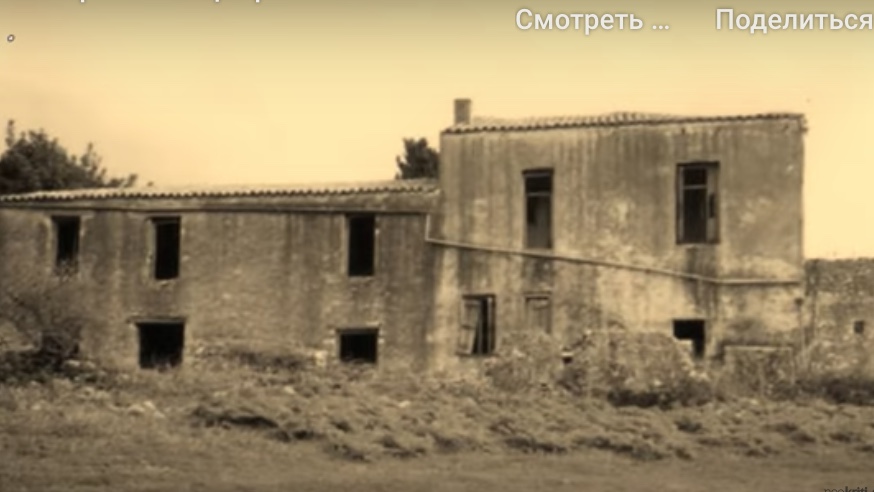
Yet none of the new owners troubled himself with the upkeep of the monastery and its treasures. And so, from 1928 to 2010, the place stood abandoned and left to decay; shepherds used the rooms to store fodder. Only in 2010 did the tide turn, when a group of committed citizens took the initiative to bring one of the oldest monastic foundations in the country back to life.
Rebirth as a museum of Byzantine art
The volunteers formed themselves into the Cultural and Development Association “Gouverniotissa”. Their first task was the careful consolidation and restoration of the old frescoes; after that they turned to rebuilding the monastery buildings and to presenting their architectural heritage. The helpers worked without any payment whatever, and every donation from supporters went straight to the craftsmen and conservators engaged for the work. They had the support of the Ephorate of Byzantine Antiquities, which supervised the work, of the Region of Crete and of the Municipality of Hersonissos; private businessmen met the cost of repairing the buildings. After six years’ work the renewed monastery was ceremonially opened in July 2016, in the presence of the regional governor, the Metropolitan of Petra and Hersonissos and hundreds of people from the surrounding villages.
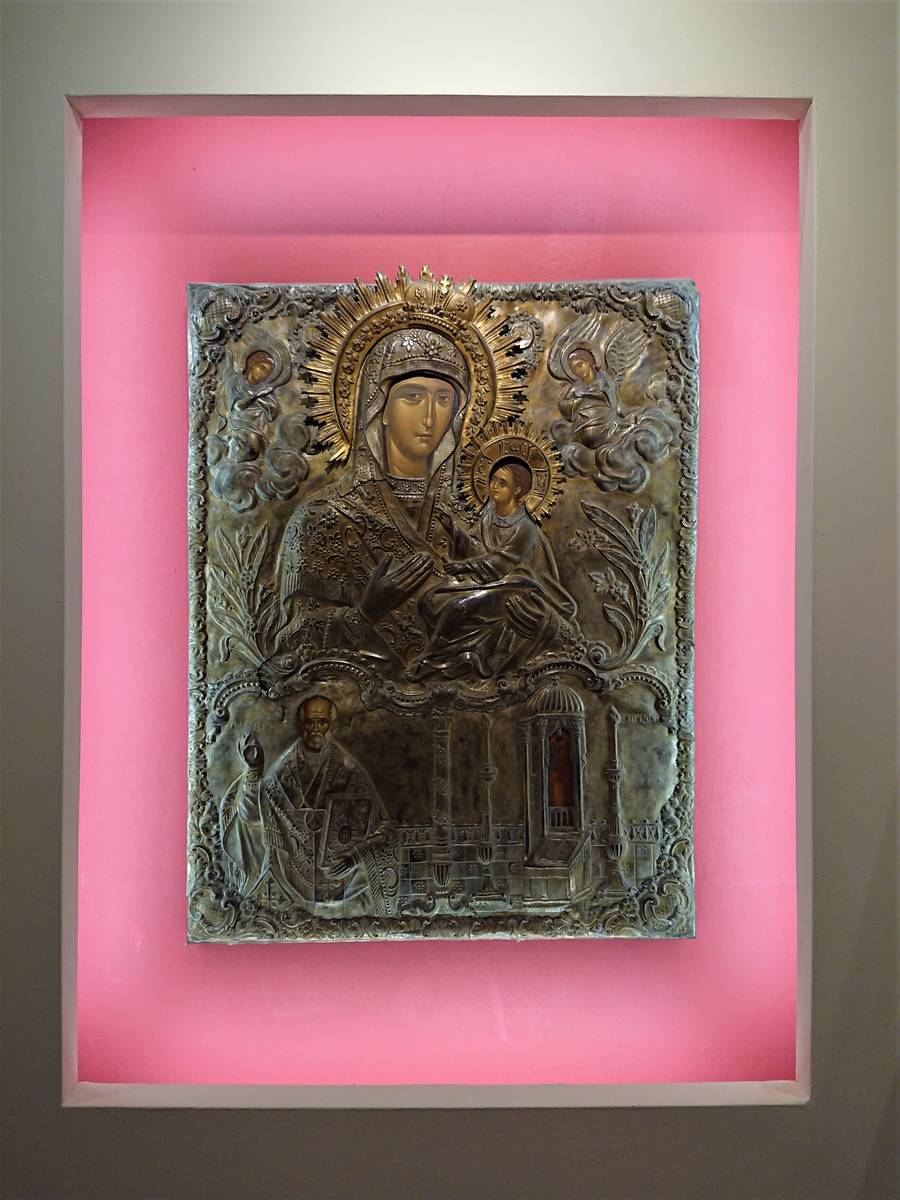
Alongside the restored frescoes and the church of Panagia Gouverniotissa itself, some exceptional pieces are now on show in the repaired monks’ cells of the 19th century: the monastery’s old wooden iconostasis, liturgical vestments, a chalice bearing the stamp of its Venetian goldsmith, the monastery’s codex of 1800, a Gospel lectionary of 1776 and a Gospel book published by the preacher Chretis, a spiritual companion of Ioannis Kapodistrias, the first head of state of liberated Greece. Portable icons of the 16th century hang here too, and weapons recall the part the monastery played in the Cretan risings; a separate corner is given over to folk life, with household objects and weaving equipment from the villages round about.
In an astonishingly short time the monastery has become a popular destination for an outing; every year hundreds of visitors come to admire the glorious frescoes and to pay tribute to what the volunteers have achieved. Concerts are held in summer, and there is also a room for conferences and temporary exhibitions, a workshop for icon and fresco painting, a small café and a botanical garden, still being laid out, to the east of the church. School parties are welcome by arrangement. Many visitors combine the visit with a detour to the Aposelemis dam, one of the largest irrigation and water-supply schemes on the island, and with a drive up to the Lasithi plateau, once regarded, on account of its thousands of windmills, as the “largest wind farm in the world”.
Notes on the route
The route to the “Mother of God of the Heart” leads south-east from Heraklion: along the coast at Karteros, past the ancient harbour of Amnisos some seven kilometres east of the city, and through the Astrakiano gorge on to the historic sites of Malia and Kera. It brings together coastal scenery, Minoan archaeology, traditions drawn from myth and popular belief, and Orthodox holy places.
Karteros and the Astrakiano gorge
The Karteros gorge, also known as the Astrakiano gorge, belongs to the natural area of the Ecological Park on Mount Juktas and forms part of the European network of protected areas, Natura 2000. It is some 12.5 kilometres long, a walk of about three and a half hours. The path begins at Kato Astraki, a hamlet now deserted, and leads down to Karteros; at the Mesa Karteros entrance there is a picnic area with room to park, reached by car. After roughly six kilometres the Kounaviano gorge, which starts near Peza, comes in from the side; the two streams then share a common bed for the last six kilometres or so to the beach. Footbridges, wooden handrails and signposts make the walk pleasant for families with children as well – it is about as easy a gorge as Crete has to offer – though after rain care is needed on some stretches. The river Karteros, called Triton in antiquity, carries water all year and forms small pools and low waterfalls on its way; plane trees, oaks, cypresses, wild olives and willows line its bed, and ornithologists have counted more than forty species of bird here.
The Neraidospilio, the “Cave of the Nymphs”, is associated with a spring whose water, gushing from openings in the rock, gathers in front of the entrance into a small pond, and with local tales of the Neraides. One of them tells of a young lyra player who saw the nymphs dancing by night, fell in love with one of them and, on the advice of an old woman, caught her before daybreak; she bore him a son but remained mute – until one day she fled with the child. Her tears, it is said, cloud the spring water to this day. The French archaeologist Paul Faure saw in the grotto the sanctuary of “Triton-born” Athena mentioned by Diodorus. Close by are Byzantine churches, among them the abandoned chapel of Agios Nikolaos, the ruins of old watermills – ten were still grinding before the Second World War – an arched bridge of Venetian date, the Astrakiani Kamara, and traces of ancient settlements. These remains show that the gorge was not merely a natural passage but a place where people have lived from the earliest times.
Amnisos and the cave of Eileithyia
Amnisos was the harbour of Knossos and is already named in Homer; on the Linear B tablets from Knossos the place appears as a-mi-ni-so, a word that proved a key piece of evidence when Michael Ventris deciphered the script. Archaeologists have investigated here the Minoan “House of the Lilies”, named after its famous frescoes of lilies – a two-storey villa of ten rooms, excavated by Spyridon Marinatos in 1932 and destroyed by fire in the Late Minoan IA period – as well as a sanctuary that in later times was dedicated to Zeus Thenatas, and the ancient harbour, which as a result of changes to the coastline after the eruption of the Santorini volcano lies partly under water. It was here that Marinatos developed his theory that a huge tidal wave following that eruption had devastated the Minoan coast.
The cave of Eileithyia, a little inland from Amnisos beside the old road towards Knossos, was sacred to the goddess of childbirth. It is a good 60 metres long and up to 12 metres wide. Joseph Hatzidakis recognised it in 1885 as the sanctuary mentioned by Homer (Odyssey 19.188), and Marinatos excavated it systematically between 1929 and 1938. The finds prove that the cave served as a place of worship from the Neolithic down to late Roman times, that is, into the 5th century AD; Strabo, too, speaks of a shrine of Eileithyia at Amnisos. Inside, a large stalagmite resembling a pregnant belly was venerated; it was enclosed by a rectangular wall like an altar, and to it women addressed their prayers for a safe delivery. The cave is usually closed off by a grille.
By way of explanation: Eileithyia
Eileithyia (Greek Ειλείθυια) is an ancient Greek goddess who watched over labour and birth; according to Homer she herself came into the world in this cave. Hesiod makes her a daughter of Zeus and Hera, and her name already occurs on the Linear B tablets of Knossos as e-re-u-ti-ja, one of which records a jar of honey sent to her at Amnisos. That is why the grotto of Amnisos was not simply a natural beauty spot but a sanctuary to which the faithful brought votive offerings.
The island of Dia
The island of Dia, some 13 kilometres off the coast north of Heraklion, is known not only for the myth of Theseus and Ariadne, who in one version of the legend was abandoned here by the Athenian hero. Another tale explains its long, low outline as a giant lizard that was making for Crete until Zeus turned it to stone with a thunderbolt. Today the uninhabited island – five kilometres long, three wide and rising to 220 metres – is a protected area within the Natura 2000 network, home to Cretan wild goats among other creatures and to a large breeding colony of Eleonora’s falcons; day trips by boat are allowed, camping is not. Underwater investigations, in which Jacques-Yves Cousteau’s team also took part in the 1970s, discovered off its shores traces of ancient seafaring – the four coves of the south coast have served as anchorages since Minoan times – and several wrecks of different periods, including Roman and Byzantine amphorae. This confirms how much the north coast of Crete mattered to the sea routes of the Mediterranean.